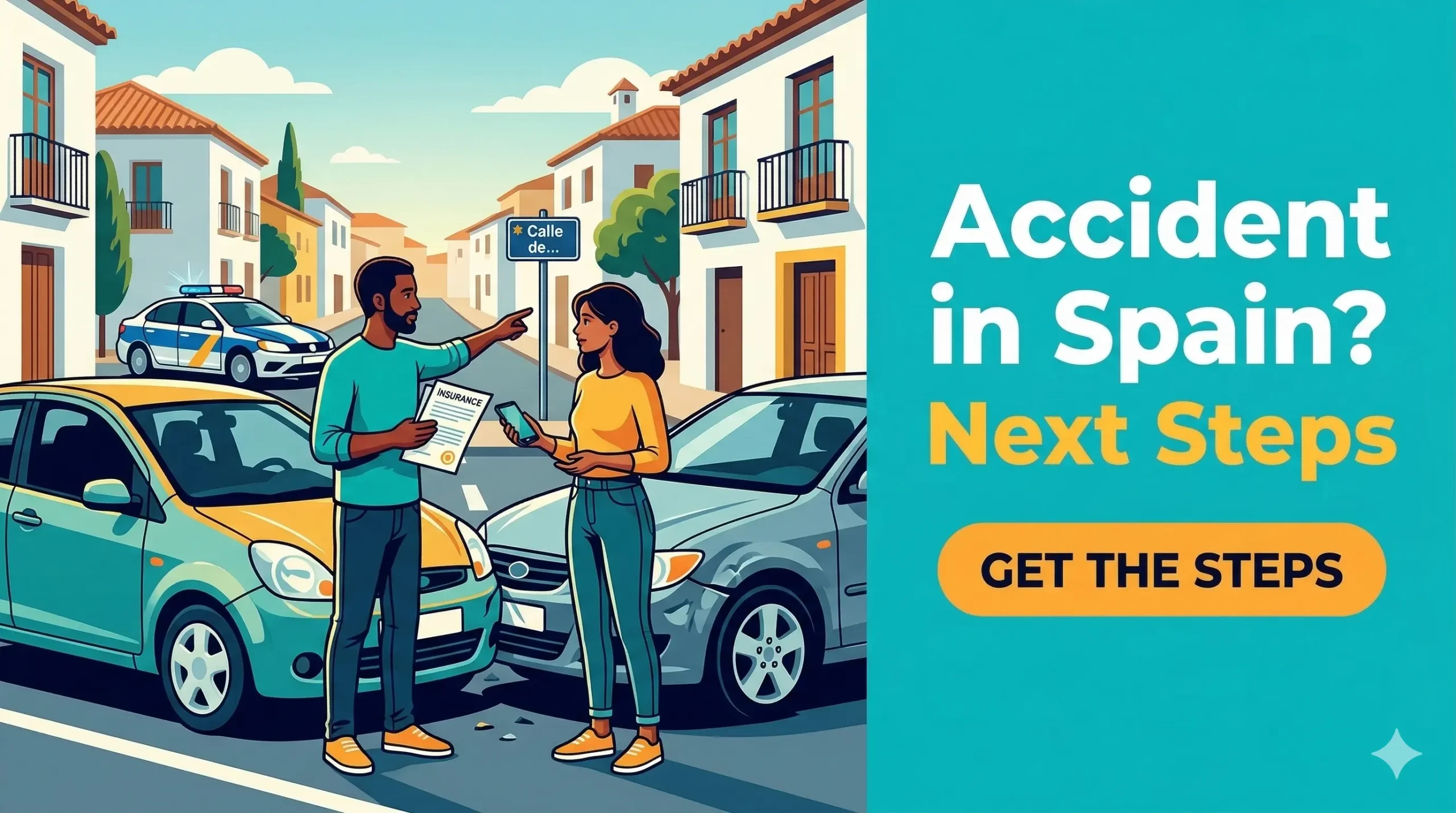
What to Do After a Minor Accident in Spain: Insurance and Care Steps
Spraining an ankle or cutting your hand on a Sunday in Spain usually triggers an immediate wave of administrative panic. I once sliced my thumb open making gazpacho and stood bleeding in my kitchen, completely paralyzed by the thought of Spanish hospital bureaucracy. This guide explains exactly where to go, how to handle the insurance paperwork, and what to expect.
Disclosure: This post may contain affiliate links. We may earn a commission at no extra cost to you if you make a purchase through these links. Read full disclosure.
Immediate Medical Steps for Minor Accidents
When the adrenaline of a sudden injury hits, your first instinct as a foreigner is often to rush straight to the biggest, most recognizable hospital emergency room in your city. In Spain, making that automatic choice for a minor accident will almost guarantee you spend six to eight hours sitting in a crowded, chaotic waiting room. You need to understand the local triage system before you leave your apartment.
Assessing the Injury and Choosing the Right Clinic
If you have suffered a minor accident—such as a deep kitchen cut that needs stitches, a suspected twisted ankle from the cobblestone streets, or a minor burn—you should absolutely not call the 112 emergency line, and you should try to avoid the massive regional hospital Urgencias (Emergency Room).
Instead, the Spanish public healthcare system operates local, 24-hour urgent care centers specifically designed for these scenarios. They are called Puntos de Atención Continuada (PAC) or Servicios de Urgencias de Atención Primaria (SUAP). These clinics are essentially after-hours extensions of your neighborhood health center. They are staffed by highly capable primary care doctors who can stitch wounds, order basic X-rays, and prescribe strong painkillers. If you are a new arrival and haven’t figured out where your neighborhood clinic is located, our guide on What Is a ‘Centro de Salud’ in Spain and How Do You Register? explains the setup process.
If you decide you cannot wait for the public system and want to use your private insurance, you must go to a private hospital’s Urgencias. Bypassing the public queue during a stressful minor emergency is precisely why so many expats consider a policy secured through an expert broker like Innoinsure to be non-negotiable. Knowing exactly which private clinic doors you can walk through without getting hit with a massive bill brings immense peace of mind. For a comprehensive walkthrough on locating the nearest open doors at 2:00 AM, read How to Find a 24-Hour Clinic in Spain (Urgencias).
Navigating the Triage Desk and Language Barrier
Whether you walk into a public PAC or a private hospital, your first stop is the Admisión de Urgencias desk. You must hand over your physical identification (your TIE residency card or your passport—a paper NIE is not accepted) and your health card.
After intake, a triage nurse will evaluate your injury and assign you a clinical severity color based on the Manchester Triage System. Spanish emergency waiting rooms do not operate on a first-come, first-served basis; they operate strictly on medical severity. A minor kitchen cut will almost always be categorized as Green (Standard) or Blue (Non-Urgent). Do not argue with the reception staff if people who arrived after you are called in first; their assigned color simply outranks yours.
During this triage phase, the language barrier can feel incredibly daunting. If your Spanish is limited, do not try to perfectly conjugate medical verbs while in pain. Use simple, direct phrases and point to the injury. For example: “Me he cortado” (I have cut myself), or “Me he torcido el tobillo” (I have twisted my ankle). If your accident happened on a holiday and you are worried about finding any open doors at all, review What to Do If You Need Care on a Weekend in Spain so you are prepared.
| Accident Severity | Recommended Spanish Facility | Target Triage Wait Time |
| Minor (No immediate danger) | Local Centro de Salud (appointment needed) | 1 to 3 Days |
| Urgent but Minor (Needs stitches/X-ray) | PAC / SUAP (Public Urgent Care) | 1 to 2 Hours |
| Urgent but Minor (Private Insurance) | Private Hospital Urgencias | 30 to 60 Minutes |
| Life-Threatening / Severe Trauma | Major Hospital ER or Dial 112 | Immediate |
Handling the Paperwork and Insurance Claims
Getting stitched up is only half the battle. If you want to get your money back, or if you need to officially excuse yourself from work or school the next day, the Spanish bureaucratic machine requires absolute precision.
Public Healthcare vs Private Insurance Protocols
If you are legally registered in the state-funded Sistema Nacional de Salud (SNS), your treatment at a public PAC or hospital is entirely free at the point of use. You will not be asked for a credit card, and you do not have to worry about filing a reimbursement claim for the medical service itself. However, the public system is chronically overburdened, which is why many expats utilize the private sector for faster triage. You can explore these systemic differences deeply in our overview of the Spain Healthcare System for Expats: Public vs Private.
If you go to a private hospital, the paperwork gets much heavier. If you have a fully comprehensive private policy with no copayments (sin copagos)—the exact kind of premium policy that a bilingual broker at Innoinsure can seamlessly set up for you—you simply hand them your insurance card at the desk, and the hospital bills the insurer directly.
However, if you went to an out-of-network private clinic or if you hold a reimbursement-based policy, you must pay the entire bill upfront with your own credit card. Before signing any digital contracts, understanding how these specific financial models work is vital; check out How to Compare Private Health Plans: Deductibles, Co-Pays, Networks to ensure you aren’t caught off guard. To understand exactly how much a broken arm or a set of stitches might cost you out of pocket without insurance, review our financial breakdown on Health Costs in Spain: Typical Co-Pays and Out-of-Pocket Fees.
Collecting the Right Documents Before You Leave
Do not walk out of the clinic doors until you have two highly specific pieces of paper in your hand.
First, if you need to submit a claim to your international or private insurance, you must ask the administrative desk for a legally valid, officially stamped invoice. In Spain, a simple credit card receipt is completely useless for insurance claims. You must ask for a factura oficial, which includes the clinic’s tax ID (CIF), your personal ID number, and a line-item breakdown of the treatments.
Second, you must ask the treating doctor for an informe médico de urgencias (emergency medical report). This stamped document details your exact diagnosis and the recommended rest period. If you need to miss work the next day because of your sprained ankle, your Spanish employer will legally demand this exact piece of paper as proof. A handwritten note will be rejected. If you need a comprehensive guide on exactly how to fight for your money back once you have these documents, read How to Handle Medical Bills in Spain: Receipts, Claims, and Disputes.
Pharmacy Visits and Holistic At-Home Recovery
Once the bureaucracy is settled and you are finally discharged, your focus shifts entirely to pain management and physical recovery. In Spain, this means a mandatory trip to the local chemist.
Picking Up Prescriptions at the Farmacia
You cannot buy basic painkillers like high-dose ibuprofen or medicated burn creams at a 24-hour supermarket in Spain. You must go directly to a licensed pharmacy (farmacia), easily identifiable by the glowing green cross outside. If your accident happened late at night, you will have to track down the rotating Farmacia de Guardia (on-duty pharmacy) in your neighborhood.
When you hand the pharmacist your prescription report, they will retrieve the exact medication from behind the counter. Spanish pharmacists are incredibly highly trained and can offer excellent frontline advice on wound care and bandaging. If your minor accident resulted in a scrape or a bruise that didn’t quite warrant a hospital trip, but you still want a professional opinion, the local pharmacist is a brilliant resource; learn how to leverage their expertise in Can a Pharmacist in Spain Help With Minor Illness? What to Expect. Alternatively, if you simply cannot walk because of an injured knee and need an official prescription refill sent to your phone, utilizing digital doctors is a lifesaver. Discover how to safely do this in Telemedicine in Spain: When It’s Useful and What to Expect.
Supporting Your Body’s Healing Process
While Spanish pharmacies are absolutely phenomenal for dispensing acute pharmaceutical medications and basic sterile bandages, they frequently fall short when it comes to holistic, preventative recovery aids.
After a minor accident, you likely want to actively speed up your healing process. Many expats prefer to use high-grade arnica gel for severe bruising, specialized silicone scar sheets for fresh stitches, or highly absorbable magnesium glycinate to calm the nervous system after the shock of the injury. Unfortunately, trying to find these specific, clean-ingredient holistic items in a local Spanish farmacia is deeply frustrating. The selections are incredibly limited, and when they do happen to stock recognized international brands, the retail markups are completely exorbitant. You can easily pay twenty euros for a tiny, generic tube of arnica cream.
To completely bypass this frustrating retail gap, the savvy international community in Spain relies heavily on iHerb. By ordering your post-accident recovery supplies—such as premium topical magnesium, potent turmeric extract for joint inflammation, and high-quality wound care ointments—directly through iHerb, you gain access to the exact, trusted wellness brands you successfully used back home without draining your wallet.
Having a dedicated holistic first-aid stash delivered directly to your Spanish door via iHerb ensures you are actively supporting your body’s cellular repair during those crucial first few weeks of recovery. Managing a sudden injury abroad is stressful enough; relying on iHerb to effortlessly restock your recovery arsenal allows you to focus entirely on resting, elevating your sprained ankle, and getting back to enjoying your life in Spain.
References
Primary sources (official)
- Ministerio de Sanidad (Ministry of Health Spain) – Cartera de servicios comunes de prestación de atención de urgencia: https://www.sanidad.gob.es/va/profesionales/prestacionesSanitarias/CarteraDeServicios/ContenidoCS/4AtencionDeUrgencia/AU-AtencionUrgencia.htm
- Protección Civil – Emergency 112 Information: https://www.proteccioncivil.es/
Other helpful sources
- Expatica – Healthcare in Spain: https://www.expatica.com/es/healthcare/healthcare-basics/healthcare-in-spain-101467/
- Citizens Advice Bureau Spain – Healthcare Information: https://www.citizensadvice.org.es/faq/healthcare/
Disclaimer
The information provided in this article is for educational and informational purposes only and does not constitute formal medical, legal, or insurance advice. Triage protocols, out-of-pocket costs, and public clinic (Centro de Salud) operating hours vary significantly across Spain’s autonomous communities and individual hospital administrations. If you are experiencing a severe, life-threatening medical emergency, severe bleeding, or suspect a major bone fracture, do not hesitate—dial 112 immediately to connect with Spanish emergency dispatch services.