Valencia to Alicante and Murcia: Mediterranean Corridor Options
You’ve probably dreamt of those sun-drenched coastal drives, or perhaps a relaxing train ride through orange groves, connecting Spain’s vibrant eastern cities. But let’s be real, actually planning how to get from Valencia down to Alicante or even further to Murcia can quickly turn into a headache, especially with public transport schedules that sometimes feel designed by a labyrinth architect. This guide is here to untangle that knot, offering you a clear path through the Mediterranean corridor, and showing you the absolute easiest way to book it all with a service that genuinely makes life simpler.
Disclosure: This post may contain affiliate links. We may earn a commission at no extra cost to you if you make a purchase through these links. Read full disclosure.
The Mediterranean Corridor: Connecting Valencia, Alicante, and Murcia
Moving along Spain’s eastern coast is a dream for many, whether you’re a long-term expat hopping between cities for a weekend escape or a tourist looking to explore more than just the capital. Valencia, Alicante, and Murcia form a vital economic and cultural spine along the Mediterranean, each offering a distinct flavor of Spanish life. But the journey between them, while relatively short on a map, can often feel like a bureaucratic marathon if you don’t know the tricks of the trade.
These cities are more than just dots on a map; they're bustling hubs, each with unique appeals. Valencia, with its futuristic City of Arts and Sciences and historic old town, often serves as a gateway. Further south, Alicante charms with its stunning castle views, expansive beaches, and lively nightlife. And then there's Murcia, a region famed for its agricultural bounty, baroque cathedral, and a more relaxed, authentic Spanish pace. Many expats find themselves gravitating to one of these areas, or frequently visiting friends and family in another, making efficient travel paramount.
The challenge, as many of us have found out the hard way, isn't just knowing which bus or train to take, but actually piecing together schedules, comparing prices, and dealing with potentially multi-leg journeys across different operators. It’s enough to make you just want to stay put, isn't it? But don’t worry, you don’t have to sacrifice exploration for convenience. The key is understanding your options and having a reliable tool to simplify the process.
Why These Cities Are Popular Destinations for Expats and Tourists
Valencia, Alicante, and Murcia each offer a slice of the Spanish dream, attracting a diverse crowd of long-term residents and holidaymakers alike. Valencia, as a larger city, boasts excellent job opportunities, a vibrant cultural scene, and a fantastic public transport network that makes getting around a breeze once you're there. It’s also often cited for its high quality of life and balance between modern amenities and rich history. Many expats choose Valencia for its cosmopolitan feel without the overwhelming density of Madrid or Barcelona.
Alicante and Murcia, while smaller, are incredibly popular for their sunny climates, beautiful beaches, and slightly lower cost of living, particularly when it comes to housing. They offer a more relaxed pace of life, often with a stronger sense of local community that many foreigners cherish. Tourists, on the other hand, are drawn to the coastal beauty, historic sites, and the delicious regional cuisine. Whether you’re relocating, planning a Weekend Getaways in Southern Spain, or just exploring, the connection between these cities is a well-trodden path.
The Realities of Spanish Public Transport Planning
Let’s be honest, navigating public transport in a new country can be an adventure, but sometimes you just want it to be easy. Spain's public transport system is generally efficient and extensive, particularly for major routes. However, when you're connecting three distinct regions – Valencia (Comunidad Valenciana), Alicante (still Comunidad Valenciana but quite far south), and Murcia (Region of Murcia) – you might find yourself dealing with different train lines, bus companies, and a maze of websites.
This is where the frustration often kicks in. You might check Renfe for trains, then Alsa for buses, then maybe another regional bus company, all while trying to sync up departure and arrival times. The language barrier can add another layer of complexity, especially when trying to understand ticket options or making changes. And if you're not careful, you could end up paying more than necessary by booking individual segments separately. This is precisely the kind of challenge that led me, and countless other expats, to seek out a smarter way to manage our travels.
Unpacking Your Travel Options: Train, Bus, and Car
When it comes to traveling the Mediterranean corridor between Valencia, Alicante, and Murcia, you essentially have three main choices: train, bus, or car. Each mode of transport has its own set of advantages and disadvantages, depending on your priorities for cost, speed, comfort, and flexibility. Understanding these can help you make an informed decision and prepare for your journey, especially when you're trying to integrate with the local way of doing things.
Traveling by Train: Speed, Comfort, and What to Expect
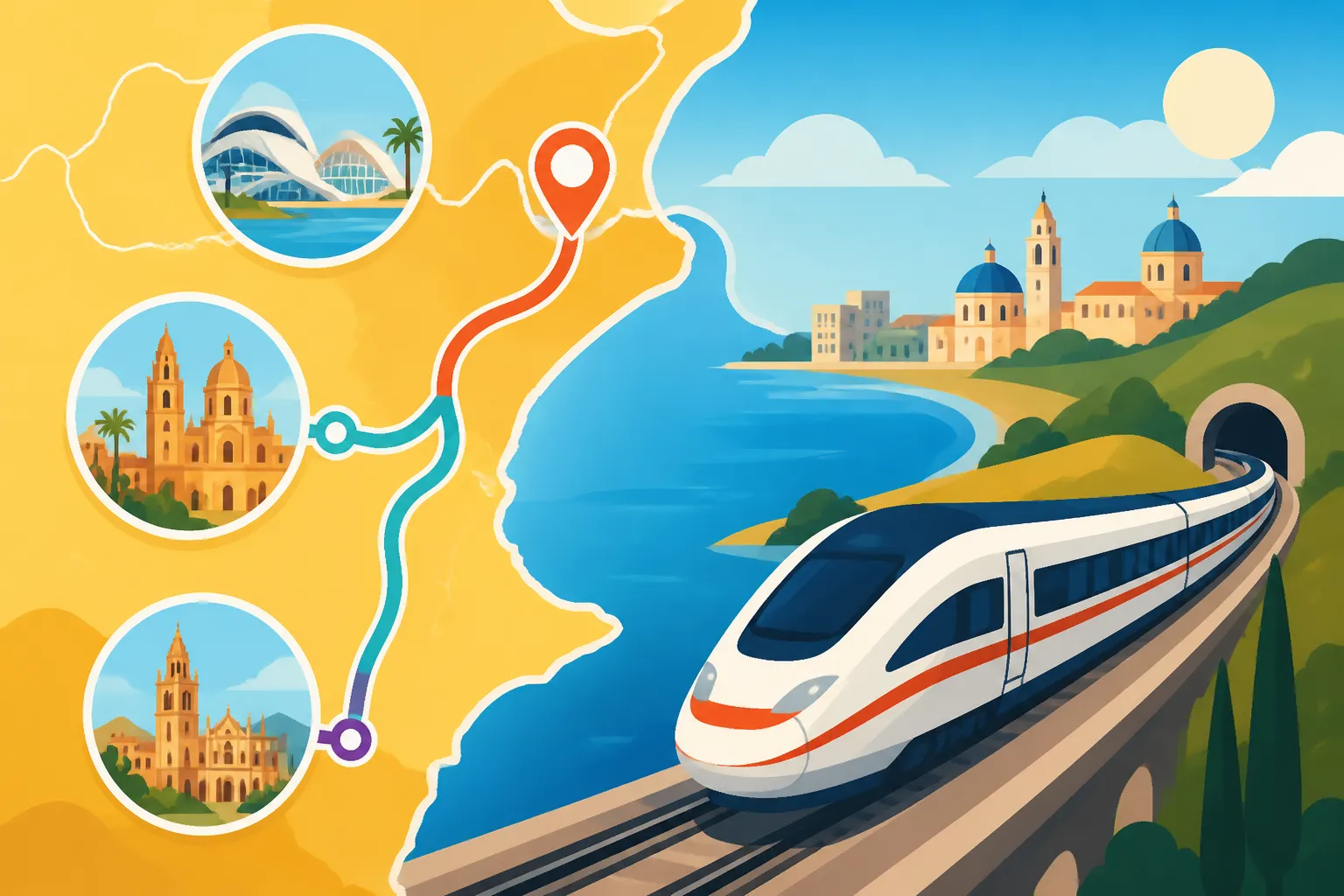
Spain's train network, primarily operated by Renfe, is generally excellent, especially for intercity connections. For the route from Valencia to Alicante, you'll find frequent direct trains, including high-speed options (like Euromed and the newer Avlo services) that make the journey incredibly swift, often under two hours. The comfort on these trains is usually very good, with spacious seating, on-board catering (on some services), and often stunning views of the Spanish countryside. For those of us who appreciate High-Speed Trains in Spain (AVE): Routes, Booking, and Savings, it's a fantastic option.
However, extending your journey from Alicante to Murcia by train requires a bit more planning. Historically, the direct train service between Alicante and Murcia has been slower or required changes. While the new high-speed AVE line has now connected Murcia to Madrid, the regional connections can still be a bit less streamlined than the main high-speed arteries. For instance, sometimes you might take a high-speed train to Alicante and then switch to a local Media Distancia train or even a bus for the final leg to Murcia. Prices can vary significantly based on how far in advance you book and the type of service, so flexibility with your travel dates can sometimes yield better deals. Booking is usually done directly through Renfe's website, which can be a little clunky, or, more conveniently, through an integrated platform.
Bus Travel: The Budget-Friendly and Flexible Choice
For many routes in Spain, the bus is often the unsung hero, especially when trains aren't direct or are simply too expensive. From Valencia to Alicante, and particularly from Alicante to Murcia, bus services are frequent, reliable, and generally more budget-friendly than trains. The main operator you'll likely encounter is Alsa, which runs a comprehensive network across the country. Bus stations in these cities are centrally located and easy to navigate, though they might not always be right next to the train station, requiring a short taxi or Getting Around Spanish Cities: Metro, Bus, Tram, and Bikes ride.
While bus journeys typically take a bit longer than high-speed trains – around 2 to 2.5 hours from Valencia to Alicante, and about an hour from Alicante to Murcia – they offer flexibility with more departure times throughout the day and often drop you off closer to city centers in smaller towns. The comfort level is decent, with most modern Alsa buses offering Wi-Fi and air conditioning. For those who prioritize cost savings or need to reach destinations not directly served by train, the bus is an excellent choice. You can find more details on booking and networks in our guide to Intercity Buses in Spain: Networks, Booking, and Tips.
Renting a Car: Freedom, Flexibility, and Hidden Costs
Renting a car offers unparalleled freedom, allowing you to explore at your own pace, stop off at charming villages along the way, or access more remote beaches that public transport might not reach. The drive itself along the Mediterranean coast is often scenic, especially once you venture off the main highways. Companies like Europcar, Sixt, and Hertz are readily available at airports and major city locations in Valencia, Alicante, and Murcia. This option is particularly appealing if you're traveling with family, a lot of luggage, or simply crave the independence of having your own wheels.
However, the "freedom" comes with its own set of considerations. Fuel costs, parking fees (which can be notoriously high and hard to find in city centers), and potential tolls on some motorways (like the AP-7) can quickly add up. Don't forget insurance, which can sometimes be a surprise cost if not factored in upfront. Also, navigating Spanish roads, especially in cities, can be daunting for those unfamiliar with local driving habits or signage. If you're considering this, make sure to review our guide on Renting a Car in Spain: Requirements, Insurance, and Driving Tips to avoid any unexpected bumps in the road.
Here's a quick comparison of your travel options:
| Travel Method | Speed (Approx. Valencia to Alicante) | Cost Range (One-Way) | Flexibility | Booking Ease (Generally) |
|---|---|---|---|---|
| Train (High-Speed) | 1.5 – 2 hours | €25 – €60+ | Moderate | Can be complex across operators |
| Bus | 2 – 2.5 hours | €15 – €30 | High (more departures) | Simple with a good platform |
| Car (Driving) | 1.5 – 2 hours | Variable (fuel, tolls, parking, rental) | Very High | Direct rental, but planning required |
Note: Costs and times are estimates and can vary based on season, booking in advance, and specific service.
The Smart Way to Book Your Journey: Making Omio Your Best Friend
Now, if all that talk of different operators, conflicting schedules, and multiple websites has you feeling a bit overwhelmed, don’t worry, there's a solution that cuts through all the noise. For expats and tourists navigating Spain, simplifying travel planning is a game-changer. That’s where Omio comes in, and frankly, it's been my go-to for years because it genuinely streamlines the entire process.
Omio is more than just a booking site; it’s an aggregator that pulls together train, bus, and even flight options from various providers into one easy-to-use interface. Think of it as your personal travel assistant, doing all the heavy lifting of comparing routes, times, and prices for you. Instead of juggling Renfe and Alsa websites, you can find the best combination of services from Valencia to Alicante to Murcia all in one place. It truly takes the headache out of planning multi-leg journeys or even just comparing direct options.
Why Omio Simplifies Complex Spanish Travel Plans
One of the biggest frustrations when traveling in Spain is the fragmented nature of the transport system. You have Renfe for trains, Alsa and a myriad of regional companies for buses, and separate airlines for flights. Trying to find the most efficient and cost-effective way to get from Valencia to Alicante, and then perhaps to Murcia, could involve opening three or four different tabs in your browser. This is not only time-consuming but also increases the chances of missing a better deal or a more convenient connection.
Omio elegantly solves this problem. It allows you to input your origin and destination, and it instantly shows you all available train and bus options, often side-by-side, from all major providers. This means you can easily see if a direct train is faster but a bus is significantly cheaper, or if a particular combination of services offers the best balance for your needs. This unified view saves an incredible amount of time and mental energy, which, let's be honest, is invaluable when you're already dealing with the general demands of Spain Immigration Appointments & Paperwork: How to Avoid Delays or trying to settle into your new life.
A Step-by-Step Guide to Booking with Omio
Using Omio is surprisingly intuitive, even if you’re not the most tech-savvy traveler. Here’s how you can make it your secret weapon for navigating the Mediterranean corridor:
- Head to the Omio Website or App: You can access Omio via their website or download their user-friendly mobile app. The app is particularly handy for on-the-go planning and for keeping all your tickets in one place.
- Enter Your Journey Details: Input your starting point (e.g., Valencia), your destination (e.g., Alicante or Murcia), and your preferred travel dates. Don't forget to specify if it's a one-way or return trip, and the number of passengers.
- Compare Options: Omio will then present you with a clear list of all available train and bus services. You’ll see journey times, prices, and the operating company (Renfe, Alsa, etc.). You can easily sort by price, duration, or departure time to find what best suits you. This is where you can clearly weigh the value of speed versus cost, for example, comparing a quick Euromed train with a more leisurely but cheaper Alsa bus.
- Select Your Tickets: Once you've chosen your preferred option, click to select it. Omio makes it transparent, showing you details like baggage allowances and any specific terms for that operator. If your journey requires a transfer, Omio will typically show you integrated tickets or highlight the transfer points, making it easy to understand the full journey.
- Secure Booking and E-Tickets: Proceed to checkout, where you can safely pay for your tickets using various methods. Omio then issues e-tickets, which are usually sent directly to your email and stored within the app. No need to print anything most of the time – just show your phone! This makes hopping between cities, even on public holidays when Public Holidays in Spain: How They Affect Travel and Opening Hours can complicate things, incredibly straightforward.
Omio is a useful option for journeys between cities like these, and it truly makes a difference. It’s saved me from frustrating website crashes and confusing Spanish forms, letting me spend more time enjoying Spain and less time wrestling with booking logistics.
Practical Tips for a Smooth Trip: What Expats Need to Know
Beyond simply booking your tickets, there are a few practical considerations that can make your journey along Spain’s Mediterranean corridor much smoother. As expats, we often learn these things the hard way, so let me share some insights to help you avoid common pitfalls and make your travels as stress-free as possible.
Essential Documents and What to Pack for Your Journey
Even for domestic travel within Spain, it’s always wise to carry your identification. If you’re an expat, this means your TIE card or NIE certificate, along with your passport. While you might not always be asked for it on trains or buses, it's better to be prepared. For children, their ID or passport is also essential. Keep your Omio e-tickets easily accessible on your phone, perhaps even take a screenshot, in case you lose internet connectivity.
When it comes to packing, consider the duration of your trip and the typically warm Mediterranean climate. Light layers are always a good idea. A small backpack for essentials like water, snacks, a book or e-reader, and a portable charger for your phone (especially if you're relying on your e-tickets and the Omio app) will serve you well. Don't forget sunscreen and a hat, even if you're just traveling between stations, as the sun can be intense year-round in this part of Spain. For financial preparedness, make sure you know your options for Money for Travel in Spain: Cards, Cash, and ATMs and how much cash to carry.
Navigating Stations and Avoiding Common Pitfalls
Spanish train and bus stations are generally well-organized, but they can still be bustling and a bit confusing, especially during peak travel times or if you're not fluent in Spanish. Aim to arrive at least 20-30 minutes before your scheduled departure, especially if you need to find your platform or bus gate, or if you plan to grab a coffee. Train stations like Valencia Joaquín Sorolla or Alicante Terminal can be quite large. Look for signs for "Andenes" (platforms) for trains or "Salidas" (departures) for buses.
A common pitfall is misunderstanding the Spanish meal times and how they affect services. Many station kiosks and cafes might have reduced hours during siesta or close earlier than you'd expect in the evening. Make sure you have water and perhaps a snack before you board. Finally, always keep an eye on your belongings. While Spain is generally safe, crowded transport hubs are always potential spots for petty theft. Our guide on Staying Safe in Spain: Common-Sense Tips for Travelers offers more detailed advice on this. With Omio, you'll have all your booking information consolidated, minimizing the stress of last-minute ticket fumbling.
Disclaimer
The information provided in this guide is for general informational purposes only and is subject to change. While we strive to provide accurate and up-to-date information, travel regulations, public transport schedules, and prices can vary. Always check the latest information from official sources and the Omio platform before making travel arrangements.