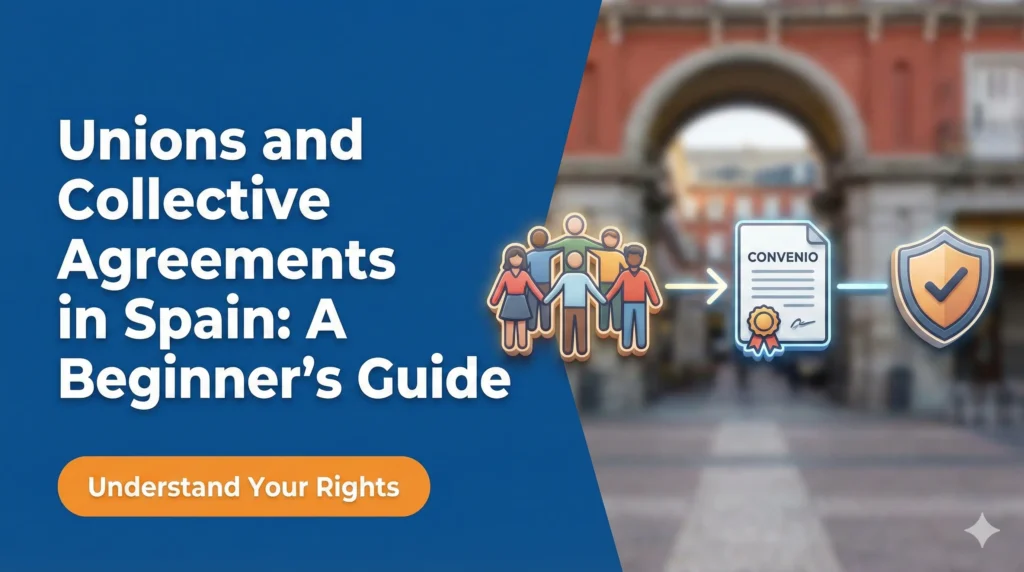
Unions and Collective Agreements in Spain: A Beginner’s Guide
Navigating the Spanish labor market requires a solid understanding of its unique regulatory framework. This comprehensive guide explains the role of major trade unions, workplace representation, and how collective bargaining agreements (convenios colectivos) dictate your wages, hours, and employment rights.
Disclosure: This post may contain affiliate links. We may earn a commission at no extra cost to you if you make a purchase through these links. Read full disclosure.
The Role of Trade Unions in Spain (Sindicatos)
Trade unions, or sindicatos, play a legally enshrined and constitutionally protected role in Spanish society. Following the end of the Franco dictatorship, the transition to democracy in the late 1970s cemented freedom of association as a fundamental right. According to Organic Law 11/1985 on Freedom of Association, any worker in Spain has the right to freely join a union, participate in its activities, and elect representatives without fear of employer retaliation.
The Spanish trade union landscape is characterized by a “dual hegemony.” The vast majority of collective bargaining at the national and sectoral levels is dominated by two massive, historically significant confederations:
Comisiones Obreras (CCOO)
The Workers’ Commissions (Confederación Sindical de Comisiones Obreras) is currently the largest trade union in Spain, boasting nearly one million members and securing the highest number of elected workplace delegates nationwide. The CCOO originally formed in the 1960s as a clandestine, underground movement tied to the Communist Party of Spain and left-wing Catholic groups fighting against the regime. Today, while it has evolved into a modern, highly institutionalized organization, it retains a strong, militant commitment to expanding workers’ rights, gender equality, and social justice.
Unión General de Trabajadores (UGT)
The General Union of Workers is the oldest trade union in Spain, founded in 1888. Historically affiliated with the Spanish Socialist Workers’ Party (PSOE), the UGT represents a slightly more social-democratic approach to labor relations. Together with the CCOO, the UGT forms a united front in major national negotiations with the government and massive employers’ associations. They operate across all sectors, from public administration to heavy industry and services.
Other National and Regional Unions
While CCOO and UGT dominate the national stage, the Spanish labor movement is fragmented and diverse. Other notable national unions include the Unión Sindical Obrera (USO) and the anarcho-syndicalist Confederación General del Trabajo (CGT).
Furthermore, because Spain is a highly decentralized country with strong regional identities, several autonomous communities feature powerful regionalist trade unions that dominate their specific geographic areas. In the Basque Country, ELA-STV (Basque Workers’ Solidarity) and LAB (Nationalist Workers’ Committees) hold massive influence and aggressive negotiating power. In Galicia, the CIG (Confederación Intersindical Galega) is a prominent force.
Workplace Representation: How Workers Are Heard
In Spain, employee representation is not merely an informal concept; it is a rigid, legally mandated structure. Representation occurs at the company or workplace level through bodies known as “unitary representation.” It is entirely the right and duty of the workers to initiate the election process for these representatives; the employer is not legally obligated to promote the elections, but they are strictly forbidden from interfering with them.
The type and size of the representative body depend entirely on the total number of employees working at the company or the specific work center.
Delegados de Personal (Staff Delegates)
For smaller enterprises, representation is handled by individual Staff Delegates.
- If a company has between 11 and 49 employees, the workers elect one or three Staff Delegates.
- If a company has between 6 and 10 workers, they may also elect a single Staff Delegate, provided the majority of the workforce explicitly votes in favor of doing so.
Comités de Empresa (Works Councils)
When a company reaches a threshold of 50 employees, the representation structure upgrades to a formal Works Council. The Works Council acts as a collegiate body representing all the employees. The number of members elected to the Works Council scales incrementally as the size of the workforce grows.
| Number of Employees in the Company | Number of Elected Representatives | Representation Body |
| 6 to 10 workers (Optional) | 1 member | Staff Delegate |
| 11 to 30 workers | 1 member | Staff Delegate |
| 31 to 49 workers | 3 members | Staff Delegates |
| 50 to 100 workers | 5 members | Works Council |
| 101 to 250 workers | 9 members | Works Council |
| 251 to 500 workers | 13 members | Works Council |
| 501 to 750 workers | 17 members | Works Council |
| 751 to 1,000 workers | 21 members | Works Council |
| 1,000+ workers | 2 per every additional 1,000 | Works Council (Max 75 members) |
The Rights and Guarantees of Representatives
Being elected as a Staff Delegate or a Works Council member comes with significant legal protections and responsibilities. These representatives are the first line of defense against workplace abuses. They have the right to be informed and consulted by management regarding major organizational changes, mass layoffs, relocations, and health and safety risks.
To ensure they cannot be coerced by management, representatives enjoy the “priority of permanence” during economic dismissals, meaning they are the last to be laid off. They also receive a specific number of paid hourly credits each month, allowing them to step away from their standard job duties to perform union activities, advise colleagues, and negotiate with human resources without suffering a reduction in their salary. If you ever find yourself facing disciplinary action or termination, consulting your Works Council representative is a vital first step to ensure your rights are protected.
What is a Collective Bargaining Agreement (Convenio Colectivo)?
A collective bargaining agreement (convenio colectivo) is a legally binding contract negotiated between representatives of the workers (trade unions or Works Councils) and representatives of the employers (individual company management or massive employers’ associations).
The purpose of the convenio is to regulate the specific working conditions, rights, obligations, and labor peace within a specific professional sphere. While the national Workers’ Statute establishes the legal floor—such as the absolute minimum wage or the maximum forty-hour work week—the collective agreement builds upon that floor, securing better conditions tailored to the realities of a specific industry.
The “Erga Omnes” Principle
The most crucial concept to grasp regarding Spanish collective agreements is the erga omnes effect. In Latin, this translates to “towards everyone.”
When a statutory collective agreement is successfully negotiated, formally registered with the labor authority, and published in the Official State Gazette (BOE) or a regional gazette, it acquires the force of law. It becomes universally applicable to every single worker and company operating within its defined functional and geographical scope.
This means that if you take a job as a graphic designer at an advertising agency in Madrid, the conditions outlined in the Madrid Advertising Sector Collective Agreement apply to you immediately. It does not matter if you are an expatriate, it does not matter if you despise trade unions, and it does not matter if you never signed a union membership card. The union negotiated the contract on behalf of the entire sector, and the employer is legally mandated to provide you with the exact salary, vacation days, and benefits established in that convenio.
What Do Collective Agreements Regulate?
Because the convenio acts as the ultimate rulebook for your daily professional life, it covers an incredibly broad spectrum of topics. A standard sectoral agreement is often a dense, fifty-page legal document that leaves very little room for ambiguity.
Professional Classification and Salary Tables
Unlike in highly deregulated markets where your salary is based purely on your personal negotiation skills, salaries in Spain are heavily standardized. Your employment contract will assign you to a specific “Professional Group” or category based on your duties and educational qualifications.
The collective agreement contains detailed Tablas Salariales (Salary Tables). These tables dictate the exact minimum base salary that a worker in your specific category must be paid. Your employer cannot legally pay you a single cent less than the amount stipulated in the table for your role. However, they are always free to pay you more. If your personal skills warrant higher compensation, your contract will reflect the convenio minimum plus a “voluntary improvement” supplement. Understanding how these base rates interact with national legal minimums is essential; you can explore this dynamic further in Spanish Salary Basics: Gross vs Net Pay and Common Deductions.
Working Hours and Shifts
The agreement dictates your annual working hours. While the law allows for a maximum of forty hours a week, a strong convenio might reduce this to 37 or 38 hours. Furthermore, the agreement regulates the distribution of those hours, the maximum length of a shift, mandatory rest periods between shifts, and how overtime is compensated or traded for time off in lieu. It also frequently regulates the “irregular distribution of the working day,” allowing companies to demand longer hours during peak seasonal production and shorter hours during low periods, up to a legal limit of ten percent of your annual hours.
Holidays, Vacations, and Paid Leave
The Workers’ Statute guarantees a minimum of thirty calendar days (or twenty-two working days) of paid vacation per year. Your convenio will outline exactly how these days can be taken, how much notice must be given, and how the summer schedule is determined.
Crucially, the agreement also specifies the exact number of paid days off you are granted for life events. This includes paid leave for your own marriage (usually fifteen days), moving to a new primary residence (one or two days), fulfilling public duties, or dealing with the severe illness or death of a close relative. To fully grasp how these specific leaves interact with national bank holidays, consult our overview on Public Holidays and Paid Leave in Spain.
Trial Periods and Notice Periods
When you start a new job, the length of your probationary period (periodo de prueba) is strictly capped by the collective agreement based on your professional category. Highly qualified technicians might have a six-month trial period, while unskilled laborers might only have a fifteen-day trial. Similarly, the agreement dictates exactly how many days of written notice you must provide your employer if you decide to resign voluntarily (usually fifteen days to one month). If you fail to provide this notice, the employer is legally entitled to deduct the equivalent days’ pay from your final settlement check. Before signing any offer letter, it is highly recommended to familiarize yourself with Understanding Spanish Employment Contracts.
Types and Levels of Collective Agreements
The Spanish system is characterized by a multilevel bargaining structure. The agreement that applies to you depends entirely on the nature of your employer’s business and where the business is physically located.
1. National Sectoral Agreements (Estatal)
These are massive framework agreements negotiated at the state level that apply to an entire industry across the whole of Spain. Examples include the National Textile Industry Agreement or the National Contact Center Agreement. These establish uniform baseline conditions for hundreds of thousands of workers regardless of whether they live in a wealthy northern city or a rural southern village.
2. Autonomous Community and Provincial Agreements
Spain is highly decentralized, and the cost of living varies wildly between regions. Therefore, the vast majority of collective bargaining happens at the provincial level.
For instance, there is no single “Spanish Hospitality Agreement.” Instead, there is a Hospitality Agreement for the Province of Madrid, and a completely separate Hospitality Agreement for the Province of Barcelona. Because the cost of living and the strength of the local unions differ, a hotel receptionist in Barcelona might have a significantly higher minimum base salary and different vacation rules than a hotel receptionist performing the exact same job in Seville, simply because they fall under different provincial convenios.
3. Company-Level Agreements (Convenio de Empresa)
Large corporations (such as major automotive manufacturers, massive retail chains, or telecommunications giants) often opt out of the broader sectoral agreements and negotiate a bespoke convenio directly with the Works Council inside their own company.
The Hierarchy and Rules of Concurrence:
What happens if multiple agreements seem to apply? Article 84 of the Workers’ Statute regulates the concurrence of agreements. Historically, company-level agreements were given priority over sectoral agreements in matters related to base salary and working hours. This allowed companies in financial distress to negotiate wage reductions to save jobs. However, recent labor reforms have restored the primacy of the sectoral agreement. Today, a company-level agreement cannot legally establish a base salary that is lower than the minimums set by the overarching provincial or national sectoral agreement.
How to Find and Read Your Convenio Colectivo
As an employee in Spain, ignorance of your convenio is your greatest vulnerability. If you do not know the rules, you cannot know if your employer is breaking them. Finding and understanding your agreement should be your first task upon accepting a new job.
Step One: Check Your Employment Contract.
By law, your formal, written employment contract must explicitly state the exact name of the collective agreement that governs your labor relationship. Look for a clause typically titled “Convenio Colectivo Aplicable.”
Step Two: Check Your Payslip.
Your monthly payslip (nómina) is an essential diagnostic tool. At the top of the document, it will list your specific “Grupo Profesional” or “Categoría.” You must cross-reference this exact category with the salary tables in your convenio to ensure your base pay is legally compliant. If you are struggling to decipher the complex accruals and deductions on your monthly statement, utilize our guide on Understanding Your Spanish Payslip (Nómina).
Step Three: Search the Official Gazettes.
Once you have the name of the agreement, you can easily find it online. Because they possess the force of law, all valid statutory agreements are published in official government gazettes. If it is a national agreement, search the BOE (Boletín Oficial del Estado). If it is a provincial agreement, search the specific official bulletin of your province (for example, the BOCM for Madrid or the BOPB for Barcelona).
Step Four: Monitor for Updates.
Collective agreements are not permanent. They are usually negotiated for a specific validity period, such as two, three, or four years. When the agreement expires, it enters a state of ultraactividad (prolonged validity) while the unions and employers negotiate a new one. Once a new agreement is signed, it frequently includes retroactive salary updates to account for inflation. It is your responsibility to stay informed when your sector publishes updated salary tables.
Strikes, Labor Peace, and Dispute Resolution
The ultimate weapon in the arsenal of the trade union is the right to strike, which is fundamentally protected by Article 28 of the Spanish Constitution.
However, collective bargaining agreements are designed to minimize industrial conflict. To achieve this, convenios almost universally include implicit or explicit “labor peace” clauses. This principle dictates that while a collective agreement is in force, the trade unions and the workers cannot legally call a strike with the intention of altering the specific subjects that have already been agreed upon in that contract. For example, if the union agreed to a three percent wage increase for the year, they cannot call a strike six months later demanding a five percent increase. Strikes can only be legally called regarding issues not covered by the agreement, or when the employer egregiously violates the terms of the signed contract.
Before a strike is called or a lawsuit is filed in the social courts, Spanish labor law requires mandatory attempts at mediation and conciliation. At the national level, the SIMA (Servicio Interconfederal de Mediación y Arbitraje) steps in to help employers and unions resolve collective disputes peacefully.
Conclusion
The Spanish industrial relations system is a complex, heavily regulated, and historically rich framework designed to balance the economic demands of modern capitalism with a profound commitment to social justice and worker protection.
For a newly arrived expatriate, surrendering the individualistic approach to salary negotiation and embracing the collective nature of the convenio colectivo requires a significant cultural paradigm shift. However, once you understand the mechanics of the system, you will realize the immense protection it offers. The trade unions, the Works Councils, and the hundreds of pages of sector-specific regulations ensure that you are not left to fend for yourself against a massive corporation. By identifying your relevant collective agreement, understanding your professional classification, and knowing exactly who your workplace representatives are, you empower yourself to build a secure, legally protected, and highly rewarding career in Spain.
References
Primary sources (official)
- Boletín Oficial del Estado (BOE) – The Workers’ Statute (Estatuto de los Trabajadores): https://www.boe.es/buscar/act.php?id=BOE-A-2015-11430
- Ministerio de Trabajo y Economía Social (Ministry of Labor): https://www.mites.gob.es/
- Eurofound (Collective Bargaining in Spain Overview): https://www.eurofound.europa.eu/en/countries/spain/collective-bargaining
Other helpful sources
- Comisiones Obreras (CCOO Official Site): https://www.ccoo.es/
- Unión General de Trabajadores (UGT Official Site): https://www.ugt.es/
Disclaimer
The information provided in this article is for educational and informational purposes only and does not constitute formal legal or labor advice. Spanish labor laws, the hierarchy of collective agreements, and the exact minimum wages established in sectoral salary tables are subject to frequent legislative updates, judicial rulings, and ongoing negotiations between social partners. We strongly recommend consulting a registered labor lawyer (abogado laboralista) or your official workplace trade union representative regarding any specific contractual disputes or grievances.