Spain Immigration Forms Explained: EX‑15, EX‑17, EX‑18, EX‑01
Staring at a stack of Spanish immigration forms written in dense legal jargon is enough to make anyone reconsider their move. I remember crying out of pure frustration at my kitchen table while trying to decipher my first EX-17 application. This guide translates the confusing EX-15, EX-17, EX-18, and EX-01 forms into plain English so you can get approved without the headaches.
Disclosure: This post may contain affiliate links. We may earn a commission at no extra cost to you if you make a purchase through these links. Read full disclosure.
General Rules for Conquering Any Spanish Immigration Form
Before we dive into the specific forms, there are some universal golden rules for filling out paperwork in Spain. Do not skip this section. Applying these simple rules will save you from immediate rejection at the counter.
Black Ink and Capital Letters Only
At the bottom of almost every official Spanish form, you will find the instruction: Rellenar en mayúsculas con bolígrafo negro y letra de imprenta o a máquina. This translates to: “Fill out in capital letters with a black pen and block lettering or typed.”
Do not use blue ink. Do not write in cursive. Your best approach is to type the information directly into the PDF on your computer, print it out, and then sign it in black ink. If you must fill it out by hand, use a black pen and write in clear, block capital letters.
Understanding Spanish Naming Conventions
Every single EX form begins with a section called Datos del Extranjero (Details of the Foreigner). This is where many expats make their first critical mistake.
You will see boxes for 1er Apellido and 2º Apellido. In Spain, citizens have two surnames (one from their father, one from their mother). If you are from a country where you only have one surname, simply write your surname in the 1er Apellido box. You can leave the 2º Apellido box blank, or draw a short dash through it.
Whatever you do, do not write your middle name in the 2º Apellido box. If you do this, the Spanish government will officially register your middle name as your second surname. This will cause endless mismatches between your Spanish residency cards and your home country’s passport, leading to nightmares when trying to open bank accounts or travel.
Date and Address Formatting
Always use the European date format: Day / Month / Year (DD/MM/YYYY). Writing 12/04/2026 when you mean December 4th will legally register your birthdate as April 12th in the Spanish system.
When entering your Spanish address (Domicilio en España), you will need to break it down. Spanish addresses are highly specific:
- Tipo de Vía: The street type (e.g., Calle, Avenida, Paseo).
- Nombre de Vía: The street name.
- Nº: The building number.
- Piso: The floor number (e.g., 1, 2, Bajo).
- Puerta: The door number or letter (e.g., A, B, Izquierda, Derecha).
- C.P.: Código Postal (Zip Code).
Quick Reference Guide to Spanish Immigration Forms
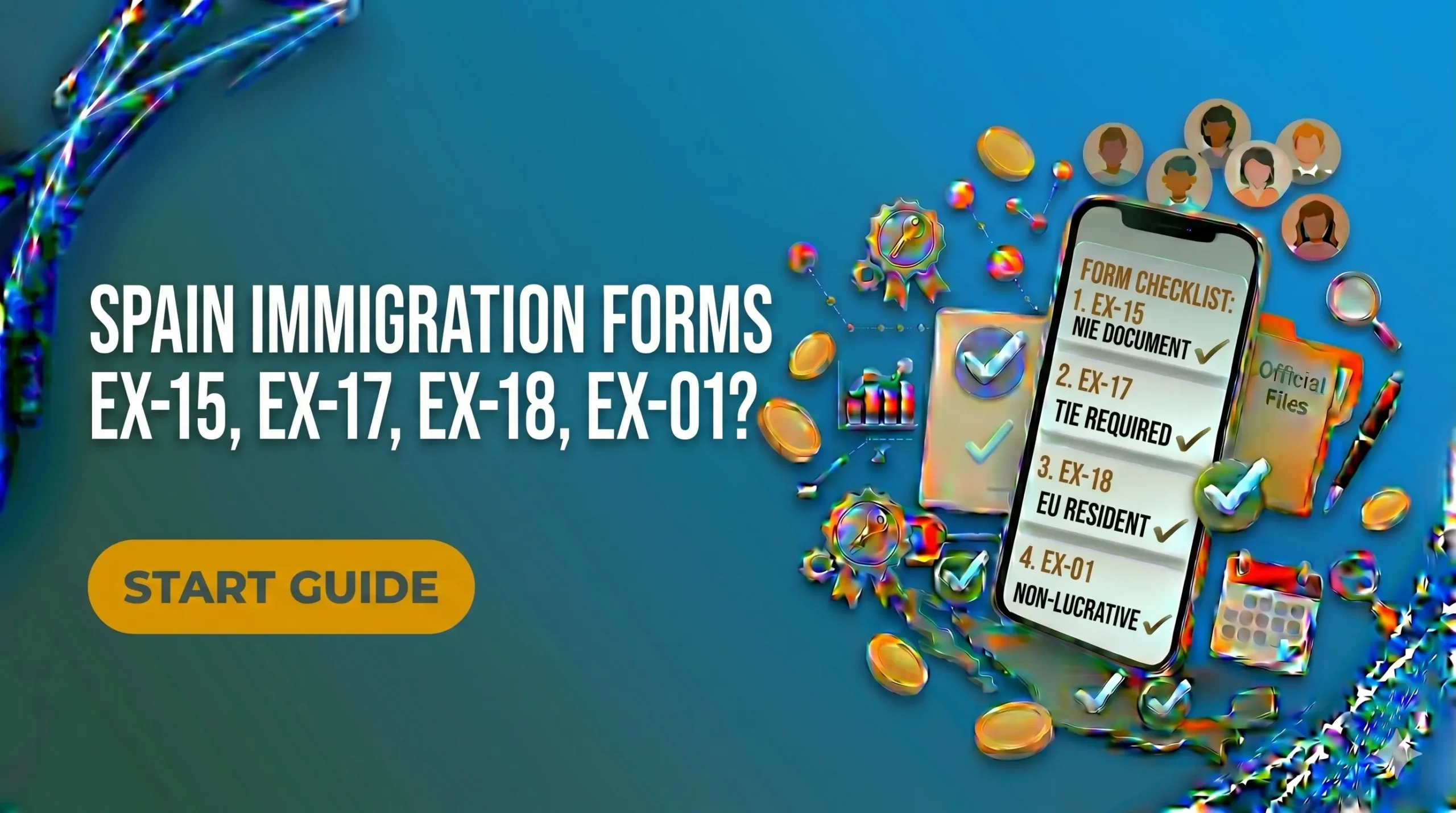
To help you get your bearings, here is a quick overview of the four forms we are covering, who needs them, and their primary purpose.
| Form Number | Official Name of the Form | Primary Purpose | Who Needs This Form |
| EX-15 | Solicitud de Número de Identidad de Extranjero (NIE) y Certificados | To apply for a non-resident NIE number or a certificate of non-residency. | Non-residents who need a tax ID to buy property, open a bank account, or accept a job offer from abroad. |
| EX-17 | Solicitud de Tarjeta de Identidad de Extranjero (TIE) | To apply for the physical biometric residency card (TIE). | Non-EU citizens who have a visa to live in Spain for more than 6 months. |
| EX-18 | Solicitud de inscripción en el Registro Central de Extranjeros | To register as an EU citizen living in Spain (the “Green Card/Paper”). | Citizens of the EU, EEA, or Switzerland moving to Spain for more than 3 months. |
| EX-01 | Solicitud de autorización de residencia temporal no lucrativa | To apply for the initial or renewal of a Non-Lucrative Residency. | Non-EU citizens applying to live in Spain without working (retirees, remote workers via foreign passive income). |
Demystifying Form EX 15 Application for NIE and Certificates
Let’s start with the EX-15. This is often the very first piece of Spanish bureaucracy a foreigner encounters, sometimes even before they move to Spain.
What is the EX 15 and Who Needs It
The EX-15 is used to apply for a Número de Identidad de Extranjero (NIE). The NIE is your foreigner identification number. It is an alphanumeric code (e.g., Y1234567Z) that serves as your tax identification number in Spain. You cannot do anything financial in Spain without a NIE. You need it to buy a house, buy a car, open a resident bank account, sign a utility contract, or accept a formal job offer.
You would use the EX-15 if you are applying for a “non-resident NIE.” For example, you live in the United States, but you want to buy a holiday home in Alicante. If you need help deciding where to apply, check out How to Get a Spanish NIE Number: In Spain vs Abroad.
Breaking Down the Sections of EX 15
1) DATOS DEL EXTRANJERO/A (Details of the Foreigner)
- Pasaporte: Enter your passport number.
- N.I.E.: Leave this blank (you are applying for one, after all).
- Sexo: Check ‘H’ for Hombre (Male) or ‘M’ for Mujer (Female).
- Estado Civil: Your marital status. ‘S’ for Soltero (Single), ‘C’ for Casado (Married), ‘V’ for Viudo (Widowed), ‘D’ for Divorciado (Divorced), ‘Sp’ for Separado (Separated).
- Nombre del padre / Nombre de la madre: Enter the first names of your father and mother. The Spanish government uses this for identity verification.
2) DATOS DEL REPRESENTANTE A EFECTOS DE PRESENTACIÓN DE LA SOLICITUD (Details of the Representative)
If you are physically going to the appointment yourself to hand in the form, leave this entire section blank. If a lawyer (abogado) or an administrative agent (gestor) is submitting this on your behalf via power of attorney, they will fill their details in here.
3) DOMICILIO A EFECTOS DE NOTIFICACIONES (Address for Notifications)
This is where you want the government to send any physical letters regarding your application. If you have a representative, put their address here. If you are handling it yourself, put your address. Pay close attention to the electronic notifications checkbox at the bottom of this section—do not check it unless you have a Digital Certificate.
4) DATOS RELATIVOS A LA SOLICITUD (Details of the Request)
This is the most critical part of the EX-15.
- 4.1 TIPO DE DOCUMENTO: Check Número de Identidad de Extranjero (NIE).
- 4.2 MOTIVOS: You must specify why you need the NIE. Check Por intereses económicos (economic interests – e.g., buying a house), Por intereses profesionales (professional interests – e.g., an upcoming job offer), or Por intereses sociales (social interests). In the (Especificar) blank, write a brief explanation in Spanish. For example: “Compra de vivienda” (Buying a house) or “Apertura de cuenta bancaria” (Opening a bank account).
- 4.3 LUGAR DE PRESENTACIÓN: Where are you handing this in? Oficina de Extranjería (Immigration Office in Spain), Comisaría de Policía (Police Station in Spain), or Oficina Consular (Spanish Consulate abroad).
- 4.4 SITUACIÓN EN ESPAÑA: Check Estancia (Stay) if you are just visiting on a tourist visa while applying.
Common Mistakes to Avoid with EX 15
The biggest mistake expats make with the EX-15 is applying for it when they actually don’t need to. If you have been approved for a long-term visa (like a student visa, work visa, or non-lucrative visa) at your consulate, a NIE number is automatically assigned to you. It will be printed directly on the visa sticker in your passport. You do not need to file an EX-15 to get a NIE; you already have one! You just need to move on to the EX-17 to get your physical card.
Accompanying Documents
When you submit the EX-15, you must also provide:
- Your original passport and a photocopy of all pages.
- Proof of why you need the NIE (e.g., a pre-contract for a house purchase, a letter from a bank, an intent-to-hire letter).
- The paid tax form. For the EX-15, this is usually Model 790 Code 012. You must fill this out online, print it, take it to a Spanish bank, pay the fee in cash, and get it stamped before your appointment. Read more on How to Pay Spain Immigration Fees (Tasa) Online: Model 790 Explained.
Navigating Form EX 17 Application for TIE
The EX-17 is arguably the form you will become most intimately familiar with. It is the gatekeeper to your actual, physical proof of residency in Spain.
The Difference Between NIE and TIE
Expats confuse these two acronyms constantly.
- NIE is a number. It is just a tax ID code. It doesn’t grant you the right to live in Spain, and a piece of paper with a NIE on it is not a residency permit.
- TIE (Tarjeta de Identidad de Extranjero) is a physical, plastic, biometric card. It has your photo, your fingerprints, your residency status (e.g., Student, Highly Qualified Professional), and your NIE printed on it.
If you are a non-EU citizen who has entered Spain with a visa meant to last longer than 6 months, you have 30 days after arriving to submit the EX-17 to get your TIE card.
Step by Step Through EX 17
Sections 1, 2, and 3 of the EX-17 are nearly identical to the EX-15. Fill out your personal details, leave the representative section blank if you are going yourself, and provide your notification address.
Pay close attention to Section 4: DATOS RELATIVOS A LA SOLICITUD.
- 4.1 TIPO DE DOCUMENTO: * Check TARJETA INICIAL if this is your very first time getting a residency card in Spain.
- Check RENOVACIÓN DE TARJETA if your current card is expiring and you have been approved to renew your residency.
- Check DUPLICADO POR ROBO, EXTRAVÍO, DESTRUCCIÓN O INUTILIZACIÓN if you lost your card, it was stolen, or it was destroyed in the washing machine.
Wait, what about changing addresses? If you moved to a new apartment in Spain, you are legally required to update your address on your TIE card. Surprisingly, there is no specific checkbox for “Change of Address” on the EX-17. In this case, you usually check “Duplicado” or simply inform the police officer at the desk, handing them your new Padrón certificate. For help with that, see Empadronamiento in Spain: How to Register Your Address.
The Fingerprint Appointment Logistics
The EX-17 is processed at a Toma de Huellas (fingerprinting) appointment. You cannot just walk into a police station. You must secure a Cita Previa online. Securing this appointment can feel like winning the lottery in busy provinces like Madrid, Barcelona, or Valencia. If you are struggling, review How to Book a Cita Previa for Extranjería in Spain (Step-by-Step).
When you finally get your appointment, you will hand over your EX-17, your passport, your visa approval letter, a recent passport-sized photo (with a stark white background), your Padrón certificate, and the stamped Model 790 Code 012 proving you paid the card issuance fee. The officer will take your digital fingerprints. About 30 to 45 days later, you will have to make an entirely separate appointment to go back and pick up the physical plastic card.
For an exhaustive breakdown of the fingerprinting day, check out How to Get the TIE Card in Spain: Fingerprints, Fees, and Pickup.
Form EX 18 Registration for EU Citizens
If you hold a passport from an EU country, the EEA (Norway, Iceland, Liechtenstein), or Switzerland, congratulations! You have the right to live and work in Spain freely. However, you are not exempt from the bureaucracy. If you plan to live in Spain for more than 90 days, you must register with the Central Register of Foreign Nationals. This is where Form EX-18 comes in.
Why EU Citizens Still Face Bureaucracy
Many EU citizens arrive in Spain thinking they don’t need to do anything. “Freedom of movement,” they say.
When your EX-18 is approved, you do not get a plastic TIE card like non-EU citizens. Instead, you receive what expats colloquially call the “Green Card” or “Green NIE.” It is a flimsy, green piece of paper (sometimes wallet-sized, sometimes a full A4 sheet depending on the region) that states your name, address, NIE, and date of registration. It has no photo on it, which means you must carry it alongside your home country’s passport or national ID card for it to be valid.
Filling Out Form EX 18 Correctly
Sections 1 through 3 are standard personal and notification details.
Section 4, SITUACIÓN EN ESPAÑA (Status in Spain), is where you must prove to the Spanish government that you have a legal right to reside there. You must check the box that corresponds to your situation:
- Trabajador por cuenta ajena: You have an employment contract with a Spanish company.
- Trabajador por cuenta propia: You are registered as an Autónomo (freelancer/self-employed) in Spain.
- No activo con recursos suficientes y seguro de enfermedad: You are not working, but you have sufficient financial savings to support yourself and comprehensive private Spanish health insurance. (This is common for EU retirees).
- Estudiante con recursos suficientes y seguro de enfermedad: You are a student enrolled in a recognized Spanish institution, you have money, and you have health insurance.
- Residencia Permanente: You are applying to upgrade to permanent residency after living legally in Spain for 5 continuous years.
If you are applying as a non-worker (“No activo”), be prepared to bring extensive bank statements showing thousands of euros in savings to prove you will not become a financial burden on the Spanish state.
The Infamous Green Paper
Let me offer a piece of veteran advice: do not laminate the green paper. I know it looks fragile and feels like it will tear in your wallet within a week. But laminating official government documents in Spain often renders them invalid in the eyes of a strict bureaucrat. Buy a small plastic sleeve for it instead. Trust me on this.
Form EX 01 Non Lucrative Visa Application
The EX-01 is specifically for the Autorización de residencia temporal no lucrativa. This is the famous Non-Lucrative Visa (NLV).
Understanding the Non Lucrative Residency
The NLV is designed for non-EU citizens who want to live in Spain without participating in the local labor market. You cannot work for a Spanish company, and historically, you couldn’t even work remotely for a foreign company (though interpretations of this have shifted, which is why the Digital Nomad Visa was created). The NLV is primarily used by retirees or individuals with substantial passive income (investments, rental properties, pensions).
Tackling Form EX 01 Sections
The EX-01 looks very similar to the others, but Section 4 (TIPO DE AUTORIZACIÓN SOLICITADA) is highly specific to the NLV lifecycle.
- If you are applying for the very first time at your consulate, you will look under the INICIAL heading. (Often, the consulate provides a slightly modified version of the EX-01, but the data requested is the same).
- If you have lived in Spain for one year and are renewing your NLV for years 2 and 3, you will look under the 1ª RENOVACIÓN heading and check Titular de autorización de residencia no lucrativa previa Inicial/Renovada.
- If you are renewing again for years 4 and 5, you check 2ª RENOVACIÓN.
Financial Proof and EX 01
The EX-01 is merely the cover sheet for a massive mountain of supporting documentation. To get the NLV approved, you must prove you meet the IPREM (Indicador Público de Renta de Efectos Múltiples) financial requirements. As of recent years, this means proving you have a guaranteed monthly income of 400% of the IPREM for the main applicant, plus 100% of the IPREM for every dependent family member.
You must submit translated, apostilled bank statements, tax returns, and proof of comprehensive private health insurance with absolutely no co-pays (sin copagos). The scrutiny on your finances for this form is intense. For a deep dive into exactly what numbers you need to hit, read Spain Non-Lucrative Visa: Financial Proof, Insurance, and FAQS.
Paying the Accompanying Immigration Fees
You will notice a recurring theme here: nothing in the Spanish immigration system is free. Every time you submit an EX form, it must be accompanied by proof that you have paid the corresponding government tax (tasa).
In immigration, you will deal primarily with two fee forms:
- Model 790 Code 012: This is managed by the National Police. You pay this fee when you are having physical documents issued, like getting your NIE assigned (EX-15) or having your physical TIE card printed and fingerprinted (EX-17).
- Model 790 Code 052: This is managed by the Ministry of Inclusion, Social Security and Migrations. You pay this fee for the processing of a residency authorization, such as when you submit the EX-01 to renew your Non-Lucrative visa.
You cannot simply transfer this money online via your foreign bank account. You must generate the PDF form on the government website, print it, physically walk into a Spanish bank, pay the teller in cash, and have them stamp your paper. That stamped paper is your golden ticket; do not lose it before your appointment.
Preparing for Your Extranjería Appointment
Once you have your EX form filled out flawlessly in black block letters, your apostilled documents translated by a sworn translator, your Padrón certificate, and your stamped fee form, you are ready for your appointment.
The Waiting Game
Arrive at the police station or immigration office at least 15 minutes early. Do not be surprised if you still end up waiting an hour past your scheduled time. The system is chronically backlogged. Bring a book and remain calm. Getting angry at the security guard or the civil servant will achieve absolutely nothing but ensure your application is scrutinized harder.
Copies, Copies, Copies
If I can leave you with one final piece of veteran expat wisdom regarding these forms, it is this: bring photocopies of absolutely everything.
Bring a photocopy of your completed EX form. Bring photocopies of every single page of your passport (even the blank ones). Bring photocopies of your health insurance policy. The civil servants are not there to run a photocopying service for you. If they ask for a copy and you do not have it, they will tell you to go find a papelería (stationary shop) to make copies and come back. Save yourself the panic attack and bring duplicates of your entire dossier.
References
Primary sources (official)
- Ministry of Inclusion, Social Security and Migration: Official download hub for all EX forms (EX-15, EX-17, EX-01).https://www.inclusion.gob.es/web/migraciones/modelos-de-solicitud/policia
- National Police Spain: Official portal for Tasa 790-012 and 052 fees and payment gateways.https://sede.policia.gob.es/portalCiudadano/_en/tramites_extranjeria_tasas.php
- Ministry of Foreign Affairs: Instructions for EX-15 submission at Consular offices.https://www.exteriores.gob.es/Consulados/edimburgo/en/ServiciosConsulares/Paginas/Consular/NIE.aspx
Other helpful sources
- Barcelona Academy of Art: Step-by-step visual guide for filling out form EX-17.https://www.academyofartbarcelona.com/wp-content/uploads/2023/10/How-to-fill-in-form-EX17-TIE.pdf
- Support in Spain: English translation and guide for Form EX-18 (EU Citizens).https://www.supportinspain.info/wp-content/uploads/2019/01/EX-18_Unofficial-Translation.pdf
- Entre Trámites: Comprehensive guide to the differences between Tasa 790 codes 012 and 052.https://entretramites.com/en/accounting/spain-immigration-fees-form-790
Disclaimer
The information provided in this article is based on personal expat experience and current Spanish immigration guidelines as of 2026. Immigration laws, form requirements, and administrative procedures in Spain are subject to frequent changes at local and national levels. This guide does not constitute formal legal advice. Always verify current requirements directly with the Ministerio de Inclusión, Seguridad Social y Migraciones or consult a registered Spanish immigration lawyer (abogado de extranjería) for advice specific to your personal situation.