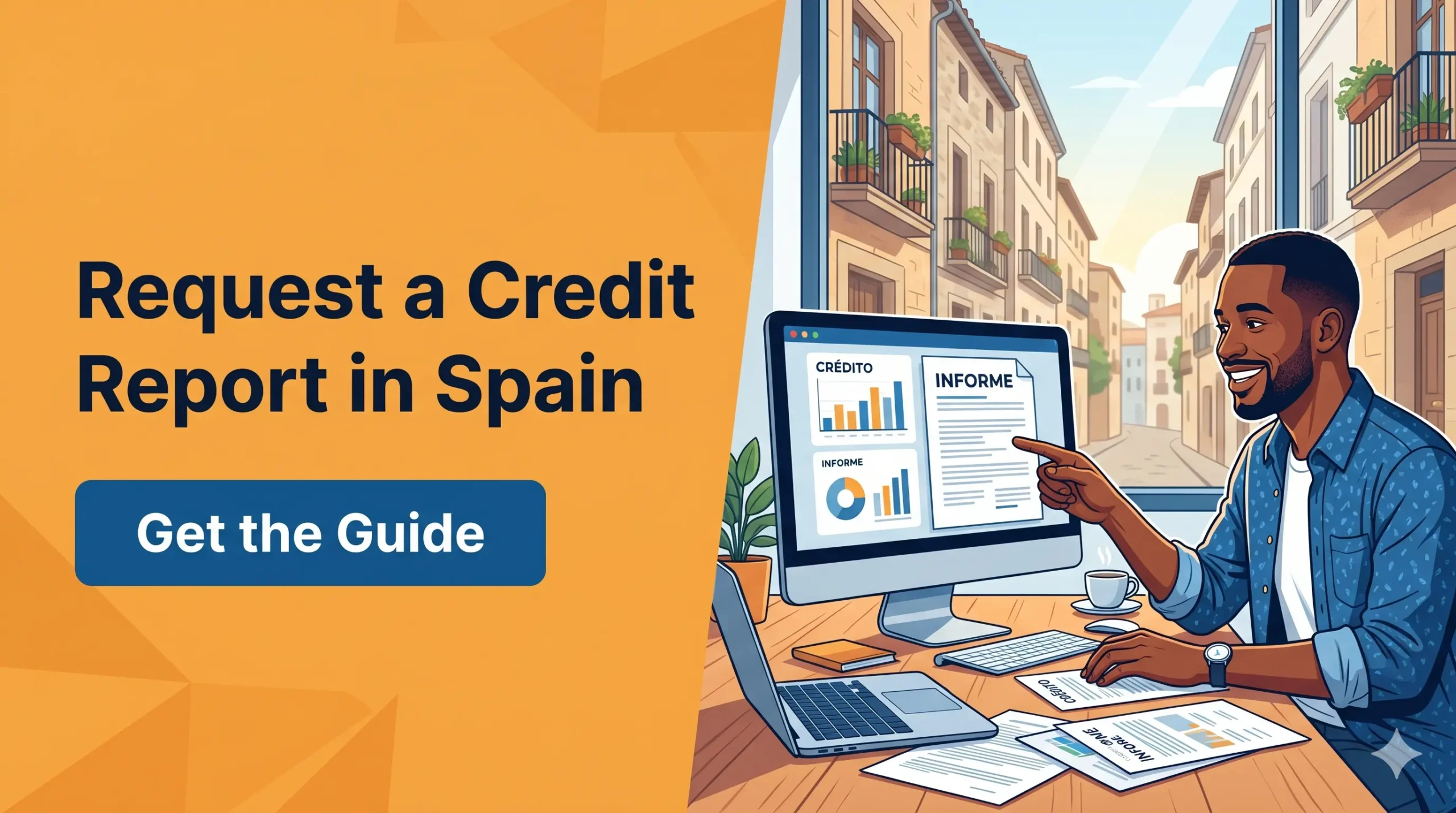
How to Request a Credit Report in Spain (Basic Guide)
Trying to secure a Spanish apartment and being asked for a credit score that technically does not exist is a massive point of confusion for new arrivals. I spent weeks trying to pull my FICO score for a Madrid landlord before realizing Spain uses an entirely different system. This guide explains how to navigate Spanish financial databases and request your reports.
Disclosure: This post may contain affiliate links. We may earn a commission at no extra cost to you if you make a purchase through these links. Read full disclosure.
The Myth of the Spanish Credit Score
When you move to Spain from the United States, the United Kingdom, or Canada, you carry an ingrained obsession with building and maintaining a numerical credit score. You naturally assume you need to open a Spanish credit card, put small daily purchases on it, and pay it off monthly to prove your financial worth to future lenders. You must completely abandon this mindset upon arriving in the Iberian Peninsula.
Why Your Home Country Score Does Not Matter
In Spain, there is no universal, positive credit scoring system like FICO or Experian scores in the US or UK. Spanish financial institutions, landlords, and telecom providers do not assign you a three-digit number that magically unlocks better interest rates. Furthermore, your immaculate credit history from your home country does absolutely nothing for you here. It does not cross the border. To a Spanish bank manager, you are a complete financial ghost on your first day.
Instead of tracking how well you manage open lines of credit, the Spanish system operates on a binary philosophy: you are either financially clean, or you are a known defaulter. Banks evaluate your creditworthiness based almost entirely on your current liquidity, your verifiable monthly income, your employment contract type, and whether your name appears on any national risk or delinquency databases. If you are struggling to even get into the system to sign an employment contract, reviewing the administrative hurdles in Getting an NIE for Employment or Study: Practical Overview is your required starting point.
Positive Risk Versus Delinquency Databases
Because there is no single “credit report” to request, you actually have to look at two entirely separate databases if you want to see what Spanish banks see when they evaluate your profile.
The first is the CIRBE, managed by the Banco de España. This is a public, government-run database that tracks “positive risk.” It records legitimate, large-scale financial obligations you have legally taken on, such as mortgages, personal loans, or large lines of credit. It exists so that banks can ensure you are not secretly holding half a million euros in debt across town before they issue you a new mortgage.
The second database type is the delinquency file, commonly known as a blacklist. The most infamous of these is ASNEF. This is a privately managed database that tracks unpaid debts. Unlike CIRBE, which tracks active, healthy loans, ASNEF only tracks defaults. You can be added to ASNEF for failing to pay a massive corporate loan, or for aggressively disputing a 20-euro monthly internet bill. Understanding the drastic differences between these two systems is critical for your financial survival.
| Feature | CIRBE | ASNEF |
| Managing Entity | Banco de España (Government) | Equifax Ibérica (Private Company) |
| What It Tracks | Active, healthy loans and guarantees | Unpaid debts, defaulted bills, collections |
| Minimum Threshold | Obligations exceeding €1,000 | No minimum (can be a €5 phone bill) |
| Impact on Expats | Affects major mortgage approvals | Causes rejection for basic bank accounts and utilities |
How to Request Your CIRBE Report
If you are applying for a Spanish mortgage or attempting to finance a vehicle, the lending institution will pull your CIRBE report. You have the absolute legal right to view this exact same report to ensure there are no fraudulent loans registered under your identity.
Understanding the Banco de Espana Database
The Central de Información de Riesgos del Banco de España (CIRBE) is not a blacklist. Having your name in the CIRBE database is perfectly normal for anyone who holds a Spanish mortgage, a car loan, or a significant personal credit line. Financial institutions are legally obligated to report any risk exceeding 1,000 euros associated with a single client.
The report will show the aggregated total of your debts, the type of debt, and whether you are the primary borrower or acting as a guarantor for someone else. However, the report does not explicitly state whether you are late on these payments, nor does it list the specific names of the lending banks in the summarized version provided to third parties. If you have absolutely zero debt in Spain, requesting your CIRBE report will simply yield a blank certificate stating that no risks are registered under your Foreigner Identification Number.
Step by Step Guide to Accessing Your File Online
Requesting your CIRBE report is completely free, but because it is managed by the Spanish government, the digital bureaucracy is intense. You cannot simply create an account with an email and password. You must securely identify yourself using the cl@ve system, a valid DNIe, or an official Certificado Digital installed on your computer browser.
If you have your digital certificate properly installed, you must navigate to the “Sede Electrónica” (Virtual Office) of the Banco de España. Locate the section titled “Petición de informes y Reclamaciones CIR” and follow the prompts to request your personal risk report. Once authenticated, the system typically generates a PDF of your CIRBE report instantly, or within a few business days depending on server loads.
If you have not yet navigated the painful process of securing a digital certificate, you can request the report physically. You must download the official request form, fill it out, and mail it to the Banco de España headquarters in Madrid alongside a notarized photocopy of your physical identity card. Given the slowness of the Spanish postal system, installing a digital certificate is highly recommended, as it is the same tool you will desperately need for managing the tax filings discussed in Foreign Income Reporting in Spain: What Residents Need to Know.
How to Check the ASNEF Blacklist
While CIRBE tracks your healthy loans, ASNEF tracks your administrative nightmares. Most expats will never need to worry about CIRBE, but almost every expat will face the terrifying prospect of the ASNEF blacklist at least once during their time in Spain.
Why Expats Unknowingly End Up on ASNEF
ASNEF is the database of defaulters. Spanish telecom providers, utility companies, and gym chains are notorious for making contract cancellations incredibly difficult. An expat might verbally cancel their internet service, but because they missed a hidden clause requiring them to return the physical router within ten days, the company continues to bill them.
When the expat realizes they are still being charged, they logically block the direct debit mandate at their bank. While you have the legal right to block charges, as explained in How Direct Debits Domiciliacion Work in Spain: Setup and Cancellations, doing so does not legally terminate the contract. The telecom provider registers this blocked charge as an unpaid debt and immediately sells it to a collections agency. The agency then adds the expat’s NIE to the ASNEF database.
The next time that expat tries to sign up for a basic mobile phone plan or switch electricity providers, the new company queries ASNEF, sees the delinquent flag, and automatically rejects the application. Because navigating daily life involves so many automated billing contracts, a chaotic reality outlined in Typical Utility Bills in Spain: Electricity, Gas, Water (Examples), this trap catches thousands of foreigners every year.
Requesting Your Equifax File for Free
By Spanish data protection law, you cannot be added to a delinquency file without prior notification. The collections agency is legally required to send you a letter warning you of your impending inclusion. This letter will contain a specific reference number.
If you have this letter, requesting your report is incredibly fast. You navigate to the Equifax Ibérica website (the company that manages ASNEF), enter your NIE and the reference number, and instantly view the details of who claims you owe them money.
If you suspect you are on the list but never received a letter—perhaps because you moved apartments and the telecom company mailed it to your old address—you must exercise your ARCO rights manually. You can send a formal email or a physical letter to Equifax requesting access to your data. You must include a signed request form and a clear, legible photocopy of your passport and residency card. Equifax is legally obligated to reply within a month, providing a full report of any debts registered against your identity. If you discover a completely fraudulent charge, the steps to fight it are complex and fully detailed in What to Do When a Spanish Company Sends You to Collections (ASNEF).
Managing Your Financial Reputation and Moving Money
If you find yourself with an empty CIRBE file but a blocked ASNEF record, your immediate financial life in Spain will become incredibly difficult. Traditional Spanish institutions will treat you as a high-risk liability until the database is cleared.
Bypassing Legacy Banks with Digital Accounts
If your name appears on a delinquency blacklist, traditional Spanish high-street banks will often refuse to open a basic checking account for you. Their automated systems reject anyone flagged by ASNEF, leaving you completely locked out of the local economy.
To bypass this legacy discrimination and secure a functional base of operations, opening your daily account with N26 is highly strategic. As a modern digital platform, N26 utilizes different risk models for basic checking accounts compared to legacy banks extending heavy overdraft lines. N26 issues a fully recognized local Spanish IBAN directly from your smartphone interface, allowing you to bypass the judgmental branch manager entirely. You can use your N26 account to seamlessly handle your rent, buy groceries, and manage your daily life even if you are battling a disputed phone bill on a national blacklist. This frictionless, guaranteed integration is exactly why digital alternatives dominate guides comparing the Best Low-Fee Bank Accounts in Spain for New Residents and Opening a Bank Account in Spain: Step-by-Step for Foreigners.
Clearing Debts and Protecting Global Wealth
If you pull your ASNEF report and realize the debt is legitimate—for example, you genuinely forgot to pay a final utility bill before moving—the fastest way to clear your name is to simply pay the collections agency.
If your primary savings are still located in your home country, executing a standard international wire transfer to pay off this Spanish debt will crush you with hidden SWIFT network fees and terrible exchange rate markups. To fiercely protect your capital, you must route your international transfers through Wise. Utilizing Wise allows you to completely bypass the expensive, antiquated legacy banking networks. Wise converts your home currency to euros using the real, transparent mid-market exchange rate. You can instantly transfer those cleanly converted euros directly to the collections agency via Wise, clearing your debt without bleeding money to banking margins. The deep mathematical advantage of this approach is mapped out in Sending Money to/from Spain: Comparing Banks vs Transfer Services.
Finally, while you navigate these local administrative hurdles, you must ensure your broader life savings are never exposed to Spanish collection agencies. If a local company wins a dispute against you, the Spanish system has the supreme authority to freeze localized retail accounts, a terrifying reality detailed in What to Do If Your Spanish Bank Account Is Frozen Common Causes.
To build robust long-term wealth securely, many veteran expats transfer their surplus capital into a global brokerage account like Interactive Brokers. Utilizing Interactive Brokers allows you to build a sophisticated, multi-currency portfolio that remains entirely portable and heavily insulated from localized Spanish retail banking embargoes. It elegantly separates your long-term global wealth from the administrative chaos of your daily Spanish disputes. Keeping your financial footprint agile through platforms like Interactive Brokers ensures your money is always working for you, well beyond the reach of local Spanish blacklists.
References
Primary sources official
- Banco de España – Central de Información de Riesgos (CIRBE): https://clientebancario.bde.es/pcb/es/menu-horizontal/productosservici/relacionentidad/cirbe/
- Agencia Española de Protección de Datos (AEPD) – Ficheros de morosidad: https://www.aepd.es/es/areas-de-actuacion/morosidad
Other helpful sources
- Equifax España – Consulta ASNEF: https://soluciones.equifax.es/
- Portal de la Administración General del Estado – Impuestos y Finanzas: https://administracion.gob.es/
Disclaimer
The information provided in this guide is exclusively for educational and informational purposes and does not constitute official legal or financial advice. Spanish banking regulations, data protection laws surrounding delinquency blacklists (ASNEF), and the procedural requirements for requesting official risk reports from the Banco de España are highly complex and subject to strict government enforcement. While we strive to ensure absolute accuracy, you should always consult a registered Spanish lawyer (abogado) or a certified financial advisor before initiating a formal legal dispute regarding fraudulent debt or attempting to secure a major Spanish mortgage based on your CIRBE file.