Spain Spouse/Partner Residency: Marriage vs Registered Partnership
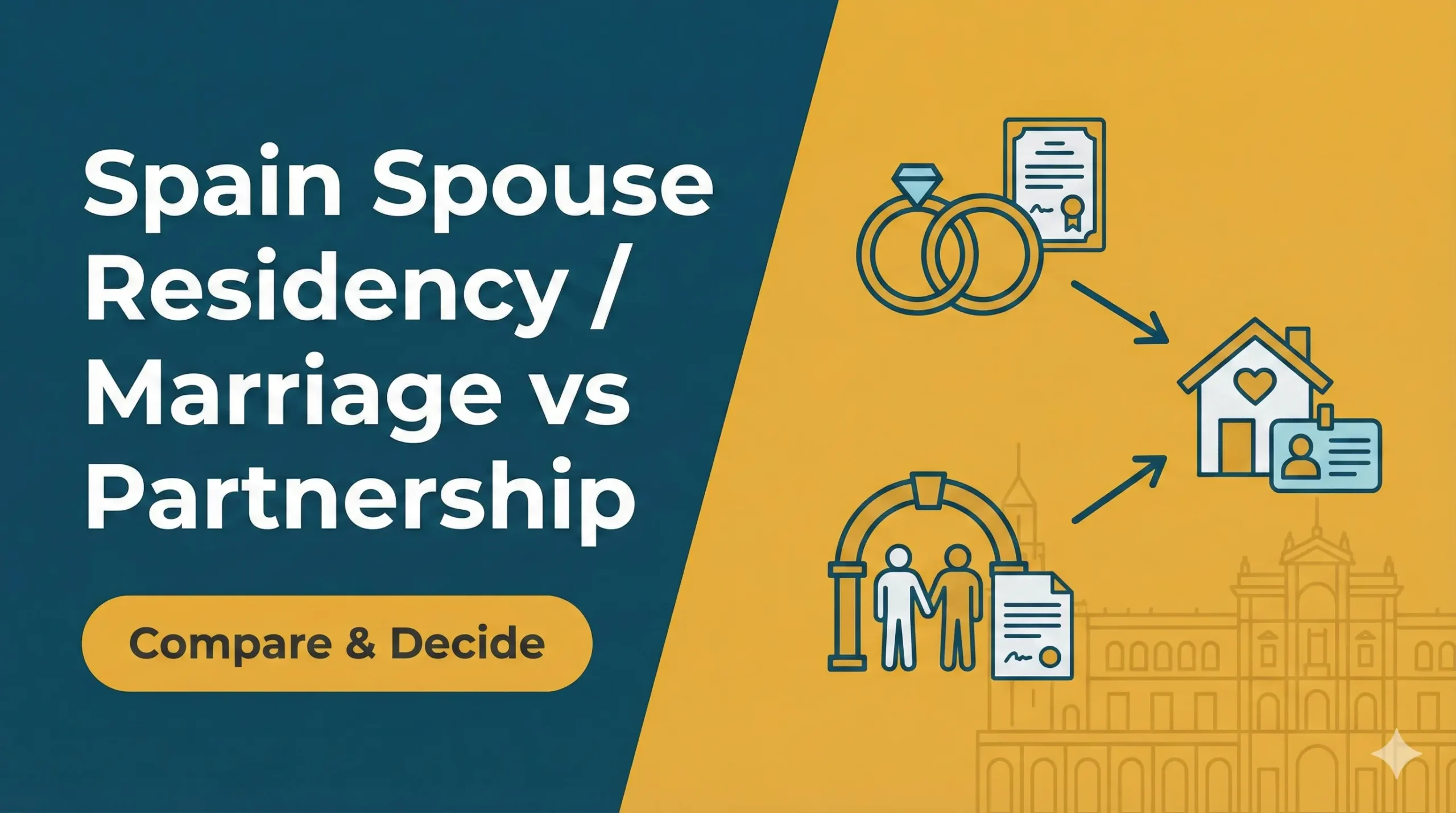
Choosing between marriage and Pareja de Hecho affects your Spanish residency timeline and rights. Marriage offers a fast track to citizenship (1 year), while Pareja de Hecho is often quicker to set up but varies wildly by region. This guide compares both routes to help you decide.
Disclosure: This post may contain affiliate links. We may earn a commission at no extra cost to you if you make a purchase through these links. Read full disclosure.
The Core Concept: Two Paths to the Same Card
Whether you marry or register as partners, the immigration outcome is generally the same. As the family member of an EU citizen, you are eligible for the Family Member of an EU Citizen Residence Card (Tarjeta Comunitaria).
- Validity: 5 years.
- Work Rights: Full authorization to work (employee or self-employed).
- Travel: Visa-free travel within the Schengen zone.
The difference lies not in the card you get, but in the process to get there and the rights you hold once you have it.
Comparison Table: Marriage vs. Pareja de Hecho
| Feature | Civil Marriage (Matrimonio) | Registered Partnership (Pareja de Hecho) |
| Regulation | National (Federal Civil Code) | Regional (Varies by Autonomous Community) |
| Citizenship Path | 1 Year of residency | 10 Years (Standard rule applies) |
| Registration Time | Slow (3–6 months avg) | Fast (1–2 months, depending on region) |
| Cohabitation Rule | Not strictly required before marriage | Mandatory (12 months in Madrid, 2 years in Catalonia, etc.) |
| Inheritance Rights | Automatic protections | Minimal/None (Must have a Will) |
| Tax Benefits | Joint tax filing allowed | Individual filing only |
| Dissolution | Divorce process (Court/Notary) | Simple cancellation at Registry |
Option 1: Civil Marriage (Matrimonio)
Marriage in Spain is a “heavy” legal status. It is recognized nationwide and internationally, offering the strongest protection.
The Process
Getting married in Spain is not a “Vegas” affair. It involves a bureaucratic file called the Expediente Matrimonial.
- The Interview: Before you can marry, a judge or notary will interview you and your partner separately to prove the relationship is genuine (not a “sham marriage” for a visa).
- The Wait: Getting the interview appointment and the final approval can take 3 to 6 months, depending on the city.
- The Ceremony: Once approved, you can marry before a notary (fast, ~€150-300) or at the Civil Registry (free, but slow).
The “Golden” Benefit: Citizenship
The single biggest advantage of marriage is the fast track to Spanish Nationality.
- If you are married to a Spaniard, you can apply for citizenship after just one year of legal residence.
- If you are Pareja de Hecho, you must wait the standard duration for your nationality (usually 10 years, or 2 years for Ibero-American citizens).
Strategy: If your goal is a Spanish passport and you are not from Latin America, marriage is almost always the superior strategic choice.
Option 2: Registered Partnership (Pareja de Hecho)
A Pareja de Hecho is a public record of a stable union between two people. Unlike marriage, it is not governed by national law, but by the Autonomous Community where you live. This means the rules in Madrid are completely different from those in Barcelona.
The Regional Patchwork (2026 Rules)
Because rules vary, your location dictates your eligibility.
Madrid
- Cohabitation: You must prove you have lived together continuously for 12 months.
- Proof: The only accepted proof is the Empadronamiento (census registration) showing both names at the same address for a full year. Private leases or photos are rarely accepted.
Catalonia (Barcelona)
- Routes: You have three ways to qualify:
- Prove 2 years of uninterrupted cohabitation.
- Have a child together.
- Sign a public deed (Escritura Pública) before a notary.
- The Loophole: Route #3 is the most popular for expats. You can theoretically register immediately without waiting years, provided you go to a notary to formalize the union.
Andalusia
- Flexibility: historically one of the most flexible regions. You usually do not need a strict 12-month waiting period if you sign a deed before a notary, though you must be registered on the town hall census (Empadronamiento).
Pros and Cons
- The Pro: It is incredibly fast. In Catalonia or Andalusia, you can sign the deed at a notary in the morning and have your official certificate in hand a few weeks later. This allows you to apply for your residency card months sooner than if you waited for a marriage license.
- The Con: Weak inheritance rights. In many regions, if your partner dies, you are legally a stranger. You have no automatic right to their assets or a widow’s pension unless you have a specific Will (Testamento) drawn up.
Financial Requirements (2026)
Whether married or partners, the European citizen must prove they can support the non-EU partner. The Immigration Office uses the IPREM (Public Indicator of Income) and the Minimum Wage (SMI) as benchmarks.
For 2026, the requirements typically look like this:
- If the EU Citizen Works:
- Employed: Present the employment contract and the last 3 payslips. No specific minimum amount is usually enforced if the contract is full-time, but it shouldn’t be below minimum wage (approx. €1,134/month).
- Self-Employed: Proof of registration in Autónomo regime and payment of social security quotas.
- If the EU Citizen does NOT Work:
- Savings: You must show a bank balance. A safe estimate is €12,000 – €15,000 for a couple (roughly IPREM x 2 for a year).
- Health Insurance: You must provide a private health insurance policy for the non-EU partner. It must be “Sin Copagos” (no copayments) and offer full coverage equivalent to the public system.
The “Extended Family” Route
What if you haven’t lived together for 12 months (Madrid) or don’t want to marry yet?
There is a third, lesser-known option: Stable Couple Not Registered (Pareja Estable no Inscrita).
- The Basis: Under the “Extended Family” rules of the EU directive, you can apply for residency if you can prove a “durable relationship.”
- The Proof: Usually requires proof of cohabitation for 1 year OR legal proof of a shared life (joint bank accounts, shared lease, etc.) if cohabitation is less.
- The Risk: This is discretionary. The immigration officer decides if your proof is enough. Marriage and Pareja de Hecho are rights; “Extended Family” is a concession. It has a higher rejection rate.
Step-by-Step Residency Application
Once you have your Marriage Certificate or Pareja de Hecho registration in hand, the procedure is identical.
1. Register the Union
- Marriage: Get the certificate from the Civil Registry. If married abroad, it must be registered in Spain (which can take a year) or legalized/Apostilled (if from the EU).
- Partnership: Get the certificate from the Autonomous Community’s Registry of Unions.
2. The Empadronamiento
Both of you must be registered at the same address in Spain. Go to your local Town Hall (Ayuntamiento) to get the collective certificate (Volante de Empadronamiento Colectivo).
3. Application for the Card (EX-19)
Submit the application to the Immigration Office (Extranjería).
- Form: EX-19 (for Family Member of EU Citizen).
- Fee: Tax Form 790-012 (approx. €12).
- Deadline: Legally, the office has 3 months to answer. Many provinces are experiencing delays.
4. The TIE Card
Once approved, you make an appointment with the National Police for fingerprints (“Toma de Huellas”) and pick up your physical card about 30-45 days later.
Common Mistakes to Avoid
1. Assuming “Registered” means “Valid Nationwide”
If you register as Pareja de Hecho in Valencia and then move to Madrid, your registration is not automatically valid in Madrid. You often have to de-register in Valencia and re-register in Madrid, resetting your clock. Marriage, by contrast, is valid everywhere.
2. Forgetting the “Fe de Vida y Estado”
To register as partners, you usually need a certificate proving you are single (Fe de Vida y Estado) or a Certificate of No Impediment. This document expires quickly (usually 3 months). Do not get it too early.
3. The “Marriage Abroad” Trap
If you marry in Las Vegas or a non-EU country, Spain does not automatically accept it for residency. You must usually register the marriage at the Spanish Consulate in that country first, a process that can take 6 to 12 months.
- Hack: If you are in a rush, getting married in Spain or registering as Pareja de Hecho in Spain is often faster than waiting for a foreign marriage to be transcribed.
Conclusion
The choice between marriage and Pareja de Hecho often comes down to two factors: Speed vs. Citizenship.
- Choose Pareja de Hecho if you need residency now. In regions like Catalonia, you can solve your immigration status in a matter of weeks.
- Choose Marriage if you want the “Platinum” status: stronger inheritance rights, joint tax filing, and the ability to get a Spanish passport in just one year.
Whichever route you choose, the destination is the same: a legal life in Spain with your partner. Once you have your residency resolved, ensure you are fully integrated by registering with the local tax office. For high earners, this is the time to consider the Beckham Law Explained: Spain’s Special Expat Tax Regime.
References
Primary sources (official)
- Ministry of Inclusion, Social Security and Migration: Information on Family Members of EU Citizens (Form EX-19).https://www.inclusion.gob.es/web/migraciones/vive-en-espana/familiares-de-ciudadanos-de-la-union-europea
- Community of Madrid: Requirements for Registering De Facto Unions (Uniones de Hecho).https://www.comunidad.madrid/servicios/justicia/inscripcion-registro-uniones-hecho
- Civil Code of Catalonia: Regulations on stable couples (Parelles Estables).https://portaljuridic.gencat.cat/
- Ministry of Justice: How to apply for Spanish Nationality by Residence (1-year rule for spouses).https://www.mjusticia.gob.es/es/ciudadania/nacionalidad/nacionalidad-espanola/nacionalidad-residencia
Other helpful sources
- Balcells Group: Detailed legal comparison of Marriage vs. Civil Partnership for residency.https://balcellsgroup.com/marriage-vs-civil-partnership-spain/
- SpainGuru: 2026 Guide to Family Reunification financial requirements.https://spainguru.es/2024/03/25/the-differences-between-pareja-de-hecho-vs-marriage-in-spain/
Disclaimer
The information provided in this article is for educational and informational purposes only and does not constitute legal advice. Regional regulations for Pareja de Hecho are subject to frequent changes by Autonomous Communities. We strongly recommend consulting with a qualified immigration lawyer to verify the specific requirements in your region before submitting any application.