Common Money Mistakes New Expats Make in Spain (and Fixes)
Bleeding cash to hidden fees and sudden administrative traps is an expensive expat initiation. I blew through hundreds of euros in invisible exchange margins during my first month in Madrid just buying basic groceries and paying utility deposits. This guide breaks down the most costly financial mistakes new arrivals make in Spain and provides the exact fixes needed to protect your budget.
Disclosure: This post may contain affiliate links. We may earn a commission at no extra cost to you if you make a purchase through these links. Read full disclosure.
Relying on Foreign Bank Cards for Daily Expenses
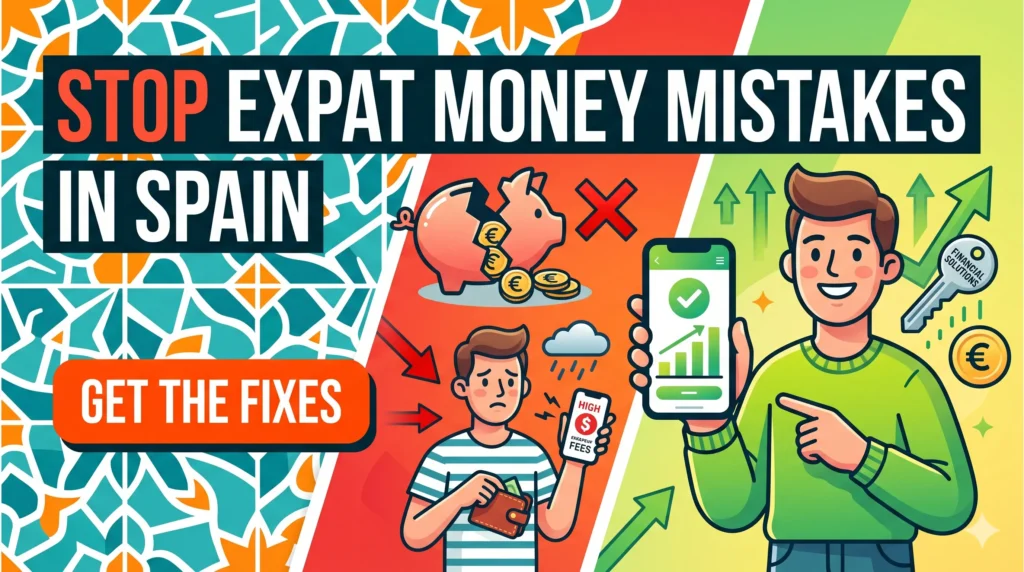
The most common and immediately destructive mistake new expats make is stepping off the plane and continuing to use their home country’s debit or credit cards for their daily Spanish life. While it feels incredibly convenient to just tap your American or British card at the local Mercadona or metro station, you are triggering a cascade of invisible fees with every single transaction.
The Hidden Fees of Currency Conversion
When you use a foreign card in Spain, you are exposing yourself to the predatory mechanics of the global foreign exchange market. Most legacy home banks will quietly tack on a foreign transaction fee ranging from one to three percent behind the scenes. This means every time you buy a coffee or pay for a restaurant meal, the bank skims a percentage directly off the top. Over the course of your first year, this can easily equate to a lost month of rent.
Furthermore, you will constantly encounter the Dynamic Currency Conversion (DCC) trap at Spanish point-of-sale terminals and ATMs. The terminal will explicitly ask if you want to be charged in euros or in your home currency. If you choose your home currency—which feels safer to many new arrivals—the local Spanish merchant’s bank applies an aggressive, highly inflated exchange rate markup. Understanding how to aggressively decline these terminal traps is precisely why mastering the tactics in How to Avoid Hidden Exchange Markups When Paying in Spain is so critical.
You literally cannot track your true euro spending when using foreign cards because the numbers on your local Spanish receipt will never match the numbers eventually deducted from your home account. Relying on a foreign banking app to track your daily Spanish life means you are inherently tracking a moving target, making local budgeting impossible.
Bypassing Legacy Banks with Local Solutions
To stop this financial bleeding, you must establish a firewall between your incoming foreign savings and your outgoing Spanish expenses. The foundation of a solid expat workflow requires executing one or two bulk currency conversions per month, rather than relying on daily card swipes. You calculate your expected monthly expenses in euros, and you transfer that exact amount into Spain.
However, you must never let your legacy home bank perform this international wire transfer. Traditional banks will crush your budget with hidden SWIFT network fees and terrible exchange rate markups. To protect your purchasing power, you must route your international transfers through Wise. Utilizing Wise allows you to completely bypass the expensive, antiquated SWIFT network. Wise converts your home currency to euros using the real, transparent mid-market exchange rate. You can then instantly transfer those cleanly converted euros directly into your localized Spanish account, ensuring your monthly budget arrives completely intact, a strategy deeply explored in Sending Money to/from Spain: Comparing Banks vs Transfer Services.
Once your euros arrive safely in Spain, they need a dedicated, frictionless home. Opening your daily operational account with N26 is highly strategic. N26 issues a fully recognized local Spanish IBAN directly from your smartphone interface. Because N26 eliminates the punitive quarterly maintenance fees charged by traditional Spanish high-street banks, it perfectly serves as your agile financial hub. By pushing a set euro amount into N26 at the beginning of the month, you create a pure, closed-loop euro ecosystem, fully integrating into the local economy without the friction of a legacy branch manager. This frictionless compliance is exactly why digital alternatives dominate lists comparing the Opening a Bank Account in Spain: Step-by-Step for Foreigners.
Mishandling Spanish Taxes and Bureaucracy
The Spanish tax system operates under a drastically different philosophy than what most expats are accustomed to. Ignorance of local tax laws is never accepted as an excuse, and the government relies on automated fines rather than polite reminder letters to enforce compliance.
Ignoring the Imputed Income Tax and IBI
Many foreign buyers purchase a holiday home in Spain and assume that because they do not rent it out to tourists, they owe no income tax. This is a massive, highly penalized mistake. The Spanish government operates under the concept of imputed income (imputación de rentas). If you own a property, do not use it as your primary residence, and do not rent it out, the government legally assumes you are deriving a theoretical benefit simply by having the property available.
You are required to file an annual Modelo 210 declaration and pay a phantom tax on the days the property sat empty. This is entirely separate from the local IBI (municipal property tax) bill that you must pay to the town hall. Expats constantly confuse the two, paying the local IBI but entirely ignoring the national imputed income tax until a massive fine arrives in the mail.
Furthermore, if you live in Spain for more than 183 days a year, you generally become a full tax resident. This means you are legally obligated to declare your worldwide income and your global assets (via the Modelo 720) to the Spanish tax agency. Failing to declare that foreign investment account or rental property back home can trigger fines that wipe out the asset itself. Establishing a baseline understanding of these aggressive tax concepts is why reviewing Spanish Taxes for Foreign Residents: Practical Guide to Staying Compliant and Foreign Income Reporting in Spain: What Residents Need to Know is absolutely mandatory.
Failing to Update Identification Documents
Spanish banking operates under incredibly strict “Know Your Customer” (KYC) and Anti-Money Laundering (AML) regulations. Every bank is legally bound to possess a current, valid copy of your legal identification at all times. This creates a massive vulnerability for expats relying on temporary visas.
When you initially open a legacy Spanish bank account, you likely provide a passport or a temporary TIE (Foreigner Identity Card). Passports expire, and temporary visas must be renewed. The legacy Spanish banking software constantly scrubs its databases, and the moment the expiration date on your file passes, the system automatically triggers a total freeze.
The bank will not let you withdraw cash, pay for groceries, or transfer money until a new, valid ID is physically scanned into their branch system. Yelling at a teller will not speed up the compliance department. Waking up financially paralyzed is a terrifying rite of passage. Knowing exactly how to unblock your life if this happens, and how to proactively provide documentation before the freeze hits, is a critical survival skill outlined in What to Do If Your Spanish Bank Account Is Frozen Common Causes.
Misunderstanding the Rental Market and Utility Payments
Securing a roof over your head in Spain is exhausting, but desperation often leads expats to agree to highly illegal financial terms out of fear of losing the apartment.
Overpaying on Rental Deposits Fianza
By law, under the Ley de Arrendamientos Urbanos (LAU), a Spanish landlord can only demand a maximum of one month of rent for the fianza (the official legal security deposit) for an unfurnished, long-term residential lease. They are strictly prohibited from asking for a three-month fianza outright.
However, landlords see expats as massive financial risks because we lack a local Spanish credit history or a permanent domestic employment contract. To mitigate this risk, landlords exploit a legal loophole by demanding a garantía adicional (additional guarantee), sometimes asking for up to six months of rent upfront. Handing over half a year’s rent completely paralyzes your liquidity, and getting that money back at the end of the lease is often a nightmare.
You must negotiate these demands downward. Offer a robust portfolio of financial proof—like tax returns and translated bank statements—to negotiate the additional guarantee down to just one extra month. Understanding how to leverage your financial profile against predatory landlord demands is the core focus of How to Negotiate Rent in Spain: Financial Prep and Tactics. Once you agree on a price, you should use Wise to instantly transfer the deposit directly into the landlord’s account, ensuring the large sum arrives intact without legacy banking delays ruining the deal.
The Direct Debit Utility Trap
When you finally get the keys, your instinct is to call the electric company and hand them your home country’s credit card to set up monthly billing. You will be immediately rejected. Spanish utility companies operate almost exclusively on a system called domiciliación bancaria (direct debit).
Under this system, you sign a SEPA mandate granting the utility provider the legal authority to automatically pull the funds they are owed from your checking account. Because utility billing cycles are notoriously erratic—with water bills sometimes arriving bi-monthly or trash taxes randomly bundled in—managing these automated pulls requires a localized banking setup. You can review exactly how chaotic these charges can be in Typical Utility Bills in Spain: Electricity, Gas, Water (Examples).
Utility companies mandate this system to eliminate collection risk, and their legacy software frequently discriminates against foreign IBANs. If you do not have a localized “ES” IBAN, the customer service agent will flatly refuse to activate your contract. You must have your N26 operational account ready to go before you even attempt to turn on the lights. Understanding how you control and dispute these automated mandates is deeply explored in How Direct Debits Domiciliacion Work in Spain: Setup and Cancellations.
Keeping Long-Term Wealth in Vulnerable Accounts
Once you have successfully navigated the rent, the utilities, and the initial bureaucratic shock, you will ideally begin accumulating surplus savings. Managing the money left over after the bills are paid is your next major financial milestone.
Exposing Savings to Local Retail Banks
The absolute worst mistake an expat can make is transferring their entire life savings from their home country into a vulnerable Spanish checking account simply because they want their money nearby.
Traditional Spanish retail banks offer virtually zero interest on standard checking accounts, meaning inflation will steadily erode your purchasing power over time. More dangerously, holding dormant wealth in a local retail bank exposes it to the threat of arbitrary administrative embargoes. If the tax authority, the social security administration, or even the local town hall claims you owe a debt, they possess the supreme legal authority to bypass the courts and freeze your funds directly. Keeping massive liquidity in a local account is an unnecessary risk.
You must compartmentalize your finances. Keep a dedicated emergency buffer locally, a strategy discussed in Best Ways to Build an Emergency Fund While Living Abroad in Spain, but move the rest of your capital out of the retail system.
Securing a Global Financial Footprint
To build robust long-term wealth securely, many veteran expats transfer their surplus capital into a global brokerage account like Interactive Brokers. Utilizing Interactive Brokers allows you to build a sophisticated, multi-currency portfolio that remains entirely portable and heavily insulated from localized Spanish retail banking fees.
It elegantly separates your long-term global wealth building from the administrative chaos of your daily Spanish living expenses. If your life circumstances change and you eventually decide to move to a third country, or back to your home country, your investments do not need to be liquidated and heavily taxed; they simply travel with you digitally. Should the Spanish tax agency require proof of your worldwide financial standing, Interactive Brokers generates incredibly clean, standardized annual reports, making it simple to maintain compliance with local asset declarations. Keeping your financial footprint agile ensures the money you fought so hard to save in Spain continues to work for you, long after you have mastered the local bureaucracy.
| Common Expat Financial Mistake | The Immediate Consequence | The Optimal Fix |
| Using Foreign Cards Daily | Losing 2-4% per transaction to hidden banking fees and DCC. | Use Wise for bulk transfers, spend locally with a dedicated digital ES IBAN. |
| Ignoring Imputed Income Tax | Compounding fines and eventual bank account embargoes by Hacienda. | File Modelo 210 annually for empty holiday homes. |
| Paying Massive Rental Deposits | Tying up critical liquid cash and risking total loss if the landlord is shady. | Negotiate using solid income proof; cap the extra guarantee at 1-2 months max. |
| Keeping Wealth in Local Banks | Exposing life savings to local inflation and arbitrary administrative freezes. | Route surplus capital into a global, multi-currency brokerage account. |
References
Primary sources (official)
- Banco de España – Comisiones bancarias: https://clientebancario.bde.es/pcb/es/menu-horizontal/productosservici/cuentasdepositos/cuentascorriente/guia-textual/CuentadepagoBasica/comisiones.html
- Agencia Tributaria – Impuesto sobre la Renta de no Residentes: https://sede.agenciatributaria.gob.es/Sede/no-residentes/irnr-sin-establecimiento-permanente.html
- Boletín Oficial del Estado (BOE) – Ley 29/1994, de Arrendamientos Urbanos (LAU): https://www.boe.es/buscar/act.php?id=BOE-A-1994-26003
Other helpful sources
- Portal de la Administración General del Estado – Impuestos Autonómicos y Locales: https://administracion.gob.es/
- Centro Europeo del Consumidor en España – Derechos en pagos y transferencias: https://portal-cec.consumo.gob.es/
Disclaimer
The information provided in this guide is exclusively for educational and informational purposes and does not constitute official legal, tax, or financial advice. Spanish banking regulations, rental laws under the Ley de Arrendamientos Urbanos (LAU), and national tax compliance requirements are highly complex and subject to strict enforcement by the Agencia Tributaria. While we strive to ensure absolute accuracy, you should always consult a certified financial planner, a registered real estate lawyer (abogado), and an official Spanish tax advisor (asesor fiscal) before making significant financial decisions, executing cross-border transfers, or signing legally binding contracts in Spain.