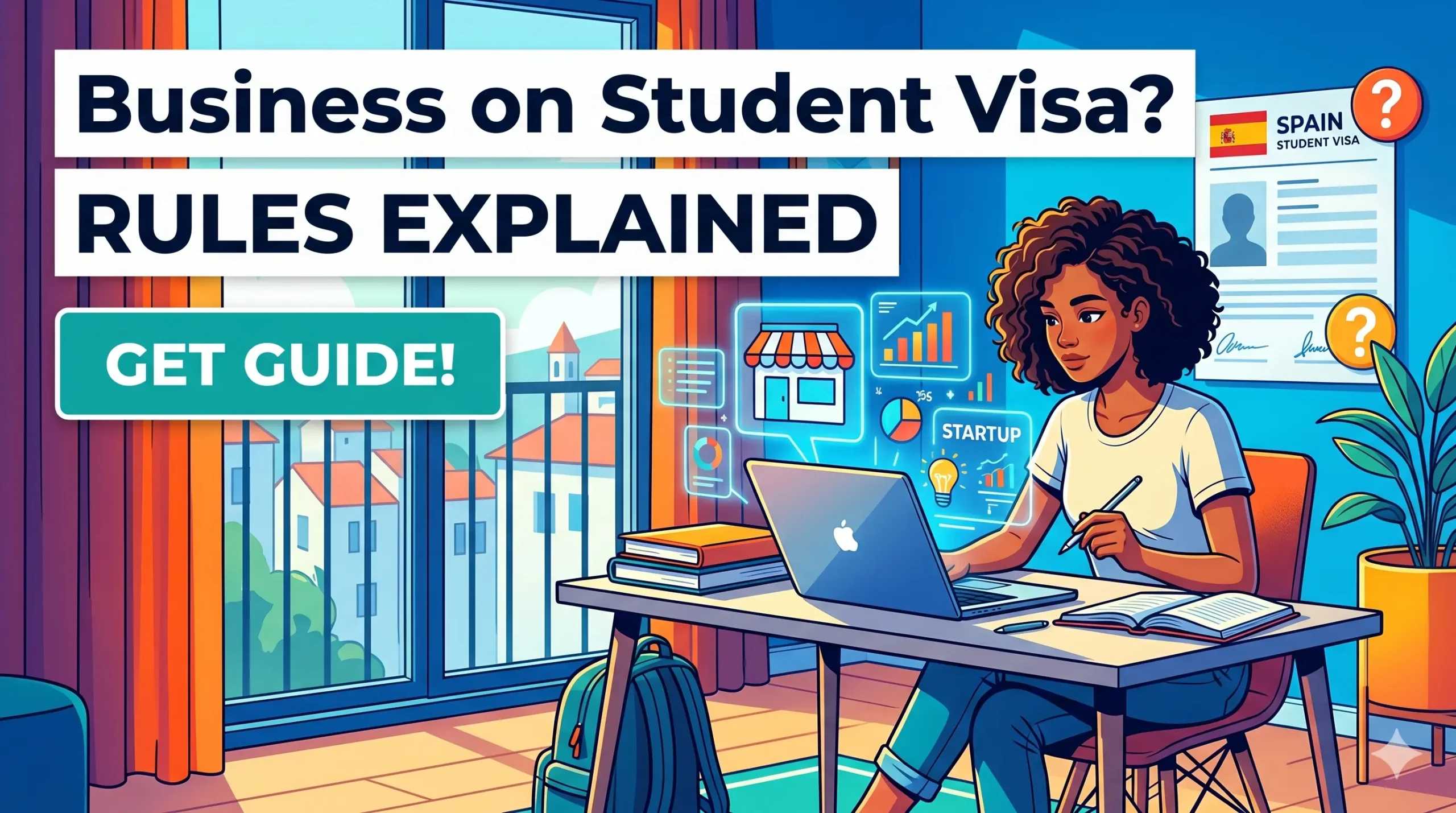
Can You Start a Business in Spain on a Student Visa? Rules Explained
Dreaming of launching a startup while studying in Barcelona sounds incredible until the immigration office threatens to revoke your visa for unauthorized freelancing. I once spent weeks frantically trying to untangle my legal status when a freelance gig almost cost me my residency. This guide explains exactly what business activities are legally permitted on a Spanish student visa.
Disclosure: This post may contain affiliate links. We may earn a commission at no extra cost to you if you make a purchase through these links. Read full disclosure.
The Reality of Working on a Spanish Student Visa
For years, the Spanish student visa explicitly forbade almost any kind of work, leaving thousands of expats struggling to survive. Thankfully, recent immigration reforms have significantly relaxed these rules, but the fine print still catches highly ambitious students off guard.
The 30-Hour Work Rule Limitations
Currently, if you hold a valid student visa for higher education (like a university degree or a master’s program), you are legally permitted to work up to 30 hours per week. However, this allowance comes with a massive caveat that destroys many entrepreneurial dreams.
The 30-hour allowance is almost exclusively designed for cuenta ajena—which means working as a salaried employee for a company that issues you a standard payroll contract. If your physical residency card says “no autorizado a trabajar” (not authorized to work), it does not mean you are banned from working; it simply means your employer must formally activate your permission with the immigration office. This administrative process is deeply explained in the Spain Student Visa Application guide.
The critical misunderstanding happens when students assume this new 30-hour rule gives them blanket permission to freelance, launch an online store, or start billing local clients from their laptop. It absolutely does not.
Salaried Employment Versus Self-Employment
In the eyes of the Spanish government, picking up weekend shifts at a local café is fundamentally different from launching a business. To start a business, invoice clients, or operate as an independent professional, you must legally register as an autónomo (a self-employed freelancer) or form a Limited Liability Company (SL).
Your standard student visa does not grant you the right to register with the Social Security system as a self-employed worker. If you simply set up a website and start taking money from Spanish clients without the proper administrative permission, you are operating entirely in the black market. If caught, you face severe financial fines, and your inevitable student visa renewal will be instantly denied. To legally become your own boss while studying, you must formally request special permission from the Oficina de Extranjería (Immigration Office).
How to Legally Register a Business as a Student
The Autonomo Authorization Trap
It is technically possible to start a business while remaining on an active student visa, but the bureaucratic mountain you must climb is incredibly steep. You must apply for an Autorización de trabajo por cuenta propia (Self-employment work authorization) that runs parallel to your student residency.
To get this approved, the immigration office demands overwhelming proof that your business is viable, fully funded, and that it will not interfere with your primary purpose in Spain: studying. You must submit a comprehensive, multi-year business plan detailing your projected revenue, your target market, and how your business will positively impact the Spanish economy. You must also prove you have the upfront capital to fund this venture, completely separate from the funds you already proved you had to secure your student visa initially. You can review the foundational steps of establishing your local financial footprint before attempting this in Getting an NIE for Employment or Study: Practical Overview.
Because your capital proof will likely originate from your home country, these dense financial documents cannot be submitted in English. You must use RushTranslate to accurately convert your foreign bank statements and investment portfolios into professional Spanish. Because RushTranslate provides highly accurate, certified translations, you can confidently present your financial backing to the immigration authorities without fear of a formatting rejection. Furthermore, if you need to submit letters from foreign investors, relying on RushTranslate ensures the civil servant perfectly understands your business structure, preventing a swift and devastating denial.
Modifying Your Student Visa to a Work Permit
If you are nearing the end of your studies, trying to run a business on an active student visa is often a waste of administrative effort. Instead, you should simply wait until you graduate and formally modify your student visa into a standard self-employment work permit (Modificación de estancia por estudios a residencia y trabajo por cuenta propia).
Historically, expats had to suffer through three full years on a student visa before they could legally apply for this modification. The recent immigration reforms thankfully abolished this brutal waiting period. The exact moment you successfully complete your academic program and hold your diploma, you can apply to modify your status. You will still need the comprehensive business plan and the capital proof, but you no longer have to convince the government that your business won’t distract you from your classes.
To execute this modification, your local financial infrastructure must be flawless. You cannot run a compliant Spanish business out of a foreign bank account. Setting up the correct local accounts to handle your future autónomo direct debits is a critical step covered in Opening a Bank Account in Spain: Step-by-Step for Foreigners.
Transitioning to the Entrepreneur Visa (Ley de Emprendedores)
Requirements for the UGE Startup Visa
If the business you want to start is not a standard freelance gig—like opening a local bakery or working as a solo graphic designer—but rather a highly scalable, innovative tech startup, you have a completely different, much faster pathway. You can apply for the Entrepreneur Visa under the Ley de Emprendedores.
This specific visa is processed by the Unidad de Grandes Empresas y Colectivos Estratégicos (UGE), bypassing the heavily backlogged standard immigration offices. To qualify, your project must be deemed highly “innovative” and of “special economic interest” to Spain. You must submit your business plan to ENISA (the national innovation agency) for a rigorous evaluation. They actively look for proprietary technology, massive job creation potential, and highly scalable business models.
If ENISA approves your project, the UGE will grant you a highly coveted three-year residency permit. The greatest advantage of the Entrepreneur Visa is that you can apply for it while you are legally in Spain on your student visa. If approved, it immediately overrides your student status, allowing you to drop your classes and focus 100% of your energy on your startup.
Preparing Your Financial and Civil Documents
The UGE operates incredibly fast, but they are ruthless regarding document formatting and background checks. When transitioning from a student visa to the Entrepreneur Visa, you must prove you have roughly €30,000 in liquid capital to support yourself, completely independent of your actual business operating funds. You must also submit a freshly issued criminal background check from your home country.
These highly sensitive foreign documents must carry a Hague Apostille and must be flawlessly translated. While certain federal background checks may require a premium MAEC-stamped linguist—a distinction heavily mapped out in How to Translate Documents for Spain: Sworn Translators (Traductor Jurado) Guide—you can safely rely on RushTranslate for your massive business plans, foreign tax returns, and general corporate evidence. Utilizing RushTranslate saves you from spending a fortune on premium sworn linguists for every single page of your 40-page startup pitch. By leaning on RushTranslate, you keep your UGE application packet perfectly organized and legally legible for ENISA’s strict review board.
| Visa / Authorization Route | Best Suited For | Can You Keep Studying? | Core Requirement |
| Cuenta Propia Authorization | Current students wanting a side business. | Yes (Must not interfere). | Business plan + Proof it won’t affect classes. |
| Modification to Cuenta Propia | Graduating students. | No (You transition to a worker). | Diploma + Complete business plan + Capital. |
| Entrepreneur Visa (UGE) | Tech founders and innovative startups. | Yes (If you choose to). | ENISA approval of an “innovative” project. |
Surviving Taxes and Mandatory Compliance
Navigating Spanish Freelance Taxes
The second you legally register your business, you trigger the wrath of Hacienda (the Spanish Tax Authority). Starting a business in Spain is absolutely nothing like setting up a casual LLC in the United States or the UK; the compliance burden is heavy, immediate, and extremely unforgiving.
As a registered autónomo, you must pay a monthly social security quota regardless of whether you actually make any profit or sign a single client that month. You must also file quarterly IVA (Value Added Tax) returns and IRPF (income tax) withholdings. If you miss a single quarterly deadline, the fines are automatic and aggressive. If you successfully secure your self-employment authorization, your very next move must be establishing a flawless tax framework, a chaotic reality thoroughly covered in Spanish Taxes for Foreign Residents: Practical Guide to Staying Compliant.
Keeping Your Medical Coverage Intact
Whether you are requesting permission to run a business on your active student visa, or modifying your status entirely to an Entrepreneur Visa, the government will ruthlessly audit your private medical coverage. Because you are not yet paying into the standard employee social security system at the start of your application, you must undeniably prove you will not become a financial burden on the public health system.
The immigration office explicitly requires your private health insurance policy to have zero co-payments (sin copagos) and no waiting periods (sin carencias). To completely bypass the terror of a sudden medical rejection, you should secure a localized policy natively through Innoinsure. Because Innoinsure explicitly designs its policies to satisfy strict Spanish immigration laws, their certificates clearly display the required “sin copagos” phrasing right on the front page.
By utilizing Innoinsure, the policy is issued natively in Spanish. This means the Extranjería and the UGE accept it immediately upon presentation without requiring an expensive translation of a massive foreign insurance booklet. Relying on Innoinsure guarantees your medical safety net is flawlessly compliant, completely neutralizing one of the most common reasons for visa denials.
Furthermore, when your business takes off and you need to formally renew your residency, Innoinsure makes generating compliant, instantly verifiable renewal certificates effortless. Keeping this coverage perfectly active is critical for surviving the strict administrative timelines detailed in Spain Residency Renewal Timing: Earliest and Latest Filing Windows and How to Renew Your Spanish Residency TIE Before It Expires.
References
Primary sources (official)
- Ministerio de Inclusión, Seguridad Social y Migraciones – Autorización de trabajo para titulares de estancia por estudios: https://www.inclusion.gob.es/web/migraciones/w/autorizacion-de-trabajo-para-titulares-de-estancia-por-estudios
- Unidad de Grandes Empresas y Colectivos Estratégicos (UGE) – Emprendedores: https://www.inclusion.gob.es/web/unidadgrandesempresas/emprendedores
Other helpful sources
- ENISA – Certificación de Empresas Emergentes: https://www.enisa.es/es/certificacion-de-empresas-emergentes
- Portal de la Administración General del Estado – Trámites de Extranjería: https://administracion.gob.es/pag_Home/atencionCiudadana/SedesElectronicas-y-Webs-Publicas/websPublicas/AGE-Ministerios/MISM.html
Disclaimer
The information provided in this guide is exclusively for educational and informational purposes and does not constitute official legal, tax, or immigration advising. The specific requirements for the Autorización de trabajo por cuenta propia, the evaluation criteria used by ENISA for the Entrepreneur Visa, and the continuous legislative changes to the 30-hour student work limit are highly dynamic and subject to strict regional variations. While we strive to ensure absolute accuracy regarding best practices, you should always consult a registered Spanish immigration lawyer (abogado de extranjería) and a local tax advisor (gestor) before invoicing clients or registering a business entity on Spanish soil.