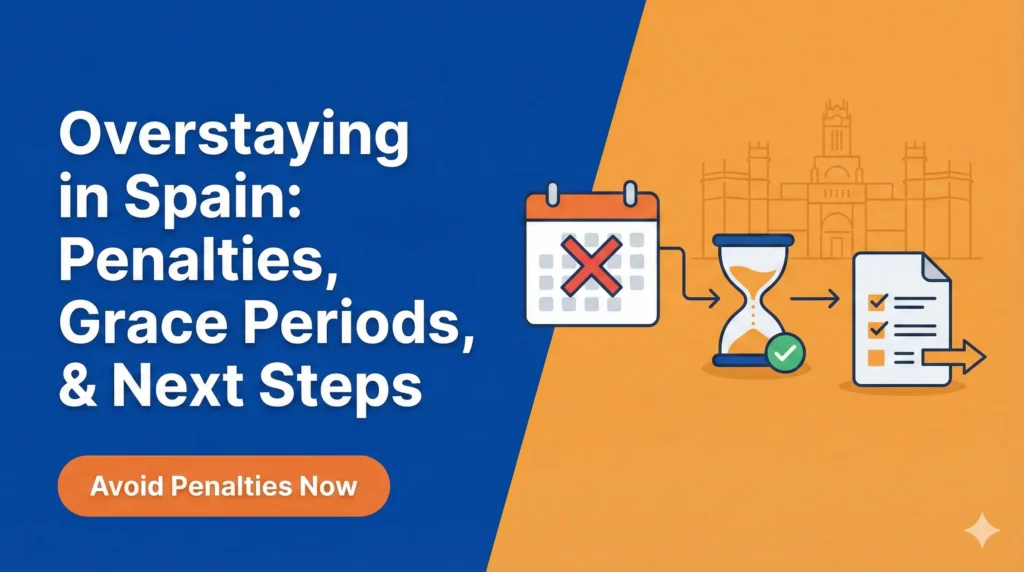
Overstaying in Spain: Penalties, Grace Periods, and Next Steps
Overstaying your 90-day limit in Spain can lead to fines ranging from €501 to €10,000, entry bans, and deportation orders. This guide explains the specific penalties in 2026, debunks the “grace period” myth, and outlines legal options like Arraigo for regularization if you find yourself in an irregular situation.
Disclosure: This post may contain affiliate links. We may earn a commission at no extra cost to you if you make a purchase through these links. Read full disclosure.
What Does Overstaying Actually Mean?
You are considered an “overstayer” (in an irregular situation) the moment you exceed 90 days within any rolling 180-day period in the Schengen Area, unless you hold a valid residence permit or long-stay visa.
It is crucial to understand that this limit applies to the entire Schengen Zone, not just Spain. If you spent 20 days in France and 71 days in Spain, you are at day 91 and are technically illegally present.
The Myth of the “Grace Period”
One of the most dangerous myths circulating in expat forums is the existence of a “15-day grace period.” This does not exist.
Spanish immigration law (Ley de Extranjería) does not grant tourists any extra days. You are either legal or you are not.
- Tourists: There is zero grace period. If you leave on day 91, you can be fined.
- Residents (TIE Holders): If you hold a valid residency card (TIE), you do have a grace period to renew it (60 days before expiration and 90 days after). Do not confuse this residency renewal window with tourist limits.
Force Majeure Exceptions
The only time “grace” is applied is in cases of Force Majeure—events completely beyond your control, such as:
- Sudden hospitalization preventing travel.
- Natural disasters canceling all flights.
- Death of a traveling companion.In these cases, you must apply for an Extension of Stay (Prórroga de Estancia) before your 90 days expire. “I couldn’t find a flight I liked” is not a valid reason.
Consequences and Penalties for Overstaying
Spanish law categorizes immigration offenses into three tiers: Light, Serious, and Very Serious. Overstaying is legally classified as a Serious Infraction (Infracción Grave).
In 2026, authorities typically choose between two punishments: a fine OR expulsion. They cannot impose both simultaneously for the same offense, but expulsion carries a secondary penalty: the Entry Ban.
Table: Penalties for Immigration Infractions
| Infraction Category | Typical Penalty (2026) | Consequence |
| Light (Leve) | Up to €500 | Usually for minor administrative errors (e.g., not reporting address change). |
| Serious (Grave) | €501 – €10,000 | The standard penalty for overstaying. Can also lead to an expulsion order. |
| Very Serious (Muy Grave) | €10,001 – €100,000 | For fraudulent marriages, fake documents, or smuggling. Always leads to expulsion. |
1. The Fine (Multa)
For a simple overstay without criminal activity, the most common outcome is a fine.
- Amount: Typically starts at €501 and scales up depending on the length of the overstay.
- Procedure: You may be notified of the fine proceedings at the airport upon exit. If you do not have a Spanish address, you may be required to pay immediately or face future debt collections that block re-entry.
2. Expulsion and Entry Bans
If your overstay is significant, or if you have other negative factors (like working illegally or a criminal record), the authorities may issue an Expulsion Order (Orden de Expulsión).
- The Ban: An expulsion order automatically triggers a Prohibition of Entry (Prohibición de Entrada) to the entire Schengen Area.
- Duration: Typically 3 to 5 years, but can be up to 10 years for severe cases.
- Consequence: You will be flagged in the Schengen Information System (SIS). You cannot enter any EU country until the ban expires.
Factors That Influence the Penalty
Not all overstays are treated equally. An immigration judge or police officer considers several factors:
- Intent: Did you leave voluntarily (e.g., heading to the airport on your own) or were you caught in a police checkpoint? Voluntary departure often leads to a fine rather than a ban.
- Duration: Overstaying by 3 days is usually treated as a minor administrative issue. Overstaying by 3 years indicates an intent to reside illegally.
- Family Ties: If you have minor children in Spain or a European spouse, expulsion becomes much harder for the state to justify legally.
What Happens at the Airport?
The moment of truth usually arrives at passport control when you try to leave Spain.
- The Scan: The border officer scans your passport. The EES system instantly flags the overstay.
- The Interaction:
- Minor Overstay (Days): You may receive a stern warning, or the officer might simply stamp you out, leaving a “black mark” in the system that could complicate future visa applications.
- Significant Overstay: You may be taken to a side room. The police will initiate “Sanctioning Proceedings” (Expediente Sancionador). You might be allowed to fly home that day, but the legal process for the fine or ban will continue in your absence.
- The Passport Stamp: Even if you aren’t fined, an “Overstay” stamp or digital flag can cause you to be denied entry on your next trip to Europe, or lead to the rejection of a future Spain Digital Nomad Visa or Non-Lucrative Visa application.
Can You Fix an Overstay Situation? (Regularization)
If you are currently in Spain in an irregular situation and do not want to leave (fearing a ban), there are limited legal pathways to “regularize” your status without returning home. These are known as Arraigo (Roots).
1. Arraigo Social (Social Roots)
This is the most common path for those who have lived in Spain illegally for a long time.
- Requirements:
- Prove continuous stay in Spain for 2 years (Note: Updated from 3 years in late 2025 reforms).
- Clean criminal record (in your home country and Spain).
- An employment contract OR sufficient financial means.
- A “Social Integration Report” from the Town Hall.
- Proof: You prove your time in Spain using your Empadronamiento (census registration).
2. Arraigo Laboral (Labor Roots)
If you have been in Spain for 2 years and can prove you worked (even illegally) for at least 6 months.
- This often involves reporting an employer who hired you illegally, which can be a complex legal battle.
3. Family Members of EU Citizens
If you enter a relationship with an EU citizen while overstaying:
- Marriage: Marrying a Spanish or EU citizen allows you to apply for the Family Member of EU Citizen residency.
- Pareja de Hecho: Registering a civil partnership also works, though some regions require you to be legally present to register the partnership initially.
Preventative Measures
If you are still within your 90 days but know you won’t be able to leave, take action immediately.
- Extension of Stay (Prórroga de Estancia): As mentioned, this is only for emergencies. You must go to the Oficina de Extranjería, show return tickets, medical proof, and financial means.
- Student Visa: You can apply for a Student Visa from within Spain, provided you still have at least 30 days left on your tourist status. This stops the clock and keeps you legal while the application processes.
- Nomad Visa: Similarly, you can apply for the Digital Nomad Visa from within Spain if you are still legal.
Conclusion
Overstaying in Spain is a high-risk gamble. The digitized borders mean you will almost certainly be caught. The consequences range from an expensive fine to a multi-year ban that locks you out of Europe entirely.
If you have already overstayed significantly, do not simply go to the airport hoping for the best. Consult with an immigration lawyer to see if you qualify for Arraigo or to negotiate your voluntary departure to minimize the risk of an entry ban.
If you are planning to live in Spain long-term, do it the right way. Explore options like the Non-Lucrative Visa or the Digital Nomad Visa to enjoy the Spanish lifestyle without the fear of a knock on the door.
References
Primary sources (official)
- Ministry of the Interior (Spain): Rights and liberties of foreigners in Spain (Ley de Extranjería).https://www.interior.gob.es/
- European Commission: Entry/Exit System (EES) and consequences for overstayers.https://home-affairs.ec.europa.eu/policies/schengen/smart-borders/entry-exit-system_en
- Boletín Oficial del Estado (BOE): Organic Law 4/2000 on rights and freedoms of foreigners in Spain.https://www.boe.es/buscar/act.php?id=BOE-A-2000-544
Other helpful sources
- SGM Legal Spain: Analysis of fines (up to €10,000) for residency breaches.https://sgmlegalspain.com/10000e-fines-for-residency-breaches/
- Delaguía y Luzón Abogados: Guide to expulsion orders vs. fines in 2026.https://delaguialuzon.com/en/blog/overstaying-visa-spain/
Disclaimer
The information provided in this article is for educational and informational purposes only and does not constitute legal advice. Immigration laws, fine amounts, and administrative procedures in Spain are subject to change. We strongly recommend consulting with a qualified immigration lawyer if you are currently in an irregular situation.