Air Quality and Allergies in Spain: Seasonal Tips for New Residents
Navigating Spain’s beautiful climate involves understanding its unique air quality challenges and seasonal allergy triggers. From major urban pollution to seasonal pollen spikes, this comprehensive guide offers essential tips, local resources, and healthcare strategies to help you breathe easily year-round.
Disclosure: This post may contain affiliate links. We may earn a commission at no extra cost to you if you make a purchase through these links. Read full disclosure.
Understanding Air Quality Across Spain
When expats envision relocating to Spain, they often picture clear blue skies and endless sunshine. While Spain certainly offers a phenomenal climate, it is also a geographically diverse nation with specific environmental challenges. Air quality can fluctuate dramatically depending on your exact location, the prevailing weather systems, and the time of year. Understanding the core drivers of Spanish air pollution is the first step toward protecting your respiratory health.
Urban Pollution in Major Spanish Cities
Like most major European hubs, Spain’s largest cities face significant challenges regarding urban air pollution. Madrid and Barcelona, the two most densely populated metropolitan areas, frequently struggle with elevated levels of nitrogen dioxide and fine particulate matter. The primary culprit in both cities is heavy vehicular traffic, compounded by the dense, narrow architecture of historic city centers which traps exhaust fumes at street level.
In Madrid, the geography severely exacerbates the issue during the winter months. The city sits on a high inland plateau, and during periods of cold, high-pressure weather, a phenomenon known as thermal inversion occurs. Cold air settles near the ground, trapping a visible layer of smog—locally referred to as la boina (the beret)—over the city for days at a time. This trapped pollution drastically reduces air quality and can trigger severe asthma attacks and respiratory distress for vulnerable residents.
Barcelona faces its own unique challenges due to its coastal location. While sea breezes can sometimes clear the air, the city’s massive commercial port is one of the busiest in the Mediterranean. Expats moving to these areas should factor these zones into their housing and transportation decisions. To better understand how the public health infrastructure supports residents dealing with urban pollution, reviewing the Spain Healthcare System for Expats: Public vs Private provides vital context.
The Calima Phenomenon in Southern Regions
One of the most unique and visually striking meteorological events in Spain is the Calima. This phenomenon occurs when powerful southern winds lift massive quantities of fine dust and sand from the Sahara Desert in North Africa and carry it across the sea to the Iberian Peninsula and the Canary Islands. While a Calima can technically reach as far north as Madrid or the Basque Country, it predominantly impacts Andalusia, Murcia, and the Canaries.
When a severe Calima strikes, the sky turns a hazy, apocalyptic shade of orange, and a fine layer of brown dust coats vehicles, balconies, and streets. From a health perspective, the Calima drastically spikes the levels of PM10 particulate matter in the air. These microscopic dust particles are small enough to be inhaled deep into the lungs, bypassing the body’s natural defense mechanisms. For individuals with asthma, chronic obstructive pulmonary disease, or severe allergies, a Calima can cause dangerous, rapid flare-ups.
Monitoring Air Quality Indexes and Health Alerts
To safely navigate outdoor activities, particularly if you have a preexisting respiratory condition, monitoring the local air quality index must become part of your daily routine. Spain operates a highly robust and transparent environmental monitoring network. The Ministry for the Ecological Transition manages the National Air Quality Index, which aggregates real-time data from hundreds of monitoring stations scattered across the country.
Expats can access this data easily through official government websites or via various regional smartphone applications. These digital tools provide a clear, color-coded map showing current pollution levels, ranging from good to extremely unfavorable. By checking these apps before planning a morning run or a weekend hike, you can make highly informed decisions about your daily exposure limits. If you are interested in other digital health tools available to residents, our guide on Health Apps in Spain: Booking, Records, and Telemedicine Options is an excellent resource.
The Spanish Allergy Calendar
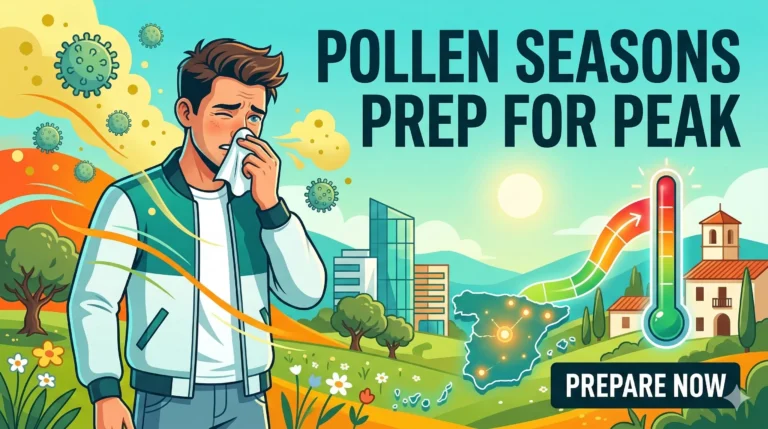
Spain’s rich botanical diversity means that allergy season is not confined to a single month. Depending on where you live, the air can be saturated with highly specific types of pollen at different times of the year. For new residents, learning the Spanish allergy calendar is essential for anticipating and mitigating symptoms before they become unmanageable.
Spring and Olive Tree Pollen Dominance
Spring is universally recognized as the most intense period for allergy sufferers in Spain, but the specific triggers vary wildly by region. In major inland cities like Madrid, Seville, and Zaragoza, the season kicks off as early as March with the blooming of the plane tree. These massive, leafy trees line the avenues of almost every Spanish city, and their pollen is highly aggressive, causing intense eye irritation and sneezing for a brief but brutal four-week window.
However, the true giant of the Spanish allergy landscape is the olive tree. Spain is the largest producer of olive oil in the world, and the southern region of Andalusia—particularly the provinces of Jaén, Córdoba, and Granada—is blanketed by millions of acres of olive groves. When these trees bloom between late April and early June, they release an astronomical amount of pollen into the air.
Summer Grasses and Coastal Wind Effects
As spring transitions into summer, the olive and plane tree pollen subsides, but a new trigger takes its place: grasses. Grass pollen is one of the most common allergens globally, and in Spain, it affects millions of people from May through July. This pollen is particularly prevalent in the vast, dry inland plateaus of Castilla y León and Castilla-La Mancha, as well as in the northern regions where rainfall keeps the pastures green late into the summer.
Coastal regions experience a unique dynamic during grass pollen season. The intense summer heat on the Spanish coast creates strong thermal winds. In places like the Costa del Sol or the Costa Blanca, specific regional winds—such as the easterly Levante or the westerly Poniente—can sweep vast clouds of inland grass pollen directly into highly populated coastal resort towns.
Autumn and Winter Triggers
While spring and summer are dominated by pollen, autumn and winter introduce entirely different respiratory challenges. In the northern regions of Spain—such as Galicia, Asturias, and the Basque Country—the climate is cool, wet, and highly humid. This constant dampness creates the perfect breeding ground for mold spores and dust mites. Expats relocating to “Green Spain” often find that their allergy symptoms peak in the autumn when fallen leaves begin to decay and indoor heating systems are turned on, stirring up settled dust and mold.
From January through March, when most expats assume allergy season is entirely dormant, Arizonica pollen counts can soar. This winter allergy often mimics a persistent, lingering cold, causing many new residents to mistakenly believe they are suffering from a winter virus rather than an environmental allergy. Recognizing this specific winter trigger is crucial for seeking the correct treatment rather than unnecessarily self-medicating for a cold.
| Season | Primary Allergen | Regions Most Affected | Peak Severity Months |
| Winter | Cypress / Arizonica trees | Madrid, Central Spain, Mediterranean coast | January – March |
| Spring | Plane trees | Major cities (Madrid, Barcelona, Seville) | March – April |
| Spring | Olive trees | Andalusia (Jaén, Córdoba, Granada) | April – June |
| Summer | Grasses | Nationwide, particularly inland plateaus | May – July |
| Autumn | Mold spores & Dust mites | Northern Spain (Galicia, Asturias, Basque Country) | October – December |
Managing Allergy Symptoms Locally
When pollen counts spike or a Calima rolls in, proactive symptom management is vital. Expats have access to excellent pharmaceutical networks, natural health resources, and clinical specialists in Spain to help mitigate the worst of their respiratory distress.
Over the Counter Relief at Spanish Pharmacies
The Spanish pharmacy, easily identifiable by its flashing green cross, is your first line of defense against seasonal allergies. Spanish pharmacists are highly trained medical professionals who can provide extensive diagnostic advice for minor ailments without requiring you to see a doctor. If you are suffering from mild to moderate allergy symptoms, you can simply walk in and request over-the-counter relief.
If you suffer an unexpected, severe allergy attack late at night or on a Sunday, you do not need to wait until Monday morning for relief. Every municipality in Spain operates a rotating on-duty pharmacy system to ensure 24/7 access to essential medications. To understand how to quickly locate these emergency dispensaries in your neighborhood, you should review our dedicated guide on How to Find a ‘Farmacia de Guardia’ Near You in Spain. If your symptoms escalate to an urgent level during the weekend, knowing What to Do If You Need Care on a Weekend in Spain is essential.
Natural Remedies and Indoor Air Quality
For expats who prefer to minimize their reliance on pharmaceutical antihistamines, managing your indoor environment is crucial. Because Spanish homes are traditionally built to retain cool air in the summer—often featuring heavy concrete walls and small windows—they can sometimes trap indoor allergens if not ventilated properly. Investing in a high-quality indoor air purifier equipped with a true HEPA filter is one of the most effective ways to remove pollen, Calima dust, and pet dander from your living space.
In addition to physical air filtration, many expats turn to natural supplements to manage systemic inflammation. Quercetin, stinging nettle root, and specialized probiotic strains are widely celebrated for their natural antihistamine properties. However, sourcing these highly specific, high-dose natural supplements in local Spanish herbalist shops can be incredibly expensive, and the selection is often quite limited.
To easily access premium natural remedies, the expat community heavily relies on global health retailers like iHerb. By ordering your seasonal allergy supplements through iHerb, you can source trusted, international wellness brands at competitive prices and have them shipped directly to your Spanish address. Maintaining a robust stock of these preventative supplements via iHerb ensures you are biologically prepared before the olive trees even begin to bloom in April.
When to See an Allergist in Spain
If over-the-counter medications and natural remedies fail to control your symptoms, or if your allergies begin to trigger asthma attacks, it is time to consult a specialist. In Spain, an allergist is a highly recognized and distinct medical specialty governed by the Spanish Society of Allergology and Clinical Immunology.
An allergist can perform precise skin prick tests or specific IgE blood tests to identify exactly which local pollens or molds are triggering your immune system. Once identified, they can prescribe highly targeted treatments, including customized immunotherapy (allergy shots or sublingual drops). Immunotherapy is particularly popular in Spain for long-term residents, as it slowly desensitizes the immune system to local triggers like olive pollen over a period of three to five years, offering a permanent cure rather than just symptom management.
Navigating Healthcare for Respiratory Issues
Accessing Public Clinics for Asthma and Allergies
If you are a registered resident paying into the Spanish social security system, you have the legal right to access the public healthcare network. To address your allergies through this route, you must first book an appointment with your assigned general practitioner at your local public clinic. If you have not yet navigated this bureaucratic hurdle, our step-by-step guide on What Is a ‘Centro de Salud’ in Spain and How Do You Register? will walk you through the exact registration process.
Your general practitioner acts as the strict gatekeeper to specialist care. They will initially attempt to treat your allergies using standard prescription medications. If your condition is severe, chronic, or unresponsive to basic treatment, they will issue an internal referral to a public allergist. However, this is where the public system’s primary flaw becomes apparent: the waiting lists.
Because severe allergies are generally not classified as life-threatening emergencies, the wait time to see a public allergist can easily stretch from three to six months, depending heavily on your autonomous community. For expats suffering from debilitating spring allergies, waiting four months for an appointment means the pollen season will likely be over before you even see the doctor. To better understand the reality of these structural delays, you can consult our detailed analysis on How Long Are Typical Waiting Times in Spain’s Public System?. Furthermore, if you require ongoing, complex management for allergic asthma, organizing your public care proactively is essential; see our insights on Chronic Conditions in Spain: Managing Ongoing Care as an Expat.
Using Private Insurance to Bypass Waiting Lists
To avoid the lengthy delays of the public sector, the vast majority of expats choose to carry comprehensive private health insurance. The private system completely revolutionizes how you access specialized allergy care in Spain. With a private policy, the primary care gatekeeper is entirely eliminated; you simply open your insurer’s medical directory, find a top-tier private allergist, and book a direct appointment, usually securing a consultation within a matter of days.
Furthermore, modern policies frequently include highly convenient digital health features. If you wake up with swollen, itchy eyes and need an immediate prescription for a stronger antihistamine, you can use your insurer’s app to instantly launch a video consultation with an English-speaking doctor. This entirely eliminates the need to sit in a physical waiting room while suffering from severe symptoms. We explore the massive benefits of these digital services thoroughly in our guide on Telemedicine in Spain: When It’s Useful and What to Expect.
Handling Medical Bills and Prescriptions
Navigating the financial logistics of allergy treatments requires understanding the Spanish prescription system. If you utilize the public healthcare system, your prescriptions will be loaded onto your digital health card. When you visit the pharmacy, the state heavily subsidizes the cost of your allergy medications based on your income bracket, meaning you only pay a small percentage out of pocket. We provide a comprehensive breakdown of these specific pharmacy tiers in our article on Health Costs in Spain: Typical Co-Pays and Out-of-Pocket Fees.
Conversely, if you visit a private allergist, they will hand you a private paper prescription. While Spanish pharmacies will readily accept this private script, the state will not subsidize the cost; you must pay the full retail market price for the inhalers or immunotherapy serums. Managing these recurring, out-of-pocket medical expenses efficiently is vital. Many expats use a multi-currency financial platform like Wise to handle these transactions. By tapping your Wise debit card at the pharmacy, you guarantee that you are paying the exact Euro amount at the true mid-market exchange rate, protecting your healthcare budget from the hidden international transaction fees charged by legacy banks.
Additionally, if your private insurance operates on a reimbursement model, you will need to pay the allergist’s consultation fee upfront and request a legally valid, itemized invoice to claim your money back. Understanding how to properly secure these documents and handle potential billing disputes is critical for expats. We detail this exact administrative process in our guide on How to Handle Medical Bills in Spain: Receipts, Claims, and Disputes. Finally, if your specialist prescribes a long-term, multi-year immunotherapy treatment plan, understanding how to continuously renew those prescriptions without paying for a new consultation every month is highly beneficial; read more about this in Medication Refills in Spain: How Renewals Work.
References
Primary sources official
- Sociedad Española de Alergología e Inmunología Clínica (SEAIC): https://www.seaic.org/
- Ministerio de Sanidad (Ministry of Health Spain): https://www.sanidad.gob.es/
- Ministerio para la Transición Ecológica y el Reto Demográfico – Índice Nacional de Calidad del Aire: https://ica.miteco.gob.es/
Other helpful sources
- Pólenes.com (Official pollen tracking site managed by SEAIC): https://www.polenes.com/
- European Environment Agency (EEA) – Spain Air Quality Data: https://www.eea.europa.eu/en/countries/spain
Disclaimer
The information provided in this article is for educational and informational purposes only and does not constitute formal medical or environmental advice. Air quality indexes, regional pollen counts, and healthcare protocols vary significantly across Spain and change continuously based on meteorological conditions. Always consult directly with a licensed medical professional or a registered Spanish allergist for personalized diagnostic testing and medical treatment tailored to your specific respiratory needs.