Traveling With Medication in Spain: Practical Carry‑On Tips
Disclosure: This article contains affiliate links. If you buy through them, we may earn a commission at no extra cost to you. Read our full disclosure.
Preparing to enter Spain with personal medication requires understanding both airport security protocols and national customs laws. This comprehensive guide explains carry-on packing strategies, legal documentation requirements, and how to safely navigate Spanish borders with your essential health treatments.
Spanish Customs and Medication Regulations
The Three-Month Supply Limit
Under Spanish law, travelers and expats are legally permitted to bring personal medications into the country. However, there is a strict legal limit: you may only bring a maximum of a three-month (90-day) supply. This rule is aggressively enforced by Spanish customs to prevent the illegal importation and distribution of pharmaceuticals. If you are a tourist visiting for a few weeks, this limit is more than sufficient. But if you are an expat relocating permanently, this poses an initial logistical challenge.
If you arrive at the border with a six-month or one-year supply of medications, customs agents possess the authority to confiscate the excess amount. For individuals managing lifelong health issues, having your medication confiscated in a foreign airport is a nightmare scenario. Therefore, the goal for any new resident should be to bring the maximum 90-day buffer and immediately begin transitioning into the local healthcare infrastructure.
To smoothly manage this transition, it is highly recommended to familiarize yourself with the Spain Healthcare System for Expats: Public vs Private before you arrive. By understanding how to register with a local doctor during your first 90 days, you can seamlessly secure local prescriptions before your imported supply runs out, ensuring zero interruptions to your treatment.
Prohibitions on Mailing Medications
A common, yet critical, mistake made by expats is attempting to circumvent the 90-day carry-on limit by having friends or family mail their medications from their home country. Spanish customs regulations explicitly prohibit the international shipment of medications to private individuals via postal services or private couriers.
If a package containing prescription drugs arrives at a Spanish border processing facility, it will be flagged, rejected, and either destroyed or returned to the sender. This rule applies even if the package includes a valid foreign prescription and a doctor’s note. The United States Embassy and other diplomatic missions routinely warn their citizens that they cannot intervene to retrieve medications seized by Spanish customs under these circumstances.
Therefore, your physical carry-on baggage is the only legal and reliable conduit for bringing your personal prescriptions into the country. If you find yourself in a bind where you have run out of medication and cannot receive a shipment, relying on an agile financial tool like Wise can be a lifesaver. It allows you to rapidly transfer funds with low conversion fees to pay for an emergency private doctor’s visit in Spain to secure a local, legal prescription.
Essential Medical Documentation
Traveling with medication requires a meticulous paper trail. You cannot simply throw loose pills into your luggage and expect to pass through border control unquestioned. Spanish authorities require verifiable proof that the medication belongs to you and is medically necessary for your personal use.
The foundational document you must carry is the original, signed prescription from your licensed healthcare provider. Additionally, you should carry a formal medical certificate or doctor’s letter. This letter should be on official clinic letterhead and include your full name (matching your passport), the exact diagnosis or medical condition being treated, the generic name of the medication, the daily dosage, and the prescribing doctor’s contact information.
While English is widely understood at major Spanish airports like Madrid-Barajas or Barcelona-El Prat, it is highly advantageous to have your medical documents translated into Spanish. This drastically speeds up the inspection process. Keeping your paperwork organized is a habit that will serve you well long-term, particularly when you need to integrate your foreign health history into the local system, a process detailed in our guide on Medical Records in Spain: Accessing and Sharing Your History.
Managing Controlled Substances and AEMPS
Identifying Narcotics and Psychotropics
Standard medications for blood pressure, cholesterol, or diabetes are relatively easy to travel with. However, if your treatment involves substances classified as narcotics or psychotropics, you are subject to an entirely different, far more rigorous set of international laws. In Spain, these regulations are overseen by the Agencia Española de Medicamentos y Productos Sanitarios (AEMPS).
Common medications that trigger these strict protocols include ADHD stimulants (like Adderall, Ritalin, or Concerta), strong opioid painkillers (such as oxycodone, morphine, or fentanyl), severe anxiety medications (like diazepam or Valium), and medical cannabis. It is crucial to understand that a drug’s legal status in your home country does not dictate its status in Spain. What might be easily prescribed back home could be heavily restricted or entirely illegal on the Iberian Peninsula.
If you are caught carrying these controlled substances without the explicit, pre-approved authorization from the Spanish government, you could face severe legal consequences, including drug trafficking charges, massive fines, and immediate deportation. Ignorance of the law is never accepted as an excuse at the border.
The Schengen Article 75 Certificate
If you are traveling to Spain from another country within the European Schengen Area, the bureaucratic process for bringing controlled substances is streamlined through the Article 75 Schengen Certificate. This standardized document allows residents of the Schengen zone to travel freely across internal borders with narcotic or psychotropic treatments for up to 30 days.
To obtain this certificate, you must apply through the competent health authority in your home country before you depart for Spain. The document must be signed by your prescribing doctor and officially authenticated by your national health department. It serves as universal proof across the Schengen zone that your possession of the controlled drug is strictly for legitimate medical purposes.
Keep in mind that the Schengen Certificate only covers a 30-day supply. If your stay in Spain exceeds this timeframe, you will need to consult a local Spanish physician to take over your prescription management. For expats dealing with these complex, ongoing pharmaceutical needs, our resource on Chronic Conditions in Spain: Managing Ongoing Care as an Expat provides actionable strategies for maintaining continuous care.
How to Apply for the AEMPS Travel Permit
For travelers arriving from outside the Schengen Area (such as the United States, Canada, the UK, or Australia) who require controlled medications, the Article 75 certificate does not apply. Instead, you must obtain a specific import permit directly from the Spanish health authorities (AEMPS) prior to your arrival.
The application process requires you to email the AEMPS Narcotics Department at least 10 to 15 days before your flight. You must attach a comprehensive PDF dossier that includes a completed application form, an updated medical certificate specifying the diagnosis and dosage, a copy of the original prescription, a scan of your passport, and copies of your flight itinerary. The permit, once granted, is valid for a maximum of a three-month supply.
Airport Security (Aena) and Liquid Rules
Exemptions for Liquid Medications
Airport security in Spain is managed by Aena. Like all European airports, Aena enforces strict regulations regarding liquids in carry-on luggage, generally limiting passengers to 100ml containers stored in a single, transparent, one-liter plastic bag. However, there is a critical, legally mandated exemption for liquid medications that are essential for your trip.
You are permitted to carry liquid medications—such as antibiotic syrups, specialized contact lens solutions, liquid painkillers, or vital dietary supplements—in containers larger than 100ml. To utilize this exemption, you must pack these medical liquids separately from your standard toiletries. When you reach the security checkpoint, you must declare them to the security officer and present them in a separate tray for screening.
The security officers may ask you to open the bottles for a specialized vapor scan or request your prescription to verify the authenticity of the liquids. This exemption also applies to essential baby foods, liquid formulas, and sterilized water for infants. If you are relocating with young children, managing these logistics is just the first step; further guidance can be found in our article on Pediatric Care in Spain: Choosing a Pediatrician.
Medical Devices and Sharp Objects
Traveling with medical hardware requires the same level of preparation as traveling with pharmaceuticals. Items that are normally strictly prohibited in the cabin—such as hypodermic needles, syringes for insulin, auto-injectors (EpiPens), or specialized surgical scissors—are permitted only if accompanied by proper medical justification.
If you are diabetic, your doctor’s letter must explicitly state that you require needles and insulin pens during the flight. At the Aena security checkpoint, you must declare these sharp objects immediately. Hiding them deep in your bag will only trigger a manual search and potentially aggressive questioning.
Passengers utilizing wearable medical technology, such as Continuous Glucose Monitors (CGMs), insulin pumps, or pacemakers, should be aware of security scanner protocols. Many manufacturers warn that advanced millimeter-wave body scanners or the magnetic fields of metal detectors can damage the delicate internal sensors of these devices. You have the right to request a manual pat-down inspection from Aena security staff instead of walking through the electronic scanners.
X-Ray Screening and Temperature Control
A common concern among travelers is whether the X-ray machines at airport security will degrade the chemical efficacy of their medications. For the vast majority of solid pills, capsules, and standard liquids, standard security X-rays pose absolutely no threat and will not alter the medication.
However, if you are traveling with highly sensitive, advanced biopharmaceuticals or specific compounded liquids, you should consult your pharmacist prior to travel. If the manufacturer specifies that the drug cannot be X-rayed, you must bring a doctor’s note explicitly stating this requirement and request a visual, hand inspection from the security officers.
Packing Strategies for Your Carry-On Bag
The Importance of Original Packaging
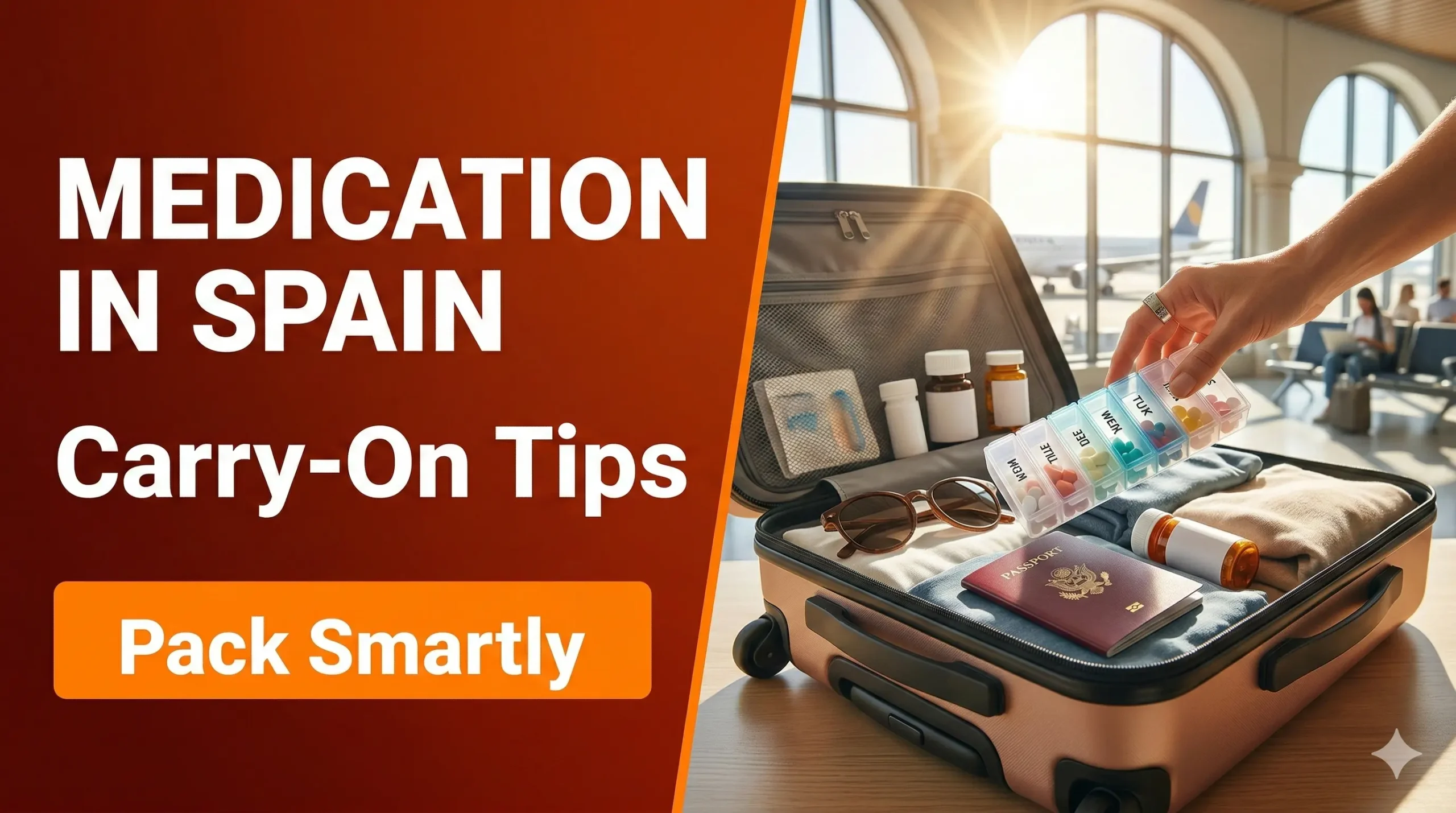
The golden rule of traveling with medication is to always pack it in your carry-on luggage and to always keep it in its original, pharmacy-issued packaging. Attempting to save space by combining different pills into a generic plastic bag or using a weekly Monday-to-Sunday pill organizer is a massive red flag for customs and security officials.
Unmarked pills cannot be easily identified by border agents. If they cannot verify what the substance is, they have the legal right to seize it for laboratory testing, which will leave you without your medication. The original packaging must display the professionally printed pharmacy label showing your full name, the prescribing doctor’s name, the generic chemical name of the drug, and the precise dosage instructions.
If your medication comes in a large, bulky box that takes up too much room in your carry-on, you can ask your home pharmacist to dispense your travel supply into a smaller, officially labeled bottle specifically for your flight.
Mitigating the Risk of Lost Luggage
You should never, under any circumstances, place essential prescription medications in your checked hold luggage. Checked bags are subjected to extreme temperature fluctuations in the cargo hold, which can destroy sensitive medications. Furthermore, checked bags are frequently delayed, misrouted, or lost entirely by airlines.
If you arrive in Spain but your checked suitcase containing your heart medication ends up in Germany, you will be facing an immediate medical crisis in a foreign country. By keeping all essential medications, along with your medical documentation, in your personal carry-on item (like a backpack or purse that fits under the seat in front of you), you maintain absolute control over your health.
For digital nomads and long-term travelers, the risk of lost baggage or stolen belongings is a constant reality. Securing comprehensive travel coverage from SafetyWing ensures that if your carry-on bag is stolen or lost in transit, you have access to a 24/7 medical assistance hotline that can help coordinate an emergency local doctor’s visit to replace your vital prescriptions immediately.
Navigating the “Cold Chain” for Biologics
Certain medications, most notably insulin, specific liquid antibiotics, and advanced immunosuppressant biologics, must be kept strictly refrigerated between 2°C and 8°C. Maintaining this “cold chain” during a long-haul international flight to Spain requires careful logistical planning.
You should invest in a high-quality, insulated medical travel cooler specifically designed for pharmaceuticals. These bags utilize specialized freezer gel packs to maintain the internal temperature. It is crucial to note that the gel packs themselves are subject to Aena’s liquid security rules. However, because they are being used to cool essential medication, they fall under the medical exemption.
Ensure your doctor’s letter explicitly mentions the need for the gel packs and the cooler bag. Once you board the aircraft, you can ask the flight attendants for extra ice to replenish your cooler if your journey is exceptionally long. Upon arriving at your accommodation in Spain, transfer the medication to a reliable refrigerator immediately.
Refilling Prescriptions as an Expat in Spain
Transitioning from Brand Names to Generics
Once you have successfully navigated Spanish customs and settled into your new life, your imported 90-day supply will eventually dwindle. Transitioning your prescription to the local Spanish system requires understanding how local doctors operate. Spanish healthcare professionals prioritize the generic, chemical name of a drug (the active ingredient) over commercial brand names.
A brand name you have used for years in the US or the UK may not exist in the Spanish pharmaceutical market, or it may be sold under a completely different commercial label. When you visit a local doctor for a refill, you must provide the exact milligram dosage and the active chemical ingredient. The doctor will use this data to prescribe the exact Spanish equivalent.
Understanding the financial dynamics of refilling these prescriptions locally is an essential part of your expat budget. The costs vary wildly depending on whether you use the public or private system. For a detailed breakdown of pharmacy pricing, copayments, and medication subsidies, read our comprehensive guide on Health Costs in Spain: Typical Co-Pays and Out-of-Pocket Fees.
Utilizing Telemedicine and Local Clinics
If you are a tourist or a newly arrived expat who has run out of medication and needs a standard, non-controlled prescription refill rapidly, you do not necessarily need to navigate the waiting rooms of a public hospital. Spain has a booming digital health sector that caters specifically to internationals.
You can easily book a virtual video consultation with an English-speaking doctor who can review your foreign medical history and issue a legally valid Spanish electronic prescription directly to your smartphone. You simply take this digital barcode to any local pharmacy to purchase your medication.
This route is fast, efficient, and bypasses language barriers. To learn exactly how to access these digital doctors and which platforms are the most reliable for expats, check out our dedicated article on Telemedicine in Spain: When It’s Useful and What to Expect.
Sourcing Non-Prescription Supplements Online
While Spanish pharmacies are highly regulated and excellent for securing life-saving pharmaceuticals, expats often experience “sticker shock” when trying to purchase non-prescription items. Over-the-counter daily vitamins, specialized vegan supplements, high-grade probiotics, and holistic wellness products are often classified as premium goods in Spain and are subjected to massive retail markups.
Furthermore, certain supplements that are sold freely in North American supermarkets—such as high-dose melatonin or specific adaptogens—are heavily regulated in the EU and may require a prescription or simply be unavailable in a local Spanish pharmacy.
To maintain their wellness routines without breaking the bank, the expat community in Spain relies heavily on international e-commerce platforms like iHerb. By ordering through these global retailers, you can legally source the exact international supplement brands you trust at a fraction of the local Spanish retail cost, having them delivered seamlessly directly to your new Spanish address.
Financial Management and Travel Insurance
Paying for Unexpected Healthcare Costs
Navigating healthcare across borders inherently involves financial friction. Whether you are paying out-of-pocket for an emergency private doctor to replace a lost prescription, covering the cost of a specialized medical translation, or paying for expensive non-subsidized private medications at a Spanish pharmacy, the costs are always billed in Euros.
Utilizing traditional foreign bank cards to cover these medical expenses subjects you to punishing dynamic currency conversion fees and hidden international transaction markups. Over the course of a few months, these banking fees can severely inflate your healthcare budget.
To protect your funds, savvy expats utilize modern financial platforms like Wise. By setting up a multi-currency account, you can instantly convert your home currency to Euros at the real, mid-market exchange rate. Using their debit card at a Spanish clinic or pharmacy ensures you are paying like a local, keeping your money focused on your health rather than enriching a bank.
Securing Comprehensive Health Coverage
Ultimately, the safest way to travel with and manage medication in a foreign country is to have an impenetrable health insurance policy backing you up. If your underlying condition flares up during your trip, or if a customs issue leaves you without vital medication, you need the financial power to access private Spanish healthcare immediately.
For those making a permanent move, navigating the requirements for residency visas usually mandates securing a robust private health policy. Working with specialized international brokers like Innoinsure ensures that you find a policy perfectly tailored to expats. These premium policies often include coverage for local specialist visits, ensuring you can smoothly transition your complex prescription needs to a top-tier Spanish doctor without facing devastating out-of-pocket consultation fees.
| Medication Category | Documentation Required for Spain | AEMPS Permit Required? | Carry-On Permitted? |
| Standard Prescriptions (e.g., Blood Pressure, Cholesterol) | Original Rx, Doctor’s Letter | No | Yes (Must be in original packaging) |
| Essential Liquids >100ml (e.g., Liquid Antibiotics) | Original Rx, Doctor’s Letter | No | Yes (Must declare at security scanner) |
| Controlled Substances (e.g., ADHD meds, Strong Opioids) | Original Rx, Doctor’s Letter, Travel Itinerary | Yes (or Schengen Art. 75) | Yes (Strictly with official permit) |
| Medical Devices/Sharps (e.g., Insulin Syringes, EpiPens) | Doctor’s Letter specifying the need for sharps | No | Yes (Must declare at security scanner) |
References
Primary sources (official)
- Agencia Española de Medicamentos y Productos Sanitarios (AEMPS) – Traveling with Controlled Substances: https://www.aemps.gob.es/medicamentos-de-uso-humano/estupefacientes-y-psicotropos/
- Aena (Spanish Airport Authority) – Passengers with medical needs and liquid regulations: https://www.aena.es/en/passengers/travellers/passengers-with-special-needs/persons-with-medical-needs.html
Other helpful sources
- U.S. Embassy in Spain – Medical Information for Travelers: https://travel.state.gov/en/international-travel/travel-advisories/spain.html
- Schengen Insurance Info – Essential Information for Traveling with Medication in the EU: https://schengeninsuranceinfo.com/travel-health-safety/travelling-with-medication-in-eu/
Disclaimer
The information provided in this article is for educational and informational purposes only and does not constitute legal or medical advice. Customs regulations, airport security protocols, and international medication laws are subject to change. Always consult with your healthcare provider and verify current requirements with the official Spanish embassy or the AEMPS before traveling with prescription medications.