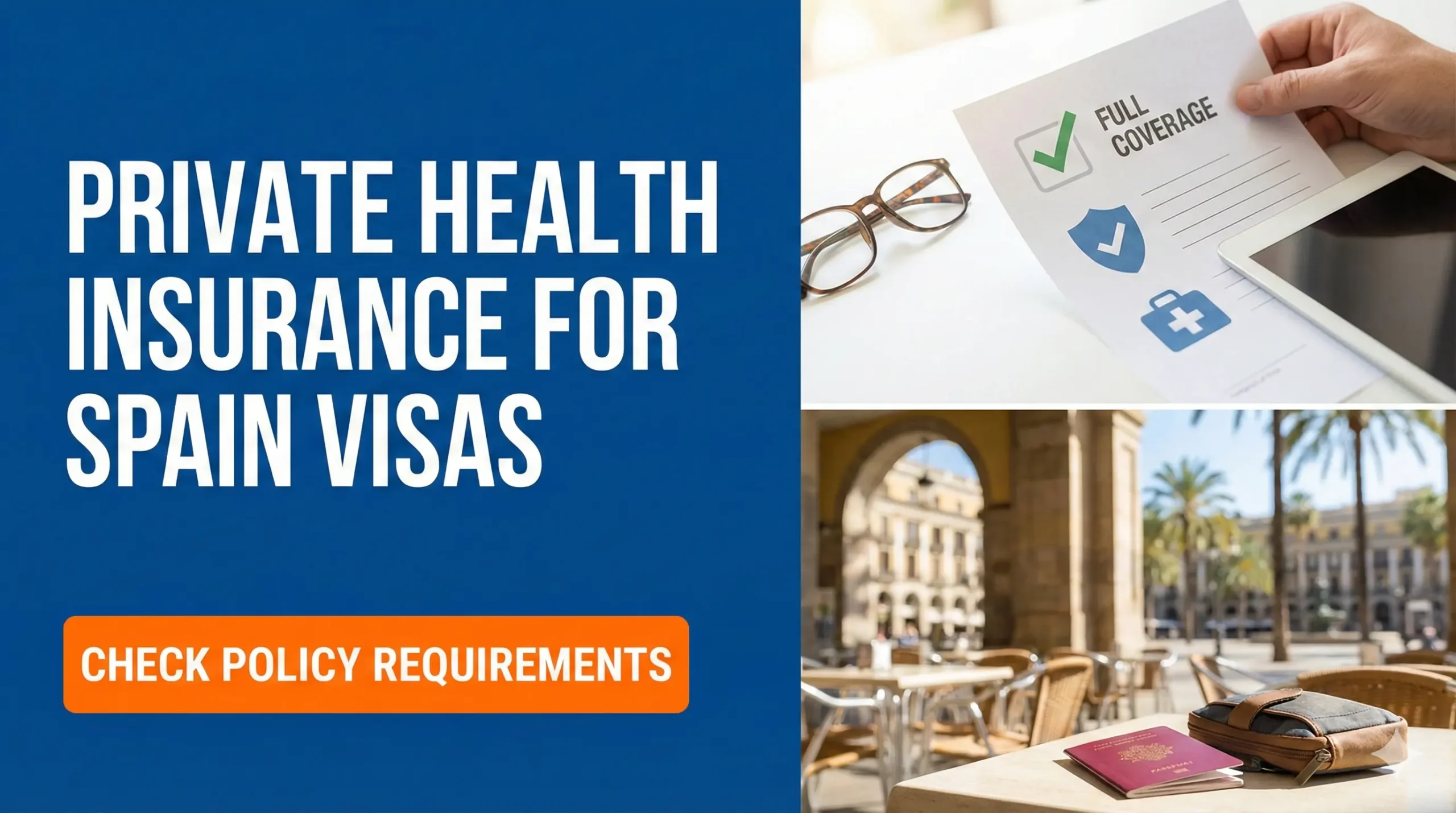
Private Health Insurance for Spain Visas: What Policies Must Include
Disclosure: This article contains affiliate links. If you buy through them, we may earn a commission at no extra cost to you. Read our full disclosure.
Moving to Spain requires strict adherence to immigration rules. This comprehensive guide details exactly what your private health insurance policy must include—such as zero copayments and no waiting periods—to guarantee your Spanish visa application is approved without delays.
The Logic Behind the Strict Requirements
To understand why the Spanish government is so pedantic about your insurance policy, you have to understand the Sistema Nacional de Salud. Spain boasts one of the most efficient, high-quality, and accessible public healthcare systems in the world. It is funded by the social security contributions of workers and residents.
When you apply for a visa that does not inherently grant you the right to work for a Spanish employer—such as a retirement visa or a study visa—you are not contributing to this social security pot. Therefore, the government must ensure that if you fall ill, break a leg, or require long-term hospitalization, the state will not be left footing the bill. Your private insurance policy acts as a total replacement for the public system. Because the public system covers almost everything without asking the patient for a credit card at the door, your private policy must do exactly the same.

Decoding the Mandatory Spanish Insurance Terminology
When shopping for an insurance policy, you will encounter specific Spanish terminology. Knowing these terms is not just helpful; it is mandatory, as the consular officer will be actively scanning your insurance certificate for these exact phrases.
Zero Copayments
In many countries, such as the United States, it is standard to pay a small fee out of pocket every time you visit the doctor, even if you have excellent insurance. This is known as a copay. In Spain, this concept is called a copago. For a visa application, your policy must absolutely state Sin Copagos (Without Copayments).
This means that whether you visit a general practitioner for a minor cold or spend three weeks in the intensive care unit following a major surgery, you will not be asked to pay a single euro out of pocket for the medical services rendered. If your policy has even a nominal five-euro copayment per visit, the consulate will reject it.
No Waiting Periods
Insurance companies inherently want to protect themselves from individuals who buy a policy simply because they already know they need an expensive surgery. To mitigate this risk, standard Spanish health insurance policies include carencias (waiting periods). For example, a standard policy might require you to hold the insurance for ten months before it covers childbirth, or six months before it covers a scheduled joint replacement.
For visa applicants, this is unacceptable. Your policy must be Sin Carencias (Without Waiting Periods). The Spanish government requires that you are fully covered from the exact moment you set foot on Spanish soil. Securing a policy without waiting periods often requires purchasing a specific “visa product” from the insurer, which typically costs slightly more than their standard domestic offering.
Unlimited Coverage
Many travel insurance policies cap their coverage at fifty thousand or one hundred thousand dollars. While this sounds like a lot of money, a prolonged hospital stay can easily exceed these limits. Your Spanish visa insurance policy must state Sin Límite de Cobertura (Without Coverage Limits). The policy must guarantee full coverage for primary care, specialized care, hospitalization, emergency room visits, and necessary surgical interventions without any financial ceiling.
Authorized to Operate in Spain
You cannot use a local insurance provider from your home country unless they have a direct, established network and legal authorization to operate within Spanish borders. The insurance company must be officially registered with the Dirección General de Seguros y Fondos de Pensiones. If you present a policy from an obscure foreign provider that requires you to pay out of pocket and request reimbursement later, the consulate will likely deny your application.
Understanding the Difference Between Medical Networks and Reimbursement
When selecting a compliant policy, you will generally have to choose between two types of operational models: a Cuadro Médico policy or a Reembolso policy. Understanding the difference is vital for your day-to-day life once you arrive in Spain.
A Cuadro Médico (Medical Directory) policy is the most common and widely accepted format for visa applications. With this policy, the insurance company provides you with a vast directory of specific hospitals, clinics, and doctors across Spain that are within their network. When you need medical attention, you present your insurance card at one of these approved facilities, and the bill is settled directly between the clinic and the insurer. You never see an invoice. Consulates prefer this model because it guarantees you will not face out-of-pocket expenses that you might not be able to afford.
A Reembolso (Reimbursement) policy allows you to visit absolutely any doctor or hospital in the world, even those outside the insurer’s official network. However, you must pay the medical bill upfront with your own money and then submit the invoices to the insurance company for a partial or full reimbursement. While some consulates occasionally accept high-end reimbursement policies, many reject them because the upfront financial burden rests on the applicant, violating the spirit of the “zero out-of-pocket” requirement. It is highly recommended to stick to a strict Cuadro Médico policy for your initial visa application to ensure smooth processing.
Nuances Based on Your Specific Visa Type
While the core rules of zero copayments and no waiting periods apply almost universally, different visa categories carry slight nuances in how the insurance requirements are interpreted and enforced by the consular staff.
The Non-Lucrative Route
This visa is designed for retirees and individuals with sufficient passive income to live in Spain without working locally. Because applicants for this visa are entirely financially self-sufficient and will not be entering the Spanish workforce, the insurance requirements are enforced with absolute strictness. There is zero leniency for copayments or coverage caps. You can learn more about the broader financial and administrative demands of this specific pathway in our detailed breakdown of the Spain Non-Lucrative Visa: Financial Proof, Insurance, and FAQS.
The Student Pathway
International students face a unique additional requirement. Not only must their insurance cover all standard medical care with no copayments, but the policy must explicitly include a clause for Repatriation. This means that in the tragic event of the student’s death, or if they suffer a severe medical emergency requiring them to be transported back to their home country, the insurance company will cover the logistical and transportation costs. Without the word “repatriation” clearly printed on the insurance certificate, a study visa will be swiftly denied. For a complete look at the academic and bureaucratic hurdles facing international students, review our guide on the Spain Student Visa: Application Steps and Common Mistakes.
The Remote Worker Option
The recently introduced visa for remote workers has brought a wave of new applicants to Spanish consulates worldwide. Because these applicants are technically working—albeit for foreign companies—the interpretation of the insurance rule can sometimes vary depending on the specific consulate and whether the applicant’s home country has a bilateral social security agreement with Spain. However, the safest and most universally successful approach remains purchasing a standard, fully compliant Spanish private health insurance policy for the first year. You can explore the timeline and specific documentation needed for this route in our overview of the Spain Digital Nomad Visa: Requirements, Documents, and Timeline.
Handling Pre-Existing Conditions
One of the most complex and anxiety-inducing aspects of securing visa-compliant health insurance is dealing with pre-existing medical conditions. Spanish insurance companies are private entities, and they underwrite their policies based on risk.
When you apply for a policy, you will be required to fill out a detailed medical questionnaire. It is imperative that you answer these questions truthfully. If you conceal a pre-existing condition—such as diabetes, a history of heart disease, or a previous cancer diagnosis—and the insurance company discovers this later, they will instantly cancel your policy for fraud, leaving you uninsured and in violation of your visa conditions.
If you declare a pre-existing condition, the insurance company’s medical underwriters will evaluate your case. They have four options:
- Accept you with standard terms.
- Accept you but apply a surcharge (a higher monthly premium) due to the increased risk.
- Accept you but place an “Exclusion Clause” on your policy, meaning they will cover everything except treatments related to your pre-existing condition.
- Deny you coverage entirely.
Exclusion clauses are highly problematic for visa applications. If your certificate shows that you have an exclusion for a major medical condition, the consulate may determine that your coverage is not “full and comprehensive,” leading to a visa rejection. If you are denied coverage by multiple major insurers due to complex health issues, you may need to consult with a specialized insurance broker who handles high-risk expat profiles.
The Importance of the Insurance Certificate
A common mistake applicants make is printing out the entire fifty-page legal terms and conditions booklet of their insurance policy and handing it to the consular officer. Consular staff do not have the time or the desire to read through a dense legal contract to verify if you have copayments.
What you actually need is a specific document called a Certificado para Extranjería (Certificate for Immigration). This is a single-page, official document issued by the insurance company. It is usually stamped and digitally signed by a representative of the insurer.
This magical piece of paper must explicitly state your full name, your passport number, the start date and end date of the policy, and contain the crucial phrases: “Sin Copagos,” “Sin Carencias,” and “Cobertura Completa.” When you purchase your policy, you must specifically tell the sales agent that you are buying this for a visa application and that you require the official immigration certificate.
Paying for the Policy Upfront
Unlike domestic residents who typically pay for their health insurance on a month-to-month basis via direct debit, visa applicants are generally required to prove they have secured coverage for the entire duration of their initial residency authorization.
This means you must pay for a full year of health insurance upfront in a single lump sum. When you submit your application to the consulate, you should include the official insurance certificate alongside the bank receipt proving that the annual premium has been paid in full. If your policy is set up on a monthly direct debit, the consulate may argue that you could simply cancel the direct debit the day after you arrive in Spain, leaving you uninsured. Paying the full year in advance eliminates this concern and demonstrates financial commitment.
Selecting the Right Insurance Provider
The Spanish private health insurance market is highly competitive, dominated by several massive, reputable corporations. Companies like Sanitas, Adeslas, DKV, Asisa, and Mapfre all offer specific “expat” or “visa-ready” packages that automatically strip out the waiting periods and copayments to ensure compliance.
When deciding between these providers, you should look beyond just the price tag. Consider the size of their medical network in the specific city or region where you plan to live. If you are moving to a small village in Andalusia, you need to ensure your chosen provider has affiliated clinics nearby. Additionally, some providers offer robust English-speaking customer service helplines and tele-medicine apps, which can be a massive comfort during your first few months in a new country. To help you evaluate the best options on the market, we have compiled a dedicated comparison in our article on Choosing a Private Health Insurer in Spain: What to Compare.
What Happens If Your Insurance Is Rejected?
Even with meticulous preparation, bureaucratic misunderstandings occur. If the consular officer reviewing your file determines that your insurance policy does not meet the strict criteria, they will usually not reject your visa outright immediately.
Instead, they will issue a formal Requerimiento (Requirement). This is an official notice giving you a strict deadline—typically ten working days—to rectify the error and submit a compliant policy. If you receive a requerimiento, you must act immediately. Contact your insurance provider, explain the consulate’s objection, and ask them to amend the certificate or upgrade the policy to meet the demands.
If you fail to meet the deadline, or if the consulate outright denies your visa based on the insurance evaluation, you have the right to challenge the decision. The legal process for contesting a consular denial is complex but entirely possible. You can learn about the specific timelines and procedures involved by reading our guide on Spain Visa Appeals: How Reconsideration and Administrative Appeals Work.
Transitioning to Public Healthcare in the Future
The requirement to hold expensive, private health insurance without copayments is a hurdle you must clear to get your foot in the door. However, it is not necessarily a lifelong financial burden.
Once you are legally residing in Spain, your situation may change. If you transition from a Non-Lucrative Visa to a work permit and secure employment with a Spanish company, you will immediately begin paying into the social security system. At that point, you gain full access to the public healthcare network, and you can choose to cancel your private insurance or downgrade it to a cheaper policy with copayments simply for convenience.
Furthermore, if you reside in Spain legally for a continuous year but do not secure employment, you may be eligible to buy into the public healthcare system through a mechanism called the Convenio Especial. This allows you to pay a flat, affordable monthly fee directly to the regional government in exchange for full public healthcare access, often eliminating the need for strict private policies for your visa renewals. To understand the various pathways into the state system, review our comprehensive breakdown of Who Can Access Public Healthcare in Spain? Eligibility Basics.
Conclusion
Securing the correct private health insurance is arguably the most critical logistical step in your Spanish visa journey. The rules are rigid, and the consulates are unforgiving of administrative errors. By ensuring your chosen policy clearly states that it operates without copayments, without waiting periods, and with unlimited coverage, you protect your application from unnecessary delays.
Do not view this requirement merely as a bureaucratic hoop to jump through. Having robust, comprehensive medical coverage provides immense peace of mind as you navigate the challenges of relocating to a foreign country. By investing in the right policy upfront, you guarantee that your transition to the Spanish lifestyle is safe, secure, and medically protected from day one.
References
Primary sources (official)
- Ministerio de Asuntos Exteriores, Unión Europea y Cooperación (Visas and Consular Services): https://www.exteriores.gob.es/
- Dirección General de Seguros y Fondos de Pensiones (DGSFP): https://www.dgsfp.mineco.gob.es/
Other helpful sources
- Sanitas (Expat Health Insurance Information): https://www.sanitas.es/
- Adeslas (Health Insurance Coverage Details): https://www.segurcaixaadeslas.es/
Disclaimer
The information provided in this article is for general informational and educational purposes only and does not constitute formal legal, financial, or medical advice. Visa requirements and insurance regulations are subject to frequent changes by the Spanish government and individual consular offices. Always verify the most current requirements directly with the specific Spanish consulate handling your application and consult with a licensed insurance broker before purchasing a policy.