Health Insurance in Spain: Options for Residents, Students, and Families
Disclosure: This article contains affiliate links. If you buy through them, we may earn a commission at no extra cost to you. Read our full disclosure.
Relocating to Spain requires navigating its dual healthcare system. This comprehensive guide explores public and private health insurance options, costs, and specific requirements for residents, families, and international students, helping you secure the right medical coverage for your new life.
Understanding the Public Healthcare System
The backbone of medical care in Spain is the public healthcare system, officially known as the Sistema Nacional de Salud (SNS). This is a universal healthcare model that is funded primarily through general taxation and social security contributions from the working population.
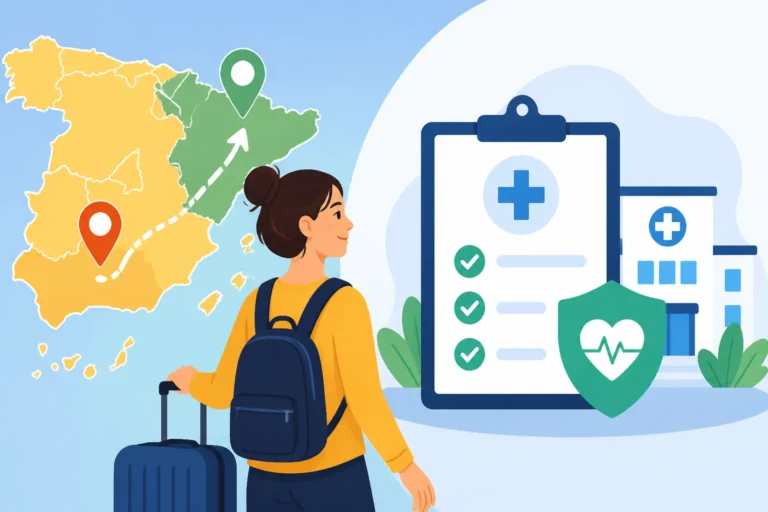
One of the most important concepts to grasp about the SNS is its decentralized nature. While the national Ministry of Health sets the overall budget, guidelines, and policies, the actual administration and delivery of healthcare are managed independently by Spain’s 17 autonomous communities. This means that the exact procedures for booking appointments, the digital patient portals you will use, and even the waiting times can vary significantly depending on whether you live in Andalusia, Catalonia, Madrid, or Valencia.
Eligibility for Public Healthcare
A very common misconception among new expats is that simply residing in Spain automatically grants you access to free medical care. This is not the case. To qualify for free public healthcare, you generally must fall into one of the following specific categories:
- Employed and Self-Employed Residents: If you are legally working in Spain—either for a company or as an autónomo (freelancer)—and paying into the social security system, you are fully covered by the SNS. To fully understand how these deductions are calculated from your salary, you should review our guide on Working in Spain: Payslips, Social Security, and Benefits Explained.
- Family Members and Dependents: The spouses and dependent children (usually under the age of 26) of a socially insured worker are also entitled to free coverage under that worker’s umbrella.
- State Pensioners: Retirees who receive a state pension from Spain are covered. Additionally, state pensioners from other EU countries and the UK can often access the system by registering an S1 form, which allows their home country to reimburse Spain for the cost of their care.
- Minors and Pregnant Women: Regardless of legal immigration status, all pregnant women and children under the age of 18 have a right to access public healthcare in Spain.
- Emergency Situations: Undocumented immigrants and tourists without coverage have the right to receive treatment in an emergency room until they are stabilized.
Pros and Cons of the Public System
The public system is heavily utilized, with the vast majority of the population relying on it for their primary medical needs.
The Advantages:
- Free at the Point of Use: There are no co-payments for general doctor visits, emergency room treatments, or standard hospital stays. You will not receive an unexpected bill after an operation.
- Comprehensive Coverage: The SNS covers almost everything, from routine preventative care and pediatrics to complex oncology, mental health services, and organ transplants.
- No Pre-Existing Condition Exclusions: Unlike the private sector, the public system does not deny you care, enforce waiting periods, or charge you higher premiums based on your medical history.
The Disadvantages:
- Waiting Lists: This is universally recognized as the most significant drawback. While emergencies are handled with incredible speed and professionalism, waiting times for non-urgent appointments with specialists (like dermatologists, gynecologists, or orthopedic surgeons) and elective surgeries can stretch into many months.
- Lack of Choice: You are assigned a primary care physician (médico de cabecera) at your local health center (Centro de Salud) based on your home address. You cannot easily shop around for a different specialist; you must follow the strict referral chain dictated by your assigned doctor.
- Language Barriers: While many doctors in major metropolitan areas may speak some English, it is absolutely not guaranteed. In the public system, you are expected to communicate in Spanish (or the co-official regional language, such as Catalan or Basque), which can add significant stress during a medical event.
How to Register for Public Healthcare
If you meet the eligibility requirements for the public system, you must actively register for it; your coverage does not activate automatically upon arrival. The bureaucratic process involves several sequential steps:
- Obtain your NIE: Your Foreigner Identity Number (Número de Identidad de Extranjero) is the absolute prerequisite for any official paperwork in Spain.
- Register your Address: You must register your residential address at your local town hall (Ayuntamiento) to obtain a certificate proving where you live. For a step-by-step walkthrough of this crucial foundational task, see Empadronamiento in Spain: How to Register Your Address.
- Register with Social Security: If you are employed, your employer typically handles your registration with the Tesorería General de la Seguridad Social (TGSS). If you are self-employed, you or your accountant will do this. You will receive a document proving your right to healthcare.
- Visit the Centro de Salud: Take your passport, your NIE, your padrón certificate, and your social security confirmation to your assigned local primary care center.
- Get your Health Card: The administration desk will register you in the regional health database, assign you a primary care doctor, and issue your Tarjeta Sanitaria Individual (TSI). This is the physical plastic card you must present at every appointment and pharmacy visit.
The Convenio Especial: The Pay-In Public Scheme
What happens if you are an expatriate who is not working, not yet of pensionable age, and cannot afford the high costs of private insurance due to severe pre-existing medical conditions?
Spain offers a vital safety net known as the Convenio Especial. This is a voluntary public health insurance scheme that allows you to buy into the SNS by paying a flat monthly premium.
- Eligibility: To qualify, you must prove that you have lived continuously in Spain (by being registered on the padrón) for at least one full year before applying.
- The Costs: The fees are standardized across the country. In 2026, it costs €60 per month for individuals under the age of 65, and €157 per month for those aged 65 and older.
- Coverage Limitations: While it grants you access to the same doctors, hospitals, and emergency care as any local resident, the Convenio Especial does not include state subsidies for prescription medications. You will have to pay the full retail price at the pharmacy.
For older expats or those with chronic conditions that make private insurance prohibitively expensive or impossible to secure, the Convenio Especial is a massive relief.
Private Health Insurance in Spain
Due to the inherent drawbacks of the public system, particularly the waiting lists, more than 20% of the Spanish population and a vast majority of expatriates opt to purchase private health insurance (seguro de salud privado) to supplement their care.
The private healthcare sector in Spain is robust, featuring state-of-the-art hospitals, modern boutique clinics, and a vast network of highly trained medical professionals.
Why Expats Choose Private Health Insurance
- Speed of Access: The primary draw of private insurance is the ability to bypass public waiting lists. If you need an MRI, a specialized blood test, or a consultation with a specialist, you can often book it within days rather than waiting half a year.
- Direct Specialist Access: In the private system, you do not need a referral from a general practitioner. If you have a persistent rash, you can open your insurance app and book an appointment directly with a dermatologist in your network.
- English-Speaking Medical Staff: Private hospitals and clinics—especially in expat-heavy areas like Madrid, Barcelona, Alicante, and the Costa del Sol—actively cater to international patients. You are far more likely to find receptionists, nurses, and doctors who speak fluent English.
- Comfort and Privacy: Private hospitals typically guarantee a private room with an en-suite bathroom and a bed for a companion if you are admitted, providing a much more comfortable recovery environment than the shared wards often found in public hospitals.
Typical Costs of Private Health Insurance
Compared to countries like the United States, private health insurance in Spain is remarkably affordable. The cost depends heavily on your age, the level of coverage, your geographical location, and whether you opt for a plan with or without co-payments (copagos).
Here is a breakdown of what you might expect to pay.
| Demographic Profile | Coverage Type | Estimated Monthly Cost (2026) |
| Young Adult / Student (Age 20-30) | Comprehensive (No Copay) | €35 – €60 |
| Middle-Aged Adult (Age 40-50) | Comprehensive (No Copay) | €60 – €100 |
| Senior / Retiree (Age 65+) | Comprehensive (No Copay) | €150 – €300+ |
| Family of Four (Parents + 2 Kids) | Comprehensive (No Copay) | €180 – €280 |
Note: Premiums rise significantly as you age. Many private insurance companies also have strict age cut-offs, refusing to issue new policies to individuals over the age of 70 or 75.
Visa Requirements for Private Insurance
If you are applying for a visa to move to Spain—particularly the Non-Lucrative Visa (NLV), the Golden Visa, the Digital Nomad Visa, or a Student Visa—you cannot rely on the promise of the public system. The Spanish Consulates require definitive proof that you will not become a financial burden on the state.
Therefore, you are legally required to purchase a specific type of private health insurance before your visa application will even be considered. Immigration authorities are incredibly strict about the policy terms. Your private health insurance must meet the following non-negotiable criteria:
- Fully Comprehensive: It must cover primary care, specialists, hospitalization, and emergencies.
- No Copayments (Sin Copagos): This is the number one reason insurance policies are rejected by consulates. Your policy must cover 100% of the medical costs. You cannot have a plan that requires you to pay a €10 fee every time you visit a doctor.
- No Waiting Periods (Sin Carencias): The coverage must be fully active from day one. You cannot submit a policy that forces you to wait six months before you can claim a surgery or diagnostic test.
- Repatriation Included: The policy must cover the costs of returning you (or your remains) to your home country in the event of a severe medical emergency or death.
- Authorized Insurer: The insurance company must be officially authorized to operate in Spain.
When shopping for these policies, you must explicitly tell the insurance broker that the plan is for a residency visa application. To ensure you don’t waste money purchasing a policy that will be rejected by the consulate, read our specific, detailed guidelines in Private Health Insurance for Spain Visas: What Policies Must Include.
Health Insurance for International Students
Spain is a premier destination for international students, but navigating the health requirements is a crucial part of the enrollment process.
For Non-EU Students:
Under Spanish regulations, having comprehensive private health insurance is a strict legal requirement for obtaining a student visa. The policy must meet all the strict criteria mentioned above (no copayments, no waiting periods, full coverage). Additionally, many consulates require students to pay for the entire year’s premium upfront to prove they are covered for the whole academic year. While the monthly cost breaks down to a very affordable €35 to €60, you should be prepared to pay €450 to €700 in a single lump sum before your visa appointment.
To ensure you don’t miss any critical deadlines or paperwork regarding your studies, be sure to review our comprehensive guide on Spain Student Visa: Application Steps and Common Mistakes.
For EU/EEA Students:
Students from within the European Union do not need a visa, and they can use their European Health Insurance Card (EHIC) to access the Spanish public healthcare system for necessary and emergency treatments during their temporary stay. However, the EHIC is not a substitute for comprehensive insurance. It does not cover private healthcare, dental care, or repatriation. Because of this, many EU students still choose to purchase an affordable private student policy for peace of mind and faster access to care.
Healthcare Options for Families in Spain
For expats moving with children, the quality of family and pediatric care is paramount. Fortunately, Spain excels in this area.
In the public system, children under the age of 18 are automatically eligible for full healthcare coverage. Pediatricians in the SNS are highly trained, and the childhood vaccination schedule is strictly adhered to and provided free of charge. Furthermore, maternal care is exceptionally well-regarded. If you are starting a family, you will find that public hospitals offer excellent maternity wards, midwife support, and post-natal care. You can learn more about the administrative steps for new parents in our article covering Having a Baby in Spain as a Foreigner: Paperwork and Residency Impacts.
However, many families still opt for private insurance. The primary reason is pediatric choice. In the private system, parents can choose their preferred pediatrician and schedule appointments at their convenience, avoiding the crowded waiting rooms of public clinics. Comprehensive family plans are quite affordable and often include valuable extras like regular dental check-ups for children and teenagers.
Pharmacies, Prescriptions, and Dental Care
Understanding how secondary medical services work in Spain is just as important as knowing how to see a doctor.
The Pharmacy System
The way you obtain medication in Spain is strictly regulated. You cannot buy medications like ibuprofen, paracetamol, or allergy pills off the shelf in a supermarket. By law, all medical products must be purchased at a licensed pharmacy (Farmacia), which are easily identifiable by their glowing green cross signs. Pharmacists in Spain are highly trained medical professionals who can offer medical advice for minor ailments, often saving you an unnecessary trip to the doctor.
To navigate the differences between what requires a doctor’s note and what you can buy directly, consult our guide on Pharmacies in Spain: Prescriptions, Over-the-Counter Meds, and Practical Tips.
Prescription Copayments
While seeing a public doctor is free, the medications they prescribe are not entirely free. Spain operates on a co-payment system for prescriptions issued through the SNS.
- Working-Age Adults: Depending on your annual income bracket, you will pay between 40% and 60% of the retail cost of the medication.
- Pensioners: Retirees pay a significantly reduced rate, usually around 10% of the cost, which is often capped at a very low monthly maximum to protect those on fixed incomes.
- Private Prescriptions: If you see a private doctor, their prescriptions are not subsidized by the state. You will pay 100% of the retail price at the pharmacy (though many medications are still surprisingly inexpensive in Spain compared to North America).
Dental and Optical Care
It is vital to note that routine dental care (such as cleanings, fillings, and extractions) and optical care (eye exams for glasses or contacts) are not covered by the public healthcare system for adults.
The SNS only covers severe emergency dental trauma and provides free routine preventative dental checks for children. For everything else, you must visit a private dentist and pay out of pocket. Because of this gap in the public system, ensuring your private health insurance policy includes a robust dental add-on is highly recommended.
Conclusion: Making the Right Choice
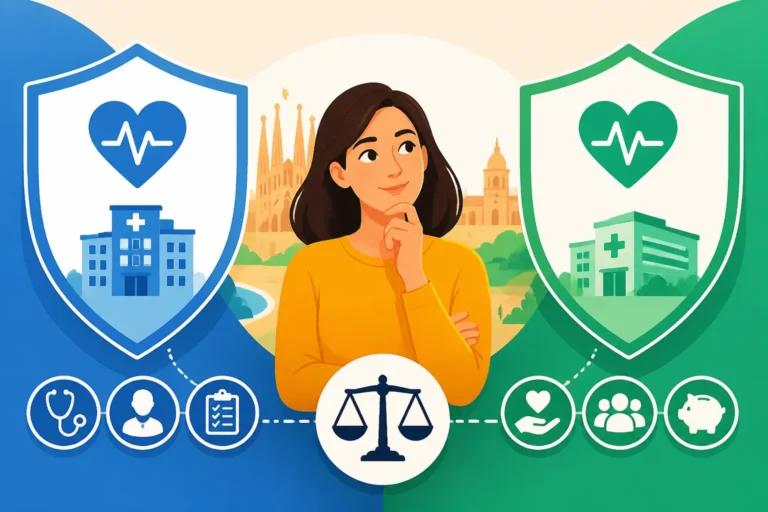
Choosing between public and private healthcare in Spain is rarely a binary, all-or-nothing decision. For many expats, the best and most practical approach is a hybrid one.
If you are legally working in Spain, you have the immense privilege of accessing a world-class public system that will catch you if you fall seriously ill. However, picking up a basic private policy for €50 a month allows you to skip the queue for a quick physiotherapy session or a specialist consultation. If you are a retiree or a visa applicant, private insurance isn’t just a luxury; it is your gateway to residency.
Spain’s healthcare infrastructure is a massive asset to your quality of life. By understanding the bureaucratic hurdles of the public sector and the contractual nuances of the private sector, you can ensure that you and your family remain happy, healthy, and protected throughout your Spanish adventure.
References
Primary sources (official)
- Ministry of Health (Ministerio de Sanidad): https://www.sanidad.gob.es/
- Spanish Social Security (Seguridad Social – Registration): https://www.seg-social.es/
- European Commission (EHIC Information for Spain): https://employment-social-affairs.ec.europa.eu/policies-and-activities/moving-working-europe/eu-social-security-coordination/european-health-insurance-card/how-use-card/spain-european-health-insurance-card_en
Other helpful sources
- World Health Organization (European Health Observatory – Spain): https://eurohealthobservatory.who.int/publications/i/spain-health-system-review-2024
- Schengen Visa Info (Spain Insurance Guide): https://schengeninsuranceinfo.com/health-insurance/spain/
Disclaimer
The information provided in this article is for general informational purposes only and does not constitute medical, financial, or legal advice. Healthcare regulations, insurance requirements for immigration visas, and monthly costs (such as the Convenio Especial premiums) are subject to change by the Spanish government and regional health authorities. We strongly recommend consulting directly with the Spanish Social Security office or a licensed, professional insurance broker to determine the best healthcare coverage and legal compliance for your specific circumstances.