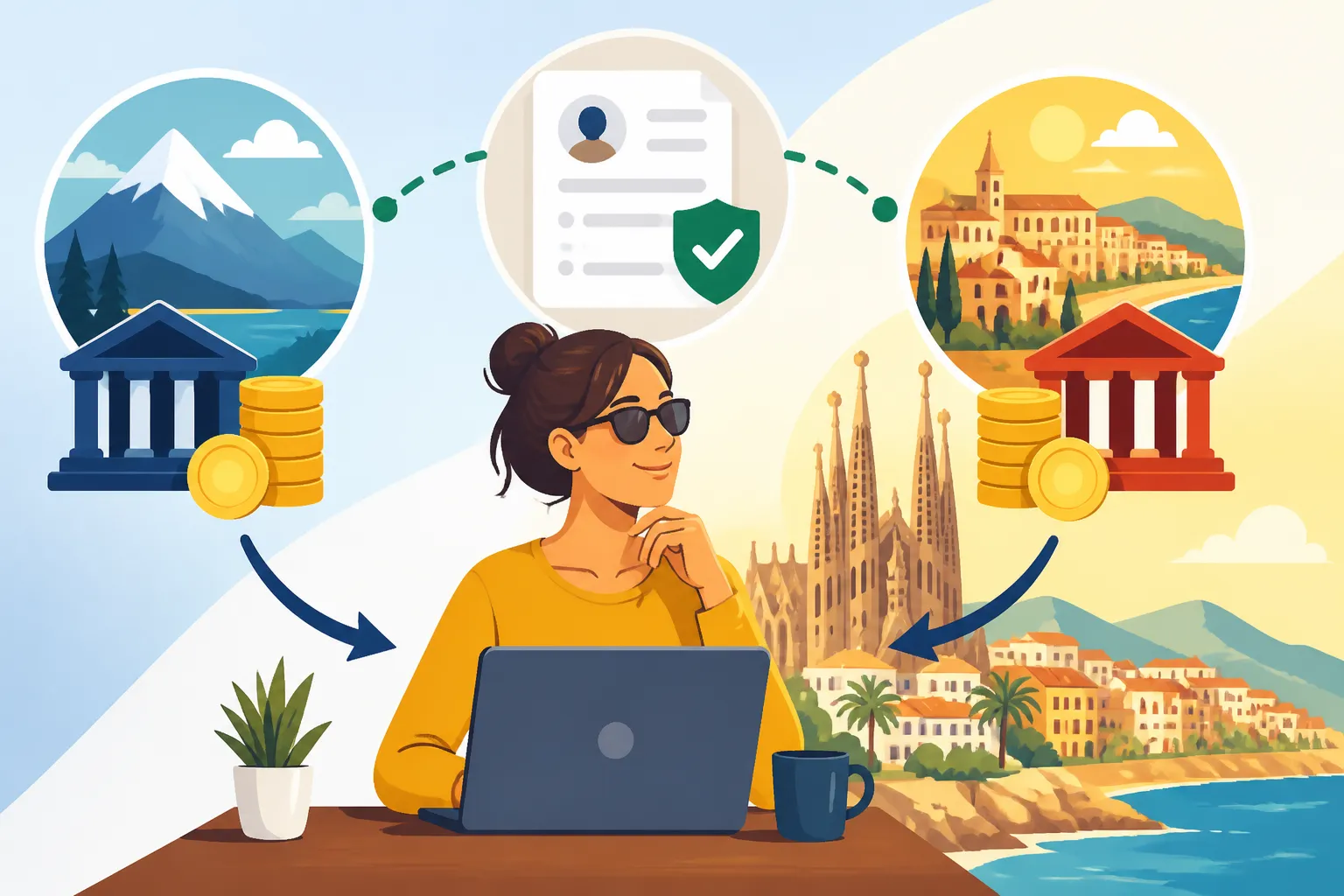
Funding a Digital Nomad Visa Application: Showing Funds Across Two Countries
Disclosure: This article contains affiliate links. If you buy through them, we may earn a commission at no extra cost to you. Read our full disclosure.
Trying to gather all your financial ducks in a row for a visa application in Spain can feel like an Olympic sport, especially when your money isn't neatly tucked into one single bank account in your home country. For those of us eyeing the Spain Digital Nomad Visa, proving sufficient funds can be a major hurdle, particularly when your income streams and savings are spread across different international banks. This guide will walk you through exactly how to present your multi-country financial standing in a way that the Spanish authorities will understand, making the process smoother and far less stressful.
Understanding Spain's Digital Nomad Visa Financial Requirements
Let's cut right to it: the Spanish Digital Nomad Visa, or DNV, is an absolute game-changer for so many of us who dream of working remotely from the sunny shores of Spain. But like any good dream, it comes with a reality check, and that check is often financial. The Spanish government, bless their bureaucratic hearts, wants to ensure you can support yourself and any dependents without becoming a burden on their social system. This means proving you have a stable, substantial income.
The IPREM Baseline and Proof of Funds
The cornerstone of the DNV's financial requirement revolves around the IPREM (Indicador Público de Renta de Efectos Múltiples). This is a public indicator of income that Spain uses to determine eligibility for various benefits and, crucially for us, visa applications. For the Digital Nomad Visa, you generally need to show a monthly income of at least 200% of the current IPREM. As of my last check, the IPREM typically hovers around €600 per month, so you're looking at needing to prove an income of at least €1,200 per month. If you're bringing a spouse, that adds another 75% of the IPREM (around €450), and for each additional dependent, it's 25% of the IPREM (around €150). This isn't just a "nice to have," it's a non-negotiable threshold.
This amount needs to be consistent and proven for the last three months, and sometimes even longer, depending on the consulate or application office. They aren't looking for a one-off windfall; they want to see stability. So, if you've had a wildly fluctuating income, you'll need to demonstrate how you meet this average over a sustained period. It's not just about what you have in your account today, but what you earn regularly. For a deep dive into the specifics, check out our guide on What Income Do You Need for the Spain Digital Nomad Visa?.
Acceptable Forms of Financial Proof
When it comes to showing your financial muscle, Spain isn't usually keen on vague promises or a verbal assurance. They want hard evidence. Typically, this means official bank statements showing regular income deposits from your remote work, clear savings, or investment accounts. Employment contracts showing your salary, or invoices and client contracts if you're a freelancer, are also critical. For freelancers, showing consistent payments over the past 3-6 months is vital to demonstrate a stable income stream.
They are looking for liquidity. While property assets or luxury goods might look good on paper, they're not easily converted to cash to pay for your groceries in Seville. Your funds need to be readily accessible. Often, they prefer to see the funds in an account that can easily convert to Euros or is already in Euros, to remove any doubt about the true value of your financial resources. This is where managing international funds becomes particularly critical for your Spain Digital Nomad Visa: Requirements, Documents, and Timeline application.
The Headache of Proving Funds Across Multiple Countries
Ah, the modern expat's dilemma! We're global citizens, our finances often reflect that, spread across various banks, currencies, and even investment platforms. While this is perfectly normal in our interconnected world, it can be a monumental headache when a rigid bureaucracy like Spain's asks for "proof of funds." They're not always equipped to deal with the complexities of international finance, and sometimes, it feels like they simply prefer things to be as straightforward as possible.
Why Multi-Jurisdictional Funds Create Bureaucratic Headaches
Imagine being an immigration officer sifting through documents from different countries, each with its own banking system, statement format, and often, a different language. It's a logistical nightmare for them. They need to be absolutely sure that the money you claim to have is real, liquid, and sufficient, and that means being able to easily verify it. When you're providing statements from a bank in, say, the US, another in the UK, and maybe a small investment account in Asia, it creates a puzzle for them to piece together.
The biggest issue is often legibility and consistency. Each bank's statement looks different, some might not clearly show the account holder's name or the account type, and currency conversions can be confusing. They might also worry about the ease of transferring these funds to Spain. If your money is tied up in accounts that are difficult to access internationally or have high transfer fees, it can raise red flags about your ability to meet living expenses quickly once you're on Spanish soil. This is why having a clear, unified presentation of your finances is absolutely paramount for a smooth DNV application.
The Challenge of Uniform Documentation and Currency
Beyond the sheer volume of different documents, there’s the issue of standardization. Spanish consulates and immigration offices have specific requirements for bank statements, often asking for them to be stamped by the bank or even notarized. Getting this done for multiple international accounts can be a monumental task, especially if you're no longer physically in the country where the bank is located. Then there’s the currency. While most major currencies are understood, constantly converting figures to EUR to meet the IPREM requirements adds another layer of mental gymnastics for the officer reviewing your application.
Even if you meticulously provide all statements, the sheer number of documents can sometimes overwhelm the immigration officer, leading to delays or requests for further clarification. You might be asked for Spain Visa Translations & Apostilles: What Needs Legalization? for every single foreign document, which adds cost and time. This fragmented approach can make your financial situation appear less stable or harder to verify than it truly is, simply because it’s not presented in a cohesive, easily digestible manner. You need a way to bring all these pieces together into one clear, Spanish-friendly picture.
Wise: Your Ultimate Solution for Consolidating and Proving Funds
This is where the right financial tools become your absolute best friend. When you're navigating the murky waters of international finance for a visa application, you need simplicity, transparency, and reliability. And for many expats, myself included, Wise (formerly TransferWise) has become the undisputed champion in this arena. Seriously, this isn't just a convenient service; it can be the linchpin that makes your Digital Nomad Visa application less of a headache and more of a straightforward process.
How Wise Simplifies Your Financial Footprint
Imagine being able to bring all those scattered funds – from your old British bank account, your freelance income from a US client, or even a small pot of savings from an Asian investment – into one easily manageable, clear, and professional account. That's exactly what Wise offers with its multi-currency account. You can hold balances in over 40 different currencies, including EUR, making it incredibly simple to receive money from various sources and then convert it into the currency needed for your Spanish life.
The real magic here is the consolidated financial overview. Instead of submitting a thick stack of statements from half a dozen banks, each looking entirely different, you can channel your funds into your Wise account. This allows you to generate one, clear, comprehensive statement that shows your total available funds, often already converted into Euros. This single, professional document makes the immigration officer's job so much easier, presenting a unified and verifiable picture of your financial stability. It drastically reduces the potential for confusion or requests for additional, time-consuming clarifications, streamlining your Spain Immigration Appointments & Paperwork: How to Avoid Delays.
Step-by-Step: Using Wise for Your Visa Application
Let's get practical. If you've got funds spread out, here's how Wise can be your secret weapon for the Spain DNV:
-
Open a Wise Multi-Currency Account: The process is quick and entirely online. You'll need to provide some ID, but it's far less cumbersome than opening a traditional bank account in a new country. Once verified, you'll have account details for multiple currencies (e.g., EUR, USD, GBP, etc.).
-
Consolidate Your Funds: Start transferring money from your various international bank accounts directly into your corresponding Wise currency balances. For example, if you have USD savings, send them to your Wise USD account. If you receive freelance payments in GBP, have them sent directly to your Wise GBP account. This centralizes everything under one digital roof.
-
Convert to EUR (Strategically): Once your funds are consolidated in Wise, you can easily convert them into Euros with competitive exchange rates and transparent fees. While you don't always need to convert all your savings into EUR immediately, having a significant portion in EUR for your application makes things incredibly clear for the Spanish authorities. It shows them, unequivocally, that you meet the IPREM requirement in their local currency without them having to do any calculations.
-
Generate Official Wise Statements: Wise provides easy-to-read, official bank statements that clearly show your name, account number, transaction history, and current balances. These statements are accepted by many authorities globally. For your DNV application, download the statements that cover the required period (usually the last 3-6 months) showing your income and savings. The clarity and consistency of these statements are a huge advantage over trying to combine disparate documents. This single, easy-to-read statement is often sufficient, along with any other income proof like employment contracts or invoices, significantly simplifying the "proof of funds" part of your application.
Essential Documentation and Expert Tips for Success
Even with Wise making your financial life simpler, the Spanish bureaucracy still demands thorough documentation. It's not enough to just have the money; you need to prove it in the exact way they want. Think of it as a meticulous scavenger hunt, and every document is a clue they need to piece together.
The Comprehensive Document Checklist
To ensure your financial proof is ironclad, you'll need more than just bank statements. Here's a breakdown:
- Bank Statements: These are paramount. You’ll need statements from all relevant accounts, ideally covering the last three to six months, showing consistent income and your total liquid assets. If you've consolidated with Wise, ensure your Wise statements clearly reflect the IPREM requirements in EUR. For any residual foreign bank accounts, you'll need their statements too, even if it's just to show transfers to your Wise account, illustrating the consolidation process.
- Proof of Income: This is separate from just having money in the bank. If you're employed, you need an employment contract, recent payslips, and a letter from your employer confirming your remote work arrangement, salary, and job title. If you're a freelancer, gather your client contracts, invoices, and bank statements showing consistent client payments.
- Proof of Funds: Beyond your regular income, any significant savings or investment accounts should be documented. Again, bank or investment statements are key. If these are in another currency, and not transferred to Wise for consolidation, be prepared for currency conversion questions.
- Sworn Translations and Apostilles: This is crucial. Any document not originally in Spanish will need to be officially translated by a "traductor jurado" (sworn translator) in Spain. This includes bank statements from foreign banks, employment letters, and contracts. Depending on your home country and the specific consulate, some documents might also require an Apostille. Make sure to clarify this requirement for your specific consulate or the office of Extranjería where you're applying. You can learn more about this in Apostilles and Sworn Translations for Spanish Visas.
It's all about leaving no room for doubt. Each document should clearly state your name, the date, and the financial figures. Any discrepancies or missing information will likely lead to delays or a request for additional documentation, pushing back your dreams of tapas and siestas.
Avoiding Common Pitfalls and Ensuring Approval
Navigating any visa application has its share of traps, and the Digital Nomad Visa is no exception, especially when it comes to finances. Here are some seasoned expat tips to help you avoid common missteps:
- Don't Wait Until the Last Minute: Spanish bureaucracy operates on its own unique timeline, which is often slower than you'd expect. Start gathering and translating your financial documents well in advance. Getting sworn translations and potentially Apostilles can take weeks. Ensure your Wise account has been active and showing consistent activity for the required period before you generate statements. A last-minute influx of cash into an otherwise empty account will raise suspicion.
- Keep Funds Stable: Don't make any massive, unusual transactions in the months leading up to your application. A sudden, unexplained withdrawal or deposit could look suspicious. The authorities want to see a predictable financial pattern that reflects genuine income and savings, not a hastily arranged loan to meet the requirements.
- Cross-Reference Everything: Ensure the names on all your bank statements, employment letters, and passport match exactly. Any minor discrepancies can cause delays. Double-check all figures and dates.
- Consider Professional Help: Seriously, sometimes a gestor or an immigration lawyer is worth their weight in gold. They know the latest IPREM figures, the exact document formats preferred by different consulates (because yes, even that can vary slightly!), and can advise on specific situations like yours. Especially with multi-country funds, having an expert review your package before submission can save you immense stress and prevent rejections. Our guide on Choosing a Gestor or Tax Advisor in Spain: What to Look For can provide excellent guidance.
- Be Prepared for Fluctuations: If you have funds in non-Euro currencies, remember that exchange rates fluctuate. While Wise provides excellent rates, always aim to have a buffer above the minimum IPREM requirement to account for any unfavorable shifts. Converting a substantial portion to EUR using Wise can mitigate this risk entirely.
- Understand the IPREM for Dependents: If you're moving with family, remember the IPREM requirements multiply. Your financial proof must clearly demonstrate you can support everyone. This is a common oversight that leads to rejections for families.
By meticulously preparing your documents, consolidating your funds through services like Wise, and anticipating bureaucratic hurdles, you significantly increase your chances of a successful Digital Nomad Visa application. It's a journey, but with the right preparation, you'll be enjoying your new life in Spain before you know it. Ready to streamline your finances? Explore Wise today and take a huge step towards your Spanish DNV.
Disclaimer
This article is for general informational purposes only and does not constitute professional advice. Laws, prices and regulations vary by location and change over time. Consult a qualified professional for guidance on your specific situation.