Coverage in Rural Spain: eSIM Networks in Andalusia, Galicia, and Extremadura
Ah, the romance of rural Spain! It calls to us with its ancient villages, breathtaking natural parks, and slow, delicious pace of life. But let's be real, as an expat who’s ventured far off the beaten path more times than I can count, I know that charm can quickly turn into frustration when you find yourself in a stunning valley, phone in hand, with absolutely no signal. You want to share that incredible photo, look up the opening hours for that tiny local bodega, or simply let family know you’re safe, and suddenly, you're cut off. This guide is here to walk you through how to tackle patchy cell service in Spain's beautiful yet sometimes signal-shy regions like Andalusia, Galicia, and Extremadura, and why an eSIM solution is often your best friend.
Disclosure: This post may contain affiliate links. We may earn a commission at no extra cost to you if you make a purchase through these links. Read full disclosure.
The Rural Spain Connectivity Conundrum: Why It’s Tricky
Navigating the nooks and crannies of Spain is an absolute joy, but it's important to understand that while urban centers are generally well-connected, the farther you stray from major cities, the more unpredictable your phone signal can become. It's not a flaw in Spain; it's simply the nature of expansive, diverse landscapes and the economics of infrastructure.
Why Rural Coverage is Tricky
Imagine vast mountain ranges, deep river gorges, endless plains, or a coastline so rugged it laughs in the face of cell towers. Spain has all of this in spades. These geographical features, while stunning, pose significant challenges for mobile network providers. They need to install expensive infrastructure, often in difficult terrain, to serve populations that are typically much smaller and more spread out than in urban areas. This means that investing in robust, omnipresent coverage simply isn't always economically viable for local carriers in every single remote village or hiking trail.
You might find that one local network has a tower in a specific valley, while another dominates the next town over. Relying on a single physical SIM card from one provider can leave you stranded when that particular network drops out. This is where the ingenuity of modern solutions comes into play, giving us options we never had just a few years ago.
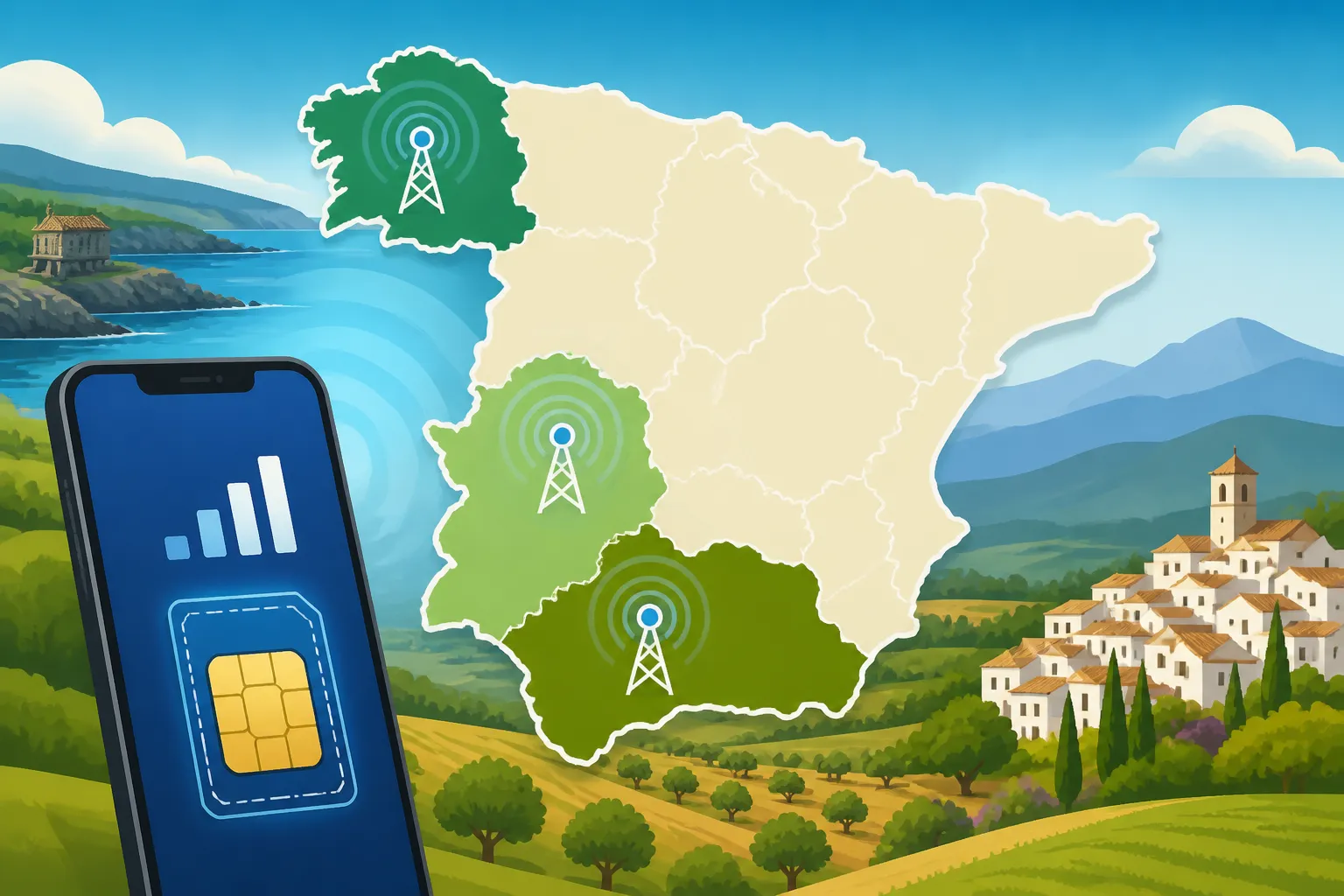
The Specifics of Andalusia, Galicia, and Extremadura
Each of these regions, for all their unique beauty, presents distinct connectivity quirks:
- Andalusia: This sprawling southern region is famous for its vibrant cities, but also for the dramatic Sierra Nevada mountains, the rolling hills of the Alpujarras, vast olive groves in Jaén, and the rugged, sometimes sparsely populated coastlines of Huelva and Almería. While cities like Seville and Granada have excellent coverage, head into the white villages tucked deep in the mountains, or explore remote stretches of natural parks, and you'll quickly encounter dead zones. The sheer scale of the region means you'll pass through many areas where a consistent signal is a luxury.
- Galicia: Up in the verdant, wild northwest, Galicia is a land of misty forests, dramatic cliff faces along the Costa da Morte, and ancient, scattered aldeas (hamlets). The undulating terrain, coupled with often dense vegetation and proximity to the Atlantic, creates natural barriers for mobile signals. You can be driving along a stunning coastal road, admiring the crashing waves, and suddenly, your GPS gives up the ghost. Connectivity can be particularly challenging in areas like the Ribeira Sacra, known for its steep river canyons, or on remote sections of the Camino de Santiago.
- Extremadura: This often-overlooked region in western Spain is a land of vast, unspoiled plains, cork oak forests, and significant natural parks like Monfragüe. With some of the lowest population densities in Spain, it's not uncommon to drive for miles between towns. While the main highways often have decent coverage, venturing into the national parks or off the primary routes to discover hidden castles or Roman ruins can quickly lead to a loss of signal. In these expansive, quiet areas, having reliable data isn't just a convenience; it can be vital for navigation or in case of an unforeseen issue.
These regions, while offering incredible experiences, demand a more thoughtful approach to staying connected.
How eSIMs Are Your Rural Roaming Heroes
So, you’ve embraced the idea of venturing into these spectacular but potentially disconnected corners of Spain. How do you keep your digital lifeline intact without juggling multiple local SIM cards or paying exorbitant roaming fees? Enter the eSIM.
The Magic of eSIM Technology
An eSIM, or "embedded SIM," is a digital SIM card that's built directly into your compatible smartphone or device. Unlike traditional physical SIM cards, there's nothing to physically swap out. Instead, you download a profile from a carrier, and your phone connects to their network.
Why is this a game-changer for travel, especially in rural Spain?
- Flexibility: You can store multiple eSIM profiles on a single device, switching between them as needed. This means you can keep your primary home SIM active for calls and texts, and simply activate a data-only eSIM for Spain when you arrive.
- Convenience: No more hunting for local SIM card vendors upon arrival, fumbling with tiny plastic cards, or trying to explain your data needs in broken Spanish. Activation is typically done via a QR code or an app, often before you even leave home.
- Local Network Access: An eSIM acts just like a local SIM, giving you access to local network speeds and prices, which are far better than typical international roaming charges.
This technology completely bypasses the physical limitations of traditional SIM cards, offering unparalleled ease and adaptability for modern travelers.
Why Airalo is Your Best Bet for Spain
Now, when it comes to choosing an eSIM provider that really delivers, especially for those challenging rural areas, Airalo consistently comes out on top. Their approach is well suited to travelers who want for a worry-free trip through Spain.
Airalo offers region-specific eSIMs that connect to Spain's major mobile networks. This is crucial for rural coverage. Instead of being locked into one provider, Airalo leverages the infrastructure of the largest local carriers like Movistar, Vodafone, and Orange. This means that your device will automatically connect to the strongest available signal from any of their partner networks in a given area. When one network is weak, your phone is more likely to find a signal from another, significantly increasing your chances of staying connected even in the stickiest of rural spots.
Here's why Airalo truly stands out:
- Broad Network Partnerships: They don't just partner with one carrier; they tap into the most extensive networks across Spain, giving you the best possible shot at a signal, no matter how remote you wander.
- Range of Data Packages: Whether you're in Spain for a quick week-long hike or a month-long exploration of hidden villages, Airalo has data plans to fit your needs, from smaller gigs for light usage to larger bundles for heavy browsing and navigation.
- Easy Activation: The process is incredibly straightforward. Purchase your plan, scan a QR code, and you're good to go. You can even do this before you travel, so you hit the ground running with connectivity.
- Cost-Effective: Their plans are competitively priced, often much cheaper than relying on your home network's roaming options, giving you peace of mind without breaking the bank.
- Reliable Support: Should you encounter any issues (which is rare, in my experience), their customer support is responsive and helpful.
Imagine hiking through the breathtaking Picos de Europa (okay, not in these specific regions, but a good example of rugged terrain!) or getting lost in the winding streets of a tiny Galician village. With Airalo, you can confidently pull up your map, translate a menu, or call for help if needed, knowing you have the best possible chance of a signal. It really takes the edge off any travel anxiety, letting you focus on the incredible experience of Spain. You can find more practical information on Mobile Data and eSIMs for Travel in Spain.
Navigating Connectivity in Andalusia, Galicia, and Extremadura with eSIM
Let’s dig a little deeper into how an eSIM, specifically one from a reliable provider like Airalo, can transform your experience in these distinct Spanish regions.
Andalusia: From Sierra Nevada to the Coast
Andalusia is a region of incredible contrasts, from the sun-drenched beaches of the Costa de la Luz to the dramatic peaks of the Sierra Nevada. These varied landscapes mean equally varied connectivity.
- The Sierra Nevada and Alpujarras: These mountainous areas are famous for their stunning vistas and picturesque white villages clinging to hillsides. Here, signals can be notoriously spotty, dropping in and out as you traverse valleys and ascend peaks. A single carrier SIM might leave you with no service for hours. With an Airalo eSIM, your phone is constantly scanning for the strongest signal from any of their partner networks, increasing your chances of finding a connection even in seemingly impossible spots. This is invaluable for using navigation apps like Google Maps when you're exploring winding mountain roads or for quickly checking opening times for a local quesería (cheese shop).
- Vast Olive Groves and Rural Interior: Areas like Jaén province, with its endless olive groves, and the wilder parts of Cádiz away from the coast, are beautiful but can feel incredibly remote. You might drive for long stretches without passing another car. Having a reliable data connection via Airalo ensures you can maintain communication, use emergency services if necessary (just dial 112, the universal European emergency number!), and look up that charming venta (roadside inn) for a coffee stop.
- Remote Coasts: Even coastal areas, particularly those that are less developed for mass tourism (think parts of the Costa de la Luz or the Cabo de Gata-Níjar Natural Park), can have patchy service due to sparse infrastructure. An eSIM helps ensure you can still access things like Outdoor Activities in Spain: Safe Hiking, Swimming, and Sun Care or look up local seafood restaurants.
Galicia: Rugged Coastlines and Misty Mountains
Galicia's charm lies in its wildness and rich Celtic heritage. This is a region where the landscape often dictates connectivity.
- Costa da Morte (Coast of Death): This notoriously rugged coastline is breathtakingly beautiful but historically unforgiving. Signals can be weak or non-existent in many coves and headlands. If you're exploring the dramatic lighthouses or walking coastal trails, having an Airalo eSIM gives you the best chance to upload a photo of the wild Atlantic or use an offline map if the signal does vanish.
- Ribeira Sacra and Interior River Canyons: The deep river canyons of the Ribeira Sacra, with its terraced vineyards and ancient monasteries, are some of Spain's most dramatic landscapes. Unsurprisingly, cell signals struggle to penetrate these deep valleys. An eSIM, by tapping into various networks, offers a much better chance of connectivity than a single physical SIM. This is essential if you're exploring the walking trails or need to re-route your drive.
- The Camino de Santiago: Many pilgrims walk sections of the Camino through Galicia. While major towns have good service, long stretches of rural path can be disconnected. Having a robust data connection is crucial for checking maps, finding accommodation, or contacting fellow pilgrims. An Airalo plan provides that vital link for those undertaking this incredible journey, especially if you need to quickly translate a sign or ask for directions, perhaps using an app like the one described in How to Use a Translation App Offline in Spain.
Extremadura: Vast Plains and Hidden Gems
Extremadura might be less known than Andalusia or Galicia, but its vast, unpopulated dehesa landscapes and incredible natural heritage make it a gem for intrepid travelers. However, its low population density directly correlates with less extensive mobile network infrastructure.
- Monfragüe National Park: This incredible birdwatching haven is largely untouched, and rightly so. While main visitor centers might have Wi-Fi, venturing into the park's interior means entering areas with minimal to no cell service. An Airalo eSIM can be a lifesaver here, providing a better chance of connecting to whatever sparse signals are available for navigation or in an emergency.
- Expansive Plains of Cáceres and Badajoz: Driving through the endless plains between towns like Cáceres and Mérida can be a truly serene experience, but also one where you might not see another soul for miles. This is precisely when reliable data from an Airalo eSIM becomes invaluable for ensuring you don't get lost, can check for nearby amenities, or handle any unexpected situations. When you're Renting a Car in Spain: Requirements, Insurance, and Driving Tips for such explorations, having stable data for your GPS is non-negotiable.
Maximizing Your eSIM Experience
Having an eSIM is a fantastic first step, but a little preparation and savvy usage can make all the difference in ensuring seamless connectivity throughout your Spanish adventure.
Before You Go: Checking Compatibility and Plans
The journey to stress-free rural connectivity starts well before you pack your bags.
- Device Compatibility: First and foremost, check if your phone supports eSIM technology. Most newer smartphones (iPhone XR and newer, Google Pixel 3 and newer, Samsung Galaxy S20 and newer, etc.) do, but it's always worth a quick search for your specific model. Without a compatible device, an eSIM won't work.
- Choose the Right Airalo Package: Airalo offers various data packages. Consider how long you'll be in Spain and how much data you anticipate using. If you're a heavy navigator, social media updater, or want to do some streaming, opt for a larger package. If you just need data for emergencies and occasional look-ups, a smaller plan might suffice. Remember, it's usually easier and more cost-effective to buy a slightly larger package upfront than to run out of data in a rural area and try to top up without a signal.
- Activation Timing: You can often purchase and activate your Airalo eSIM even before you depart. This means you'll have data the moment you land, eliminating any scramble at the airport. Just follow the clear instructions provided by Airalo – it's usually a simple QR code scan or manual setup. Make sure to enable data roaming for your eSIM line once you're in Spain.
On the Ground: Troubleshooting and Usage Tips
Even with the best eSIM, rural areas can present unique challenges. Here’s how to handle them:
- Enable Data Roaming for eSIM: This might sound counterintuitive since you're using a local eSIM, but it's often a necessary setting to allow your eSIM to connect to its partner networks. Don't worry, you won't incur exorbitant roaming charges as you would with your home SIM.
- Toggle Airplane Mode: If you find your signal is weak or non-existent, a quick trick is to toggle airplane mode on and then off again. This forces your phone to re-scan for available networks and often helps it latch onto a stronger signal if one exists.
- Conserve Data: In areas with patchy service, high data usage can drain your battery faster and make your connection even slower. Download maps for offline use (Google Maps allows this), limit streaming, and use Wi-Fi whenever available (many rural casas rurales or restaurants will offer it).
- Battery Life: Searching for a signal constantly drains your battery. If you know you're heading into a particularly remote area, consider putting your phone on low power mode or carrying a portable power bank. This also ties into important general travel considerations like Travel Logistics in Spain: Money, Safety, and Connectivity.
- Local Wi-Fi: While the eSIM is your hero for mobile data, always take advantage of local Wi-Fi when it's offered. Many smaller establishments and hotels in rural Spain understand the connectivity challenge and provide Wi-Fi for their customers.
- Emergency Preparedness: Even with an eSIM, there might be areas where no signal from any carrier penetrates. Always have a backup plan. Let someone know your itinerary, especially if you're embarking on Hiking in Spain: Popular Trails and How to Prepare. Consider carrying a physical map or a fully charged satellite communication device if you’re doing serious backcountry exploration.
- Stay Hydrated: Especially in hot regions like Andalusia and Extremadura, Airalo can help you check weather updates and locate shade or water sources. Remember tips like Heatwaves in Spain: Health Precautions for Expats to stay safe.
By combining the convenience and network flexibility of an Airalo eSIM with a little bit of foresight, you'll be well-equipped to explore the breathtaking rural landscapes of Andalusia, Galicia, and Extremadura without constantly worrying about your phone signal. Happy travels!
| Region | Typical Rural Landscape | Connectivity Challenges | How Airalo eSIM Helps |
|---|---|---|---|
| Andalusia | Mountains (Sierra Nevada), vast olive groves, coastal stretches, white villages | Topography, patchy signal in valleys, remote historical sites, less developed coastlines | Accesses multiple major Spanish networks (Movistar, Vodafone, Orange), increasing the likelihood of finding a signal in diverse terrain; essential for navigation in remote areas. |
| Galicia | Rugged coastline, misty mountains, dense forests, scattered hamlets, river canyons | Coastal dead zones, weather interference, deep valleys, remote pilgrim paths (Camino) | Automatically connects to the strongest available network, crucial for staying linked on coastal drives, within river canyons like Ribeira Sacra, and on the Camino de Santiago. |
| Extremadura | Vast plains, national parks (Monfragüe), scattered small towns, dehesa landscapes | Low population density, long stretches of empty roads, protected natural areas | Provides a vital data link for navigation, emergency contact, and searching for services across expansive, less populated plains and within national parks where infrastructure is limited. |
Disclaimer
The information provided in this guide is intended for general informational purposes only and does not constitute professional advice. While we strive to provide accurate and up-to-date information, local network conditions, regulations, and service offerings can change. Always check the latest information directly with service providers and official sources before making any decisions. We are not responsible for any actions taken based on the information provided herein.