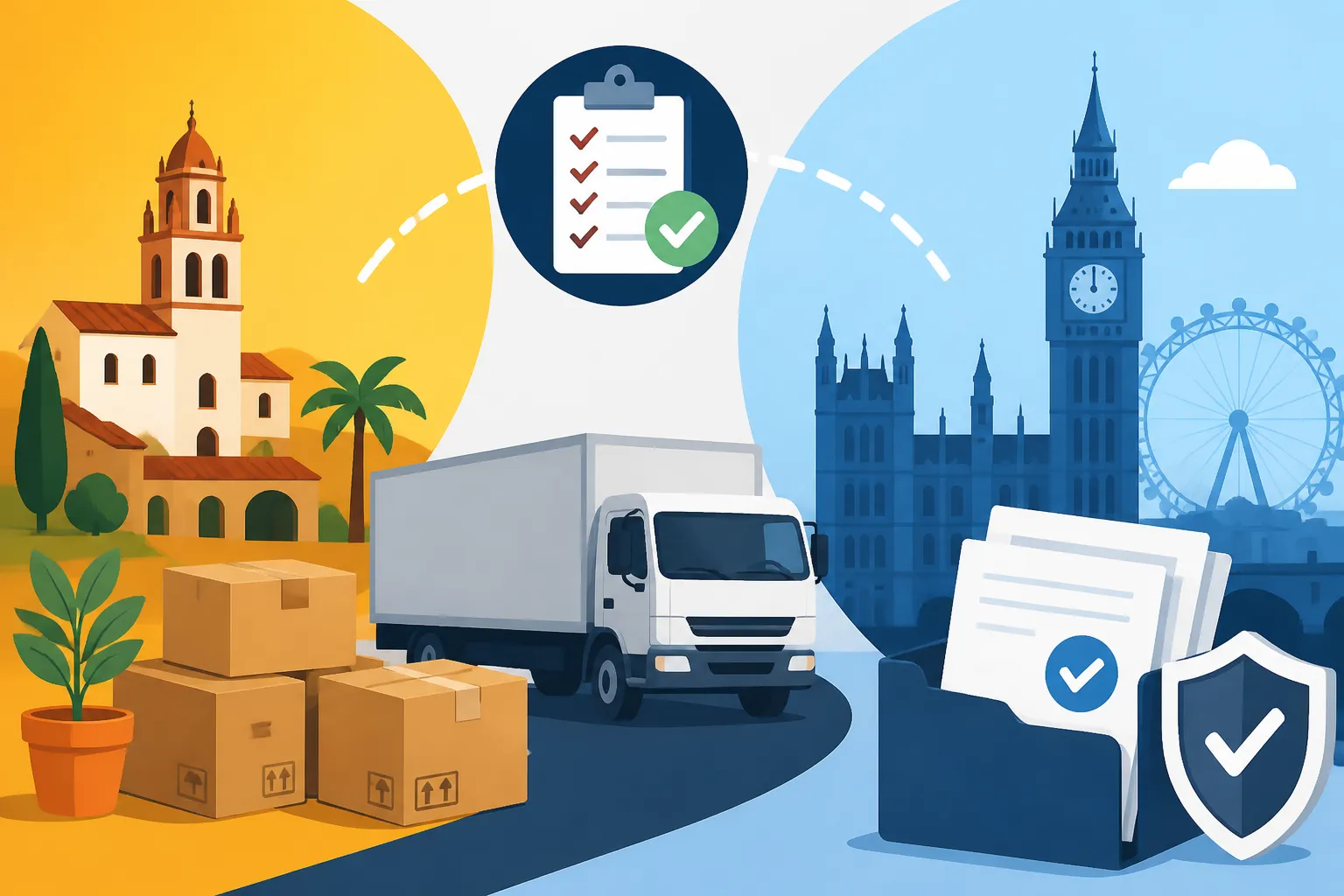
Moving From Spain to the UK: Post-Brexit Export Paperwork and Costs
Your flat in Valencia is half-packed, the removal van is booked, and then the mover asks for your ToR1 reference number. Since Brexit, moving from Spain to the UK means your sofa, books and kitchenware cross a customs border. This guide covers the export paperwork on both sides, explains what drives the cost of a Spain-to-UK move, and shows how to use Sirelo to compare removal quotes properly.
Disclosure: This post may contain affiliate links. We may earn a commission at no extra cost to you if you make a purchase through these links. Read full disclosure.
What Brexit Changed for a Move From Spain to the UK
Your Belongings Now Cross a Customs Border
Before Brexit, a move from Málaga to Manchester worked like a move from Málaga to Madrid with more motorway. Nobody asked what was in the boxes, and nobody needed a declaration. That has ended. Spain is in the EU customs union and Great Britain is not, so every household shipment leaving Spain for the UK is an export from the EU and an import into the UK. Each step needs paperwork.
In practice there are two customs events. When your goods leave Spain, an export declaration is lodged with Spanish customs, part of the Agencia Tributaria. When they arrive in Great Britain, an import declaration is lodged with HMRC. Without the right relief, that import could attract duty and import VAT on your own used possessions. Most families moving home never pay those charges, because the UK offers relief for people genuinely transferring their residence. You have to claim that relief, though. It is not applied automatically.
I remember the first post-Brexit move I helped a friend with, from a ground-floor piso in Alicante to a terraced house in Bristol. She assumed the removal company would “sort the customs bit”. They would lodge the declarations, but only she could apply for the relief, and only with her own documents. That small misunderstanding nearly held her shipment at the port for a week. Once you know the sequence, the process is manageable.
Who Qualifies for Transfer of Residence Relief
Transfer of Residence relief, usually shortened to ToR, lets you bring personal belongings into the UK without paying import duty or VAT. HMRC applies three broad conditions. You must have lived outside the UK for a minimum continuous period before the move. You must have owned and used the goods for a minimum period before importing them. And you must be moving your normal home to the UK. HMRC’s own guidance sets the exact thresholds, so check them against your dates before you plan anything else.
A UK citizen returning after years on the Costa del Sol and a Spanish national relocating to London for a new job can both qualify. Relief depends on where you have lived and how long you have owned your things, not on your passport. Spending part of each year in each country can complicate the residence test. In that case, gather your evidence early.
The relief also carries ongoing conditions. Goods imported under ToR generally cannot be sold, lent, hired out or otherwise disposed of for a set period after import without the relief being withdrawn. If you were planning to bring that antique dresser over and sell it in a London auction house, that changes the calculation. Some categories of goods sit outside the relief or carry their own rules. These are covered further down.
Why Removal Companies Matter More Than Before
Because two customs declarations now sit inside every move, the removal company’s competence has become part of the paperwork. A mover experienced on the Spain-UK route will know which customs agents they use at each end and how long clearance normally takes. They will also ask for your ToR reference before collection day, not after the lorry has left. An inexperienced firm might quote cheaply and then pass on surprise brokerage charges or delays.
This is where Sirelo earns its place in your planning. Sirelo is a comparison platform for removal companies. You describe your move once and receive quotes from international movers who cover your route, along with reviews from previous customers. On a cross-border move, being able to see which firms actually work the Spain-UK corridor regularly is worth more than a slightly lower headline price.
There is a quieter benefit too. When three or four removal firms quote for the same job, the differences in what they include show you which costs are standard and which are optional. Customs handling, insurance and access charges stand out quickly. That comparison does the work a broker or a consultant would otherwise charge for. If you are still deciding whether to ship everything or start fresh, see Repatriation From Spain: What to Ship Home and What to Sell Locally.
The Export Paperwork Step by Step
Leaving Spain Cleanly: Padrón, Utilities, and Deposits
Before the customs forms, there is the Spanish life you are closing down. Tell your ayuntamiento you are leaving so you are taken off the padrón. Keep a copy of your certificado de empadronamiento before you do, because it is one of the strongest pieces of evidence of your residence abroad for the UK relief application. Many people request a fresh certificate showing the full period of residence, which makes HMRC’s job easier.
Utilities come next. Electricity, gas, water, internet and mobile contracts in Spain often need formal cancellation, and some providers want a final meter reading or the router returned. Leave it too late and you can end up paying for a flat you no longer live in. For a step-by-step approach, see How to Cancel Utilities When Leaving a Spanish Rental. Keep the final bills as well. A run of utility bills in your name at a Spanish address is useful supporting evidence for ToR.
If you rent, your fianza is the other loose end. Spanish landlords sometimes take weeks to return deposits, and chasing one from the UK is far harder than chasing it from down the street. Photograph every room on your last day, return keys against a signed receipt, and agree a forwarding method for the refund. Getting Your Deposit Back in Spain: Disputes and Documentation walks through what to do if the money does not arrive. Settle all of this before the removal date, so moving day is only about the move.
Applying for ToR1 Before Your Goods Move
The UK relief claim is made on form ToR1, which you complete online through GOV.UK. The single most important timing rule is to apply before your goods arrive in the UK. Ideally, apply before they leave Spain, because your removal company will want the approval reference to complete the import declaration. Once HMRC approves the claim, you receive a ToR reference number. Treat it like gold.
The application asks for your personal details, your UK address, the dates of your residence abroad and your move, and a description of the goods. You will also need to supply evidence. Typical documents include:
- Proof of your residence in Spain, such as your padrón certificate, rental contract, property deeds, or Spanish tax and utility documents.
- Proof of your new UK address or intention to live there, such as a tenancy agreement, purchase completion documents or an employment contract.
- Proof of ownership and use of higher-value items, such as receipts or registration documents, where you have them.
- A list or inventory of the goods being moved, which your removal company usually produces during the survey.
HMRC processing is not instant, and response times vary with demand. Build a comfortable buffer into your timeline. If your move date is fixed by a job start or a lease, apply as soon as you have your UK address and a draft inventory. A missing ToR reference is the most common reason a household shipment sits in a UK warehouse accruing storage fees.
The Packing Inventory and Customs Declarations
The inventory is the document that ties the whole process together. It lists every box and item, often with a number and a description, and sometimes with a value. Spanish customs uses it to process the export, HMRC references it on import, and your insurer relies on it if anything is damaged. A vague inventory reading “boxes, misc.” invites questions. A clear one reading “Box 14: kitchen, plates and glasses” keeps things moving.
On the Spanish side, the export declaration is normally lodged by your removal company or their customs agent. Exporting your own used household goods from Spain is usually routine, but the declaration still has to exist. Its confirmation is part of the chain of evidence that the goods left the EU properly. Ask your mover to confirm in writing that export clearance is included in their price.
On the UK side, the import declaration goes through HMRC’s customs system with your ToR reference attached. Again, your mover or their UK agent handles the submission. Your job is to give them the reference, answer queries quickly, and be reachable by phone and email during the transit. Keep digital copies of everything in one folder on your phone: ToR approval, inventory, passport, proof of addresses and the removal contract. It saves a lot of stress on delivery day.
What It Actually Costs to Move From Spain to the UK
The Cost Drivers Behind Every Quote
There is no single price for moving from Spain to the UK, because every quote is built from the same handful of variables. Volume is the biggest. Movers price by cubic metre, so a studio in Barcelona’s Gràcia costs a fraction of a four-bedroom villa in the Algarve-side hills of Huelva. Distance and route come next. Collection from Girona is a very different drive from collection in Cádiz, and the destination in the UK matters as much as the origin.
Access is the variable people underestimate. Spanish city centres are full of narrow streets, pedestrianised zones and fourth-floor flats without a lift big enough for a wardrobe. Your mover may need a parking permit from the ayuntamiento, an external furniture lift, or a smaller shuttle vehicle to ferry goods to the main lorry. Delivery Day in a Spanish Building: Narrow Streets, Lifts, and Permits explains the practical side, and the same issues apply in reverse when you are the one being collected. UK councils have their own parking suspension rules at the delivery end.
Timing shapes price too. Summer is peak season for international removals, when families move around the school calendar. Month-end dates are popular because leases end then. If you can be flexible about your collection window, some movers will price lower, especially if they can combine your goods with another load heading north. Services such as packing, crating fragile items, dismantling furniture and storage add to the total. So do customs handling and insurance.
Comparing Road Freight, Groupage, and Sea Options
For most households, road freight is the default way to move from Spain to the UK. Goods are collected by lorry, driven north through France, and cross the Channel by ferry or tunnel, or travel on a direct ferry from northern Spain. Within road freight, the key choice is between a dedicated vehicle and groupage, where your goods share a lorry with other customers’ consignments.
| Option | How It Works | Best Suited To | Main Trade-Off |
|---|---|---|---|
| Dedicated road move | A lorry or van carries only your goods, door to door | Full homes, tight dates, fragile or valuable items | Highest cost, but fastest and simplest |
| Road groupage | Your goods share space with other moves on the same route | Partial loads, flexible dates, budget-conscious moves | Longer and less predictable delivery window |
| Sea freight container | Goods travel in a container by ship from a Spanish port | Very large volumes or vehicles alongside furniture | Port handling and longer transit, more steps |
| DIY van hire | You rent a van and drive the goods yourself | Small volumes, people who enjoy a road trip | You handle customs, ferry booking and all lifting yourself |
| Courier or baggage services | Boxes sent by parcel or excess luggage | A few boxes, students, minimal moves | Poor value for furniture, limited insurance |
Groupage is often the sweet spot for a one- or two-bedroom flat. You pay for the space you use rather than a whole vehicle, but you trade some control over dates. Your goods may wait at a depot until the lorry fills, then make several drops on the way. A dedicated move costs more but suits families on a fixed schedule, such as someone starting a job in Leeds on a specific Monday. Sea freight makes sense mainly for very large volumes or when shipping a vehicle with the household goods.
The DIY route deserves an honest warning. Driving a hired van from Spain to the UK means you become the importer. You handle the customs formalities yourself or pay an agent at the border, and you carry every box. It suits a small, low-value load and a sense of adventure. For anything more, a professional mover’s customs experience is usually worth paying for. For a deeper look at shipping choices when heading home, see Leaving Spain: Shipping Your Belongings Home Without Overpaying.
Customs Brokerage, Insurance, and the Extras
The headline price on a removal quote is only part of the story. Customs brokerage is the fee for preparing and submitting the export and import declarations. Some movers include it, others list it separately, and a few leave it out entirely and bill it later. Always ask whether both the Spanish export clearance and the UK import clearance are included.
Insurance is the second big variable. Standard carrier liability is usually minimal and based on weight, not value. Full transit insurance costs extra and is normally calculated on the value you declare for your goods. Declare realistic replacement values, not what you paid years ago. Read the policy for exclusions on owner-packed boxes, as many insurers limit cover for items you packed yourself.
Then there are the extras that appear on moving day if nobody discussed them during the survey: long carries from the lorry to the door, stair charges, furniture lifts, parking permits, waiting time, and storage if your UK keys are not ready. Hidden Costs in Spanish Moving Quotes: Access Fees, Permits, and Stairs covers these in detail, and the same principle applies to a Spain-to-UK move. Ask about each extra before you sign, not after.
How to Use Sirelo to Get Comparable Quotes
Filling In the Request So Movers Can Price Accurately
The quality of the quotes you receive depends on the quality of the information you give. When you use Sirelo, you enter your origin and destination, the approximate size of your home or the volume of goods, your preferred moving dates, and any special requirements. Be specific. “Third-floor flat, old building in Seville’s Barrio de Santa Cruz, no lift, narrow pedestrian street” gets you an accurate quote. “Flat in Seville” gets you a guess.
List anything unusual: a piano, a large terrace table, artwork, a motorbike, or a garage full of tools. Say whether you need packing, whether you want storage, and whether your UK address has its own access issues, such as a London mansion block with a tiny lift. Mention the customs side directly. Say you are moving residence to the UK and will claim ToR relief, so movers know to include the customs workflow in their quote.
Sirelo passes your request to removal companies that serve your route. Several will typically follow up with a quote or a request for a video or in-person survey. Accept the survey. A mover who has seen your home on a video call will give a far more reliable price than one working from a form. It also gives you a feel for how each company communicates, which matters when your belongings are on a lorry somewhere near Bordeaux.
Reading Quotes Side by Side
Once quotes arrive, resist the urge to sort by price and pick the lowest. Line them up and check what each one includes. Are packing materials included? Is export and import customs clearance covered at both ends? What insurance is offered, and on what basis? Is it a dedicated vehicle or groupage, and what is the delivery window? Comparing International Removal Quotes for Spain: Line Items That Hide Costs explains how to normalise quotes so you are comparing like with like.
| What to Check | Why It Matters | Red Flag |
|---|---|---|
| Customs clearance at both ends | Both declarations are now mandatory | Quote silent on customs, or only one side included |
| Insurance basis | Liability cover is not the same as full transit cover | Only weight-based liability mentioned |
| Vehicle type and delivery window | Groupage dates can stretch | No delivery window given at all |
| Access and permit charges | Spanish and UK streets can both be tricky | “Subject to access” with no detail |
| Storage terms | Useful if UK keys are delayed | Daily storage charges not stated |
| Cancellation and date change policy | Plans change, especially with HMRC timing | Large non-refundable deposit with no flexibility |
Sirelo’s reviews are useful at this stage. Look past the star rating and read what previous customers say about cross-border moves specifically: punctuality, how customs queries were handled, how damage claims were resolved. A firm with excellent reviews for local moves within Spain may have little experience of post-Brexit clearance. A firm that regularly mentions UK deliveries in its reviews is a safer bet.
Questions to Ask Before You Book
Before you commit, ask each shortlisted mover a few direct questions. Who lodges the export declaration in Spain, and who lodges the import declaration in the UK? Do they need your ToR reference before collection, and what happens if it has not arrived yet? Which route will your goods take, and is there a depot where they might be held? Who is your contact during transit?
Ask about damage claims too. How long do you have to report damage after delivery, and what evidence will they want? Photograph valuable items before packing, and keep the inventory to hand when the lorry is unloaded. Check items against it as they come off, and note any damage on the delivery paperwork before you sign. A good mover will welcome these questions. A vague answer is useful information in itself.
Finally, confirm everything in writing: price, inclusions, dates, insurance, and payment schedule. Pay deposits by traceable methods only. When comparing quotes through Sirelo, you are dealing with established removal companies rather than anonymous adverts, which reduces the risk of the scams that circulate around international moves. You should still verify that the company name on the contract matches the one that quoted.
Restricted Items, Pets, and Vehicles
Food, Plants, Alcohol, and Tobacco
Not everything in a Spanish kitchen can travel. Great Britain applies strict controls on importing meat, dairy and many animal products from the EU, so your jamón ibérico leg, manchego wheel and frozen sobrasada should be eaten, gifted to neighbours, or left behind. Packaged dry goods are generally lower risk, but movers often prefer you do not pack open food at all. It attracts pests and causes problems at inspection.
Plants and soil are another sensitive area. Bringing the olive tree from your terrace or the potted geraniums from your balcony may require plant health certificates, and some species are restricted entirely. For most people, the honest answer is to give plants to friends or sell them locally. Second-Hand Shopping in Spain: Apps and Tips for Expats covers the apps Spaniards use to sell household items quickly, which helps with furniture too.
Alcohol and tobacco are treated separately from ordinary household goods. They generally fall outside Transfer of Residence relief and are subject to excise rules. That wine collection from La Rioja or the cases of cava from the Penedès could trigger duty if shipped in your removal. Declare them honestly and ask your mover how they handle excise goods, or drink the collection at a farewell party before you go.
Pets on the Move
Moving a dog or cat from Spain to the UK involves its own set of requirements, separate from your household goods. Pets need a microchip, a valid rabies vaccination given after the microchip, and the correct travel documentation. Dogs also need tapeworm treatment administered by a vet within a specific window before arrival. The rules are set by the UK government, so check the current pet travel guidance well before you book anything.
Pets usually travel separately from your furniture. Options include driving them yourself via a pet-friendly ferry, using a specialist pet transport company, or flying them as cargo through an approved route. Ferries from Santander or Bilbao to the south coast of England are popular with families driving north with a dog in the back seat, because they avoid the long drive through France. Book pet-friendly cabins early, as they are limited.
Coordinate the timing. Ideally your pet arrives when your new UK home is ready, not when you are camping on an air mattress waiting for the lorry. Your Spanish vet can usually help with the paperwork sequence, and many vets on the Costa del Sol and Costa Blanca handle UK-bound pets regularly. Ask for copies of every certificate, and keep the originals with you, not packed in a box on the removal lorry.
Bringing a Spanish-Registered Car
If you are driving your Spanish-registered car to the UK, treat it as an import. It must be notified to HMRC after arrival and then registered with the DVLA, which involves meeting UK vehicle standards and potentially paying taxes, depending on how long you have owned it and whether ToR relief applies. Left-hand-drive cars are legal in the UK but can be harder to sell later and less practical on narrow British roads.
Many people moving from Spain to the UK decide that selling the car in Spain is simpler. The Spanish used car market is active, particularly for diesel hatchbacks and small SUVs, and a left-hand-drive car often sells better there than in Britain. Weigh the hassle of UK registration, insurance and the eventual resale value against the cost of buying a car in the UK.
If you do bring the car, tell your removal company early. Some will load a car into a container or onto a car transporter alongside your goods, which changes the quote and the customs paperwork. If you are also selling Spanish property as part of the move, see Selling Spanish Property and Repatriating the Proceeds, because the timing of the sale often dictates when you can leave.
A Realistic Timeline for Your Spain to UK Move
The Months Before Moving Day
A well-run move from Spain to the UK starts earlier than most people expect. Set aside a planning period of a few months, especially if you own property or have school-age children. The order matters more than the speed, because some steps depend on others. ToR approval, for example, depends on having a UK address and an inventory.
- Confirm your UK address or a realistic move-in date, and check you meet HMRC’s residence and ownership conditions for ToR relief.
- Request quotes through Sirelo and book video or in-person surveys with your shortlisted movers.
- Decide what to ship, sell, donate or store, and start selling large items you will not take.
- Choose your mover, confirm the inventory, and get written confirmation of customs, insurance and dates.
- Submit your ToR1 application online with your evidence, and send the approval reference to your mover as soon as you receive it.
- Arrange pet travel documentation and book transport for your animals.
- Give notice on your Spanish rental or finalise your property sale, and schedule utility cancellations.
Start the selling phase early. Furniture sells slowly in August when half of Spain is on holiday, and a large wardrobe listed the week before collection usually ends up given away. A realistic plan has you living with a slightly emptier flat for a few weeks, which is far less stressful than a frantic last weekend.
The Final Weeks and Moving Day
In the last weeks, confirm parking or loading permits with your ayuntamiento if your mover has not arranged them. Spanish town halls can take time to process a reserva de espacio for the removal lorry, and some cities require it for any street parking during a move. Book a final cleaning, schedule meter readings, and arrange to return keys and the router.
On moving day, keep a small box or suitcase of essentials with you: documents, chargers, medication, a few clothes, and anything you would not want sitting in a depot for a week. Walk through the inventory with the crew, check each room is empty before they leave, and get a copy of the signed collection paperwork. Photograph the empty flat for your deposit file.
If your UK keys are delayed, you will need short-term storage at one end or the other. Your mover may offer storage in their depot, or you may prefer a self-storage unit. Storage While You Relocate: Home-Country Units vs Spanish Trasteros compares the options. If you have a gap of a few weeks and want goods held in Spain, see Renting Storage Units in Spain: Costs and Contract Tips.
After You Land in the UK
Once your goods are on the road, the customs process runs mostly in the background, provided your ToR reference is in place. Stay reachable. Your mover or their UK agent may contact you with a question about an item on the inventory, and a quick answer can mean the difference between same-week delivery and a held shipment. Keep your HMRC approval letter accessible.
When the lorry arrives at your new home, check items against the inventory as they come off and note any damage on the delivery paperwork before you sign. Report problems to your mover and insurer within the timeframe in your contract, with photos. Unpack fragile boxes first so you can catch damage while the claim window is open.
Finally, close the remaining Spanish loose ends from the UK. Confirm your deposit has been returned, check final utility bills have been paid, and decide what to do with your Spanish bank account. Some people keep it open for a while to receive refunds, then close it. How to Close a Spanish Bank Account Safely (Avoid Surprise Fees) explains how to do that without leaving fees running. Remember the ownership conditions attached to ToR relief, too. Do not sell or lend items imported under the relief until the restriction period has passed.
Moving from Spain to the UK after Brexit takes more paperwork than it used to, but the process is predictable. Claim your ToR relief before your goods travel, choose a mover who knows the corridor, and compare quotes on what they include rather than only what they cost. Start by entering your move details on Sirelo, book surveys with the movers who respond, and you will have a clear, comparable set of options in front of you before the boxes come out.
Disclaimer
This article is for general informational purposes only and does not constitute professional advice. Laws, prices and regulations vary by location and change over time. Consult a qualified professional for guidance on your specific situation.