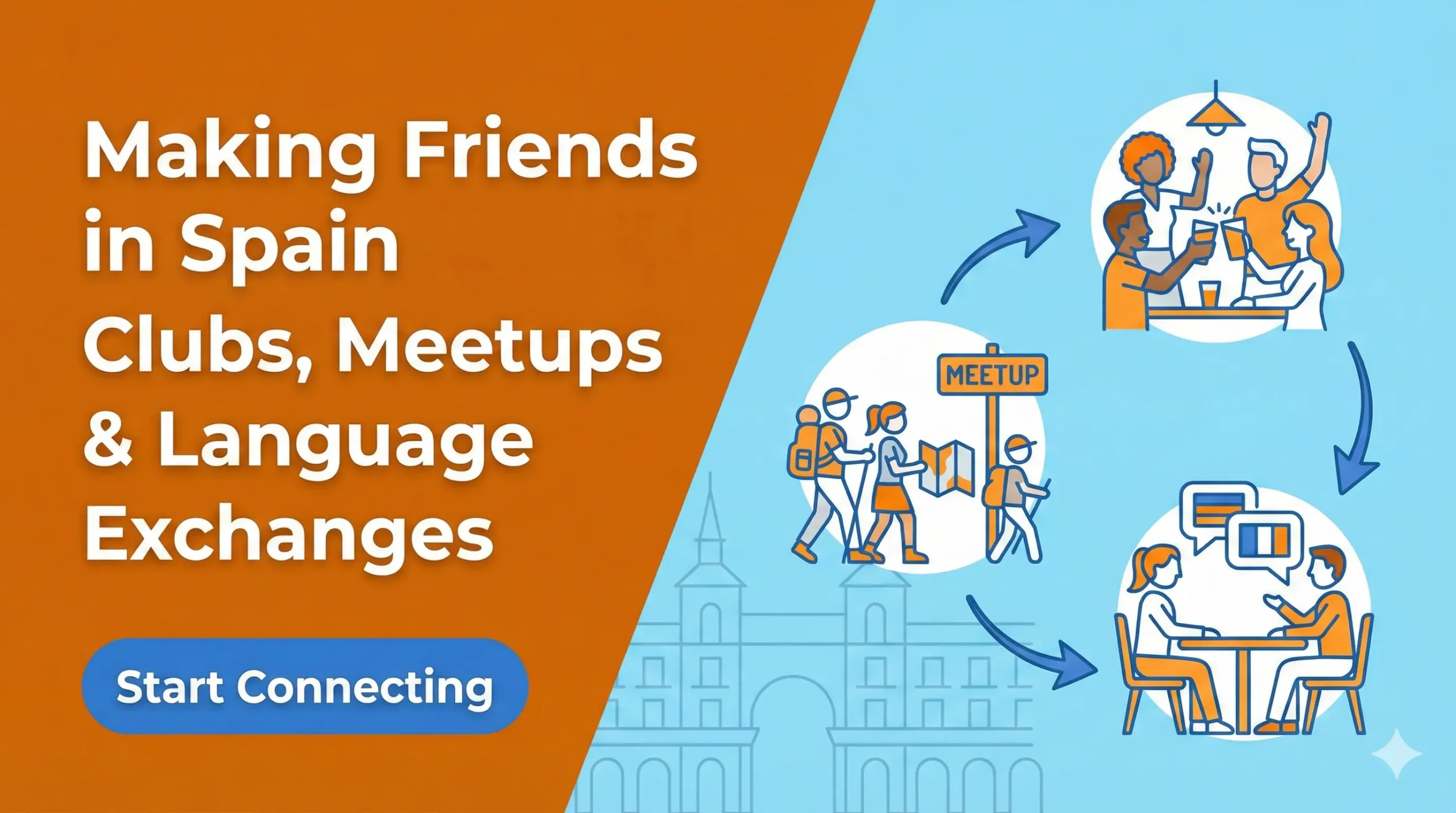
Making Friends in Spain: Clubs, Meetups, and Language Exchanges
Disclosure: This article contains affiliate links. If you buy through them, we may earn a commission at no extra cost to you. Read our full disclosure.
Moving to Spain offers a vibrant lifestyle, but building a local social circle takes effort and patience. This comprehensive guide explores the best strategies to make friends, from navigating language exchanges and expat meetups to sports clubs and understanding Spanish social dynamics.
Understanding the Spanish Social Fabric
Before you can effectively make friends in Spain, you must understand how Spanish society naturally organizes itself. The social structure here operates differently than in the United States, the United Kingdom, or Northern Europe.
The Concept of La Pandilla
In Spain, the core unit of social life is often the pandilla (the squad or friend group). Spaniards are highly localized; many grow up, attend university, and work in the exact same city. Consequently, their pandillas are often formed in primary school or high school and remain tightly knit for decades. When you meet a Spaniard in their thirties, they likely already have a fully saturated social calendar filled with childhood friends, university friends, and family obligations.
This is the primary reason expats often feel that Spaniards are hard to truly befriend. It is not that they are unfriendly or exclusive; they simply do not have the same pressing need to actively seek out new companions as someone who has just moved across the world.
Life Happens Outside
Unlike in colder climates where socializing often means inviting people over to your home for a dinner party, Spanish social life is profoundly public. People live in the streets, the plazas, and the bars. Inviting someone you just met to your apartment can actually be perceived as overly intimate or slightly unusual. Socializing means meeting at a neutral, public location—usually a terrace or a neighborhood café.
Spontaneity Over Scheduling
If you are used to scheduling coffee dates three weeks in advance, you must completely rewire your approach. Spanish social life thrives on spontaneity. Plans are often made on the same day, via a quick WhatsApp message: “I am having a beer in the plaza, are you coming?” Flexibility is crucial. If you constantly require rigid plans, you will miss out on the organic flow of Spanish community building.
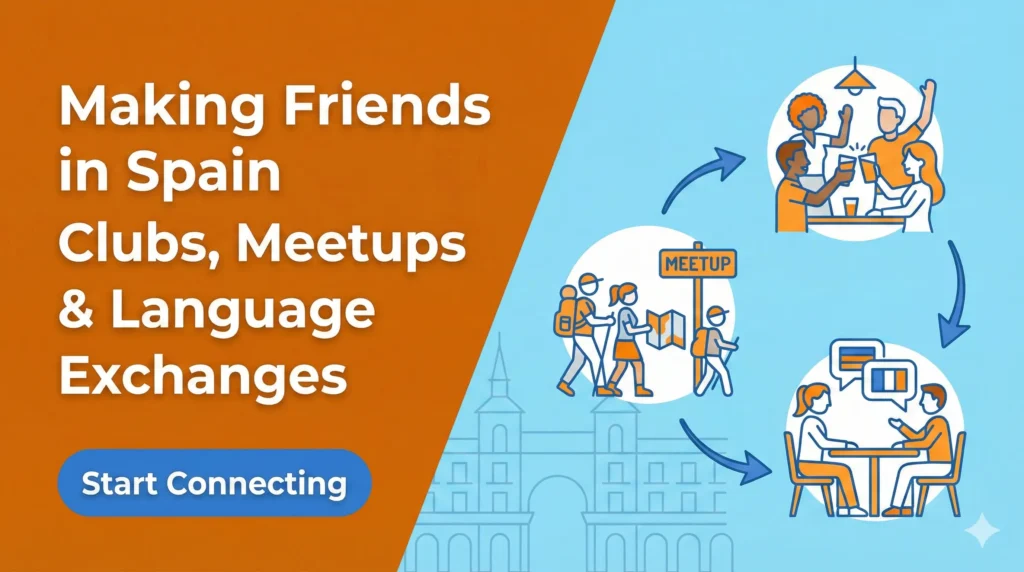
Language Exchanges: The Gateway to Local Connections
For an expatriate, the absolute most effective way to bridge the gap between the foreign community and the local Spanish population is the intercambio de idiomas (language exchange).
How Intercambios Work
Language exchanges are organized events, typically held in a bar or café during the early evening, where people gather with the explicit goal of practicing a foreign language. Half of the attendees are usually locals wanting to practice their English, French, or German, and the other half are foreigners wanting to practice their Spanish.
The format is inherently social. You might sit at a table of four, speaking English for thirty minutes and then switching to Spanish for thirty minutes. It is a completely low-pressure environment because everyone is there to make mistakes and learn.
Why They Are So Effective for Friendship
Intercambios bypass the usual social barriers. The people attending these events are actively seeking out international connections. They are already demonstrating an open-mindedness and a desire to meet people outside of their established pandilla.
Even if your Spanish is currently limited to ordering a coffee, you should attend. Your native English (or other language) is a highly valuable commodity. You provide a service to the locals, and they help you in return. Over time, the conversations naturally shift from basic grammar corrections to shared interests, leading to plans outside the exchange.
If you are balancing a demanding job while trying to improve your language skills, incorporating these social events into your routine is highly effective. You can find strategies for managing this balance in our guide on Studying Spanish While Working Full Time: Time Efficient Plan.
Digital Platforms and Expat Communities
In the digital age, you do not have to rely solely on serendipity to meet people. Several platforms are heavily utilized in Spain for community building.
The Power of Meetup.com
Meetup is arguably the most powerful tool in your social arsenal. In major cities like Madrid, Barcelona, Valencia, and Malaga, the platform is incredibly active. You can find groups for literally every niche interest: hiking in the surrounding mountains, board game nights, vegan cooking clubs, photography walks, and tech networking.
The beauty of Meetup is that it removes the awkwardness of approaching strangers. Everyone who attends a Meetup event is there for the exact same reason: to meet new people. Start by attending large, general expat mixers to cast a wide net, and then narrow your focus to smaller, hobby-specific groups to find people with whom you share genuine common ground.
Facebook Groups and Local Forums
Despite shifts in social media trends, Facebook remains a massive hub for localized expat communities in Spain. Search for groups like “Expats in Madrid,” “Girl Gone International Barcelona,” or “Digital Nomads Valencia.”
These groups are not just for asking bureaucratic questions; they are highly active social boards. It is incredibly common for someone to post, “Hi, I just moved here, I am 28, I love running and trying new coffee shops. Does anyone want to meet up this weekend?” Be brave, make a post introducing yourself, and say yes to the invitations that follow. Finding the right community is often tied to where you live, so understanding the vibe of different areas is key. You can explore this further in Finding Long-Term Rentals in Spain.
Friendship Apps
Applications like Bumble BFF have gained significant traction in Spain, particularly among women. These apps function similarly to dating apps but are strictly for finding platonic friends. You can filter by age, interests, and neighborhood. It is an excellent way to arrange one-on-one coffee meetups if large group settings feel overwhelming.
Joining Sports Clubs and Local Associations
Shared physical activity is a universal language. If you play a sport, joining a local Spanish club is a fast track to integration.
The Padel Phenomenon
If there is one sport that dominates the social life of adult professionals in Spain, it is padel. A mix between tennis and squash, played on an enclosed court, padel is uniquely accessible, relatively easy to learn, and intensely social.
You do not need to know anyone to start playing. Download the application “Playtomic,” which is ubiquitous in Spain. The app allows you to book courts, but more importantly, it allows you to join “open matches” with three strangers at your exact skill level. After a match, it is a strict cultural tradition to have a beer or a sports drink together at the club’s café. Many deep friendships begin with a random Tuesday night padel match.
Municipal Sports Centers (Polideportivos)
Every neighborhood in Spain has a municipal sports center (polideportivo). These are heavily subsidized by the local government and offer incredibly cheap classes for everything from swimming and yoga to martial arts and team sports.
Joining a class at your local polideportivo guarantees that you will be interacting with people who live in your immediate neighborhood, primarily locals rather than transient tourists. To sign up for these municipal services and secure the resident discount, you must have your local paperwork in order. You can learn how to navigate this process in Spanish Bureaucracy for Daily Life: Padrón, IDs, and Local Services.
Hiking and Outdoor Clubs
Spain’s geography is spectacular. If you live near the mountains (such as the Sierra de Guadarrama near Madrid or the Pyrenees near Barcelona), joining a club de montaña (mountaineering club) is highly recommended. These clubs organize weekend excursions, arranging carpools that force you into hours of conversation with locals.
Professional Networking and Coworking Spaces
For digital nomads, freelancers, and remote workers, the lack of a traditional office environment can severely limit social opportunities. If you work from your living room, you must intentionally seek out professional communities.
Choosing a Social Coworking Space
Spain has embraced the coworking revolution. However, not all spaces are created equal. Some are sterile, silent environments designed strictly for corporate productivity. Others are vibrant community hubs that prioritize social interaction.
When touring a coworking space, ask the community manager about their events calendar. Do they host weekly networking breakfasts? Do they organize “after-work” drinks on Fridays? A good coworking space acts as an instant professional and social network, surrounding you with ambitious, like-minded individuals who are often also navigating life as an expat or a relocated professional. To find the right fit for your working style, consult our guide on Coworking in Spain: How to Choose a Space and Membership.
Networking Events and Chambers of Commerce
If you are looking to build a professional network that blends into your personal life, look into local business associations. Organizations like the British Chamber of Commerce in Spain or various international business women’s networks host regular galas, luncheons, and seminars. These events are excellent for meeting established expats who have successfully integrated into the Spanish corporate world.
Food and Drink: The Ultimate Social Glue
You cannot separate Spanish socialization from food and drink. Understanding the etiquette and unwritten rules of the Spanish dining scene is crucial for making a good impression on your new acquaintances.
The Art of the Tapeo
Going out for tapas (ir de tapas) is not just about eating; it is a highly dynamic social activity. You rarely sit at one table for the entire night. Instead, a group will meet at a bar, stand, share a small portion of food (a ración), have a small beer (caña), and then physically move to the next bar to repeat the process.
This standing, moving environment is incredibly conducive to mingling. You are not trapped next to one person at a long table; you can circulate and talk to everyone in the group.
Paying the Bill (Pagar a Rondas)
When you are out for drinks with a Spanish group, it is highly unusual to ask the bartender to open a separate tab just for yourself, or to calculate your exact share of the bill down to the cent.
The most common practice is paying in rounds (pagar a rondas). One person pays for the first round of beers for the entire group. At the next bar, the next person pays. It is an exercise in communal trust. If the group is eating a large sit-down meal, the bill is usually split equally down the middle (pagar a escote), regardless of who ordered the more expensive dish. Arguing over the bill is considered bad form. For a deeper dive into these cultural nuances, review Spanish Business Etiquette.
The Sobremesa
If you are invited to a Spanish home or a long weekend lunch at a restaurant, you must understand the sobremesa. This translates literally to “over the table.” When the meal is finished, nobody leaves. The group will stay at the table for hours, drinking coffee, perhaps a digestif, and engaging in deep, prolonged conversation. Do not rush to leave the moment the plates are cleared; the sobremesa is where true bonding happens.
Strategies for Breaking the Ice with Locals
Joining clubs and attending meetups puts you in the same room as people, but you still need to cross the threshold from acquaintance to friend.
1. Be a Regular
Spaniards value community and familiarity. Choose one local café, one bakery, or one neighborhood bar and go there consistently. Order the same thing, smile, and greet the staff. Once you become a recognizable face, the barriers drop. The barista will start chatting with you, and soon, you will be introduced to the other neighborhood regulars.
2. Lose the Fear of Making Mistakes
Perfectionism is the enemy of connection. If you wait until your Spanish grammar is flawless before you try to speak to a local, you will be waiting years. Spaniards are generally incredibly patient and deeply appreciative of foreigners who make an effort to speak their language. Laugh at your own mistakes, ask for the correct word, and embrace the vulnerability.
3. Navigate the Boundary Between Work and Personal Life
If you work in a Spanish office, you will find that the line between professional and personal life is much blurrier than in the US or Northern Europe. Colleagues frequently socialize after hours. Furthermore, WhatsApp is used heavily for both professional communication and personal banter. Do not be surprised if your coworkers add you to a casual WhatsApp group filled with memes and weekend plans. Embrace this; it is an invitation into their circle. You can navigate these workplace dynamics smoothly by reading Spanish Business Etiquette: Gifts, Greetings, and WhatsApp Norms.
4. Initiate the Plans
Expats often complain that Spaniards never invite them out. The reality is that their schedules are already full. If you want to break in, you must be the initiator. Do not say, “We should hang out sometime.” Be specific. Say, “I am going to check out that new vermouth bar on Calle Mayor this Thursday at 8:00 PM. I would love for you to join me.”
Comparison of Socializing Methods in Spain
To help you prioritize your efforts based on your current comfort level and budget, here is a breakdown of the most effective socializing methods.
| Method | Financial Cost | Spanish Level Required | Best Suited For |
| Language Exchanges | Low (Cost of a drink) | Beginner to Intermediate | Finding locals who want international friends. |
| Meetup.com Groups | Free to Low | Varies by group | Exploring specific hobbies, casting a wide net. |
| Padel (Playtomic) | Medium (€5-€10/match) | Basic sports vocabulary | Active individuals looking for organic, post-match socializing. |
| Municipal Sports/Classes | Low (Subsidized) | Intermediate | Meeting people who live in your immediate neighborhood. |
| Coworking Spaces | High (Monthly desk fee) | English is often sufficient | Remote workers seeking daily professional and social interaction. |
| Facebook/WhatsApp Groups | Free | English is common | Finding specific expat advice, quick coffee dates. |
Conclusion
Building a social life in a foreign country is a project that requires intentionality, resilience, and an open mind. You will experience moments of loneliness, and you will attend events that feel awkward or unproductive. That is a universal part of the expatriate experience.
However, Spain rewards those who persist. The culture is fundamentally built on connection, shared experiences, and community. By stepping out of your comfort zone to attend a language exchange, downloading a padel app to play with strangers, and learning to embrace the spontaneous, late-night rhythm of the Spanish terrace, you will gradually build a network.
Do not try to force a deep pandilla connection in your first month. Focus on saying yes to invitations, being a familiar face in your neighborhood, and leaning into the warmth of the local culture. Before you realize it, your phone will be buzzing with impromptu WhatsApp plans, and you will have found your own community under the Spanish sun.
References
Primary sources (official)
- Instituto Cervantes (Cultural and Language Integration): https://www.cervantes.es/
- Ministerio de Asuntos Exteriores, Unión Europea y Cooperación (Living in Spain): https://www.exteriores.gob.es/
- Red Española de Albergues Juveniles (Youth and Cultural Associations): https://reaj.com/
Other helpful sources
- Meetup (Spain Directory): https://www.meetup.com/cities/es/
- Playtomic (Sports Social App): https://playtomic.io/
Disclaimer
The information provided in this article is for educational and informational purposes only. The cultural dynamics described are general observations and may vary significantly between different Spanish regions (e.g., the social pace of Andalusia differs from that of the Basque Country). Costs for coworking spaces and sports clubs are estimates and subject to change based on local providers.