How to Keep Valuables Safe in Spanish Hostels
You’re back from a sunset walk along the Albaicín. Your laptop was charging on the bunk, and now the dorm in Granada feels different. Six strangers share the room, one locker has a broken latch, and your passport sits in a daypack. This guide covers how to choose, lock up, and live in Spanish hostels without losing sleep or belongings.
Disclosure: This post may contain affiliate links. We may earn a commission at no extra cost to you if you make a purchase through these links. Read full disclosure.
I’ve spent a lot of nights in Spanish dorms over the years. That includes cheap bunks in Madrid’s Lavapiés, beach hostels in Tarifa, and albergues along the Camino. Very few of those nights ended in theft. The ones that came close all had the same cause: a small lapse when I was tired, distracted, or rushing for a train. Spain is not a dangerous place to stay in a hostel. Most problems are opportunistic, and that’s good news, because opportunistic theft is the easiest kind to prevent.
Choosing a Hostel That Takes Security Seriously
Keeping your valuables safe starts before you arrive. A hostel with good lockers, controlled entry, and an attentive front desk does half the work for you. A hostel without them leaves you improvising with a padlock and hope.
What to Look for in Listings and Reviews
When you compare hostels on Booking.com or similar platforms, skip the photos of the rooftop bar for a moment and read the facilities list. You want to see these features:
- Lockers in the room, ideally one per bed, big enough to fit a backpack or at least a laptop bag.
- Key card or code entry to both the building and the individual dorms.
- A reception desk staffed around the clock, or at least late into the night.
- A locked luggage room for storing bags after checkout.
Then read the reviews, and sort them by most recent. Search for the words “locker,” “safe,” “stolen,” and “security.” One review complaining about a missing phone charger doesn’t mean much. A pattern of comments about broken lockers, front doors left propped open, or staff who shrug at problems is a real warning sign. Also check whether the lockers need your own padlock or come with a built-in electronic lock, so you know what to pack.
Location matters too. Hostels in the busiest tourist zones, such as the streets around La Rambla in Barcelona or Puerta del Sol in Madrid, are often secure inside. You’ll still be walking through pickpocket hotspots every time you leave. For a broader look at the types of places to stay, see Accommodation in Spain: Hotels, Hostels, and Rentals.
Dorms, Private Rooms, and Camino Albergues
A dorm is not inherently unsafe, but it does mean more people pass near your things. If you’re carrying expensive camera gear or working remotely with a laptop, a private room in a hostel or a small pensión can be worth the extra cost for peace of mind. Hostels and Pensiones in Spain: Private Rooms vs Dorms on Total Cost breaks down that trade-off in detail.
Camino de Santiago albergues are a different situation. Many municipal albergues are simple, with open bunk rooms and no lockers at all. The pilgrim culture is generally trusting, but these are still shared spaces with constant turnover. Pilgrims usually keep their passport, credencial, phone, and money in a small pouch that never leaves their body, even in the shower block. If you’re planning the route, Albergues on the Camino: What You Can and Can’t Pre-Book explains which places you can reserve ahead and which run on a first-come basis.
Locks, Lockers, and the Gear That Actually Helps
Most hostel thefts in Spain happen from beds and open bags, not forced lockers. Good gear is less about building a fortress and more about removing temptation.
Choosing the Right Padlock
Hostel lockers vary a lot. Some have thick hasps that only fit a chunky lock. Others have narrow holes that need a slim shackle. Because you won’t know until you arrive, a versatile lock pays off.
| Lock Type | Strengths | Weaknesses | Best For |
|---|---|---|---|
| Combination padlock with long, thin shackle | No key to lose, fits most locker hasps | Slow to open in the dark | Standard dorm lockers |
| Keyed padlock | Fast to open, often sturdier | Key can be lost or left in the locker | Travelers who keep keys on a lanyard |
| Cable lock | Can secure a bag to a bunk frame | Easy to cut, more deterrent than barrier | Securing a backpack to a bed or luggage rack |
| Hostel electronic locker | No extra gear needed | Code or card can fail, needs staff to reset | Modern hostels in big cities |
| Portable lockable bag or mesh protector | Covers an entire pack | Bulky and adds weight | Hostels with no lockers at all |
I carry a small combination lock with a long shackle plus a light cable lock. The combination lock handles most lockers. The cable lock lets me attach my main pack to the bed frame when the locker is too small for it. Choose a combination you’ll remember, and avoid anything obvious such as your birth year.
Splitting Your Valuables
Don’t keep everything important in one place, even in a locker. Here’s the setup I use:
- On your body: phone, one bank card, a modest amount of cash, and a photo of your passport on your phone.
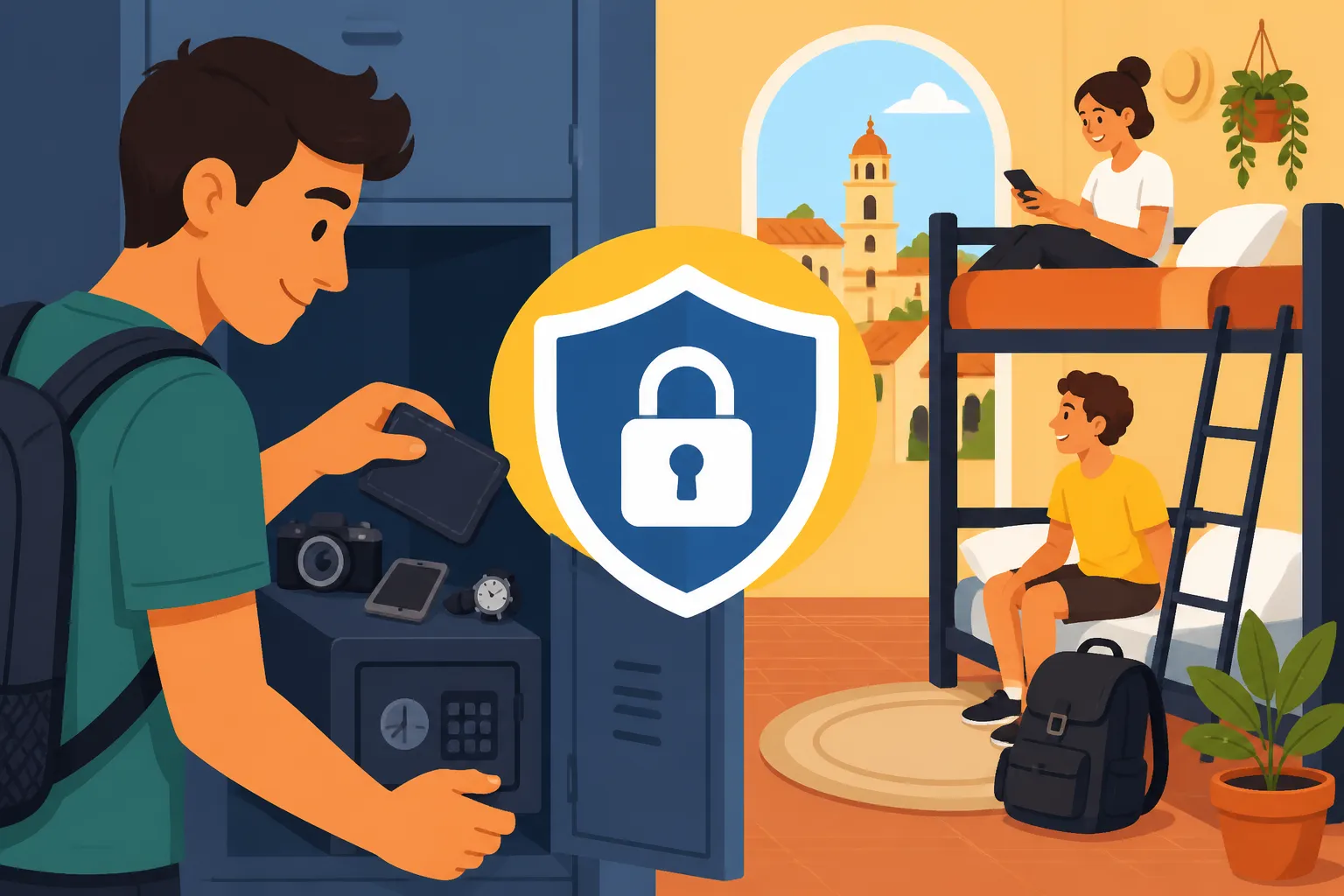
- In the locker: passport, backup bank card, laptop or tablet, chargers, and spare cash.
- Hidden in your main bag: an emergency card and a small cash stash in an unexpected spot, such as a sock inside a shoe.
If one place is compromised, the others keep you going. Digital backups help a lot too. Email yourself scans of your passport, your travel insurance policy, and any booking confirmations. Spain is still a country where cash comes in handy at small bars and markets. Even so, carrying large amounts is unnecessary, and How Much Cash Should You Carry When Traveling in Spain? helps you find a sensible amount.
Daily Habits in the Dorm and Beyond
Gear only works if you use it consistently. The real security system is your routine, especially at night and on travel days.
The Night Routine and the Charging Problem
Charging your phone is the most common weak point in Spanish dorms. Sockets are often by the door or on the far wall, so you either leave your phone unattended or sleep without a charged battery. A few fixes:
- Choose a bottom bunk near a socket when you can, or ask at check-in whether beds have individual plugs.
- Charge devices in your locker if it has an internal socket, which many newer hostels provide.
- Carry a power bank and charge it during the day in the common room while you’re sitting with it.
- Sleep with your phone and wallet inside your pillowcase or in a small pouch clipped to your bunk.
- Lock your locker every time, even if you’re just going to the bathroom down the hall.
Late returns are another risk. In Spain, nightlife starts late and people stumble back into dorms at four in the morning, flipping on lights and rummaging through bags. It’s rarely sinister, but it’s when things get mixed up or grabbed. Keep your belongings zipped and stowed before you go out, so nothing is spread across the bunk when the room is full of half-awake people.
Common Areas, Rooftops, and Hostel Bars
Many Spanish hostels have lively rooftop terraces, shared kitchens, and bars, especially in Seville, Valencia, and Barcelona. These are great places to meet people. They’re also where phones get left on tables and bags get draped over chairs. Treat a hostel bar the way you’d treat any city bar. Keep your phone in a front pocket, loop your bag strap around your leg or the chair, and don’t leave a laptop open while you go for another drink.
The same instincts apply once you leave the hostel. Metro carriages, crowded plazas, and beach promenades are where Spanish petty theft is concentrated. Avoiding Pickpockets in Spain’s Tourist Areas covers the common tricks, and if you’re based in Barcelona, How to Avoid Pickpockets on the Barcelona Metro goes line by line through the trouble spots. For general advice on travel safety, see Staying Safe in Spain: Common-Sense Tips for Travelers.
Check-Out Day: The Riskiest Hours
Travel days are when your belongings are most exposed. You’ve emptied your locker, everything is packed, and you still have hours before your train. This is when travelers leave a bag in a hostel lobby or carry it through crowded streets all afternoon.
A bit of planning helps. Use Omio or the operator’s own site to book your train or bus in advance, so you know your exact departure time and can plan the day around it. Then put your bags in the hostel’s locked luggage room rather than an open storage corner, and ask the staff whether that room is supervised or key-controlled. Keep your passport and electronics on you, not in the stored bag.
If you’d like to fill the gap productively, booking a morning walking tour or museum slot through GetYourGuide gives you a fixed plan close to your hostel. You’ll return in time to collect your bags without hauling them around the city. When you do pick them up, check zips and pockets before you leave. It’s far easier to raise a problem with staff on the spot than from a train halfway to Córdoba.
If Something Goes Missing: Filing a Denuncia Step by Step
Even careful travelers sometimes lose things. If it happens, act quickly and methodically. A police report, called a denuncia in Spain, is essential for insurance claims and for replacing documents.
The First Hour
Start by searching properly. Check under bunks, in your other bags, and in the common areas, and ask reception whether anything was handed in. Hostels often keep a lost property box, and a phone left in the kitchen is far more common than an actual theft.
If you’re sure something was stolen, tell the staff right away and ask whether the hostel has security cameras covering entrances or corridors. Footage is usually kept only for a limited time, so asking early matters. Ask staff to note the time you reported the incident.
If cards were in a stolen wallet, block them immediately through your banking app or the bank’s emergency line. How to Report Lost or Stolen Bank Cards in Spain Quickly walks you through that process. If your phone was taken, use your device’s tracking or remote-lock feature from another device, and change passwords for email and banking.
Filing the Report With Spanish Police
Which police force handles your report depends on the region. In most of Spain, it’s the Policía Nacional. In Catalonia, the Mossos d’Esquadra handle these reports, and in the Basque Country, the Ertzaintza. In some areas, the Guardia Civil may also take reports. Hostel staff can tell you where the nearest station, or comisaría, is.
- Gather what you need: your passport or a copy of it if the original was stolen, the hostel’s address, and a list of stolen items with descriptions, serial numbers, and approximate values where you have them.
- Check whether you can start the report online. The Policía Nacional offers an online pre-report for certain thefts without violence or a known suspect, which you then finalize and sign in person at a station.
- Visit the station. In tourist-heavy cities, some stations have staff or interpreters used to dealing with foreign visitors, and Madrid has a dedicated assistance service for foreign tourists.
- Describe what happened clearly: when you last saw the items, where they were stored, and whether the locker was forced or the bag was taken from a bed.
- Review the written statement before signing, and ask for help if you don’t understand something.
- Keep your copy of the denuncia safe, and photograph it right away. You’ll need it for your insurer and possibly for your consulate.
Expect some waiting, especially at busy city stations in summer. Bring water, a charged phone, and patience. Staff deal with a steady stream of similar cases, so a calm, organized account makes the process much smoother.
For a genuine emergency, such as a confrontation, an injury, or a threat to your safety, call 112, the EU-wide emergency number, which operates in multiple languages.
Passports and Insurance Claims
A stolen passport needs a call to your embassy or consulate as soon as you have the denuncia. What to Do If You Lose Your Passport in Spain explains how emergency travel documents work. If you’re staying in Spain for a longer trip, Registering with Your Embassy in Spain: Why It Helps shows how being on your consulate’s radar can speed things up when documents go missing.
Then contact your insurer. Most policies ask for the police report, proof of ownership such as receipts or photos, and evidence that you took reasonable care. This is where using the locker pays off twice: insurers often look closely at whether items were left unattended. Check your policy’s single-item limits and exclusions before you travel, especially for laptops and cameras. Travel Insurance for Trips to and Within Spain covers what to compare. If a loss happens during a night out, read Festival and Nightlife Incidents in Spain: What Insurance Won’t Touch, because policies often treat those situations differently.
Losing something on a trip feels personal, and it’s normal to feel shaken afterward. Most travelers who go through it find that hostel staff, other guests, and Spanish police are more helpful than they expected. With a good lock, a few consistent habits, and your valuables split across a few places, you can enjoy Spain’s hostels as they’re meant to be enjoyed: as cheap, sociable bases for seeing the country.
Disclaimer
This article is for general informational purposes only and does not constitute professional advice. Laws, prices and regulations vary by location and change over time. Consult a qualified professional for guidance on your specific situation.