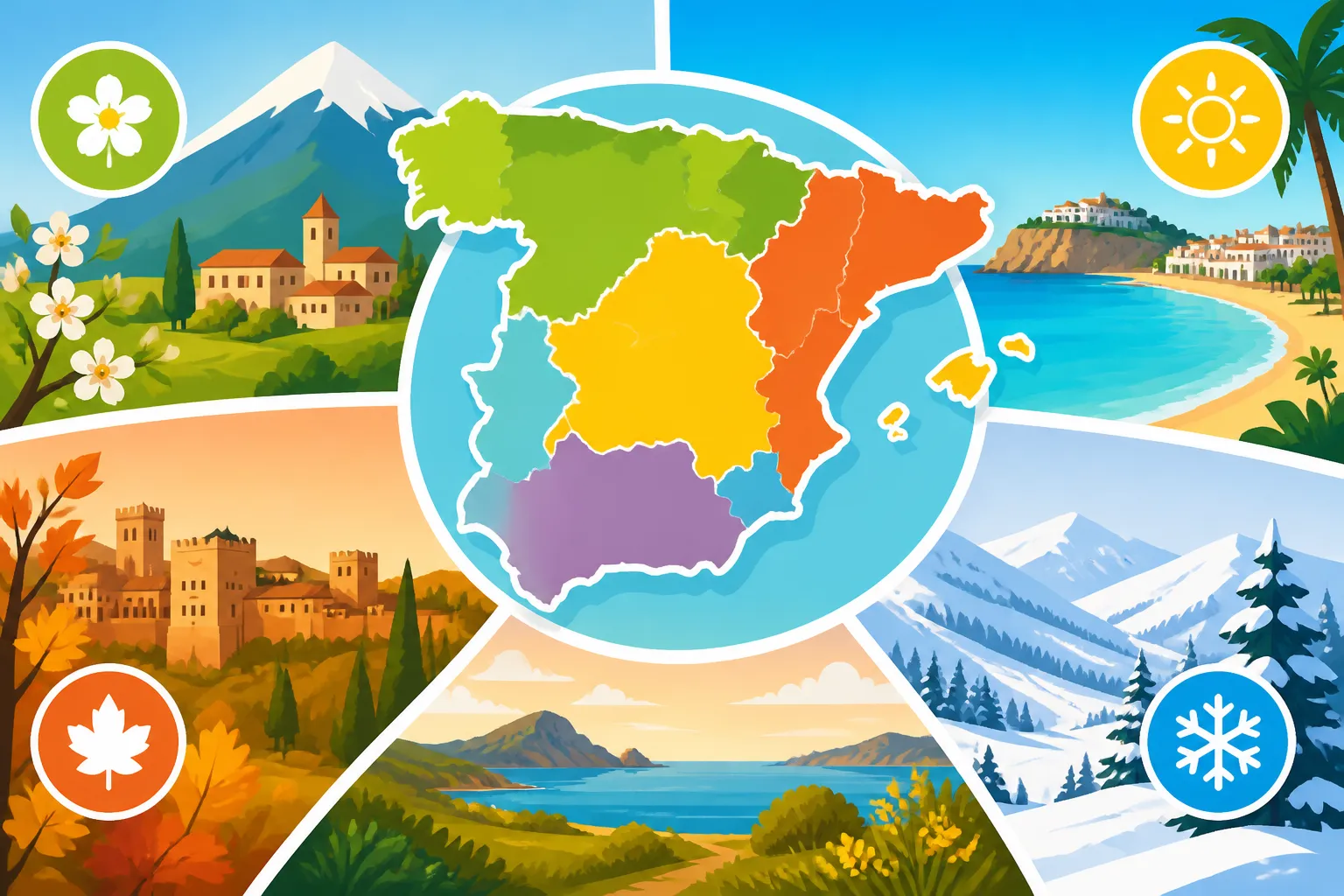
When to Visit Each Spanish Region for the Best Weather
Planning a trip to Spain based on a generic Mediterranean weather stereotype is a recipe for shivering in a drafty Madrid apartment or melting on a Seville sidewalk. I once packed only sundresses for a May trip to Asturias and ended up buying a heavy wool sweater within two hours of landing. This guide breaks down Spain's diverse climate zones so you actually pack the right gear and hit the right region at the perfect time.
Disclosure: This post may contain affiliate links. We may earn a commission at no extra cost to you if you make a purchase through these links. Read full disclosure.
Central Spain and the Meseta: Survival in the Heart of the Peninsula
The center of Spain is dominated by a massive high-altitude plateau known as the Meseta. This includes Madrid, Segovia, Toledo, and the vast plains of Castile-Leon and Castile-La Mancha. The weather here is famously described by the locals as "nueve meses de invierno y tres de infierno"—nine months of winter and three months of hell. While that is a bit of an exaggeration, the continental climate means that the temperature swings are much more dramatic than they are on the coast.
Madrid and the High Plateau
Madrid sits at about 650 meters above sea level, making it the highest capital city in the European Union. This altitude plays a massive role in how the weather feels. In the winter, the air is crisp, dry, and biting. You might have bright blue skies and a blazing sun, but the moment you step into the shade, the wind coming off the Sierra de Guadarrama will cut right through your coat. If you are visiting during the winter months, you should prioritize layers.
The best time to visit the central region is undoubtedly the shoulder seasons. April, May, and June offer a sweet spot where the parks like El Retiro are lush and the outdoor terraces are buzzing but not unbearable. Similarly, September and October provide a beautiful autumnal light and mild temperatures that make walking through the historic centers of Toledo or Salamanca a joy. During these months, it is worth checking How to Use the Renfe App to Plan Train Travel in Spain to coordinate quick day trips from the capital before the weather turns.
The Extremes of Summer and Winter
If you visit the Meseta in July or August, be prepared for a dry, relentless heat that often tops 40 degrees Celsius. The city of Madrid can feel like an oven because the stone buildings and asphalt retain heat long into the night. Many locals flee to the coast during August, leaving the city quieter but significantly hotter. If you do find yourself here in the summer, follow the local rhythm: stay indoors during the peak afternoon hours and only venture out after 8:00 PM when the air finally begins to cool.
Winter in the center is surprisingly long. While it rarely snows heavily in the city of Madrid itself, the surrounding towns like Avila can be blanketed in white for weeks. The dryness of the air means you won't feel the damp "chill to the bone" that you get in London or Seattle, but you will need a proper winter coat, scarf, and gloves. It is also the time when you should learn How to Find Authentic Restaurants in Spain (Not Tourist Traps) to find those cozy, hidden spots serving hearty stews like Cocido Madrileño to keep you warm.
The Mediterranean Coast: Chasing the Eternal Sun
The Mediterranean coast, stretching from the French border down to Gibraltar, is what most people imagine when they think of Spanish weather. However, even this long stretch of coastline has significant variations. The north is greener and more humid, while the south is arid and desert-like in places.
Catalonia and the Costa Brava
The weather in Catalonia, including Barcelona and the Costa Brava, is generally mild, but it can be surprisingly fickle. In the spring, you might experience "Girona weather," which involves sudden, heavy rain showers followed by intense sunshine. The humidity here is much higher than in the center, which means that a 30-degree day in Barcelona feels much more stifling than a 30-degree day in Madrid.
The ideal time for the Costa Brava is June or September. During these months, the Mediterranean Sea has warmed up enough for swimming, but the massive summer crowds haven't yet descended upon the small coves of Begur or Cadaqués. If you are planning a trip, it is wise to look into When Is the Best Time for a Beach Holiday in Spain? to understand how the water temperatures lag behind the air temperatures. Using Booking.com to find a place with thick stone walls or good cross-ventilation can make a huge difference in your comfort level during the humid nights.
Valencia, Alicante, and the Costa Blanca
As you move south into the Valencian Community and the Costa Blanca, the weather becomes more stable and significantly warmer. This region enjoys more than 300 days of sunshine a year. Winters are incredibly mild; it is not uncommon to see people sitting in t-shirts on a terrace in Alicante in the middle of January. However, this region is also subject to the "Gota Fría" (Cold Drop) in late autumn, where massive storms can cause flash flooding.
For those looking to experience the famous Fallas festival in Valencia, March is a gamble. You might have beautiful spring weather, or you might have wind and rain that makes the massive bonfires a logistical nightmare. Regardless of the month, always check What to Wear and Bring to a Spanish Outdoor Festival to ensure you are prepared for the specific microclimate of the Mediterranean coast.
The Balearic Islands
Mallorca, Menorca, Ibiza, and Formentera have a classic maritime Mediterranean climate. The islands are perfect from May to October, but they essentially "shut down" in the winter. While the weather remains relatively mild, many hotels and restaurants close their doors from November to March. If you visit in the off-season, you'll have the hiking trails and beaches to yourself, but you'll need to be self-sufficient. Using Omio to check ferry schedules can help you hop between islands during the spring when the wildflowers are in bloom and the temperatures are perfect for cycling.
Andalusia and the Deep South: Dancing with the African Heat
Andalusia is a land of extremes. It contains both the only desert in Europe (Tabernas) and the sunniest cities on the continent. Because of its proximity to Africa, the weather here is heavily influenced by hot winds blowing across the Mediterranean.
The Guadalquivir Valley: Seville and Cordoba
Seville and Cordoba are often referred to as the "frying pan of Europe." In July and August, temperatures frequently exceed 45 degrees Celsius. This is not a "dry heat" that you can simply ignore; it is a physical weight that dictates every aspect of life. In the summer, the streets are virtually empty between 2:00 PM and 7:00 PM. If you are asking yourself Is It Too Hot to Visit Southern Spain in August?, the answer for the inland cities is almost certainly yes, unless you plan on spending the entire day in a pool.
The best time to visit Seville is during the spring, specifically around the time of the Feria de Abril. The air is filled with the scent of orange blossoms (azahar), and the temperature is a perfect 25 degrees. However, this is also the most expensive and crowded time to visit. Late October and early November are the "secret" best months, where you can still enjoy lunch outside under a clear blue sky without the crowds or the crushing heat.
The Costa del Sol and the Tropical Coast
The coastline of Andalusia, including Malaga and Almuñécar, benefits from the sea breeze, which keeps the summer temperatures about 10 degrees lower than in the inland valleys. However, Malaga is famous for a weather phenomenon called the "Terral"—a hot, dry wind that blows from the interior. When the Terral hits, the temperature can jump 10 degrees in an hour, and the air feels like a hairdryer.
The Costa del Sol is one of the few places in mainland Europe where you can truly enjoy a winter break. While you might not be tanning on the sand in January, the daytime temperatures often hover around 18-20 degrees, which is perfect for golf or exploring the mountain white villages (pueblos blancos). Using GetYourGuide to book a walking tour of the Malaga Alcazaba in January is a much more pleasant experience than doing it in the heat of July.
| Region | Best Months | Average Temp (High) | Why? |
|---|---|---|---|
| Central (Madrid) | May, June, Sept, Oct | 22°C – 26°C | Avoids the "Tres de Infierno" heat and biting winter winds. |
| North (Galicia/Basque) | July, August, Sept | 22°C – 25°C | Best chance for sun; much cooler than the rest of Spain. |
| East (Barcelona/Valencia) | June, Sept, Oct | 24°C – 27°C | Perfect sea temps and avoids the peak humidity of August. |
| South (Seville/Granada) | April, May, Oct, Nov | 23°C – 28°C | Orange blossoms in spring; pleasant sun in late autumn. |
| Canary Islands | Year-round | 20°C – 28°C | The "Land of Eternal Spring"; great winter escape. |
Green Spain: The Atlantic North and the Basque Country
If you drive north from Madrid, you eventually hit the Cordillera Cantábrica mountain range. Once you cross those peaks, the landscape changes instantly from yellow and brown to a vivid, mossy green. This is "España Verde," and the weather here is entirely different from the rest of the country.
Galicia, Asturias, and Cantabria
The Atlantic coast is governed by the jet stream and the ocean. It is rainy, misty, and temperate. Even in the middle of August, you are likely to encounter the "orballo"—a fine, persistent drizzle that the Galicians have dozens of names for. While the rest of Spain is burning in 40-degree heat, Galicia and Asturias usually sit comfortably at 25 degrees. This makes it the premier summer destination for Spaniards trying to escape the heat.
The challenge of visiting the North is the unpredictability. You can have four seasons in a single afternoon. If you are hiking the Camino de Santiago, you must pack high-quality rain gear regardless of the month. Because of the dampness, it is also essential to have your logistics sorted; knowing How Much Cash Should You Carry When Traveling in Spain? is helpful when you find yourself in a tiny Galician village where the only local bar doesn't take cards and you need a hot coffee to dry off.
The Basque Country and the Pyrenees
The Basque Country, including San Sebastian and Bilbao, shares this Atlantic climate but with the added influence of the Pyrenees. The mountains can trap clouds, leading to prolonged periods of grey skies. However, when the sun does come out, the light in places like San Sebastian is legendary. The best time to visit is late summer (August and September) when the rainfall is at its lowest and the film festival season brings a special energy to the region.
Winter in the north is wet and grey, but rarely freezing at sea level. However, if you head into the Pyrenees for skiing, you'll find world-class snow conditions. The transition between the damp coast and the snowy mountains is remarkably fast, so if you are driving, be prepared for rapidly changing road conditions.
The Canary Islands: The Land of Eternal Spring
Located off the coast of Africa, the Canary Islands (Tenerife, Gran Canaria, Lanzarote, Fuerteventura, La Palma, La Gomera, and El Hierro) offer the most consistent weather in Spanish territory. They are truly a year-round destination, but they are not without their quirks.
Microclimates and Trade Winds
The islands are mountainous, which creates dramatic microclimates. In Tenerife, for example, it can be raining in the lush, green north (Puerto de la Cruz) while people are sunbathing in the arid, desert-like south (Los Cristianos) only 45 minutes away. The trade winds (vientos alisios) keep the islands from becoming too hot in the summer, making them a popular escape even in July.
One phenomenon to watch out for is the "Calima." This is a weather event where dust and sand from the Sahara Desert are blown over the islands. It causes the temperature to spike, the sky to turn an eerie orange, and the air quality to drop. Calimas usually only last a few days, but they can happen at any time of year.
High Season vs. Low Season
Unlike mainland Spain, the "high season" in the Canaries is winter. From December to February, Europeans flock to the islands to escape the snow. If you plan to visit during this time, you should use Booking.com to secure accommodation months in advance. The shoulder seasons of May and November offer the best value, with warm water and plenty of sunshine. It is a great time to settle in, and perhaps even look into the Best Way to Get a SIM Card in Spain as a New Arrival to share your "winter" beach photos with friends back home.
Logistics and Practical Planning Tips
Understanding the weather is only half the battle; the other half is planning your movement and your wardrobe to match these diverse regions.
Packing Strategies for Each Region
Because you might be moving between climate zones, the "layering" philosophy is your best friend. Even in the height of summer, if you are taking a bus or train, the air conditioning is often set to "Arctic" levels. Always carry a light pashmina or a thin hoodie in your day bag. If you are traveling in the spring or autumn, a lightweight, waterproof trench coat or a "puffa" vest that can be rolled into a tiny ball is essential.
When booking tours via GetYourGuide, check the start times. In the south, look for morning tours to avoid the heat. In the north, look for afternoon tours when the morning mist has usually cleared. Also, keep an eye on Spanish Holidays and Public Closures: Planning Errands in 2026, as the weather often dictates when local festivals are held, which can lead to unexpected business closures.
Booking and Transport Considerations
When traveling between regions, Omio is a fantastic tool for comparing whether a flight or a high-speed train is the better option. For example, traveling from the rainy north to the sunny south is often faster via a domestic flight from Bilbao to Seville, whereas the train is much better for navigating the Meseta.
Finally, don't let a bad weather forecast ruin your trip. Spain is a country built for social life, and much of that happens indoors in beautiful markets, historic cathedrals, and cozy taverns. If you find yourself caught in a downpour in Madrid or a heatwave in Seville, use it as an excuse to slow down, find a great "Menu del Dia," and watch the world go by. For more tips on navigating the crowds that inevitably follow the good weather, check out our guide on How to Avoid the Crowds in Spain's Peak Season.
Disclaimer
The information provided in this guide is based on historical weather patterns and personal experience living in Spain. Weather can be unpredictable, and climate change is causing more frequent extreme weather events. Always check a reliable local weather forecast (such as AEMET) shortly before your trip and follow all local safety advisories regarding heatwaves or storms.