Domestic Flights in Spain: When They Beat the Train
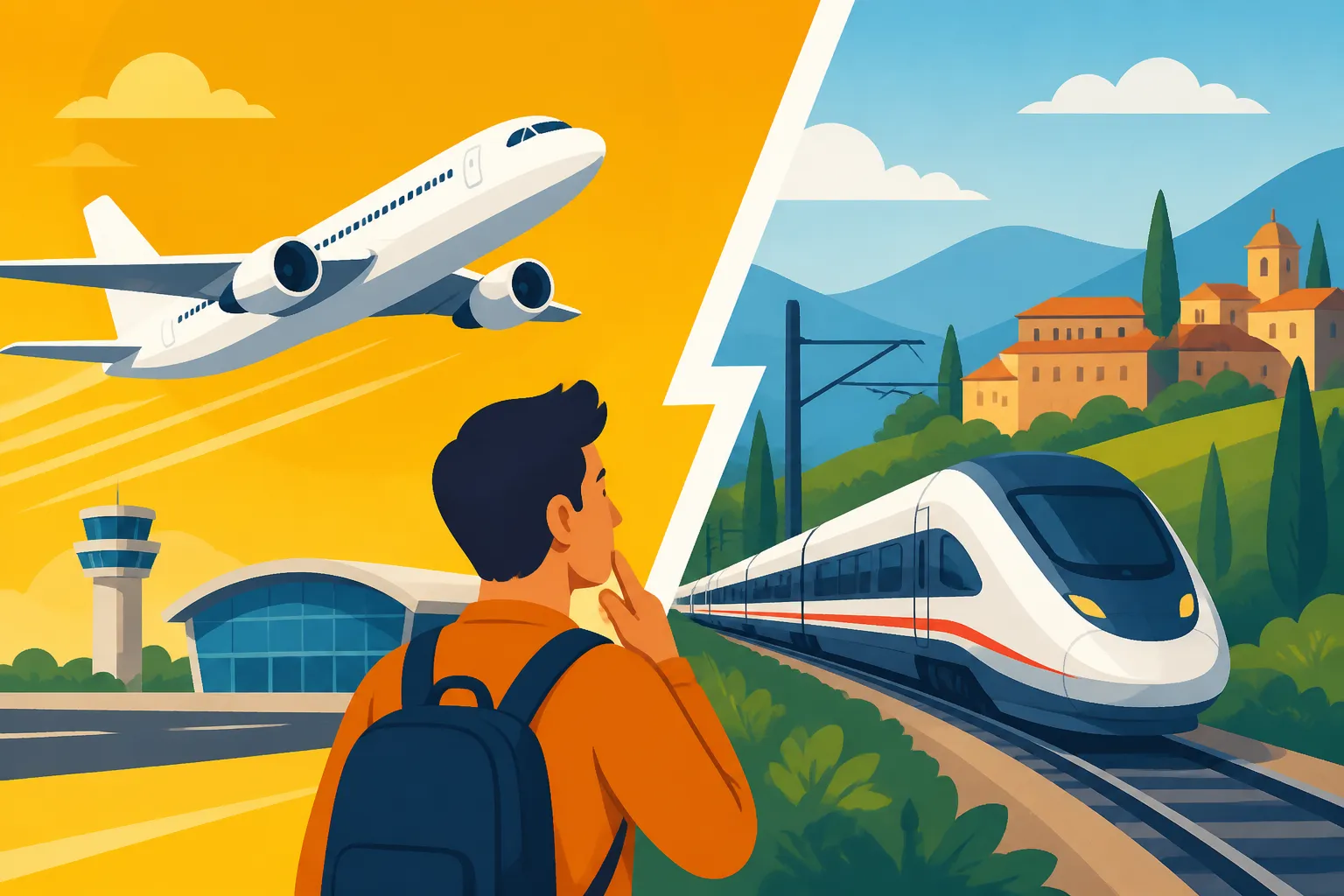
Choosing between a high-speed train and a domestic flight in Spain often feels like a high-stakes gamble where the prize is either your sanity or your savings. I remember spending my first six months here stubbornly taking the AVE everywhere until a cross-country trip to Galicia left me exhausted and broke. This guide breaks down exactly when you should head to the airport instead of the station to save time and money.
Disclosure: This post may contain affiliate links. We may earn a commission at no extra cost to you if you make a purchase through these links. Read full disclosure.
The Geography of Choice: Spain’s Radial Layout and the Island Factor
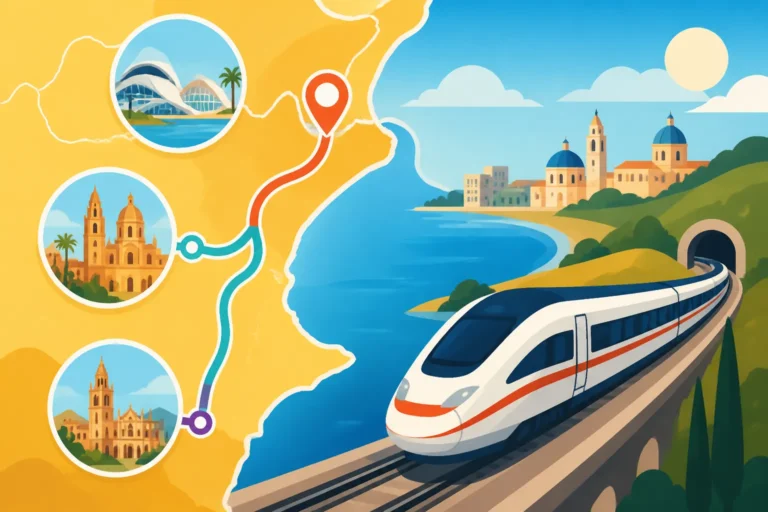
When you look at a map of Spain, it’s easy to assume that the high-speed rail network covers every corner of the peninsula. While the AVE (Alta Velocidad Española) is a marvel of engineering, the system is primarily radial, meaning almost all major lines pass through Madrid. This is the first hurdle many expats and tourists overlook. If you are trying to get from Seville to Valencia, for example, the train might force you to go up to Madrid and back down again. In these "lateral" movements across the country, domestic flights often become the most logical choice.
Furthermore, Spain isn’t just a peninsula. If your heart is set on the volcanic landscapes of Lanzarote or the turquoise coves of Menorca, the train obviously isn't an option. For those living on the mainland, the frequency of flights to the Balearic and Canary Islands is staggering. I’ve found that even for coastal cities like Barcelona to Málaga, the distance is significant enough that the flight time—roughly 90 minutes—is hard to argue with when the alternative is a five-to-six-hour train journey.
When planning these jumps, using a tool like Omio is incredibly helpful because it allows you to see the flight and train options side-by-side. It visualizes that "radial" problem I mentioned; sometimes you’ll see a train route that takes seven hours because of a transfer in Madrid, while a direct flight is done in under two. This is the reality of Spanish geography that many newcomers don't realize until they've spent half a day sitting in Atocha station waiting for a connection.
The Peninsula’s Long Hauls
For routes like Barcelona to Seville or Bilbao to Málaga, you are looking at crossing nearly the entire length of the country. Even with the expansion of high-speed rail, these journeys can be grueling. The high-speed lines to the north, particularly toward the Basque Country and Galicia, are still under development in parts or involve slower sections of track. If you are heading to the green rainy hills of the north from the sunny south, the airport is almost always your best bet.
By the sixth hour, the charm of the Spanish countryside had definitely worn off. Domestic flights between these secondary hubs are often operated by regional carriers like Air Nostrum or budget giants like Vueling, making them surprisingly affordable if you book even just a few weeks in advance.
When the Islands are Calling
If you are moving to Spain or visiting for an extended period, you will eventually want to visit the islands. The Balearic Islands (Mallorca, Menorca, Ibiza, Formentera) are a short hop from the Mediterranean coast. While ferries exist, they are mostly for those who want to bring a car or have a lot of time. For a weekend getaway, the flight is king.
The Canary Islands are a different beast entirely. Located off the coast of Africa, they are a minimum of two and a half to three hours from the mainland by air. There is no "train" alternative here, and the ferry from Huelva or Cádiz takes over 30 hours. For these routes, flying isn't just "beating" the train; it’s the only viable way to maintain your travel schedule. Once you land, it’s worth checking Booking.com for local accommodation, as island availability can fluctuate wildly depending on the season and local festivals.
Time Efficiency: The Door-to-Door Reality Check
The biggest mistake people make is comparing the 1 hour and 15-minute flight time to the 2 hour and 30-minute train time and declaring the flight the winner. In Spain, the "hidden" time of air travel is significant. Most Spanish airports, like Madrid-Barajas or Barcelona-El Prat, are massive. Navigating Terminal 4 in Madrid can feel like a marathon in itself. You have to factor in the commute to the airport, the security lines (which, while generally efficient, can be unpredictable during Public Holidays in Spain), and the wait at the gate.
Conversely, train stations in Spain are almost always in the heart of the city. In Madrid, you arrive at Atocha or Chamartín and you are already "there." In Seville, Santa Justa is a short walk or a very cheap cab ride from the historic center. This central location often saves you an hour on each end of your trip. You should only consider the flight the faster option when the rail journey exceeds four hours.
Comparing the "Buffer" Times
To accurately judge which is better, you need to look at your "buffer" time. For a domestic flight, you need to be at the airport at least 90 minutes before departure if you have checked bags, or 60 minutes if you only have a carry-on. Add to that the 30-40 minutes it takes to get to the airport from the city center. For a train, you can show up 20 minutes before departure, pass through a quick luggage X-ray (no need to take off your shoes or take out your laptop), and walk straight onto the platform.
I’ve had days where I flew from Madrid to Barcelona because the ticket was €20 cheaper, but by the time I paid for the Aerobús and spent two hours in security, I realized the AVE would have gotten me to my hotel in Gràcia much sooner. If you are a fan of Slow Travel in Spain, the train journey itself is part of the experience, allowing you to see the changing landscape from the Meseta to the coast without the stress of a boarding group.
The "Puente Aéreo" vs. High-Speed Rail
The Madrid-Barcelona route is one of the busiest air corridors in the world, known as the Puente Aéreo (Air Bridge). Iberia offers a "walk-on" service where you can show up and take the next available flight. However, since the introduction of the AVE and low-cost rail competitors like Ouigo and Iryo, the train has largely won this battle for business travelers.
The train takes about 2.5 to 3 hours and drops you at Sants or Atocha. Unless you are connecting to an international flight at the airport, the train is almost always the superior choice for this specific route. It is worth reading up on High-Speed Trains in Spain (AVE): Routes, Booking, and Savings to understand how to get the best prices on this highly competitive corridor.
Cost Analysis: More Than Just the Ticket Price
On paper, domestic flights in Spain can look ridiculously cheap. It is not uncommon to see a Vueling or Ryanair flight for €15 between major cities. However, the budget airline model is alive and well in Spain, and the "ancillary fees" are where they get you. If you have a suitcase that isn't a small backpack, you will likely pay more for the bag than the seat.
Trains in Spain have a much more generous luggage policy. On most Renfe services, you can bring two or three bags without an extra charge, provided you can carry them yourself. When you add the cost of a checked bag (€30-€50) and the cost of transport to the airport (the metro supplement to Barajas is about €5, and a taxi is a flat €33 from central Madrid), that "cheap" flight suddenly costs €80.
Hidden Costs of Flying
- Airport Transfers: Taxis and rideshares to airports are expensive. Even the Getting Around Spanish Cities: Metro, Bus, Tram, and Bikes systems often have special surcharges for airport stations.
- Luggage Fees: Strict weight and size limits are enforced.
- Onboard Costs: Unlike many long-distance trains that have a "cafetería" car where you can buy a decent bocadillo, budget flights charge premium prices for water and snacks.
- Time as Money: If you have to miss a half-day of work to navigate the airport, the train—with its reliable Wi-Fi and spacious tables—might be the more "economical" choice for remote workers.
When the Train is More Expensive
There are times when the train is undeniably the luxury option. Renfe’s pricing is dynamic; if you book a train for the following day, you might be looking at €120 for a one-way ticket. In these instances, checking Omio for a last-minute flight can save you a fortune. Also, for certain regions, the Regional and Local Trains in Spain (Cercanías and Media Distancia) are much cheaper but significantly slower. If you are on a budget but have no time, the low-cost flight remains a powerful tool in your expat arsenal.
| Route | Average Flight Time | Average Train Time (High-Speed) | When to Fly |
|---|---|---|---|
| Madrid to Barcelona | 1h 20m | 2h 30m | Only for connecting flights |
| Madrid to Málaga | 1h 15m | 2h 45m | If train prices spike |
| Barcelona to Seville | 1h 40m | 5h 30m | Almost always |
| Madrid to Palma de Mallorca | 1h 20m | N/A (Ferry: 8h+) | Always |
| Madrid to Santiago de Compostela | 1h 15m | 3h 15m | If you prefer the airport to the station |
| Bilbao to Málaga | 1h 35m | 7h+ (with transfer) | Almost always |
Comfort, Reliability, and the Expat Experience
As someone who has lived through the transition of moving my entire life in two suitcases, I can tell you that the "experience" of travel matters. Domestic flights in Spain are utilitarian. The seats are cramped, the boarding process is a frantic scramble, and the air conditioning is either non-existent or freezing.
The train, however, feels civilized. There’s something deeply satisfying about watching the Spanish olive groves whiz by at 300 km/h while you sip a coffee in the bar carriage. For those who struggle with the stress of security lines, the train is a mental health savior. You don't have to worry about the size of your shampoo bottle or whether your belt will set off the metal detector.
Reliability and Strikes
One thing any veteran expat will tell you is to keep an eye on the news for "huelgas" (strikes). Both the airlines (particularly the budget ones) and the rail workers occasionally strike. However, air travel is generally more susceptible to weather delays and air traffic control issues. Spain’s high-speed rail is famously punctual—so much so that Renfe used to offer a full refund if the train was more than 15 minutes late (though these rules have become slightly more complex recently).
If you have a strict deadline, such as a residency appointment or a wedding, I generally trust the train over a flight. If you do go the flight route, make sure to book any necessary tours or activities ahead of time through GetYourGuide so that if there is a minor delay, you have your tickets and meeting points ready on your phone to save time once you land.
Amenities and Work-Life Balance
For the digital nomads among us, the train is a mobile office. Most high-speed trains have power outlets at every seat and increasingly reliable Wi-Fi. It is much easier to get two hours of solid work done on the AVE than it is in the middle seat of a budget airline. If your trip is for business, the "lost time" of a flight is a major factor to consider. Even the Madrid, Barcelona, and Spain's Great Cities: Explorer's Guide will tell you that the commute between hubs is best spent either resting or being productive, both of which are easier on rails.
Navigating Spanish Hubs: Pro Tips for Expats
If you’ve decided that the flight is the way to go, you need to know how to navigate the hubs. Madrid-Barajas (MAD) and Barcelona-El Prat (BCN) are the primary nodes. If you are flying with Iberia, you will almost always be in Terminal 4 in Madrid, which is a stunning building but requires a shuttle train to get to the satellite gates (T4S). Give yourself an extra 20 minutes just for that.
Budget airlines like Ryanair and EasyJet often fly out of Terminals 1, 2, or 3. These are older and can be more crowded. In Barcelona, Terminal 1 is the main hub, while Terminal 2 is mostly for low-cost carriers. Knowing which terminal you are in is crucial because they are not always walking distance apart.
Regional Airports and Hidden Gems
Don't overlook the smaller airports. Cities like Granada, Santander, and Vigo have small, incredibly efficient airports where you can get from the curb to the gate in 15 minutes. Flying into these can sometimes be a "hack" to avoid the long bus or train rides from the major hubs. For instance, if you are visiting the Alhambra, flying directly into Granada instead of flying to Málaga and taking a bus can save you a lot of logistical headache.
Booking Strategy: When to Pull the Trigger
In Spain, the "sweet spot" for domestic flight prices is usually 4 to 6 weeks before departure. Unlike the US or UK, last-minute deals are rare here; prices tend to skyrocket in the final 48 hours. For trains, the low-cost operators (Ouigo and Iryo) have forced Renfe to be more competitive, but the best prices are still found by booking as soon as the "window" opens (usually 60 to 90 days in advance).
Always check if there is a local holiday in your destination city. If you fly into Valencia during Las Fallas or Seville during April Fair, prices will be triple the normal rate, and the airports will be chaotic. Planning around the Spanish Holidays and Public Closures: Planning Errands in 2026 calendar is essential for any resident.
Final Verdict: When Does the Flight Actually Beat the Train?
To wrap this up, the domestic flight beats the train in three specific scenarios:
- The Island Exception: If you are going to the Balearics or Canaries, you are flying. Period.
- The "Lateral" Move: If your journey doesn't pass through Madrid and involves a slow regional train or multiple transfers (e.g., Bilbao to Seville), flying will save you 4+ hours.
- The Price Gap: If the train is €150 and the flight is €30 (including bags), your wallet wins the argument.
For everything else—especially the Madrid-Barcelona, Madrid-Valencia, and Madrid-Seville routes—the train is the champion of Spanish travel. It’s more comfortable, more central, and significantly more environmentally friendly. As you settle into life here, you’ll find your own rhythm, but when in doubt, the silver tracks of the AVE are usually the way to go.
Disclaimer
This guide is intended for informational purposes only. Travel prices, schedules, and luggage policies in Spain are subject to change by the operators (Renfe, Vueling, Iberia, etc.) without notice. Always verify the specific terms of your ticket and current travel regulations before booking. The author is an expat sharing personal experiences and is not a licensed travel agent.