Intercity Buses in Spain: Networks, Booking, and Tips
Finding your way between two Spanish cities that are not Madrid or Barcelona can often feel like solving a riddle without an answer key. I once spent nearly an hour wandering around a terminal in Málaga because I didn't realize the bus to my mountain village left from a completely different level than the main lines. This guide serves as your definitive roadmap to mastering the Spanish intercity bus network, ensuring you can travel across the peninsula with confidence and ease.
Disclosure: This post may contain affiliate links. We may earn a commission at no extra cost to you if you make a purchase through these links. Read full disclosure.
The Architecture of the Spanish Bus Network
The first thing any expat or traveler needs to understand is that the Spanish bus system is not a free-for-all market. Instead, it is built on a series of government-granted concessions. This means that for a specific route, such as Madrid to Granada, only one company is legally allowed to operate that direct service. While this limits price competition, it ensures a high level of reliability and a consistent schedule that doesn't fluctuate wildly based on a whim.
The system is largely a "hub-and-spoke" model centered on the major provincial capitals. If you are trying to get from a small town in Extremadura to a small town in Castile-La Mancha, you will almost certainly have to route through Madrid. This is a common frustration for newcomers, but once you accept that all roads—and bus lines—lead to the big cities, planning becomes much simpler. You can often find comprehensive route overviews in our guide on Traveling Around Spain: Trains, Buses, Flights, and Car Hire to see how these networks intersect.
Regional networks fill the gaps between the major hubs. In regions like Andalusia or Galicia, local companies like Damas or Monbus dominate the landscape. These smaller lines often have less of a digital presence than the national giants, making it essential to check local station boards or use aggregators to find the hidden connections. Understanding these layers is the first step in truly How to Use Spain's Bus Network for Long-Distance Travel effectively.
Major National Operators
Alsa is the undisputed king of the Spanish roads. Their blue and white buses are ubiquitous, covering almost every corner of the country from the northern coast of Asturias to the sun-drenched ports of Almería. They offer various levels of service, including "Supra" and "Premium" classes, which provide more legroom, leather seats, and sometimes even a host or hostess on board. If you are planning a journey of more than four hours, spending the extra ten euros for a Supra seat is a decision your back will thank you for later.
Avanza is the other major player, primarily controlling routes in the center of the country and connecting Madrid to cities like Segovia, Salamanca, and parts of the Mediterranean coast. While their fleet is generally modern, the booking experience on their proprietary website can sometimes be temperamental for foreign credit cards. This is where using a third-party aggregator like Omio can save you a significant amount of stress, as they handle the payment processing more smoothly for international users.
Regional Monopolies and Local Lines
In the south, you will frequently encounter Socibus and Damas. Socibus is a fantastic option for those traveling between Madrid and western Andalusia (specifically Córdoba, Seville, and Huelva), often offering lower prices than the train with comparable comfort. Damas, on the other hand, handles much of the coastal traffic along the Costa de la Luz. These companies are deeply ingrained in the local culture, and you will often find the bus drivers are a wealth of knowledge for local tips.
In Catalonia, companies like Sagalés or Moventis handle the traffic between Barcelona and the surrounding coastal towns. If you are looking for a weekend escape, these lines are often more reliable than the regional train system, which can be prone to delays during peak summer months. When arriving at a new destination, it is always wise to look into Getting Around Spanish Cities: Metro, Bus, Tram, and Bikes to ensure your final mile of travel is as smooth as the bus journey itself.
Mastering the Booking Process
In the past, you had to show up at the station, wait in a long "taquilla" line, and hope for the best. Today, digital booking is the norm, but it comes with its own set of Spanish quirks. Most tickets are released anywhere from a month to a few days in advance. Unlike the AVE high-speed trains, bus prices do not fluctuate wildly based on demand, though you will find slight increases during "Puentes" (long bank holiday weekends) or the peak of August.
One major hurdle for expats is the "Localizador" or booking code. When you book online, you will receive a PDF with a QR code and a localizador. In most cases, you do not need to print this; showing the QR code on your phone is sufficient. However, in very remote areas or with smaller regional lines, having a physical copy or a very clear screenshot is a safety net you’ll be glad to have if your mobile data fails. For those who prefer to keep all their travel plans in one place, Omio is an excellent tool for comparing these bus times alongside train options.
Online vs. In-Person Purchases
If you are someone who likes to feel the ticket in your hand, you can still buy at the "taquilla" (ticket window) or at the "máquina autoventa" (self-service machine) located in the stations. Be prepared for a bit of a linguistic challenge. While many machines have an English option, the ticket windows in smaller cities may not. It is helpful to brush up on Spanish Language and Everyday Communication for Visitors or keep a guide on How to Pronounce Common Spanish Place Names handy so the agent knows exactly where you are headed.
When buying in person, remember that many smaller stations close their ticket windows during the "siesta" hours, typically between 14:00 and 17:00. The self-service machines remain open, but they occasionally refuse to accept non-Spanish debit cards. Always carry some cash as a backup. For more on handling payments in the country, see our advice on Money for Travel in Spain: Cards, Cash, and ATMs.
Understanding Ticket Classes and Add-ons
Spanish buses are surprisingly tiered. A "Normal" or "Estándar" ticket gets you a standard seat and one piece of luggage in the hold. However, look out for "Supra Economy" or "Supra+." These seats are often in a 2+1 configuration, meaning if you are traveling alone, you can get a single seat by the window with nobody sitting next to you. On a six-hour haul from Madrid to Bilbao, this privacy is invaluable.
You will also see options for insurance or "cancellation protection." Unless you are traveling during a time of extreme weather or potential strikes, the standard ticket is usually flexible enough for a small fee. One hidden cost is the "gastos de gestión" (management fees), which are added at the very end of the checkout process on many official sites. Using Omio often reveals these fees upfront, which makes budgeting more transparent. Once you arrive, you might want to check Booking.com for hotels that are within walking distance of the bus terminal to avoid the need for a taxi.
Navigating the Bus Station Experience
Spanish bus stations, known as "Estaciones de Autobuses," range from gleaming modern terminals like Madrid’s Estación Sur (Méndez Álvaro) to dusty, one-room stops in the heart of Castile. The most important word to learn is "Dársena." This refers to the specific bay or platform where your bus will park. Unlike train platforms, which are usually clearly marked and static, a bus dársena can change at the last minute.
Always arrive at least 20 to 30 minutes before departure. Use the overhead screens to find your destination and the corresponding dársena number. If the screen doesn't show your bus, don't panic—sometimes the information only appears ten minutes before the bus arrives. If you are feeling overwhelmed, remember to follow Staying Safe in Spain: Common-Sense Tips for Travelers and keep a close eye on your belongings in crowded terminal areas.
Luggage and Security Procedures
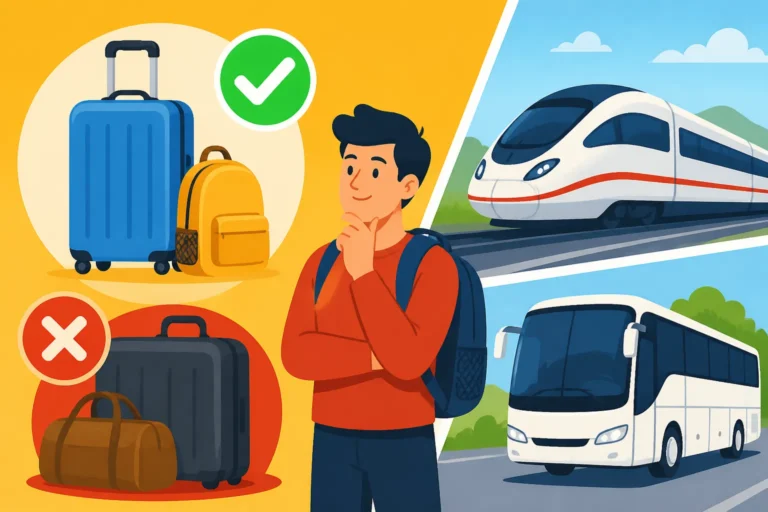
The luggage policy on Spanish intercity buses is generally generous but strictly enforced regarding where items go. Large suitcases and backpacks must go in the "maletero" (the hold underneath the bus). You are responsible for placing your own bag in the hold and taking it out at the end. There is rarely a tag system, so it is wise to put a distinctive ribbon or sticker on your bag to prevent another passenger from grabbing yours by mistake.
Inside the bus, you are only allowed a small "bolso" or a laptop-sized backpack. The overhead bins are much smaller than those on airplanes or trains. If you have a carry-on sized suitcase, the driver will likely insist it goes underneath. Valuable items like passports, cameras, and laptops should always stay with you in the cabin. If you find yourself with a long layover, many stations have "consignas" (lockers) where you can store your bags for a few euros while you go explore the city.
Facilities and Life at the Terminal
Most medium-to-large stations have a "cafetería" which is the heart of the terminal. Here you can get a "café con leche" and a "tostada" for a few euros while you wait. These cafes are also the best place to find a functioning restroom, as the ones in the main terminal area can be hit-or-miss in terms of cleanliness. If you are using your bus journey as a jumping-off point for sightseeing, you can often find great tours through GetYourGuide that start near the central city hubs.
| Feature | Standard Bus (Normal) | Premium/Supra Bus |
|---|---|---|
| Seat Configuration | 2 + 2 (Standard) | 2 + 1 (More Space) |
| WiFi | Usually included, but slow | High-speed, more reliable |
| Power Outlets | Common on newer fleet | Guaranteed USB or AC |
| Refreshments | None (Bring your own) | Often includes water/snack |
| Legroom | Standard | Extended / Reclining |
| Entertainment | Shared overhead screen | Individual touchscreens |
The Onboard Experience and Etiquette
Once you are on the bus, the experience is generally quiet and professional. Spanish passengers tend to be respectful of the shared space, especially during the afternoon hours when many people take the opportunity to nap. It is considered polite to keep phone conversations brief and at a low volume. If you want to listen to music or watch a movie, headphones are a non-negotiable requirement.
Buses are equipped with "climatización" (air conditioning), which can be quite aggressive in the summer. Even if it is 40 degrees outside, I always carry a light sweater or a large scarf because the interior of a Spanish bus in July can feel like a refrigerator. Conversely, in the winter, the heating can be quite high, so dressing in layers is the best strategy for a comfortable journey.
Staying Connected and Entertained
Most national lines like Alsa and Avanza offer free WiFi. However, the quality of this connection depends heavily on the terrain. If you are crossing the mountains of the Picos de Europa or the Sierra Morena, expect the signal to drop out frequently. I always recommend downloading your maps, podcasts, or movies before you leave the station.
On many long-haul routes, the bus will make a scheduled 15-to-20-minute stop at a "vía de servicio" (roadside service station). This is your chance to stretch your legs, use a proper restroom, and grab a "bocadillo." Be very careful to note the bus number and the dársena; at a busy service station, five identical Alsa buses might be parked in a row, and they will not wait for you if you are late returning from the snack bar.
Facilities on the Bus
Most intercity buses in Spain have a small toilet located near the middle or rear exit. While these are fine for emergencies, they are quite cramped and can be difficult to use while the bus is moving at 100 km/h. It is always better to use the facilities at the station before you board. If you are traveling with children, the "Supra" classes often have cleaner and more accessible restrooms. If you are arriving in a city for a quick visit, you might even consider Best Day Trips From Madrid by Train as a point of comparison for facilities, as trains generally offer more spacious amenities.
Comparing Buses to Other Modes of Transport
The perennial question for any expat is: "Should I take the bus or the train?" In Spain, the answer depends entirely on your destination. For the "radial" routes out of Madrid (like to Valencia, Seville, or Barcelona), the AVE high-speed train is much faster but often three to four times the price of a bus. However, for "transversal" routes (like traveling along the northern coast or between Mediterranean cities), the bus is often the only direct option.
Buses are also the undisputed winners for reaching "España Vaciada"—the rural heartland of the country. Many beautiful medieval villages are not served by trains at all. In these cases, the bus is not just a cheaper option; it is the only way to travel without a car. When planning your accommodation near these rural stops, Booking.com often has the most comprehensive listings for small "pensiones" or rural guesthouses.
Cost vs. Time Efficiency
If you book in advance, a bus ticket from Madrid to Granada might cost 20 euros and take 5 hours. The train might cost 60 euros and take 3.5 hours. For a student or a budget-conscious expat, that 40-euro saving is significant. Additionally, bus stations are often located more centrally in smaller towns than train stations, which might be a few kilometers outside the "casco antiguo" (old town).
Furthermore, the bus allows for more spontaneous travel. While AVE trains often sell out days in advance during peak periods, you can almost always find a seat on a bus, even if you book just a few hours before departure. This flexibility is perfect for those who want to explore the country without a rigid itinerary. You can use Omio to see these options side-by-side and decide if the time saved on a train is worth the extra cost.
Environmental and Scenic Benefits
Traveling by bus is one of the most environmentally friendly ways to see Spain, second only to the train. It also offers a unique perspective on the landscape. From the window of a bus, you see the changing colors of the olive groves in Jaén, the rugged red earth of La Mancha, and the misty green valleys of the Basque Country at a pace that allows you to actually appreciate them.
If you are using the bus to reach a scenic area, consider booking a guided tour through GetYourGuide once you arrive. They offer many walking tours or specialized excursions that pick up from central locations near the bus terminals, allowing you to maximize your time in a new city without the stress of navigating local transport immediately.
Practical Tips for a Stress-Free Journey
To wrap up your preparation, keep these veteran tips in mind. First, always check which station your bus departs from. Large cities like Madrid have multiple terminals (Estación Sur, Avenida de América, Moncloa, etc.), and going to the wrong one can mean missing your trip entirely. Double-check your ticket for the specific station name.
Second, keep your "NIE" or passport number handy. When booking online, you will often be asked for a document number. This is a standard part of Spanish security, and you should carry the corresponding ID with you on the bus, as the driver may check it against your ticket.
Finally, don't be afraid to ask for help. While the system has its complexities, the people working in the stations are generally helpful if you approach them with a "por favor" and a smile. Navigating the Spanish bus network is a rite of passage for any expat, and once you’ve mastered it, the entire Iberian Peninsula truly becomes your backyard.
Disclaimer
The information provided in this guide is for general informational purposes only and reflects the state of the Spanish bus network as of mid-2026. While we strive to provide the most accurate and up-to-date details, transport schedules, prices, and company policies are subject to change by the operators or government authorities. We recommend verifying specific travel details on official booking platforms or at the station before your journey. This guide does not constitute legal or professional travel advice.