How to Format Dates, Phone Numbers, and Addresses on a Spanish CV
Missing out on an interview because a recruiter misread your graduation date is a heartbreaking expat rookie mistake. I once had a hiring manager throw out my application entirely because my unformatted, foreign phone number looked like a scam. This guide explains exactly how to correctly format dates, phone numbers, and addresses on a Spanish CV so local recruiters actually call you back.
Disclosure: This post may contain affiliate links. We may earn a commission at no extra cost to you if you make a purchase through these links. Read full disclosure.
The Spanish Date Format Decoded
In Spain, everything from contract start dates to your personal date of birth is scrutinized by human resources. However, the American formatting system will cause immediate confusion if pasted directly onto your application.
Days, Months, and Years in the Correct Order
In the United States, dates are written in the Month/Day/Year format. If you write 05/04/2023 on your CV, an American recruiter reads it as May 4th. However, Spain officially uses the Day/Month/Year format. A Spanish recruiter reading that exact same number will automatically assume you mean April 5th. This seemingly minor difference can cause catastrophic misunderstandings when listing your university graduation date or the expiration date of your legal residency card, an administrative detail heavily scrutinized by employers, which we explain in Getting an NIE for Employment or Study: Practical Overview.
When writing out dates completely on a CV, the Real Academia Española (RAE) dictates that months should never be capitalized in Spanish unless they start a sentence. Therefore, you should write “14 de octubre de 2023” instead of “October 14th”. If you are using a purely numerical format for brevity, use slashes or hyphens (14/10/2023 or 14-10-2023). Mastering these minor linguistic rules is an essential part of integration and a core component of How to Build a Spanish‑Style CV From Scratch (Template Guide).
Listing Experience Timelines
When you list your professional experience, you must clearly dictate your start and end dates. Avoid using the English abbreviation “Present” or “Current” to describe your active job. The correct Spanish term to use on a resume is Actualidad. Your employment timeline should look clean and read exactly like this: Ene 2021 – Actualidad.
If an employer calls you to verify these dates over the phone, you must be able to confidently read them aloud in Spanish without hesitation. Dedicating time to practicing numbers and calendar dates with SpanishPod101 ensures that when the HR manager asks you to confirm your previous employment timeline, your spoken Spanish matches the professional accuracy of your resume. Understanding how to structure your overall resume architecture around these specific chronological dates is a vital skill that will keep your application out of the rejection pile.
Formatting Your Phone Number for Local Recruiters
Your phone number is the single most important piece of data on your CV. If the recruiter cannot reach you instantly, the rest of your incredible qualifications do not matter.
The Importance of Country Codes
Spanish mobile numbers are exactly nine digits long and always begin with a 6 or a 7. If you are applying for jobs before you have officially relocated, or if you are still using your home country’s mobile device, you must absolutely include your international country code (e.g., +1 for the US or +44 for the UK).
However, foreign phone numbers often trigger an unconscious bias in local recruiters. They might instantly assume you live abroad, require a costly relocation package, or will face complex visa issues. To drastically increase your callback rate, it is highly recommended to secure a local Spanish prepaid SIM card as soon as possible. Because legacy telecom companies charge ridiculous international transaction fees when you try to top up a local Spanish prepaid SIM with a foreign bank card, using Wise to fund your new Spanish phone plan allows you to bypass these hidden exchange rate markups effortlessly.
Grouping Digits the Spanish Way
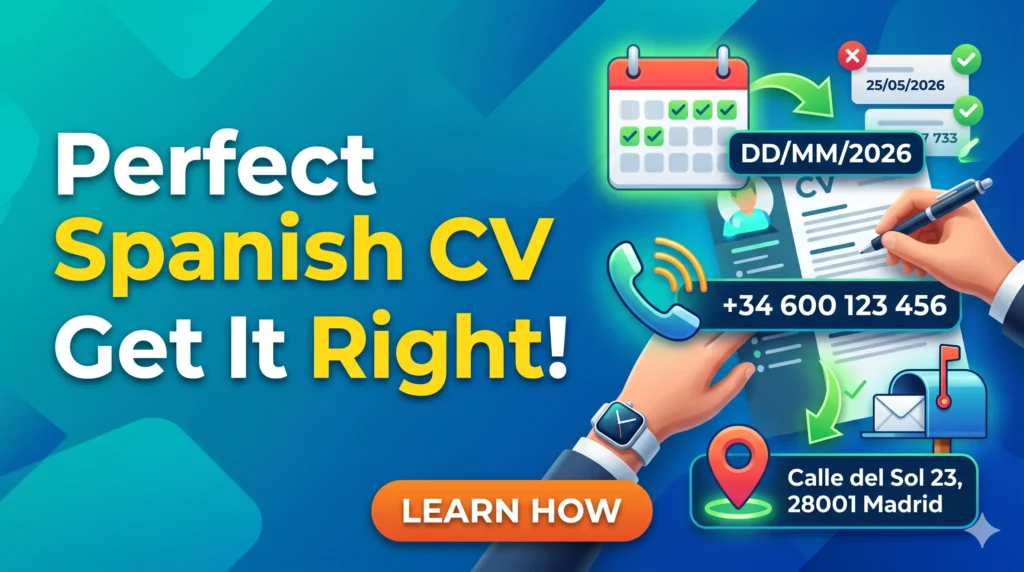
In North America, phone numbers are traditionally grouped with parentheses and dashes, such as (XXX) XXX-XXXX. In Spain, recruiters expect to see mobile numbers grouped in blocks of three, or a block of three followed by pairs. The standard visual formats are XXX XX XX XX (e.g., 600 12 34 56) or XXX XXX XXX (e.g., 600 123 456).
Do not use dashes or parentheses. Use simple spacing. This is exactly how Spanish recruiters read numbers aloud when dialing. If you manage to secure a phone screen, the interviewer will likely rattle off a follow-up office number for you to call. By utilizing the auditory exercises on SpanishPod101, you can train your ear to catch these rapid-fire paired numbers (sesenta, doce, treinta y cuatro), preventing you from constantly asking the busy recruiter to repeat themselves. Formatting your number correctly shows that you already understand the rhythm of local corporate communication.
Translating and Formatting Your Address
Including your full physical address is a mandatory cultural requirement in Spain. Leaving it off makes your CV look highly suspicious.
Spanish Address Architecture
Spanish addresses contain layers of dense information that simply do not exist in standard Anglo-Saxon formats. A typical address looks like this: Calle Mayor 12, 3º B.
You must construct your address block using the exact local hierarchy:
- Tipo de Vía: Always start with the street type (Calle, Avenida, Paseo, Plaza).
- Nombre: The specific name of the street.
- Número: The building number.
- Piso: The floor of the building. (3º means the third floor).
- Puerta: The door letter or number (B).
Sometimes you will see unique abbreviations like Bajo Izda (Ground floor, left door) or S/N (Sin número – Without a number). You must format your address exactly as it appears on your official rental contract, a vital document we explain how to secure properly in Renting an Apartment in Spain: A Guide for Expats. If you successfully secure a job, your employer will use this exact address format to draft your official, legally binding employment contract. If you happen to move apartments during your job hunt, updating this address on your CV and your legal paperwork is absolutely mandatory, a bureaucratic chore identical to the one outlined in How to Change Address on Your TIE Card After Moving in Spain.
Why the Postal Code Matters
The Spanish Código Postal (CP) is a five-digit number that precedes the name of the city (e.g., 28013 Madrid). You must include the postal code on your CV without fail.
For local retail, hospitality, or entry-level student jobs—which we discuss heavily in How to Find a Legal Part-Time Job as a Student in Spain—recruiters use the postal code to instantly determine if you live within a reasonable commuting distance of the storefront. Furthermore, many modern Spanish corporations use automated Applicant Tracking Systems (ATS) that automatically filter out and reject CVs missing a valid five-digit postal code.
Once you land the job and your address is verified by the company, the HR department will need a local Spanish IBAN to process your first monthly paycheck. Establishing this financial lifeline is a necessity mapped out in Opening a Bank Account in Spain: Step-by-Step for Foreigners. However, while you are waiting for that first local deposit to clear at the end of the month, using Wise allows you to easily transfer your foreign savings to cover your daily commuting costs and rent, ensuring your initial weeks of employment are completely financially stress-free.
| Data Type | Standard Anglo-Saxon Format | Spanish CV Format | Example on a Spanish CV |
| Dates | MM/DD/YYYY | DD/MM/YYYY | 14/10/2023 |
| Months | Capitalized (October) | Lowercase (octubre) | 14 de octubre de 2023 |
| Current Job | Present / Current | Actualidad | Ene 2021 – Actualidad |
| Phone Number | (XXX) XXX-XXXX | XXX XX XX XX | +34 600 12 34 56 |
| Address | 123 Main St, Apt 4B | Street Type, Name, Number, Floor, Door | Calle Mayor 12, 3º B |
Avoiding Translation Errors and Regional Formatting
When constructing your CV, localizing your contact information requires understanding the deep linguistic nuances of the specific Spanish autonomous community you are targeting.
Co-Official Languages and Street Names
Spain is not a monolith. If you are applying for a job in Barcelona, Valencia, or Bilbao, the street names on your CV should reflect the local co-official language. For example, in Catalonia, a street is a Carrer, and an avenue is an Avinguda. In the Basque Country, a street might be a Kalea.
You should never aggressively translate a Catalan or Basque street name into standard Castilian Spanish on your CV. If your official rental contract says you live on Carrer de la Marina, do not write Calle de la Marina. Altering the official registered name of the street will deeply confuse the local postal service and instantly flag you as an expat who is entirely disconnected from the local culture. Demonstrating linguistic respect on your CV proves to the employer that you are actively integrating into their specific region. To truly nail these regional pronunciations during your interview, utilizing the regional dialect features on SpanishPod101 guarantees you won’t butcher the name of the company’s headquarters when asked about your daily commute.
Consistency Across All Platforms
Formatting your CV correctly is utterly useless if your digital footprint tells a completely different story. Spanish recruiters will almost certainly cross-reference your submitted PDF with your LinkedIn profile. You must ensure that the date formats, the spelling of your address, and your phone number spacing are perfectly identical across every single platform.
If your CV says you graduated in Ene 2021 but your LinkedIn says January 2021, it breaks the immersion of a fully localized applicant. The ultimate goal is to make the HR manager completely forget that they are reading the resume of a foreigner. By meticulously managing these formatting details, you prove that you possess the precise administrative skills necessary to handle the complex, bureaucratic realities of Spanish corporate life. This directly justifies why they should hire you over a local candidate.
And once they do hire you, knowing that you can rely on Wise to seamlessly manage the transfer of your international savings into your new Spanish lifestyle removes the final layer of anxiety from your expat job hunt. Getting the formatting right is the very first step toward building a sustainable, lucrative career in Spain.
References
Primary sources (official)
- Real Academia Española (RAE) – Escritura correcta de las fechas: https://www.fundeu.es/recomendacion/como-se-escriben-las-fechas/
- Servicio Público de Empleo Estatal (SEPE) – Orientación y modelos para el Currículum Vitae: https://www.sepe.es/
- Correos España – Normas de direccionamiento postal: https://www.correos.es/
Other helpful sources
- InfoJobs – Consejos para redactar los datos personales en el CV: https://orientacion-laboral.infojobs.net/
- Europass – Estandarización de formatos europeos: https://europass.europa.eu/en/country/work-spain
Disclaimer
The information provided in this guide is exclusively for educational and informational purposes and does not constitute official career, legal, or immigration advising. The formatting recommendations for dates, phone numbers, and addresses reflect standard corporate cultural practices and postal regulations in Spain but may vary depending on the specific applicant tracking system (ATS) utilized by multinational corporations. You should always ensure that the personal data provided on your CV matches your official legal documentation (padrón, TIE, or rental contract) to prevent administrative delays during the formal hiring and payroll onboarding process.