How to Extend a Spanish Student Visa: Renewal Checklist
Staring at a calendar realizing your TIE expires in three weeks while you still haven’t gathered your translated bank statements is a panic-inducing expat rite of passage. I almost lost my legal residency because I misunderstood the new financial requirements and submitted my paperwork late. This guide breaks down the exact checklist to successfully extend your Spanish student visa without rejection.
Disclosure: This post may contain affiliate links. We may earn a commission at no extra cost to you if you make a purchase through these links. Read full disclosure.
Understanding the Student Visa Renewal Rules
Spanish bureaucracy is infamous for shifting its rules without warning. If you are applying for a prórroga de estancia por estudios (extension of stay for studies) for the upcoming academic year, you must understand that the landscape has changed significantly, especially regarding how the Extranjería (Immigration Office) views long-term students.
Strict New Regulations for Language Students
The most massive shift in recent Spanish immigration law targets foreigners perpetually enrolling in language schools to maintain residency. Under the new regulations, a student visa based on language courses can only be renewed one time, for a maximum total stay of two academic years.
Furthermore, simply showing a certificate of attendance from your academy is no longer enough. You must prove genuine academic progress. The immigration office now requires language students to present an official DELE or SIELE certificate (or proof of exam registration) to secure a renewal. To prepare for the DELE or SIELE exam, studying daily with SpanishPod101 is an incredibly effective way to ensure you pass this mandatory test on your first try.
The Critical Application Timeline
By law, you can submit your renewal application during a highly specific window: 60 days before your current TIE expires, and up to 90 days after it expires.
Do not rely on the 90-day grace period. Submitting after your card expires limits your right to travel freely outside of Spain and puts you at the mercy of bureaucratic backlogs. The moment you start planning your renewal, you must also consider if you will be moving flats for the next academic year. Securing a new lease requires deep research, a process outlined in Renting an Apartment in Spain: A Guide for Expats. If you do move, your renewal paperwork must reflect your new empadronamiento (city hall registration).
The Ultimate Prorroga Document Checklist
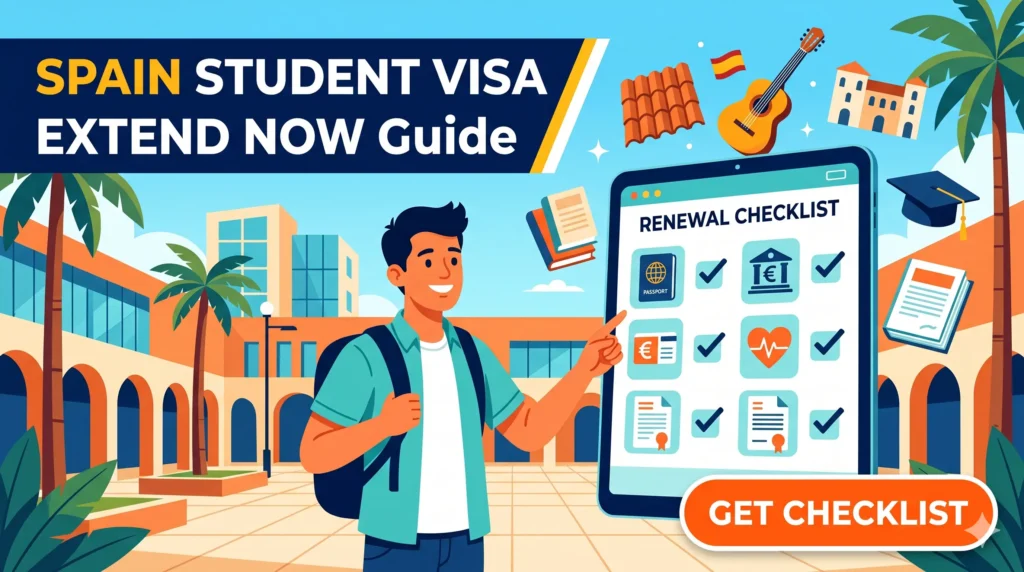
To avoid the dreaded trámite requerido (request for missing documents), your application dossier must be flawless. Prepare the following items meticulously.
Form EX-00 and Academic Proof
Your primary application document is the official Form EX-00. Alongside this, you must prove two distinct academic facts: you successfully completed your previous year, and you are enrolled for the next. You will need a certificado de aprovechamiento (certificate of achievement) from your past school and a matrícula (enrollment letter) for your future program. To request your certificate of completion from your university’s administration office, practicing administrative vocabulary through SpanishPod101 will make the interaction much smoother and prevent bureaucratic misunderstandings.
Proving Financial Means The IPREM Rule
The Spanish government requires you to prove you can support yourself without working. The financial threshold is 100% of the IPREM. Currently, this equates to €600 per month, or €7,200 for a standard 12-month renewal. Providing foreign bank statements is a nightmare because immigration officers often demand expensive, sworn translations of non-Spanish documents.
Instead of paying high bank fees to translate foreign currency statements, using a borderless account like Wise allows you to generate a clean Euro statement that Spanish immigration officials easily understand. Furthermore, you can use your Wise balance to easily pay your tuition for the upcoming semester without getting hit by terrible international wire transfer markups.
While the government asks for €600 to prove your solvency, actually surviving on that amount is nearly impossible in major cities like Madrid or Barcelona, a financial reality mapped out heavily in Cost of Living in Spain.
| Document Name | Spanish Term | Purpose |
| Application Form | Modelo EX-00 | The official government application form for student stays. |
| Academic Progress | Certificado de Aprovechamiento | Official proof that you passed your previous year’s classes. |
| Next Year’s Enrollment | Matrícula | Proves you are registered and have paid for the upcoming term. |
| Financial Proof | Certificado Bancario | Shows a minimum balance of €600/month (100% IPREM). |
| Health Insurance | Seguro Médico Sin Copagos | Full coverage private medical insurance with no deductibles. |
| Application Fee | Tasa 790 código 052 | The administrative processing fee paid at a local bank. |
Handling Insurance, Fees, and Submission
Once your academic and financial paperwork is gathered, you must finalize the administrative requirements before clicking submit.
Health Insurance and the Tasa 052
You must provide proof of comprehensive private health insurance. The policy must offer full coverage with zero copays (sin copagos) and no waiting periods (sin carencias). The coverage must span the entirety of your requested visa extension.
You are also required to pay the administrative processing fee, known as Tasa 790-052 (specifically checking the box for “prórroga de estancia”). The fee is currently around €17.49. You must download the PDF, print it, and physically pay it at a bank teller or ATM. To accomplish this, you need a functional local banking setup, which we decode in Opening a Bank Account in Spain: Step-by-Step for Foreigners. If you need to top up your account at the last minute to hit the €7,200 annual threshold or pay these administrative fees, transferring emergency funds through Wise is nearly instant and keeps your savings intact.
Electronic vs In-Person Submission
While you technically can submit your documents physically through a public registry office, the fastest and most secure method is submitting online via the government’s Mercurio platform using a Digital Certificate (Certificado Digital). Submitting online provides you with an immediate, timestamped receipt (resguardo).
Navigating the Mercurio online submission portal requires solid reading comprehension, which you can quickly build by completing modules on SpanishPod101 before tackling the dense government website. To process anything online, you obviously need stable home internet to upload massive, multi-page PDF files. Ensure your flat is properly connected by reading Best Internet Providers in Spain for Expats. You will also need a functional local phone number to receive SMS verification codes during the digital signature process, an infrastructural hurdle explained in Best Way to Get a SIM Card in Spain as a New Arrival.
The Final Step Fingerprints and the New TIE
Waiting for your renewal to be processed can take anywhere from one to four months. Once you check the portal and see the glorious words Resuelto Favorable (Approved), your journey is still not completely over.
Securing the Toma de Huellas Appointment
Your approval letter grants you the right to stay, but you must physically issue a new foreigner identity card (TIE). You have one month to book a Toma de Huellas (fingerprinting) appointment at the national police station. You will need your approval letter, a recent passport photo, the application form EX-17, and proof of payment for the card issuance fee (Tasa 790-012).
When you finally attend your fingerprinting appointment at the police station, having practiced your conversational skills with SpanishPod101 ensures you understand the officer’s rapid instructions without needing a frantic translator. If you moved apartments during the renewal waiting period, you must bring an updated padrón certificate to the police station; dealing with these official address updates is a strict procedure we detail in How to Change Address on Your TIE Card After Moving in Spain.
Setting Up Your Renewed Life
With your new card secured, you can finally relax and focus on your studies. If you moved into a new place for the academic year, make sure you properly manage your home infrastructure so you are not overpaying. You will likely need to manage your own utility contracts; understanding exactly what taxes and tolls you are paying for is covered in Understanding Utility Bills in Spain and Setting Up Electricity and Gas in Spain.
If your flat feels too expensive, beware of hidden maintenance costs in your building, a topic we explore in A Guide to Spanish Community Fees. Conversely, if you are unhappy with your current power rates, you have the legal right to change them immediately, as explained in How to Switch Electricity Provider in Spain Step-by-Step. When tracking your domestic budget against the strict immigration rules, holding your day-to-day funds in Wise protects you from fluctuating exchange rates so you never accidentally fall below the government’s financial threshold during your stay.
References
Primary sources (official)
- Ministerio de Asuntos Exteriores – Visado de estudios: https://www.exteriores.gob.es/Embajadas/kingston/en/ServiciosConsulares/Paginas/Consular/Visado-de-estudios.aspx
- Portal de Administraciones Públicas – Tasa 052: https://sede.administracionespublicas.gob.es/pagina/index/directorio/tasa052/
Other helpful sources
- Esade – Guide to Student Visas in Spain: https://www.esade.edu/beyond/en/student-visa-spain/
- Pro Spain Consulting – Extension of a Student Visa in Spain: https://prospainconsulting.com/2026/02/20/extension-of-a-student-visa-in-spain-how-to-stay-in-the-country-after-your-studies/
Disclaimer
The information provided in this guide is exclusively for educational and informational purposes and does not constitute official legal or immigration advising. Spanish immigration laws, specifically the requirements regarding language school renewals (DELE/SIELE exam mandates), IPREM financial thresholds, and the Mercurio online submission portal, are highly dynamic and subject to frequent updates by the Ministerio de Inclusión, Seguridad Social y Migraciones. You should always consult with a registered Spanish immigration lawyer (abogado de extranjería) or verify the latest requirements directly with your local Oficina de Extranjería before submitting your visa renewal application.