What You Can Bring to Spain Duty‑Free When Moving (Household Goods)
Disclosure: This article contains affiliate links. If you buy through them, we may earn a commission at no extra cost to you. Read our full disclosure.
Paying thousands of euros in unexpected import taxes because a customs agent decided your used sofa looked “too new” is an expat’s worst nightmare. I practically sobbed when I was threatened with a massive tax bill over a used vacuum cleaner. This guide breaks down exactly what household goods you can legally bring to Spain duty-free and how to prove it to customs.
The Core Rule for Duty-Free Import Exemption
Expats often assume that because they are moving their own personal, used belongings across the ocean, Spanish customs will simply wave their shipping container through the port. This is a massive, incredibly expensive misconception.
The Agencia Tributaria (Spanish Tax Agency) does not grant tax relief automatically to anyone crossing the border. You must actively apply and legally qualify for a Franquicia por traslado de residencia (tax exemption for change of residence). If you fail to prove your absolute eligibility, you will be hit with the standard 21% IVA (Value Added Tax), plus additional import tariffs based on the estimated value of your entire household. Factoring the lingering risk of these sudden customs taxes into your relocation cash reserves is a survival tactic deeply explored in Cost of Living in Spain: Budgeting for Expats.
The Twelve-Month Non-EU Residency Proof
The very first hurdle in avoiding the 21% IVA trap is proving you actually lived outside the European Union for at least twelve consecutive months prior to your move. You cannot just casually claim you were living abroad; the Spanish government requires an airtight, officially stamped paper trail.
If you are a returning Spanish citizen, this is strictly proven via the Baja Consular (your official deregistration from the Spanish consulate in your previous country). For non-EU expats, you must provide official certificates of residency, localized tax returns, or long-term employment contracts from your previous home country. You will also need to show your newly approved Spanish visa or residency card (TIE).
You must upload these heavy, heavily scanned PDF dossiers directly to your customs broker’s digital portal. Attempting to manage this dense digital bureaucracy on a lagging hotel Wi-Fi network will cause the portal to time out repeatedly. Utilizing an expat-centric, high-speed fiber provider like Tiekom ensures your massive customs files upload flawlessly the first time, preventing a digital timeout from delaying your container’s release.
The Six-Month Ownership Mandate
This is the strict customs rule that catches almost everyone off guard. To qualify for the tax exemption, you must explicitly prove that you have owned and actively used the items you are shipping for at least six months prior to your relocation.
You cannot buy a massive, brand-new OLED television, an expensive mattress, or high-end kitchen gear a week before your flight and expect to bring it into Spain tax-free. Customs agents actively look for items still wrapped in their original retail packaging or sporting pristine factory tags. If an inspector physically opens your box and finds a new laptop sealed in factory plastic, they will flag the entire shipment. For high-value items that look suspiciously new, customs may demand the original purchase receipts to verify the purchase date.
What Exactly Qualifies as Duty-Free Household Goods
The Spanish government defines bienes personales (personal property) quite strictly. It covers the standard, expected contents of a primary home, but there are massive logistical and legal caveats you must understand before you start packing boxes.
Acceptable Furniture and Electronics
Used furniture, clothing, bicycles, books, and standard household electronics are generally accepted without issue by customs, provided they clearly look used. However, you must critically evaluate whether it is actually worth the physical effort to ship these items across the world.
The most destructive mistake North American expats make is shipping 110V household appliances. Spain operates entirely on a 230V electrical grid. Do not bring your expensive stand mixer, blender, hair dryer, or vacuum cleaner. Even if you purchase a heavy, expensive step-down voltage converter, the differing hertz frequency (50Hz in Spain versus 60Hz in the US) will eventually burn out the appliance’s motor. Instead of paying exorbitant international shipping fees for appliances that will inevitably break, sell them before you leave. Use the cash to order brand new, 230V-compliant European appliances directly from Amazon Spain once you sign your new lease.
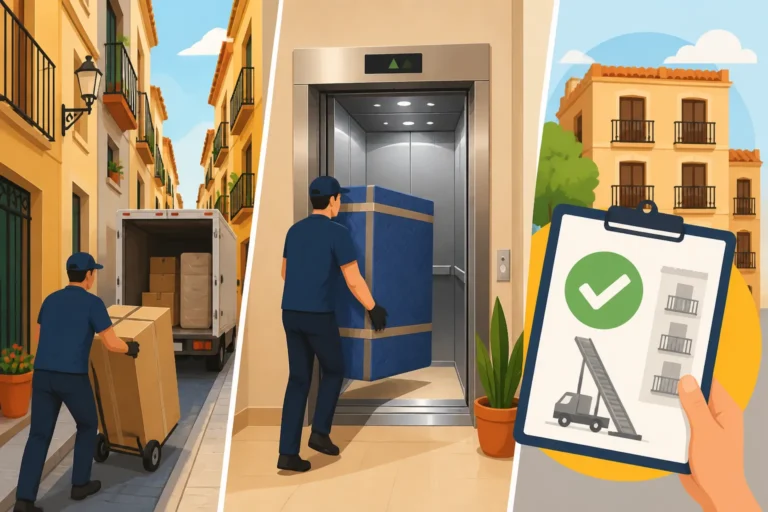
Furthermore, Spanish apartment dimensions are drastically smaller than suburban North American houses. Your oversized, deep-seated sectional sofa likely won’t physically fit through the narrow, winding stairwell of a historic building. To understand these intense spatial limitations before you pack a single box, meticulously read Spanish Apartment Sizes: m², Floor Numbers, and Listing Terms Explained. Leaving heavy furniture behind and ordering modular, flat-pack replacements via Amazon Spain is often vastly cheaper than paying international ocean freight rates and exterior hoisting fees.
Strict Exclusions and Prohibited Items
There are absolute hard limits on the duty-free exemption. You absolutely cannot import alcohol, tobacco products, or commercial goods under this personal household exemption. If you are a freelancer bringing over specific tools of the trade (like specialized cameras or drafting equipment), they might qualify, but anything that looks like “commercial stock” meant for bulk resale will be heavily taxed and potentially seized.
Additionally, the Agencia Tributaria attaches a major legal string to this tax relief: the “prohibition of transmission.” Once your shipment clears customs and enters Spain tax-free, you are legally forbidden from selling, renting, or lending out any of the imported items for a full twelve months. If you import an expensive vintage car duty-free and try to sell it in Madrid three months later, the tax agency will retroactively hit you with the original import duties plus severe financial penalties. For a broader look at the logistical timelines of actually moving these large items safely, review How to Ship Personal Belongings to Spain: Customs and Timing.
| Item Category | Duty-Free Exemption Status | Key Customs Condition |
| Used Furniture & Clothing | Exempt | Must be owned and physically used for at least 6 months prior. |
| Brand New Electronics / Furniture | Taxed (21% IVA + Duties) | Items in original packaging or visibly unused trigger full taxes. |
| Personal Vehicles (Cars/Motos) | Exempt (with strict conditions) | Must be registered in your name > 6 months; cannot be sold for 12 months. |
| Alcohol & Tobacco | Strictly Prohibited | Does not qualify for personal household exemption under any circumstance. |
| Commercial Stock / Trade Goods | Taxed | Any items meant for resale or massive bulk face full commercial import duties. |
The Logistics of Clearing Spanish Customs
Customs clearance is a bureaucratic gauntlet. Your interaction with the Agencia Tributaria requires extreme precision, deep patience, and an understanding of their specific, unyielding timelines.
The Packing List Nightmare
To clear customs, your moving company or broker will demand a highly detailed, translated packing list (lista de empaque). This is not a casual summary; it must include estimated values and itemized contents for every single box.
Never write vague descriptions like “misc household goods” or “kitchen stuff.” If customs officers see vague descriptions on the manifest, they will immediately assume you are hiding commercial goods. They will physically open and inspect the box, which triggers mandatory inspection fees (aforos) that you must pay entirely out of pocket. Be brutally specific: “12 used cotton shirts, 4 pairs used shoes, value €50.” While you are standing in a chaotic room trying to write this detailed inventory in Spanish, having a reliable mobile data plan from Tiekom allows you to instantly pull up a translation app on your phone to find the exact vocabulary words for your obscure household items.
Timing and the One-Year Window
You do not have forever to claim this tax exemption. The Spanish government explicitly requires you to import your duty-free household goods within twelve months of officially establishing your residency in Spain. If your container arrives thirteen months after your visa is approved, the exemption expires, and you will pay full taxes on everything inside it.
Once the cargo ship finally arrives at the Port of Valencia or Barcelona, unloading the ship and waiting for customs officials to physically process the paperwork can add an additional two to four agonizing weeks to your timeline. To survive this painful gap without sleeping on a bare floor, veteran expats immediately order temporary household essentials like an air mattress, cheap cookware, and folding chairs from Amazon Spain to be delivered to their empty apartment on day one.
If your container miraculously beats you to Spain and you have not yet signed a residential lease, you will be forced to find off-site commercial storage for your goods until you secure an apartment. To avoid getting trapped in expensive, predatory storage contracts while you wait for real estate agents to call you back, carefully review Renting Storage Units in Spain: Costs and Contract Tips.
You must also be prepared to pay small, unavoidable port handling fees (tasas) when the shipment is finally released. Attempting to pay these urgent fees with a foreign credit card often triggers international fraud alerts, causing your cargo to sit in the port accruing massive daily storage penalties (demorajes). Having local financial infrastructure is essential; review Opening a Bank Account in Spain as a Non-Resident to avoid payment failures holding your cargo hostage. You will also eventually need an official address document to finalize your long-term local status, so ensure you read How to Get a Spanish ‘Certificado de Empadronamiento’ Copy.
Finally, while you are waiting in an empty apartment for customs to release your life, establishing your base home network immediately is critical. Getting your internet active so you can work and communicate with your frantic customs broker is a process thoroughly mapped out in Utility Costs in Spain: Electricity, Gas, Water, and Internet. You should also use this quiet downtime to build out your basic household safety gear; review What to Keep in a Spain ‘Emergency Kit’ (Heatwaves, Floods, Fires) to ensure you are prepared for unexpected Mediterranean weather events while waiting for your primary belongings to finally clear customs and arrive at your door.
References
Primary sources (official)
- Agencia Tributaria – Traslado de residencia. Franquicias y exención de impuestos: https://sede.agenciatributaria.gob.es/Sede/no-residentes/exenciones-viajeros-embajadas-otros/traslado-actividad-empresarial-residencia-otros/traslado-residencia-franquicias-exencion-impuestos.html
- Agencia Tributaria – NI GA 08/2021 de 5 de marzo, relativa a la franquicia aduanera y la exención de IVA por traslado de residencia: https://sede.agenciatributaria.gob.es/static_files/Sede/Tema/Aduanas/Notas_info/NI_2021/NIGA_08_21.pdf
Other helpful sources
- La Vanguardia – Cómo traer tus muebles y el coche sin pagar ni un euro en impuestos: https://www.lavanguardia.com/dinero/bolsillo/20260405/11503272/mala-planificacion-sale-cara-como-traer-tus-bienes-espana-mudanza-internacional-pagar-impuestos-pca.html
- Grupo Amygo – Requisitos de una mudanza internacional: https://www.grupoamygo.com/requisitos-de-una-mudanza-internacional/
Disclaimer
The information provided in this article is for educational and informational purposes only and does not constitute formal legal, tax, or customs brokerage advice. The regulations surrounding the Franquicia por traslado de residencia, the application of the 21% Impuesto sobre el Valor Añadido (IVA), and the strict twelve-month timelines for importing personal household goods are governed exclusively by the Spanish Agencia Tributaria and are subject to rigid enforcement. The prohibition on selling, renting, or transferring imported duty-free goods for twelve months after clearance is strictly monitored. Always consult directly with a licensed Spanish customs broker (agente de aduanas) to verify your specific tax liabilities and eligibility for import duty exemptions before shipping your belongings.