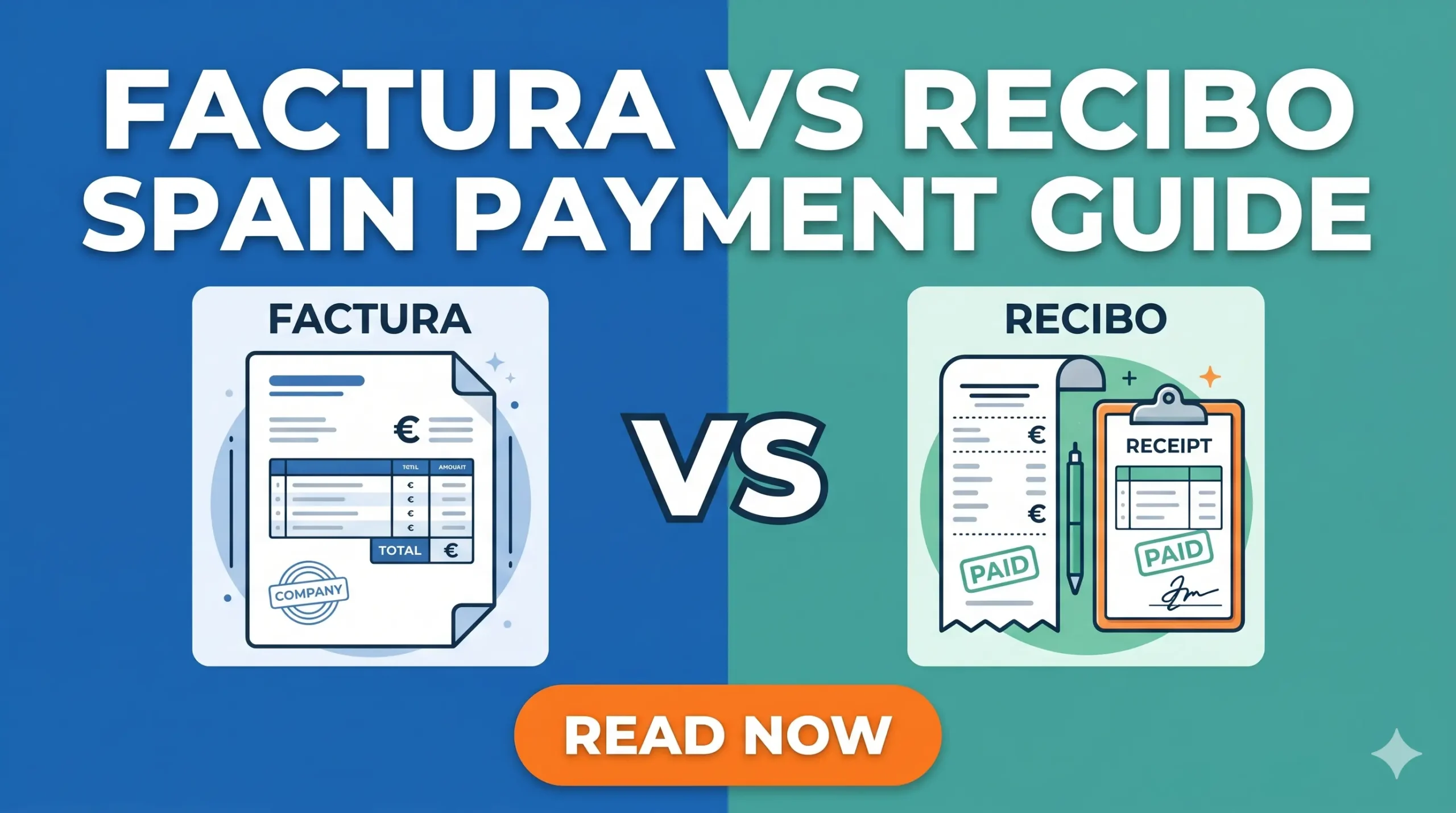
What Is ‘Factura’ vs ‘Recibo’ in Spain? Payment Terms Explained
Expats constantly assume any piece of paper proving they paid for something holds legal weight in Spain. This guide decodes the crucial differences between these Spanish payment terms, ensuring you secure the exact paperwork needed for your taxes, refunds, and warranties.
Disclosure: This post may contain affiliate links. We may earn a commission at no extra cost to you if you make a purchase through these links. Read full disclosure.
The Legal Weight of the Factura
In Spain, a factura is not just a casual receipt; it is a highly regulated, legally binding tax invoice. If you are self-employed, running a business, or trying to claim a tax deduction for a home renovation, a factura is the absolute only document the Spanish tax authority (Agencia Tributaria) will accept as proof of your expense.
What Makes a Document an Official Factura
A proper factura is a formal commercial document. It must explicitly state the word “Factura” at the top and include a sequential invoice number. More importantly, it must contain the complete, official identification details of both the buyer and the seller.
This means your full name, your registered Spanish address, and your Foreigner Identification Number must be printed directly on the page. Without officially securing your identification paperwork through the steps outlined in Getting an NIE for Employment or Study: Practical Overview, you cannot legally request or receive a personalized factura. The document must also clearly break down the base price of the item or service, the exact percentage of the IVA (Value Added Tax) applied, and the final total.
How to Ask for a Factura
You cannot walk back into a store three weeks later and ask them to convert a standard receipt into a factura; their accounting software usually prevents it. You must explicitly request it at the exact moment of purchase.
When you approach the cash register to buy a laptop for your home office, you must proactively say, “¿Me haces factura, por favor?” (Can you make me an invoice, please?). The cashier will then ask for your NIE and your address to generate the document. If you fail to do this and only receive a standard store receipt, you absolutely cannot use it to offset your quarterly IVA declarations. Beyond taxes, possessing a formal factura is the most powerful piece of evidence you can hold during a warranty dispute or when filing a formal consumer complaint against a business.
When to Accept a Recibo or Ticket
If you are just living your daily life and do not need to deduct a specific expense on your annual tax return, the strict documentation rules relax significantly.
The Everyday Ticket
A ticket (officially known in Spanish law as a factura simplificada or simplified invoice) is the standard strip of thermal paper you get at Mercadona, a local cafe, or a Zara clothing store. It proves a transaction occurred, lists the items bought, and shows the total IVA paid, but it does not contain your personal identifying information.
While a ticket is completely useless to your tax accountant, it is exactly what you need to enforce your everyday consumer rights. If you buy a sweater and need to exchange it for a different size, or a microwave that breaks in the first week, the ticket is your legal proof of purchase. Knowing how long you must hold onto these slips to protect your consumer rights is deeply explored in Refunds in Spain: Return Periods and Proof You Need.
The Bank and Rent Recibo
A recibo translates directly to “receipt,” but in the Spanish administrative world, it almost always refers to a proof of payment or a bank deduction, rather than an itemized list of retail goods.
When you pay your monthly rent, your landlord should issue you a recibo del alquiler. It is a simple document acknowledging that funds were received for that specific month, serving as your primary shield against false eviction claims. Understanding how to manage these specific rent receipts and what they should contain is a vital tactic covered in How to Negotiate Rent in Spain: Financial Prep and Tactics.
Similarly, when your internet or water provider automatically pulls money from your checking account, your bank generates a recibo bancario. This document proves the bill was successfully paid to the company, but it does not break down the specific kilowatts used or the exact tariff applied. Managing these automated bank recibos is central to controlling your household overhead, a chaotic reality detailed in Typical Utility Bills in Spain: Electricity, Gas, Water (Examples).
| Document Type | Primary Purpose | Contains Your NIE? | Valid for Tax Deductions? | Valid for Retail Returns? |
| Factura | Official tax invoice for accounting. | Yes (Mandatory) | Yes | Yes |
| Ticket | Standard retail proof of purchase. | No | No | Yes |
| Recibo | Proof of a bank transfer or rent payment. | Sometimes | No | N/A |
Managing Your Payments and Paperwork
To keep your facturas and recibos organized without bleeding money to legacy bank fees or losing track of your expenses, you must optimize your financial infrastructure.
Controlling Automated Recibos Locally
Because Spanish utility companies and gym memberships operate almost exclusively via direct debit, you will generate dozens of bank recibos every single month. Understanding how you can legally block, authorize, or dispute these automated pulls is critical, as explained in How Direct Debits Domiciliacion Work in Spain: Setup and Cancellations.
To bypass the agonizingly slow bureaucracy and the punitive quarterly maintenance fees of traditional Spanish high-street banks, opening your daily operational account with N26 is highly strategic. N26 issues a fully recognized local Spanish IBAN directly from your smartphone interface, allowing you to seamlessly process all your local recibos without hidden fees. You get an instant notification every time a recibo is charged, giving you total visibility over your spending. This frictionless integration is exactly why digital alternatives dominate guides comparing the Best Low-Fee Bank Accounts in Spain for New Residents and Opening a Bank Account in Spain: Step-by-Step for Foreigners.
Settling Facturas Across Borders
If you hire a Spanish immigration lawyer, an architect, or a real estate agent to help you relocate, they will issue you a massive formal factura that must be paid via bank transfer. If your primary savings are still sitting in US dollars, British pounds, or Australian dollars, do not use your legacy home bank to execute an international wire transfer to pay this invoice.
Traditional legacy banks will crush your budget with hidden SWIFT network fees and terrible exchange rate markups. To fiercely protect your capital, you must route your international payments through Wise. Utilizing Wise allows you to completely bypass the expensive, antiquated SWIFT network entirely. Wise converts your home currency to euros using the real, transparent mid-market exchange rate. You can instantly transfer those cleanly converted euros directly to the lawyer’s Spanish account to settle the factura. The massive mathematical advantage of this cross-border strategy is heavily mapped out in Sending Money to/from Spain: Comparing Banks vs Transfer Services and Spanish Bank Transfer Terms: Transferencia, Bizum, SEPA Explained.
Organizing Documents for Tax Season
Keeping the difference between a factura and a recibo strictly separated is the only way you will survive the Spanish tax calendar. Spain taxes your worldwide income, and compiling your local business facturas alongside your global earnings requires extreme organization. Getting a head start on understanding what paperwork the government expects is precisely why reviewing Spanish Income Tax IRPF 101: Who Pays and When and Spanish Taxes for Foreign Residents: Practical Guide to Staying Compliant is non-negotiable for new arrivals.
To streamline your international tax reporting and protect your surplus wealth from local retail inflation, many veteran expats consolidate their global assets in a sophisticated brokerage account like Interactive Brokers. Utilizing Interactive Brokers allows you to build a multi-currency portfolio that generates incredibly clean, standardized annual tax reports.
This elegantly separates your long-term global wealth from the administrative chaos of tracking your daily Spanish grocery tickets and utility recibos. Keeping your financial footprint organized through agile platforms like Interactive Brokers ensures you can easily supply your Spanish accountant with the exact, verifiable documents needed to satisfy the strict compliance structures detailed in Foreign Income Reporting in Spain: What Residents Need to Know. Managing the right paperwork ensures you stay fully compliant while allowing your capital to grow securely.
References
Primary sources official
- Agencia Tributaria – Contenido de la factura: https://sede.agenciatributaria.gob.es/Sede/ayuda/manuales-videos-folletos/manuales-practicos/manual-iva-2021/capitulo-10-obligac-formales-suj-registro/obligaciones-materia-facturacion/contenido-factura.html
- Boletín Oficial del Estado (BOE) – Real Decreto 1619/2012, por el que se regulan las obligaciones de facturación: https://www.boe.es/buscar/act.php?id=BOE-A-2012-14696
Other helpful sources
- Portal de la Administración General del Estado – Trámites y Consumo: https://administracion.gob.es/
- Ministerio de Derechos Sociales, Consumo y Agenda 2030 – Derechos del consumidor: https://www.consumo.gob.es/
Disclaimer
The information provided in this guide is exclusively for educational and informational purposes and does not constitute official legal, accounting, or tax advice. Spanish invoicing regulations under Real Decreto 1619/2012, Value Added Tax (IVA) deductibility rules, and the specific documentation required by the Agencia Tributaria for business expenses are highly complex and subject to strict enforcement. While we strive to ensure absolute accuracy, you should always consult a registered Spanish accountant (gestor or asesor fiscal) to determine exactly which facturas are eligible for tax deductions in your specific professional or personal situation.