What Is the Difference Between IRPF and IVA in Spain?
Disclosure: This article contains affiliate links. If you buy through them, we may earn a commission at no extra cost to you. Read our full disclosure.
Staring at Spanish invoices and payslips full of confusing acronyms leaves many expats wondering what they actually owe the government. I remember panicking over my first freelance invoice, terrified I was accidentally committing tax fraud by mixing up these two completely different deductions. This guide explains the exact difference between Spanish income tax and value-added tax to keep you compliant.
Understanding IRPF The Spanish Income Tax
Before diving into the complex intersection of Spain’s dual tax systems, you must isolate and understand the core tax that impacts absolutely everyone who earns money in the country. The IRPF is the cornerstone of the Spanish financial landscape.
What IRPF Actually Taxes
IRPF stands for Impuesto sobre la Renta de las Personas Físicas, which translates directly to Personal Income Tax. This is the direct tax levied on the money you earn over the course of a calendar year. If you are legally classified as a tax resident in Spain, you are liable to pay IRPF on your worldwide income, regardless of where that money was physically generated.
The Spanish income tax is divided into two distinct categories: the general base and the savings base. The general base applies to the money you earn from your standard employment salary, your profits as a self-employed worker, and any rental income you might generate from properties you own. This general base is highly progressive, meaning the more you earn, the higher the percentage the government takes from your upper earnings brackets. State and regional governments both take a cut, meaning your final IRPF rate depends heavily on the autonomous community where you live. Understanding this division is a critical first step when navigating Spanish Income Tax IRPF 101: Who Pays and When.
The savings base applies to your investments. If you generate capital gains from selling stock or receive dividends, this income is taxed at a different, usually lower, progressive rate. Many expats use global platforms like Interactive Brokers to maintain a portable investment portfolio. When you generate capital gains within your Interactive Brokers account, those profits must be declared under the savings base of your Spanish IRPF, ensuring you are fully compliant with local regulations regarding global wealth.
How IRPF is Collected Throughout the Year
Spain does not wait until the end of the year to collect your income tax. The system operates on a “pay-as-you-go” model through mandatory withholdings, known as retenciones.
If you are a salaried employee, your human resources department is legally required to estimate your annual tax burden and withhold a percentage of your gross salary every single month. This money is sent directly to the tax authority (the Agencia Tributaria) on your behalf. When you look at your monthly paystub, the large deduction shrinking your gross pay down to your net pay is the IRPF withholding. Learning Understanding Spanish Payslips: IRPF and Social Security Lines Explained is essential to ensure your employer is not over-withholding or under-withholding your taxes.
At the end of the fiscal year, every taxpayer must perform a grand reconciliation during the annual tax campaign, known as the Declaración de la Renta. You submit a form to calculate your exact tax burden based on your actual earnings. If your employer withheld too much IRPF throughout the year, the government refunds you the difference. If they withheld too little, you must pay the shortfall out of pocket. To ensure these annual payments or refunds process smoothly, it is highly recommended to use a reliable local bank account. Having your account with N26 makes this seamless, as N26 provides a recognized Spanish IBAN that plugs flawlessly into the government’s tax portal for direct debits and instant refunds.
Understanding IVA The Spanish Value Added Tax
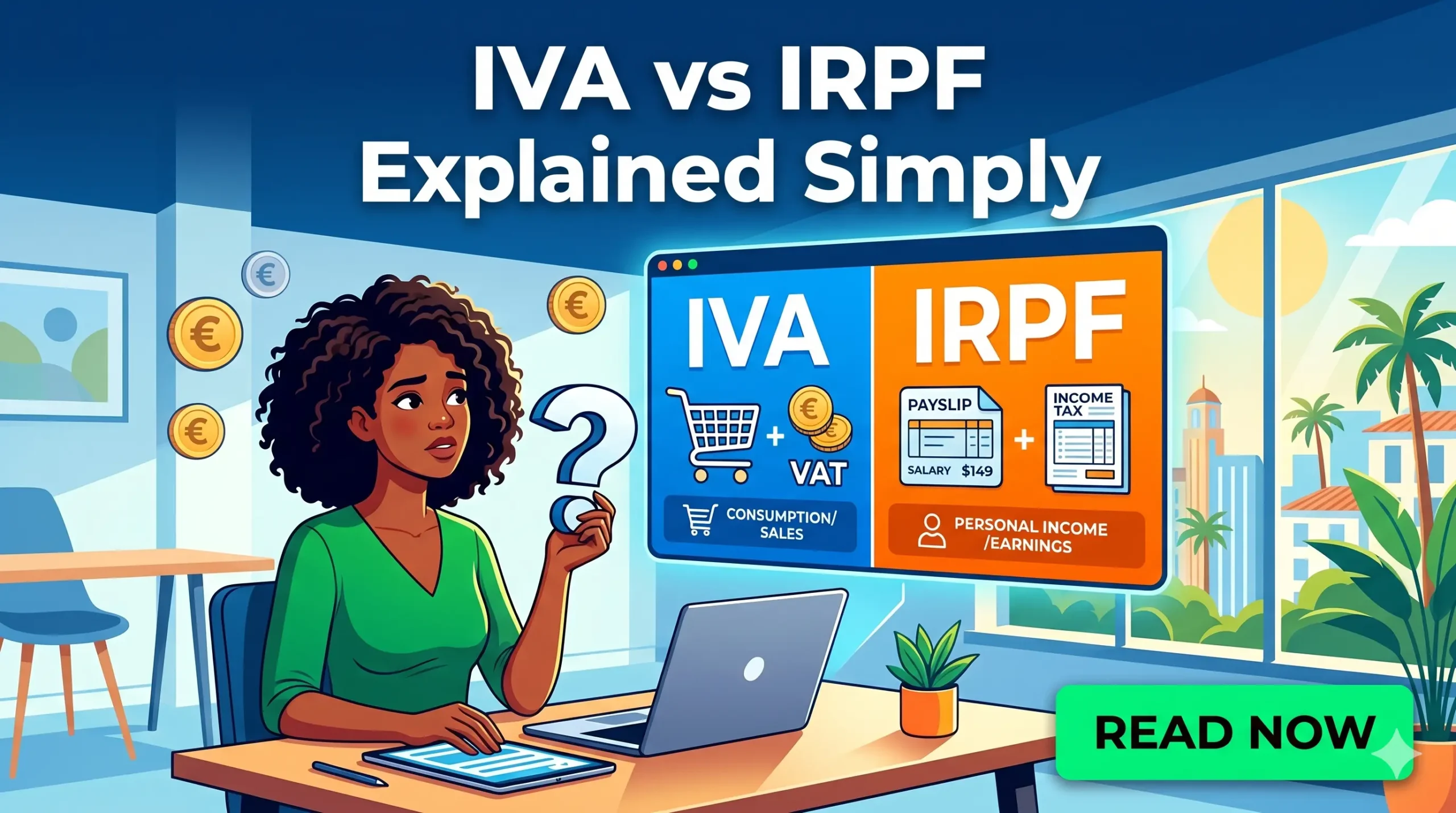
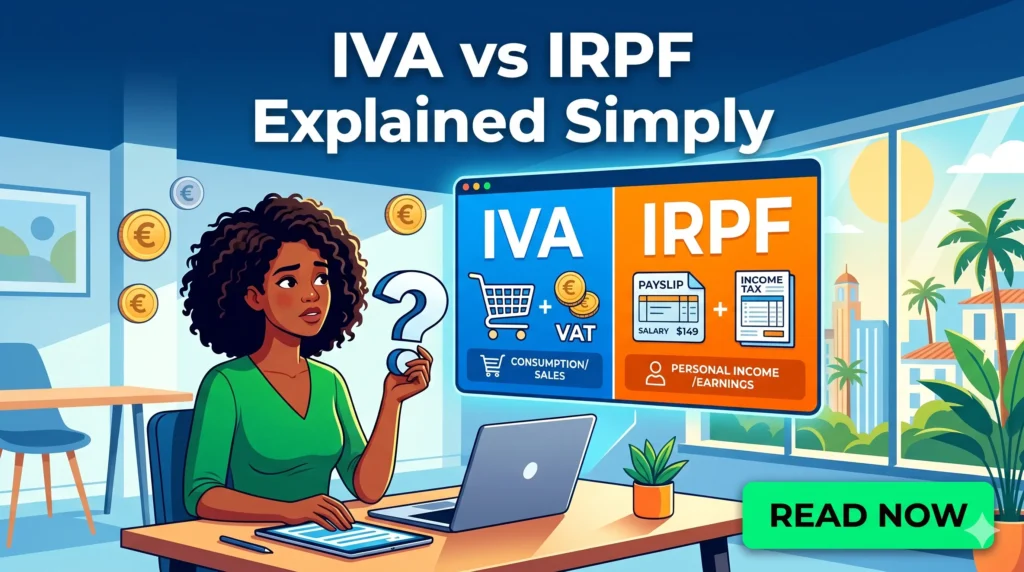
While IRPF is a direct tax on the money you earn, IVA is an indirect tax on the money you spend. Grasping the psychological difference between these two taxes is the key to surviving the Spanish bureaucratic system.
How the IVA System Works
IVA stands for Impuesto sobre el Valor Añadido, which is the Spanish equivalent of Value Added Tax (VAT) or sales tax. It is an indirect consumer tax applied to almost all goods and services sold within the country.
The most important concept to understand about IVA is that it is fundamentally designed to be paid by the end consumer. Businesses and freelancers do not technically pay IVA out of their own profits; they merely act as unpaid tax collectors for the Spanish government. When a business sells a product, they add the IVA percentage to their base price. The consumer pays the total amount, and the business holds onto that IVA portion until the end of the quarter, at which point they hand it over to the Agencia Tributaria.
Because it is a consumption tax, you pay IVA every time you buy groceries, pay your internet bill, or hire a plumber. Unlike IRPF, your personal income level does not change the amount of IVA you pay. A millionaire and a university student pay the exact same IVA on a cup of coffee.
IVA Rates in Spain
To complicate matters, Spain does not apply a flat IVA rate to everything. The government categorizes goods and services into different tiers to make essential items more affordable while heavily taxing luxury goods and general services.
| IVA Tier | Current Rate | Common Examples of Goods and Services |
| Standard Rate (General) | 21% | Clothing, electronics, internet services, alcohol, freelance services. |
| Reduced Rate (Reducido) | 10% | Public transport, hotel stays, restaurant meals, water bills. |
| Super-Reduced Rate (Superreducido) | 4% | Basic necessities like bread, milk, medicine, books, newspapers. |
| Exempt (Exento) | 0% | Public healthcare services, official education, insurance services. |
Understanding these rates is crucial if you are trying to budget your daily life or if you are planning major purchases. The standard 21% rate applies to the vast majority of commercial transactions you will encounter as an expat living in Spain.
How IRPF and IVA Impact Autonomos
The true confusion between IRPF and IVA peaks when an expat decides to become a freelancer (Autónomo). As an employee, you only ever worry about your IRPF being withheld. As an Autónomo, you suddenly become personally responsible for calculating, collecting, and paying both taxes simultaneously. Navigating this overlap is the most stressful part of Autonomo Registration in Spain: RETA Models and Deadlines.
Invoicing as a Freelancer
When you issue an invoice to a Spanish business client, you must calculate both the IVA and the IRPF directly on the document. This double calculation trips up almost every new freelancer.
First, you determine your base rate. Let’s say you charge 1,000 euros for a marketing project. Because you are providing a standard service, you must add 21% IVA. Your client owes you an additional 210 euros, making the subtotal 1,210 euros. You must mentally separate that 210 euros because it is not your money; it belongs to the government.
Simultaneously, because you are billing a Spanish business, that business is legally required to withhold a portion of your IRPF to send to the government on your behalf. The standard freelance IRPF withholding is 15% (though it can be 7% for your first three years). Therefore, you must subtract 15% of your base rate (150 euros) from the total invoice.
The final amount your client transfers to your bank account is 1,060 euros. You collected 210 euros in IVA for the government, and the client withheld 150 euros of your IRPF for the government. This complex mathematical dance requires extreme organization and a clear understanding of How to Pay Taxes in Spain Online: AEAT Payment Options.
Quarterly Tax Declarations
Unlike salaried employees who settle their IRPF once a year, freelancers must interact with the tax agency every three months. Every quarter, you must file separate forms to declare the IVA you collected and the IRPF you owe.
The Modelo 303 is the quarterly IVA declaration. You total up all the IVA you charged your clients (Output IVA) and subtract the IVA you paid on your business expenses, like a new laptop or your internet bill (Input IVA). You must pay the remaining balance to the Agencia Tributaria.
The Modelo 130 is the quarterly IRPF declaration. If you invoice individual consumers rather than businesses (meaning no one is withholding your IRPF for you), you must proactively pay 20% of your net quarterly profit as an advance payment on your annual income tax.
If you have a particularly profitable quarter, the combined IVA and IRPF tax bill can easily reach thousands of euros. If you are caught off guard and do not have enough euros in your local account, you might need to transfer emergency funds from your home country. Using traditional bank wires will cost you heavily in exchange rate fees. Transferring those emergency tax funds via Wise ensures you get the real mid-market exchange rate, saving you significant money when settling your quarterly obligations. Once your taxes are safely paid, you can review What Is Model 100 in Spain? A Simple Guide to the Annual Return to see how these quarterly IRPF prepayments eventually offset your final yearly burden.
Practical Tips for Managing Your Spanish Taxes
Mixing your personal grocery shopping with your business invoices is a guaranteed way to trigger an audit and miscalculate your IRPF and IVA obligations. Surviving the Spanish tax system requires strict structural boundaries.
Keeping Personal and Business Finances Separate
The golden rule for expats, especially freelancers, is to maintain separate bank accounts. You should have one account dedicated solely to receiving client payments and paying the quarterly IVA and IRPF bills.
Operating your freelance business through an N26 account is highly effective because it offers deep visibility into your cash flow without the punishing monthly maintenance fees charged by traditional Spanish high-street banks. When you receive an invoice payment, you can instantly categorize the IVA portion within the N26 app so you never accidentally spend the government’s money. When quarter-end arrives, the AEAT portal will seamlessly direct debit the funds from your local N26 IBAN. Finding efficient banking solutions is heavily detailed in Opening a Bank Account in Spain: Step-by-Step for Foreigners.
Handling International Financial Overlap
The rules regarding IVA change drastically when you deal with international clients. If you are a Spanish freelancer billing a client located in the United States or the United Kingdom, you generally do not charge them Spanish IVA, as the service is considered an export outside the European Union. However, you are still liable for your Spanish IRPF on that income.
Receiving payments from non-EU clients also introduces heavy currency conversion fees. Having your foreign clients pay your invoices directly into your Wise account allows you to receive dollars or pounds locally, convert them to euros at the mid-market rate, and then transfer the clean net profit to your Spanish operating account. This protects your margins from being eaten by legacy banking systems, a strategy highlighted in Sending Money to/from Spain: Comparing Banks vs Transfer Services.
Once you have successfully calculated your IVA, paid your quarterly IRPF, and finalized your net income, you should actively invest your surplus rather than letting it sit idle. Maintaining your investments in a global brokerage like Interactive Brokers prevents you from being locked into restrictive local Spanish investment products. You can route your clean, post-tax euros into Interactive Brokers and build a globally diversified portfolio that remains portable if you ever decide to leave Spain. Just remember that any dividends generated in that account must be declared on your annual tax return, reinforcing the importance of mastering Foreign Income Reporting in Spain: What Residents Need to Know.
References
Primary sources (official)
- Agencia Tributaria (AEAT) – Sede Electrónica: https://sede.agenciatributaria.gob.es/
- Ministerio de Hacienda: https://www.hacienda.gob.es/
Other helpful sources
- Portal de la Administración General del Estado: https://administracion.gob.es/
Disclaimer
The information provided in this guide is exclusively for educational and informational purposes and does not constitute official legal, financial, or tax advice. Spanish tax laws, IRPF brackets, IVA rates, and freelance regulations are highly complex and subject to frequent updates by national and regional authorities. While we strive to ensure absolute accuracy, you should always verify the latest requirements directly with the Agencia Tributaria or consult a registered Spanish Gestor or certified tax advisor for personalized guidance regarding your specific financial situation.