Spain Relocation Checklist: First 30 Days for New Residents
Disclosure: This article contains affiliate links. If you buy through them, we may earn a commission at no extra cost to you. Read our full disclosure.
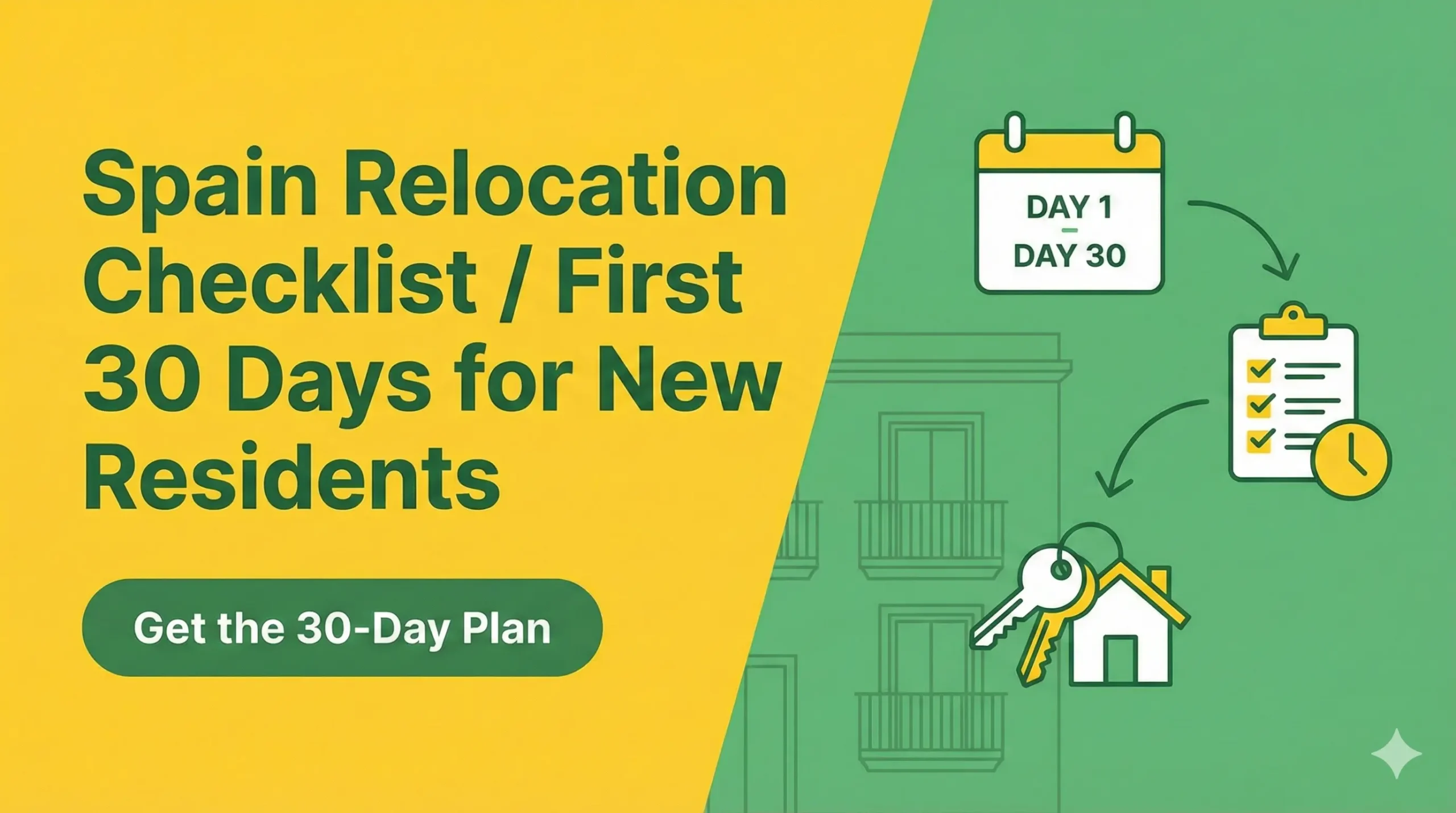
The first month in Spain sets the trajectory for your entire residency. This detailed checklist guides new arrivals through the critical administrative steps of the first 30 days, including securing a SIM card, finding housing, registering on the Padrón, obtaining the TIE card, and opening a bank account.
Week 1: Arrival and Immediate Connectivity
The priority for your first week is simple: land, connect, and orient yourself. Do not try to solve complex residency issues on day one. Focus on the tools you need to function. The most urgent task is securing a local phone number. You cannot navigate Spanish life effectively with a foreign number because you will need a Spanish (+34) line to receive two-factor authentication codes from banks, appointment confirmations from government offices, and calls from potential landlords. To ensure you select the right connectivity option immediately, reading up on Mobile Phone Plans in Spain: Prepaid vs Contract for Foreigners will help you decide between a temporary prepaid SIM and a long-term contract. Generally, a prepaid SIM is the fastest solution for week one as it only requires a passport.
Understand Your NIE Status
If you obtained a visa before coming to Spain (like a Non-Lucrative Visa or Digital Nomad Visa), your NIE (Número de Identidad de Extranjero) should be stamped on the visa in your passport. Memorize this number. It is your fiscal identity for life. If you are an EU citizen arriving without a visa, or if you somehow arrived without an NIE, you typically cannot get one in the first week as it requires a specific appointment. However, you should identify exactly which category you fall into so you can book the correct appointment for later. Without an NIE, you cannot sign a long-term rental contract or set up home internet.
Get Your Transport Card
Depending on your city, public transport is the lifeline of daily movement. In Madrid, you should buy a Tarjeta Multi at any metro machine. If you are under 26, apply online immediately for the Abono Joven (youth pass), which offers unlimited travel for a very low monthly fee. In Barcelona, the T-mobilitat system is the standard. Do not rely on single tickets; they are expensive and inefficient. Having a monthly pass allows you to explore neighborhoods freely as you hunt for an apartment.
Temporary Accommodation Check-In
Ideally, you have booked a temporary rental (Airbnb, hotel, or specialized expat housing) for at least the first 3-4 weeks. Do not assume you can find a long-term apartment in three days. The market is competitive and rushing leads to bad contracts. Use this week to walk around different barrios (neighborhoods) to see where you actually want to live.
Week 2: Housing and The Padron
Week two is about establishing a legal footprint. You need a physical address to proceed with almost any other bureaucratic step. This will likely be your full-time job this week. Use apps like Idealista and Fotocasa, but be aggressive. Good apartments in cities like Madrid, Barcelona, and Valencia disappear in hours. Call agents immediately rather than emailing, and have your financial documents ready to prove solvency.
Signing the Contract
When you find a place, you will sign a lease (contrato de arrendamiento). Ensure this is a long-term contract (vivienda habitual) if you plan to stay for years, as this gives you rights regarding rent caps and extensions. If you sign a seasonal contract (temporal), you have fewer rights. Before you commit to a property, it is vital to understand the legal distinctions and protections available to you by reviewing our guide on Renting in Spain: Contracts, Deposits, and Tenant Rights, which covers the essential clauses you must look for to avoid predatory terms. Crucially, ask the landlord immediately if you can register on the Padrón. If they say no, walk away. You legally cannot be a resident in Spain without being on the Padrón.
The Padron Municipal Registration
Once you have your signed rental contract, you must register at the Town Hall (Ayuntamiento). This process is called the Empadronamiento. It is the most critical bureaucratic step you will take because the resulting certificate proves you live in a specific municipality. You will need this certificate for getting your TIE (residency card), accessing public healthcare, and enrolling children in school. Because this process varies slightly by city and is often the first major hurdle for new arrivals, we have compiled a dedicated walkthrough on Empadronamiento in Spain: How to Register Your Address to help you prepare the correct documents and book your appointment.
Week 3: Legal Residency and Banking
Now that you have an address and a Padrón certificate, you can tackle the heavyweights: the National Police and the bank.
The TIE Appointment
If you are a non-EU citizen (e.g., UK, USA, Canada) with a visa, you must apply for your physical residency card, the TIE (Tarjeta de Identidad de Extranjero), usually within one month of arrival. This appointment takes place at a National Police station (Comisaría de Policía Nacional) and involves the “fingerprint taking” (toma de huellas). You will need to bring Form EX-17, the tax form 790-012 (paid), your passport with visa, your new Padrón certificate, and recent photos. This step transforms you from a “tourist with a visa” to a documented resident. For a step-by-step breakdown of the appointment and how to track your card’s status, refer to How to Get the TIE Card in Spain: Fingerprints, Fees, and Pickup.
Open a Resident Bank Account
With your NIE and ideally your TIE application receipt (or just your passport and visa), you should open a Spanish bank account. While you can survive with a Wise or Revolut account for day-to-day spending, you need a Spanish IBAN (starting with ES) for utility bills, paying taxes, and receiving a salary from a Spanish company. Traditional banks often charge high maintenance fees unless you deposit a salary, while online banks are often free. To navigate the compliance requirements and choose the best bank for your needs, check our article on Opening a Bank Account in Spain: Step-by-Step for Foreigners.
Digital Certificate
This is a “pro tip” that will save you hours of queuing. The Digital Certificate (Certificado Digital) is a software file you install in your browser that verifies your identity. It allows you to access almost all Spanish government websites (Tax Agency, Social Security, Town Hall) to do paperwork online. You can apply for the code online via the FNMT website, then verify your identity at a designated office (often the same place you do your Padrón or Social Security), and then download the certificate. Do this in Week 3, and you will rarely have to visit a government office physically again.
Week 4: Health, Utilities, and Integration
By Week 4, the stress should be subsiding. You have a home, an ID in process, and a bank account. Now, connect the final dots to make your life comfortable and secure.
Register for Healthcare
If you are employed or self-employed in Spain, you contribute to Social Security and are entitled to free public healthcare. You first need to obtain your Social Security Number (which can be done online with your new Digital Certificate) and then visit your local health center (Centro de Salud) to be assigned a GP and issued a health card (Tarjeta Sanitaria). If you are on a Non-Lucrative Visa or Digital Nomad Visa with private insurance, the process differs. To understand which system applies to you and how to navigate it, see our comparison of Spain Healthcare System for Expats: Public vs Private.
Set Up Home Utilities
Now that you have a Spanish bank account, switch the utility bills (electricity, water, gas) into your name. This is called cambio de titular. Check the “potencia” (power capacity) contracted for your electricity; if it is too low, your fuses will blow when you turn on the oven and AC, but if it is too high, you are overpaying. Internet installation is usually fast in Spain, with fiber optic providers installing within a few days.
Integration and Language
You have survived the bureaucracy. Now, live the life. Sign up for a language exchange or find a local academy, as even basic Spanish changes how locals treat you. Use apps like Meetup to find groups with shared interests. Take a train to a nearby town and remind yourself why you moved here.
30-Day Relocation Timeline Summary
| Timeframe | Key Tasks | Documents Needed |
| Week 1 | SIM Card, Transport Card, Temp Housing | Passport |
| Week 2 | Find Apartment, Sign Lease, Padrón | Passport, Employment Proof, Lease |
| Week 3 | TIE Appointment, Bank Account, Digital Cert | Passport, Visa, Forms 790/EX-17, Padrón |
| Week 4 | Health Card, Utilities, Social Life | Social Security #, Padrón, Bank IBAN |
Common Pitfalls to Avoid in the First Month
The “Mañana” Trap
Do not assume things will happen quickly. August is notoriously a “dead month” where government offices run on skeleton crews and businesses close. Christmas and Easter also slow everything down. If you arrive during these periods, adjust your expectations and budget for a longer stay in temporary accommodation.
Ignoring the Padrón
Many expats delay this, thinking it is optional or just a census. It is not. Without it, you are blocked from almost every other administrative step, including getting your residency card and health card. Prioritize it above everything except finding a roof over your head.
Losing Paperwork
Keep every piece of paper given to you by a government official. Even if it looks like a scrap of receipt paper (like the TIE collection slip), it is a legal document. Organize them in a physical folder. Spain is digitizing, but physical paper trails are still king in many interactions.
Falling for Scams
In the rush to find housing in the first 30 days, you are vulnerable. Never pay a deposit for an apartment you haven’t seen. Never send money to a “landlord” who claims to be out of the country and wants to send you the keys by courier. These are classic scams targeting new arrivals.
Conclusion
The first 30 days in Spain are a baptism by fire. You will likely feel frustrated by the appointments system, confused by the forms, and exhausted by the apartment hunt. This is normal. Every resident in Spain has gone through it. By following this checklist, you can methodically knock down the barriers. Focus on one week at a time. Secure your phone, get your home, register your address, and apply for your ID. Once those pillars are in place, the chaos subsides, and you can finally order a caña, sit on a terrace, and enjoy the Spanish lifestyle you worked so hard to achieve.
References
Primary sources (official)
- Ministry of the Interior (TIE & Foreigners): https://www.interior.gob.es/
- Sede Electrónica (Appointments – Cita Previa): https://sede.administracionespublicas.gob.es/icpplus/
- Fabrica Nacional de Moneda y Timbre (Digital Certificate): https://www.sede.fnmt.gob.es/
- Seguridad Social (Social Security): https://www.seg-social.es/
Other helpful sources
- Age in Spain (Residency Guides): https://www.ageinspain.org/
- Idealista (Housing Market): https://www.idealista.com/
Disclaimer
The information provided in this article is for educational and informational purposes only and does not constitute legal or immigration advice. Immigration procedures, appointment availability, and document requirements in Spain are subject to frequent changes by the government and local administration. We recommend consulting with a qualified ‘gestor’ or immigration lawyer to assist with your specific relocation needs.