Buying Property in Spain as a Foreigner: Process and Costs
Disclosure: This article contains affiliate links. If you buy through them, we may earn a commission at no extra cost to you. Read our full disclosure.
Purchasing real estate in Spain is a dream for many, but the bureaucratic process differs significantly from other countries. This guide details every step for foreign buyers, from obtaining an NIE and opening a bank account to calculating taxes, notary fees, and understanding the total cost of ownership.
Can Foreigners Buy Property in Spain?
The short answer is yes. The Spanish government places virtually no restrictions on foreigners buying property. You do not need to be a resident to purchase real estate. Whether you are an EU citizen or a non-EU national (such as from the USA, UK, or Canada), you have the same rights to buy property as a Spanish citizen.
However, while the right to buy is unrestricted, the process requires specific documentation. You cannot simply sign a contract and transfer money. You must first exist in the Spanish administrative system.
The Essential Prerequisite: The NIE Number
Before you can sign any official deed or even open a bank account to transfer your funds, you must obtain a Número de Identidad de Extranjero (NIE). This is your all-purpose fiscal identification number in Spain.
The NIE is mandatory for any significant financial transaction. It does not grant you residency or the right to work; it simply identifies you to the Spanish Tax Agency (Agencia Tributaria). You can apply for this in person at a police station in Spain or via a Spanish consulate in your home country. Because appointments can be scarce and bureaucratic processing times vary, we recommend initiating this step as soon as you decide to start looking for property. For a detailed walkthrough on how to navigate this application, refer to our guide on How to Get a Spanish NIE Number: In Spain vs Abroad.

The Step-by-Step Buying Process
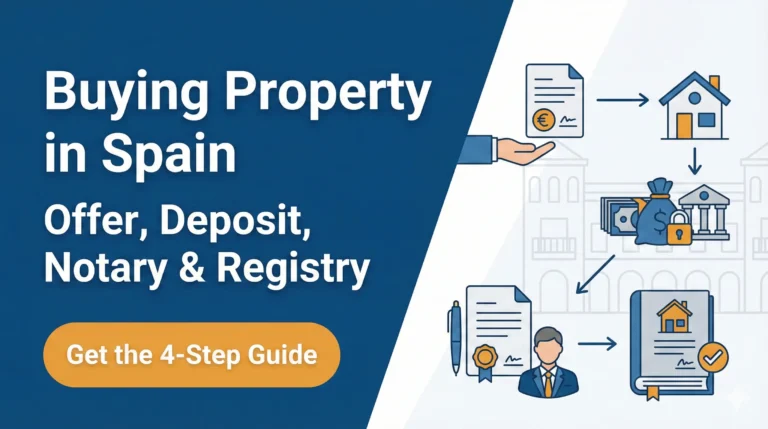
Buying a home in Spain is a multi-stage process that typically takes between two to four months from the initial offer to the final signing. Rushing these steps is the most common cause of legal disputes later on.
Step 1: Organizing Your Finances and Team
Before you fall in love with a property, you must have your financial logistics in place. This means more than just having savings; it means having those savings accessible in Spain.
You will typically need to open a non-resident bank account in Spain. While it is technically possible to transfer funds directly to the seller via the Notary, most utility companies and local councils will require a Spanish IBAN for direct debit setup (domiciliación) of bills after the purchase. Furthermore, transferring a large sum of money from a non-Euro account requires strategic planning to avoid losing thousands in exchange rates. To ensure you choose the right bank and avoid excessive non-resident fees, read our advice on Opening a Bank Account in Spain: Step-by-Step for Foreigners.
At this stage, you should also engage a specialized property lawyer (abogado). Do not rely solely on the real estate agent’s advice, and do not rely on the Notary to check for debts or illegal structural changes. The Notary’s job is to certify identity and signature, not to investigate the physical or legal reality of the building.
Step 2: The Property Search and The “Nota Simple”
Once you find a property, your lawyer must perform due diligence before you pay a single euro. The most critical document in this phase is the Nota Simple Informativa.
The Nota Simple is a report from the Land Registry that reveals:
- The true owner: Verifying the person selling it actually owns it.
- Debts and Encumbrances: In Spain, debts (like unpaid mortgages, seized assets, or unpaid taxes) are attached to the property, not the person. If you buy a house with a debt, you inherit that debt.
- Description: Whether the square footage matches what is advertised.
Step 3: The Reservation Contract (Contrato de Reserva)
If everything looks good initially, you may be asked to sign a Reservation Contract to take the property off the market. This usually involves a small fee (between €3,000 and €6,000).
Warning: Be extremely cautious at this stage. If you sign a reservation contract and pay a fee, and then simply change your mind, you lose that money. Ensure your lawyer includes a clause stating the deposit is refundable if legal checks reveal structural issues or if financing is denied.
Step 4: The Arras Contract (Contrato de Arras)
This is the point of no return. The Contrato de Arras is the private purchase contract between buyer and seller. At this stage, you typically pay 10% of the purchase price (minus the reservation fee already paid).
The most common type is the Arras Penitenciales (Penitential Arras), which dictates:
- If you (the buyer) pull out of the deal without valid legal cause, you lose your deposit.
- If the seller pulls out, they must return your deposit doubled.
This contract sets the final deadline for the purchase and details exactly what is included in the sale (furniture, appliances, etc.).
Step 5: The Public Deed (Escritura Pública)
The final stage happens at the Notary’s office. Both buyer and seller (or their power of attorney holders) meet to sign the Escritura de Compraventa (Public Deed of Purchase).
The Notary will read the deed aloud (in Spanish), verify identities, and confirm that payment has been made. Once signed, the keys are handed over, and you are officially the owner.
Step 6: Registration
Signing the deed makes you the owner, but you are not secure until that deed is entered into the Land Registry (Registro de la Propiedad). Your lawyer or the Notary will send the deed to the Registry immediately to prevent the seller from selling the property twice or taking out a mortgage on it after the sale.
The Cost of Buying: The “10-15% Rule”
One of the biggest shocks for foreign buyers is the high transaction cost in Spain. The price you see on the listing is not the price you pay. As a general rule of thumb, you must budget an additional 10% to 15% on top of the purchase price to cover taxes and fees.
The exact amount depends on whether you are buying a New Build (Obra Nueva) or a Resale Property (Segunda Mano), and which region of Spain you are in. For a granular look at exactly where this money goes, check our breakdown of Closing Costs When Buying in Spain: How Much to Budget.
Taxes on Resale Properties (ITP)
If you are buying a used home, you do not pay VAT. Instead, you pay Property Transfer Tax (Impuesto de Transmisiones Patrimoniales or ITP).
This tax is regional, meaning the rate changes depending on where the property is located.
- Valencia: 10%
- Catalonia: 10%
- Andalusia: 7% (General rate, though it can vary slightly based on value)
- Madrid: 6%
Taxes on New Build Properties (IVA + AJD)
If you are buying a brand-new property directly from a developer, the tax structure is different.
- VAT (IVA): You pay a flat 10% across most of Spain (IGIC is lower in the Canary Islands).
- Stamp Duty (AJD): You must also pay the Actos Jurídicos Documentados tax. This varies by region but typically falls between 1% and 1.5%.
So, for a new build in Valencia or Catalonia, you are effectively paying 11.5% in taxes alone.
Other Essential Fees
Beyond taxes, there are professional fees to consider:
- Notary Fees: These are fixed by law based on a sliding scale of the property value, usually ranging from €600 to €1,000.
- Land Registry Fees: Also based on property value, typically between €400 and €650.
- Legal Fees: Lawyers usually charge either a flat fee or a percentage of the purchase price (typically 1% + VAT). Do not skip this; the cost of a lawyer is tiny compared to the cost of fixing a legal mess later.
Comparison Table: New Build vs. Resale Costs (Estimate on €300,000 Property)
To visualize the difference, here is an estimated breakdown for a property purchased in the Valencian Community (one of the most popular regions for foreigners).
| Cost Item | Resale Property (Second Hand) | New Build Property (Developer) |
| Purchase Price | €300,000 | €300,000 |
| Transfer Tax (ITP) | €30,000 (10%) | N/A |
| VAT (IVA) | N/A | €30,000 (10%) |
| Stamp Duty (AJD) | N/A | €4,500 (1.5%) |
| Notary Fees | ~€800 | ~€800 |
| Registry Fees | ~€500 | ~€500 |
| Lawyer Fees | ~€3,630 (1% + VAT) | ~€3,630 (1% + VAT) |
| TOTAL ESTIMATED COST | €334,930 | €339,430 |
Note: These figures are estimates. ITP rates vary by region, and lawyer fees vary by firm.
Financing Your Purchase: Mortgages for Foreigners
If you require financing, the Spanish banking system is open to lending to foreigners, but the conditions are stricter than for tax residents.
Loan-to-Value (LTV) Ratios
- Residents: Banks will typically lend up to 80% of the property value (or the appraisal value, whichever is lower).
- Non-Residents: Banks see non-residents as higher risk. Consequently, the maximum LTV is usually 60% to 70%.
This means you need a significantly larger cash deposit. If you buy a €300,000 home as a non-resident, the bank might only lend you €180,000. You need to provide the remaining €120,000 plus the ~€35,000 in taxes and fees in cash. To understand how to improve your chances of approval and what documents you need to gather, consult our dedicated article on Mortgage in Spain for Foreigners: Eligibility and Documents.
Documentation Required
Spanish banks will scrutinize your solvency. You will need to provide:
- NIE number.
- Proof of income (payslips, pension, or tax returns from your home country).
- Credit report from your home country (e.g., Experian or Equifax).
- Bank statements for the last 6 months.
It is highly advisable to get a mortgage pre-approval before signing a Reservation Contract. If you sign a contract and then cannot get the funds, you risk losing your deposit unless your lawyer inserted a specific “subject to financing” clause.
Avoiding Common Pitfalls
The Spanish property market has a reputation for “legal irregularities,” particularly with properties in rural areas (campo properties). Here are three major pitfalls to watch out for.
1. Illegal Builds
In the past, many properties were built without proper planning permission or on land designated as “rustic” where building was prohibited. You might see a beautiful villa, but legally, the town hall might consider it a “tool shed.” If the property is illegal, you cannot legally renovate it, you might face demolition orders, and you cannot rent it out for tourism. Always check the Cédula de Habitabilidad (Habitability Certificate).
2. The “Complementary Tax” Surprise
Sometimes, the Tax Office decides that the price you paid for the property was “too low” compared to their internal valuation tables. Months after you buy, you might receive a bill for impuesto complementario, asking you to pay the tax difference. Your lawyer can appeal this, but it is a common headache in bargain purchases.
3. Community Debts
If buying in an urbanization or a building with shared facilities (pool, gardens, elevator), ensure the previous owner is up to date with their Community Fees. The administrator of the community should provide a certificate proving the seller is debt-free.
Ownership Costs: Beyond the Purchase
Once you own the property, the costs do not stop. You must budget for the annual running costs of a Spanish home.
Annual Property Tax (IBI)
The Impuesto sobre Bienes Inmuebles (IBI) is the local council tax. It is calculated based on the cadastral value (valor catastral) of the land and building. It is usually paid once a year (typically between September and November). For a standard 2-bedroom apartment, this might range from €200 to €600 per year, but villas can be significantly higher. For a more detailed look at the recurring expenses of homeownership, see our guide on Property Taxes in Spain: IBI, Community Fees, and Annual Costs.
Non-Resident Imputed Income Tax
This is a tax that confuses many foreigners. If you are a non-resident and you own property in Spain that you do not rent out (it is just for your personal holiday use), the Spanish government still taxes you on it. They assume you generate a “benefit” from owning it.
This Imputed Income Tax (Impuesto sobre la Renta de No Residentes) is calculated as a small percentage (usually 1.1% or 2%) of the cadastral value, taxed at 19% for EU/EEA residents and 24% for non-EU residents. It is essential to file this annual return to avoid fines. To understand exactly how to calculate and pay this, refer to our article on Non-Resident Tax in Spain for Property Owners: Basics.
Community Fees
If you live in a complex with a pool, gardens, or concierge, you will pay monthly community fees (comunidad). These can range from €50/month in simple buildings to over €300/month in luxury resorts. Always ask for the minutes of the last Annual General Meeting (AGM) to check if the community is planning any expensive works (like fixing the roof or repainting the facade) that you would have to pay for.
Conclusion
Buying property in Spain is a rewarding investment, offering a gateway to a lifestyle that prioritizes leisure, climate, and culture. However, it is not a process to be navigated blindly. The key takeaway is to prioritize due diligence over speed.
The costs are high—expect to spend 10-15% above the asking price—and the paperwork is dense. But with a trustworthy lawyer, a clear understanding of your budget, and a valid NIE in hand, you can navigate the complexities of the Spanish market safely. Whether you are looking for a bustling city apartment or a quiet retreat in the countryside, understanding the process is the first step toward making Spain your home.
References
Primary sources (official)
- Colegio de Registradores de España (Land Registry): https://www.registradores.org/
- Consejo General del Notariado (Notaries of Spain): https://www.notariado.org/
- Agencia Tributaria (Spanish Tax Agency – Non-Resident Tax): https://sede.agenciatributaria.gob.es/
- Ministry of Foreign Affairs (NIE Information): https://www.exteriores.gob.es/
Other helpful sources
- Idealista (Market Data & Listings): https://www.idealista.com/en/
- Spanish Property Insight (Market Analysis): https://www.spanishpropertyinsight.com/
Disclaimer
The information provided in this article is for educational and informational purposes only and does not constitute legal, financial, or investment advice. Property laws, tax rates (such as ITP and VAT), and mortgage regulations in Spain are subject to change. We strongly recommend consulting with a qualified ‘abogado’ (lawyer) and a tax advisor specializing in Spanish property law before signing any contracts or transferring funds.