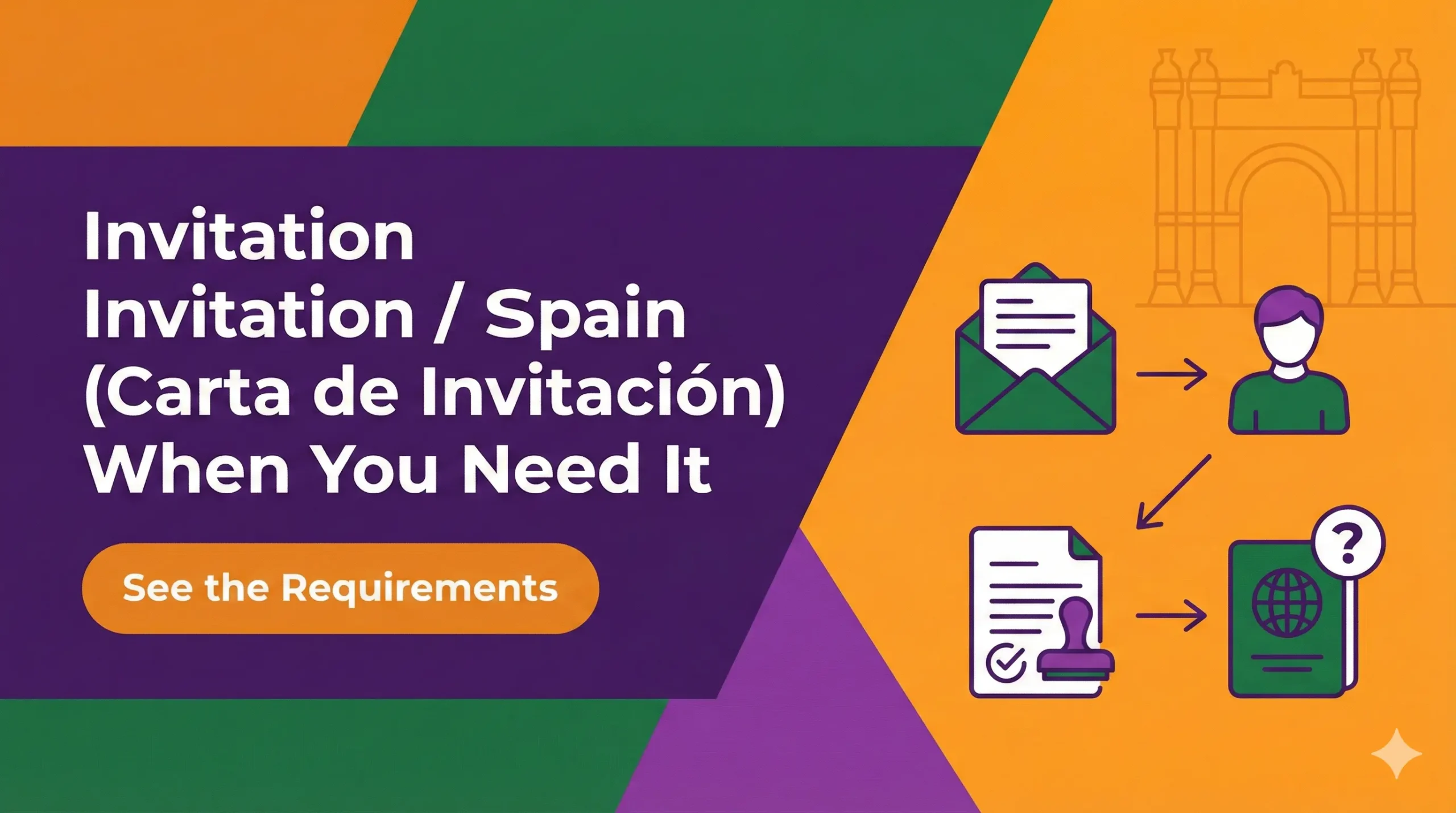
Invitation Letter (Carta de Invitación) in Spain: When You Need It
The Carta de Invitación is a mandatory police-issued document for non-EU visitors staying with friends or family in Spain, not a handwritten note. This guide details who needs it, how hosts apply at the National Police station, the costs involved, and the severe penalties for non-compliance.
Disclosure: This post may contain affiliate links. We may earn a commission at no extra cost to you if you make a purchase through these links. Read full disclosure.
What Exactly is the Carta de Invitación
The Carta de Invitación is a formal proof of accommodation. It certifies that a legal resident or citizen of Spain (the host) has officially invited a non-EU national (the guest) to stay in their home for a specific period, usually up to 90 days.
It serves two primary legal purposes:
- Proof of Accommodation: It satisfies the Schengen entry requirement regarding “evidence of lodging.”
- Assumption of Responsibility: It creates a binding legal contract where the host accepts full financial and legal responsibility for the guest, including ensuring they leave Spain before their visa or 90-day allowance expires.
It is crucial to understand that the Carta does not replace other entry requirements. The guest must still prove they have money for food and travel, valid health insurance, and a return ticket. The letter only covers the “roof over their head” requirement.
Who Actually Needs This Document
The requirement for a Carta de Invitación depends on your nationality and your accommodation plans.
1. Travelers Needing a Schengen Visa
If you are from a country that requires a visa to enter Spain (e.g., India, China, South Africa, Bolivia), and you plan to stay with a friend or relative, you must submit the original physical Carta de Invitación with your visa application at the consulate. Without it, the visa will be rejected immediately because you have no proof of accommodation.
2. Visa-Exempt Travelers (UK, USA, Canada, etc.)
Citizens of visa-waiver countries often assume this rule does not apply to them. However, since Brexit, UK citizens are Third Country Nationals. While you do not need a visa to board the plane, you are still subject to Schengen border checks upon arrival.
Spanish border guards have the authority to ask any non-EU traveler for proof of accommodation. If you say “I am staying with my friend,” and you cannot produce a Carta de Invitación, the officer is legally entitled to deny you entry. While spot checks are random, the risk is real.
3. Who Does NOT Need It
- EU/EEA/Swiss Citizens: They have freedom of movement.
- Travelers Booking Hotels/Airbnbs: If you have a commercial booking confirmation for the entire duration of your stay, that is your proof of accommodation. You do not need an invitation letter.
- Digital Nomads/Residents: If you already hold a Spanish residency card or visa, you do not need an invitation to enter.
For a broader context on how this fits into your overall travel limits, it is vital to understand the Spain Schengen Rules: 90/180 Day Rule Explained for Spain, as the dates on the invitation letter will be strictly counted against your allowance.
The Host Responsibilities and Risks
The process is entirely initiated by the host living in Spain. The guest cannot apply for it.
Who Can Be a Host
Any person who legally resides in Spain can apply. This includes:
- Spanish nationals.
- EU citizens living in Spain (with a green residency certificate).
- Non-EU residents with a valid TIE (Tarjeta de Identidad de Extranjero).
The Penalties (The Scary Part)
By signing the application, the host declares that they are responsible for the guest. If the guest overstays their 90-day limit and remains in Spain illegally, the host faces severe penalties for “aiding illegal immigration.”
- Fines: Penalties for the host can range from €500 to over €100,000 depending on the severity and whether it is deemed a recurring offense.
- Criminal Charges: In extreme cases, it can be prosecuted under the Penal Code.
This is why you should never agree to issue a Carta de Invitación for someone you do not trust implicitly. If they decide to stay and “figure it out later,” you are the one who will pay the price.
Step-by-Step Application Guide for Hosts
Applying for the letter is a bureaucratic process that takes time. Do not leave this until the week before your friend arrives. It can take anywhere from 2 to 6 weeks depending on the workload of your local police station.
Step 1: Gather Required Documents
The host must prepare a file with the following originals and photocopies:
- Host’s ID: DNI, Passport, or TIE card.
- Proof of Housing:
- If you own: The property deed (Escritura Pública) or a recent Nota Simple from the Property Registry.
- If you rent: A valid rental contract. Crucial: Some police stations require the landlord’s explicit written permission to host guests if it is not clearly stated in the lease.
- Empadronamiento: A current certificate of registration from the Town Hall (less than 3 months old) to prove you actually live there. If you need to update this, check Empadronamiento in Spain: How to Register Your Address.
- Guest’s Passport Copy: A clear copy of the data page of the guest’s passport.
- Application Form: The official request form (Solicitud de Carta de Invitación).
Step 2: Book an Appointment (Cita Previa)
You cannot walk into any police station. You must go to the National Police station assigned to your specific district or town.
- Go to the official Sede Electrónica appointment website.
- Select your province.
- Look for the procedure titled “POLICIA – CARTA DE INVITACIÓN”.
- If no appointments are available, you must keep checking daily, usually early in the morning.
Step 3: The Interview
On the day of the appointment, the host goes to the police station. An officer will review the documents. They may ask questions:
- “How do you know the guest?”
- “What are the exact dates of the visit?”
- “How many people live in your house?” (To ensure there is no overcrowding).
If satisfied, they will accept the application and give you a receipt. They will not issue the letter immediately.
Step 4: Approval and Payment
After a processing period (usually 10-20 days), you will be notified that the application is approved. You must then return to the station to pick up the payment forms (Modelo 790 Code 012).
- Fee 1 (Authorization): Approx. €75 – €80.
- Fee 2 (Issuance): Approx. €6 – €10 per letter.
You must take these forms to a bank, pay the fee in cash or via account, and return the stamped receipts to the police station. Only then will they hand over the official Carta de Invitación.
Step 5: Mailing the Original
This is the step most people fail. A scan or email is not valid. You must send the original paper document with the police stamp to your guest in their home country via courier (DHL, FedEx, etc.) or certified mail. The guest must carry this physical document across the border.
Financial Requirements for the Guest
Having an invitation letter solves the accommodation issue, but it does not solve the money issue. The Spanish border code states that travelers must prove they have sufficient economic means to support themselves.
However, holding a Carta de Invitación does not remove the money requirement.
- Without Invitation (Hotel): You need to prove approx. €113 per day (10% of the SMI) for the trip.
- With Invitation: Since you do not pay for accommodation, officials may be more lenient, but you must still prove you can cover food and emergencies. The absolute minimum is 10% of the gross minimum interprofessional wage (SMI) or a flat minimum of roughly €1020 per person per trip (numbers adjusted annually).
For a detailed breakdown of the exact euros you need to show at the airport to avoid rejection, refer to What Counts as ‘Sufficient Financial Means’ for Spain Entry?.
Common Reasons for Rejection
The police can and do deny these requests. Common reasons include:
- Overcrowding: If you live in a one-bedroom apartment and invite a family of five, the police will deny it based on lack of habitable space.
- Missing Landlord Permission: If you rent, and your contract prohibits guests or subletting, the police may demand a letter from the landlord. If you cannot provide it, the application fails.
- Previous Overstays: If you previously invited someone who overstayed their visa, you will be blacklisted from inviting others.
- Inconsistent Dates: If the guest’s flight dates (if provided) do not match the requested invitation dates.
Costs Breakdown
The cost falls entirely on the host. It is not cheap, which deters casual applications.
| Item | Estimated Cost | Notes |
| Application Fee | ~€75.00 | Paid upon approval |
| Issuance Fee | ~€7.00 | Per letter issued |
| Courier to Guest | €30.00 – €60.00 | DHL/UPS recommended for speed |
| Total Cost | ~€110.00 – €140.00 | Paid by Host |
Note: Fees change annually based on the IPREM and government budgets.
Alternatives to the Letter
If this process sounds too cumbersome, or if you do not have enough time before the travel date, the only legal alternative is for the guest to stay in commercial accommodation.
- Book a Hotel: The guest can book a hotel or hostel for the duration of the stay.
- Refundable Bookings: Many travelers book refundable accommodation to satisfy the visa/entry requirement. However, cancelling a booking immediately after entering the country is a risky strategy. If border officials check your reservation upon arrival and see it is cancelled, you will be denied entry.
- Apartment Rentals: A verifiable Airbnb or holiday rental contract is also valid proof.
For a deeper dive into the different ways to satisfy the accommodation requirement, including leases and commercial bookings, check How to Prove Accommodation for a Spain Visa (Lease, Hotel, Invitation Letter).
Checklist for the Guest’s Arrival
When the guest arrives at a Spanish airport (Madrid Barajas, Barcelona El Prat, etc.), they should have a folder ready in their hand luggage. Do not pack this in checked bags.
- Passport: Valid for at least 3 months beyond the departure date.
- Original Carta de Invitación: The physical police document.
- Return Flight Ticket: Confirmed booking leaving the Schengen area.
- Proof of Funds: Bank statements, cash, or traveler’s checks.
- Travel Insurance: Proof of medical coverage.
If the guest is asked “Where are you staying?”, they should present the letter immediately. It answers the question definitively.
Conclusion
The Carta de Invitación is a serious bureaucratic hurdle designed to prevent irregular immigration. It transforms a friendly visit into a state-monitored event. While it is annoying for honest travelers just wanting to visit Abuela, strict adherence to the rules is the only way to guarantee entry.
If you are the host, assess the risk honestly. Are you certain your guest will leave on time? If the answer is yes, start the process at least a month in advance. If you are the guest, respect the document. Your host is putting their legal status on the line for you.
Before finalizing your travel plans, ensure you have ticked every other box for a smooth entry by reviewing the full Spain Visa Checklist: What to Do Before You Fly. With the original letter in hand and your finances in order, you can look forward to a stress-free reunion in Spain.
References
Primary sources (official)
- National Police (Carta de Invitación Procedures): https://www.policia.es/_es/tramites_extranjeria_tramite_cartainvitacion.php
- Ministry of Interior (Entry Requirements): https://www.interior.gob.es/
- Sede Electrónica (Appointment Booking): https://sede.administracionespublicas.gob.es/icpplus/index.html
Other helpful sources
- Spanish Ministry of Foreign Affairs (FAQs for Tourists): https://www.exteriores.gob.es/
- Official State Gazette (BOE – Penalties): https://www.boe.es/
Disclaimer
The information provided in this article is for general informational purposes only and does not constitute legal advice. Immigration regulations, fees, and police station procedures in Spain are subject to change. The Carta de Invitación process is handled at the discretion of individual police stations, and requirements may vary locally. We recommend consulting with a qualified lawyer or gestor for specific advice regarding your situation.