How to Cancel a Direct Debit in Spain (Step-by-Step)
Disclosure: This article contains affiliate links. If you buy through them, we may earn a commission at no extra cost to you. Read our full disclosure.
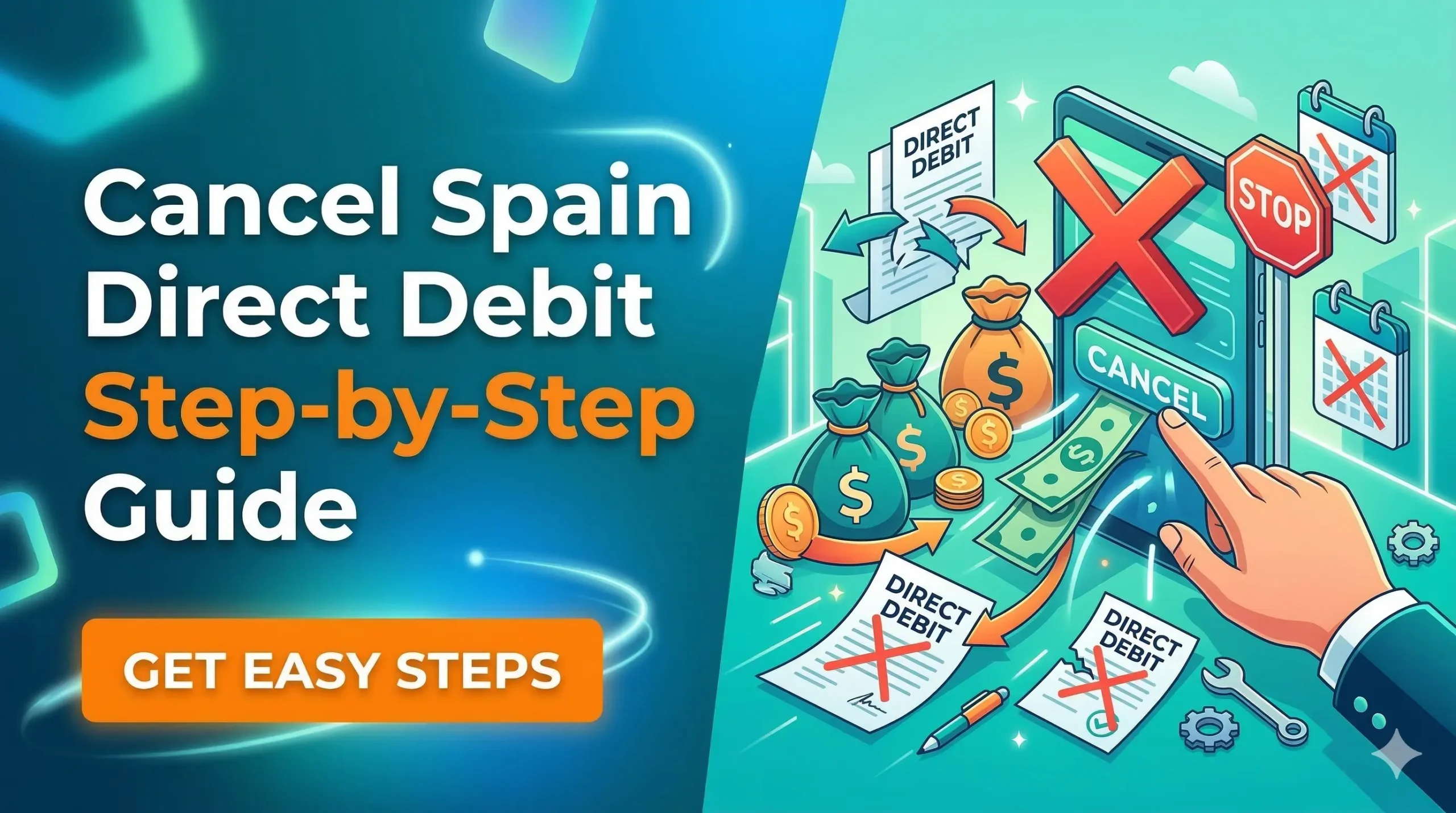
Discovering your Spanish bank account has been drained by a gym you quit six months ago is an infuriating expat rite of passage. Many newcomers lose hundreds of euros to a phone company or other provider because they assume ignoring its emails will cancel a contract. This step-by-step guide explains exactly how to permanently block and cancel direct debits in Spain.
The Trap of the Spanish Domiciliacion
When you relocate to Spain, you must completely rewire your brain regarding how monthly bills are paid. The financial ecosystem here operates almost entirely on automated pulls rather than manual pushes, creating a system where the consumer has significantly less day-to-day control over their cash flow.
Why Ignoring Bills Never Works
In many Anglo-Saxon countries, if you want to cancel a digital subscription, a gym membership, or a minor utility, you can often just log into a portal, delete your credit card information, or simply stop paying the manual invoice. In Spain, this strategy will plunge you into administrative misery.
Spanish bills operate on the domiciliación bancaria (direct debit) system. When you sign a contract, you hand over your International Bank Account Number (IBAN). The merchant does not charge a plastic card that you can simply cancel; they reach directly into the core of your checking account via the European SEPA network. They pull the funds automatically on their specific billing cycle, completely bypassing your active consent for each individual transaction.
If you attempt to stop paying by simply emptying your Spanish checking account, the direct debit will forcefully bounce. Your Spanish bank will charge you a penalty for an uncovered balance, the utility company will instantly apply a late payment surcharge, and the merchant’s automated system will simply try to pull the inflated amount again next week. To understand how deeply entrenched this automated billing culture is, you must review our guide on Cost of Living in Spain: Budgeting for Expats.
The Difference Between Blocking a Payment and Canceling a Contract
The most dangerous misconception expats hold is confusing a banking block with a legal contract cancellation. You absolutely have the power to stop a merchant from pulling money out of your bank account, but doing so does not dissolve the underlying legal agreement you signed.
Within a few months of blocked payments, the Spanish company will sell your debt to a collection agency and formally register your passport or NIE on the ASNEF (Asociación Nacional de Establecimientos Financieros de Crédito) blacklist. Being on the ASNEF list fundamentally destroys your financial reputation in Spain, barring you from opening new bank accounts or securing housing in the future. You must manage both the banking block and the legal cancellation simultaneously, a dual process we will outline below. To see how these billing mandates tie into your housing contracts, read How to Pay Bills in Spain: Direct Debit, Cash, and Online Portals.
Step by Step How to Return a Charge and Block Future Payments
If a company has already pulled money from your account unfairly, or if you need to stop them from pulling it again next month while you argue over a contract cancellation, you must utilize your European banking rights immediately.
Returning a Charge (Devolver el Recibo)
Under the strict rules of the Single Euro Payments Area (SEPA), you have incredibly robust consumer protections regarding direct debits. If a Spanish company pulls a scheduled, authorized direct debit from your account, but the amount is incorrect or you had already asked to cancel the service, you possess the absolute legal right to return the receipt (devolver el recibo).
By law, you have exactly eight weeks from the date the funds left your account to demand an unconditional, no-questions-asked refund from your bank. If the company pulled a direct debit that you absolutely never authorized in the first place, that protection window legally extends to thirteen months.
Blocking the Issuer Permanently (Bloquear Emisor)
Returning a specific receipt only refunds that single, isolated transaction. It does absolutely nothing to prevent the exact same company from trying to pull the money again the very next day. To secure your account, you must take the secondary step of blocking the merchant entirely.
Inside your banking portal, usually located under the “Direct Debits” (Recibos domiciliados) tab, you will find a list of all active mandates. You must select the specific company (the issuer) and select Bloquear emisor or Dar de baja la domiciliación.
By executing this block, you are digitally instructing your bank to categorically reject any future SEPA requests from that specific company’s identification number. The bank acts as a shield, bouncing the request before it ever touches your balance. This forces the hostile company to contact you directly to resolve the dispute, shifting the leverage back into your hands.
The Legacy Bank Struggle Versus Digital Banking
Executing these crucial SEPA rights sounds simple on paper, but traditional Spanish high-street banks—such as Santander, BBVA, or CaixaBank—routinely make this process agonizingly difficult. Legacy banking apps frequently throw inexplicable error codes when you attempt to block a major domestic utility provider, effectively forcing you to visit a physical branch.
Once at the branch, tellers will often actively discourage you from returning a receipt, lecturing you on the dangers of unpaid bills or demanding physical proof that you canceled the contract first. To completely bypass this hostility and archaic friction, savvy expats utilize modern digital platforms like N26.
By opening a dedicated checking account with N26, you receive a recognized, official Spanish IBAN, but you completely escape the bureaucratic nightmare of legacy branches. The N26 application allows you to instantly return a direct debit or permanently block an issuer with a single tap on your smartphone screen. You maintain absolute, immediate control over your liquidity without ever having to justify your actions to a bank teller. For a comprehensive look at setting up this frictionless financial infrastructure, read Opening a Bank Account in Spain as a Non-Resident.
Officially Canceling the Underlying Contract
Once your bank account is secured and the hostile charges are blocked, you must immediately pivot to the legal reality of your situation. You must formally dissolve the contract with the Spanish merchant to avoid the devastating ASNEF blacklist.
Requesting the Baja
In Spain, the act of formally canceling a service or contract is universally known as requesting the baja (deregistration). You cannot simply send a casual email saying, “I do not want this anymore.” You must follow the exact, highly specific cancellation procedure outlined in the merchant’s original terms of service.
For gyms, telecom providers, and private health insurance companies, this usually requires providing explicit notice fifteen to thirty days before the next billing cycle. If your billing cycle resets on the 1st of the month and you request the baja on the 28th, you are legally bound to pay for the entirety of the following month.
You must contact their customer service department, explicitly state you want to process a baja definitiva, and demand a confirmation number or a formal cancellation document (justificante de baja). To understand how frequent these disputes are in the domestic market, review Utility Costs in Spain: Electricity, Gas, Water, and Internet.
The Burofax Escalation
If a Spanish company aggressively ignores your cancellation emails, refuses to answer their customer service lines, or suddenly claims they “lost” your cancellation request, you must deploy the ultimate weapon in the Spanish consumer arsenal: the Burofax.
A Burofax is a highly secure, legally certified postal service provided by the national Spanish postal network (Correos). It securely delivers a physical document and provides court-admissible, irrefutable proof of exactly what was sent, who received it, and when it was signed for.
You must draft a formal cancellation letter in Spanish, stating your identification details, your contract number, and your explicit demand for immediate cancellation. You then use the online Correos portal to send this letter via Burofax to the company’s official corporate headquarters. Because a Burofax carries massive, undeniable legal weight, companies are terrified of them. To understand the broader scope of consumer leverage, read Consumer Rights in Spain: Refunds, Warranties, and Disputes.
| Action Taken | Financial Result | Legal Consequence | Best Used For |
| Devolver el Recibo | Reclaims funds from a specific past charge (up to 8 weeks). | Does not stop future charges or cancel the contract. | Fixing an accidental double-charge or billing error. |
| Bloquear Emisor | Stops the company from pulling any future funds. | You will accrue legal debt if the contract is still active. | Protecting your account while fighting a hostile merchant. |
| Tramitar la Baja | Permanently ends the billing relationship safely. | Legally severs the contract; protects your credit score. | Officially ending a gym, internet, or insurance service. |
Managing Expat Finances Across Borders
Consumer disputes often occur right as expats are preparing to leave Spain or move to a new region. Managing these sudden direct debit returns and account closures while moving across borders requires highly strategic financial routing.
Avoiding Currency Scams on Returned Funds
If you successfully use your SEPA rights to return a massive, fraudulent €500 direct debit, those Euros will instantly reappear in your Spanish checking account. However, if you have already relocated back to the United States or the United Kingdom, those funds are effectively trapped in a foreign jurisdiction.
To fiercely protect your recovered capital, you must bypass the legacy banking system entirely and use a dedicated currency specialist like Wise. By linking your Spanish account to a Wise transfer, you successfully secure the true, transparent mid-market exchange rate. You completely eliminate the hidden bank markups, ensuring your recovered funds safely reach your home country checking account without lining the pockets of institutional bank managers. To fully grasp how these invisible spreads destroy your purchasing power, review Sending Money to/from Spain: Comparing Banks vs Transfer Services.
Protecting Your Global Wealth
The constant threat of hostile direct debits, municipal tax embargoes, and unexpected banking freezes highlights a fundamental reality of expat life in Spain: you should never keep your life savings in a local retail checking account.
To actively protect and safely grow the wealth you are not spending on daily Spanish living expenses, veteran expats route their surplus capital to highly secure, global brokerage platforms like Interactive Brokers. By transferring your savings into an institutional-grade account with Interactive Brokers, you manage your liquid wealth securely outside the predatory, direct-debit-heavy Spanish retail banking ecosystem. To navigate how managing this global wealth interacts with strict Spanish reporting laws, read Spanish Taxes: Guide for Expats and Wealth Tax and Solidarity Tax in Spain: Overview for Foreigners.
References
Primary sources (official)
- Banco de España – Devolución de recibos: https://clientebancario.bde.es/pcb/es/menu-horizontal/productosservici/serviciosdepago/recibosdomicilia/guia-textos/devolucion_recibos/
- Banco de España – Derechos SEPA para consumidores: https://www.bde.es/bde/es/secciones/servicios/Particulares_y_e/SEPA/
- Correos de España – Burofax Premium Online: https://www.correos.es/es/es/particulares/enviar/envios-nacionales/burofax-cartas/burofax
Other helpful sources
- Expatica – Consumer rights and how to complain in Spain: https://www.expatica.com/es/living/gov-law-admin/consumer-rights-spain-106678/
- N26 – How to manage direct debits safely: https://n26.com/en-eu/direct-debit
Disclaimer
The information provided in this article is for educational and informational purposes only and does not constitute formal financial, banking, or legal advice. Spanish banking regulations regarding SEPA direct debit returns (specifically the 8-week and 13-month rules), the legal weight of a Burofax, and the operational procedures of the ASNEF debtor registry are highly complex and subject to frequent updates by the Banco de España and domestic consumer protection agencies. Always verify current billing cancellation requirements directly with your specific service provider and consult a certified Spanish civil lawyer (abogado civil) regarding severe contract disputes before purposefully blocking major financial payments.