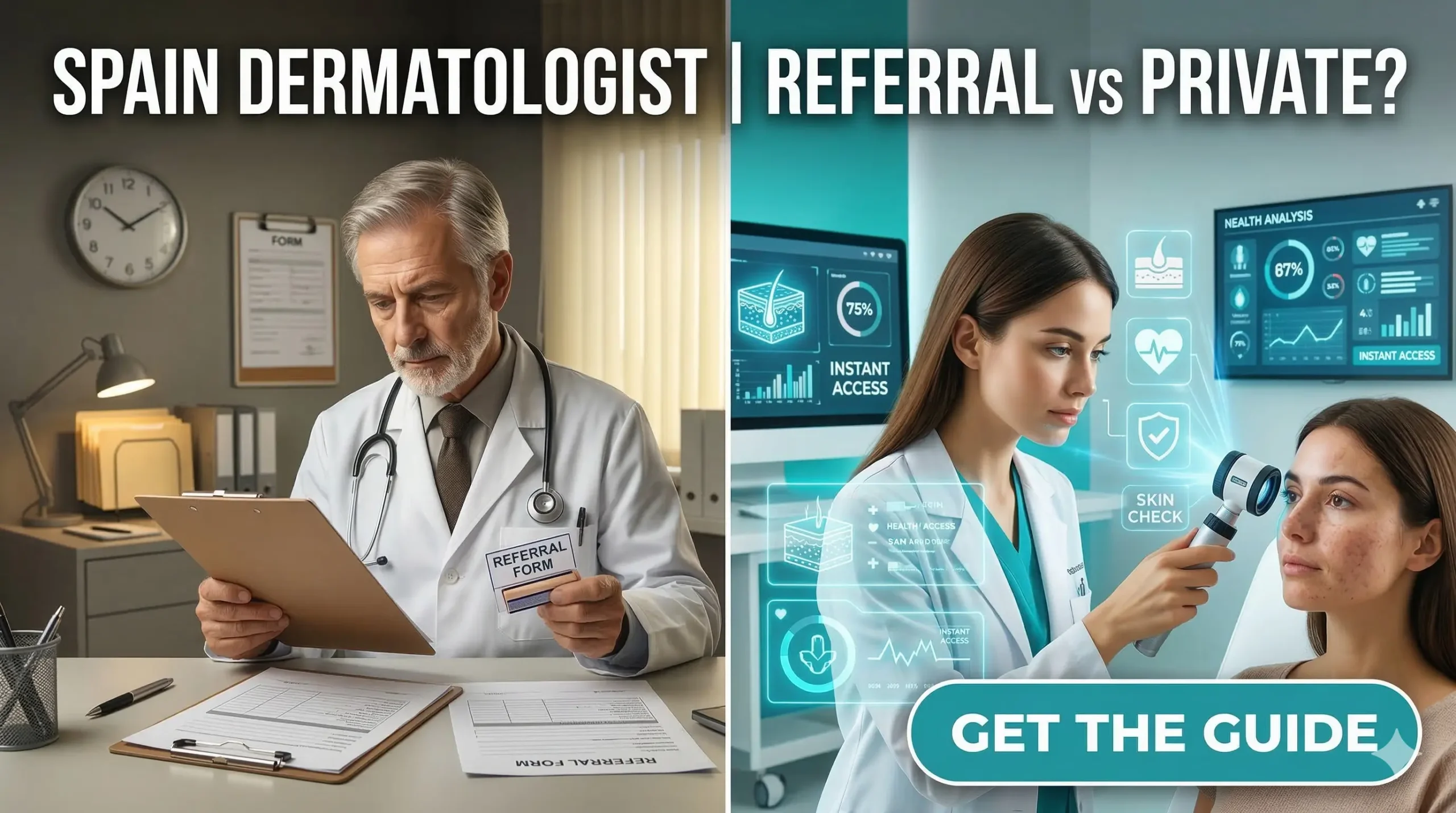
How to Find Dermatology Care in Spain: Referral vs Private
Trying to get a strange, changing mole checked in Spain can feel like an endless loop of bureaucratic gatekeeping. I once waited four agonizing months just to get a basic eczema consultation through the public health system. This guide demystifies the exact steps to find dermatology care, explaining the rigid public referral process versus the fast-tracked private route for expats.
Disclosure: This post may contain affiliate links. We may earn a commission at no extra cost to you if you make a purchase through these links. Read full disclosure.
The Public Referral System for Dermatology
When you first enter the Spanish medical system, your natural instinct is to simply search for a local skin specialist on Google and call them to book an appointment. If you rely entirely on the state-funded public health system, this direct approach is fundamentally impossible. The public system operates on a rigid hierarchy designed to filter out non-essential specialist visits.
Seeing Your General Practitioner First
In Spain, the public healthcare system utilizes a strict gatekeeper model. If you have a suspicious rash, severe adult acne, a painful cyst, or a changing mole, your absolute first step is to book a standard appointment with your assigned primary care physician, known locally as the médico de cabecera. If you have recently relocated and have not yet navigated this initial administrative hurdle, reviewing our step-by-step guide on What Is a Centro de Salud in Spain and How Do You Register is your mandatory starting point.
Your general practitioner will examine your skin issue during a brief, usually ten-minute consultation. Public doctors are highly trained, but they are also under immense pressure to keep patient turnover high. Unless they immediately suspect an aggressive melanoma or a highly contagious skin infection, they will often try to treat the issue themselves first. For common ailments like mild dermatitis, rosacea, or standard acne, they will prescribe a generic topical steroid or a basic antibiotic cream.
Triage and Public Wait Times
Securing the volante from your doctor is a massive relief, but the true test of your expat endurance is the regional waiting list. The Spanish public health system categorizes specialist referrals by strict clinical urgency: normal, preferred (preferente), and urgent (urgente).
If your general practitioner strongly suspects skin cancer, your file will be flagged as urgent, and you will usually be seen by a hospital dermatologist within a few weeks. However, if your referral is for a chronic, non-life-threatening issue like severe acne, mild psoriasis, hair loss (alopecia), or unexplained hives, you are pushed to the bottom of the regional priority list.
According to the latest data from the Spanish Ministry of Health, the average wait time for an external specialist consultation can easily exceed 90 days, with some overwhelmed autonomous communities taking up to six months just for an initial intake appointment. Waiting half a year for a professional to look at an agonizingly itchy rash is a massive point of frustration for foreigners used to faster access. If you are managing a life-long skin condition that requires ongoing monitoring, establishing your baseline care early is critical; read Chronic Conditions in Spain: Managing Ongoing Care as an Expat for strategies on officially transferring your medical history into the Spanish system before your medication runs out.
Navigating Private Dermatology Options
The sheer terror of waiting months to have a changing mole examined, combined with the lack of control over which doctor you are assigned to, is exactly why the vast majority of expats completely abandon the public dermatology route and opt for private healthcare.
Bypassing the Wait with Private Insurance
In the private healthcare sector, the public gatekeeper model vanishes entirely. You have the absolute freedom to bypass the general practitioner, browse a directory of specialists, and book an appointment directly with a dermatologist of your choosing.
However, navigating the private directory—known as the cuadro médico—of massive Spanish insurance companies can be incredibly confusing if you do not speak fluent Spanish. Finding a clinic that explicitly staffs English-speaking doctors is a priority for most expats, so nothing is lost in translation during a complex medical diagnosis. This administrative hurdle is exactly why utilizing an expert, expat-focused broker like Innoinsure can be a massive tactical advantage.
A bilingual agent from Innoinsure can seamlessly filter the market to help you set up a premium private health policy that grants you immediate, unrestricted access to a vast network of top-tier, English-speaking private dermatologists. With a comprehensive policy secured through Innoinsure, you can simply open your provider’s mobile application, search for skin specialists in your neighborhood, and book a comprehensive mole check or acne consultation for the very next day. To fully grasp the systemic differences between these two medical pathways, review our deep dive into the Spain Healthcare System for Expats: Public vs Private.
Out of Pocket Costs and Clinic Visits
If you do not have private insurance and want to pay entirely out-of-pocket for a private dermatologist consultation, the Spanish market is surprisingly accessible compared to the United States, though costs can add up quickly.
You can expect to pay anywhere from €80 to €150 for the initial clinical consultation. However, this base fee only covers the doctor’s time and basic visual examination. If the doctor needs to perform a dermoscopy (specialized mole mapping), extract a deep cyst, perform a punch biopsy to test for cancer, or freeze off a wart with liquid nitrogen (cryotherapy) during that visit, the clinic will charge you additional itemized fees for each procedure.
To fully understand the baseline of these hidden medical retail costs before you sit in the examination chair, see our detailed breakdown on Health Costs in Spain: Typical Co-Pays and Out-of-Pocket Fees. If you do choose to secure coverage to avoid these out-of-pocket fees, ensuring your network actually covers the top dermatology clinics in your city without heavy co-payments is vital. Using a service like Innoinsure ensures you understand these exact limits; you should also read How to Compare Private Health Plans: Deductibles, Co-Pays, Networks before signing any contract.
Furthermore, if you simply have a mild rash, a weird bug bite, or a flare-up of a known condition and do not want to commute across town, many premium policies brokered by Innoinsure offer highly robust digital access. You can upload a high-resolution photo of your skin issue to a secure app and consult an English-speaking dermatologist via video call. Discover how to safely leverage this incredible digital perk in Telemedicine in Spain: When It’s Useful and What to Expect.
Essential Spanish Vocabulary for Skin Conditions
Even if you seek out an English-speaking doctor in the private sector, the receptionists, nurses, and pharmacy staff you interact with will almost exclusively speak Spanish. Arriving at your appointment equipped with the correct anatomical and diagnostic vocabulary is crucial for ensuring you receive the correct treatment.
Do not rely on online translation apps to explain nuanced pain or itching while sitting in the examination room. Memorize the following terms to clearly articulate why you booked the appointment:
| English Term | Spanish Translation | Pronunciation Guide |
| Mole | Lunar | Loo-NAR |
| Rash | Sarpullido or Erupción | Sar-poo-YEE-do / Eh-roop-SYON |
| Itchy | Pica or Picor | PEE-kah / Pee-KOR |
| Acne / Pimple | Acné / Grano | Ak-NEH / GRAH-no |
| Skin Cancer | Cáncer de piel | KAN-ser deh pyel |
| Biopsy | Biopsia | Bee-OP-see-ah |
If your skin condition is accompanied by severe systemic symptoms, such as a rapidly spreading rash, high fever, or difficulty breathing, you may be experiencing a severe allergic reaction rather than a standard dermatological issue. In this scenario, bypass the dermatologist and go straight to an emergency room. Ensure you can communicate the urgency by reviewing Spanish Emergency Phrases: How to Describe Symptoms Quickly.
Managing Skin Health and Pharmacy Protocols
Securing a diagnosis is just the first step. Surviving the harsh Spanish climate and managing the daily health of your skin barrier requires adapting your consumer habits to the local retail environment and understanding how Spanish pharmacies operate.
The Role of the Spanish Pharmacist
While you are waiting for a public dermatology appointment, or trying to manage a minor flare-up over the weekend, your absolute best friend is the local Spanish pharmacy (farmacia). Spanish pharmacists are highly trained medical professionals who can legally dispense excellent frontline triage advice for minor dermatological issues.
If you show them a mild case of contact dermatitis or a localized fungal infection, they can recommend and sell clinical-grade topical steroid creams or antifungal ointments without requiring a doctor’s prescription. However, they cannot dispense oral antibiotics or heavy acne medications (like Accutane/Isotretinoin) over the counter. To understand exactly what they can and cannot legally provide, check out Can a Pharmacist in Spain Help With Minor Illness? What to Expect.
Furthermore, the most significant threat to your skin health as an expat is the brutal Mediterranean climate. The UV index in Spain reaches extreme levels from May through September. If you are moving from a northern latitude like the UK or Canada, your skin barrier is likely entirely unprepared for this daily radiation assault. Protecting your epidermis and understanding local sun habits is not optional; read Sun Safety in Spain: UV Index Basics and Habits to avoid severe, blistering sunburns that require emergency medical care.
Climate Challenges and Preventative Skincare
While local Spanish pharmacies are absolutely brilliant for dispensing acute pharmaceutical steroid creams and high-grade European sunscreens, they frequently fall incredibly short when it comes to holistic, preventative skin wellness and daily barrier repair.
One of the biggest shocks for new expats is the heavy, hard water (cal) that flows through the taps in major coastal cities like Barcelona, Alicante, Málaga, and Valencia. Showering in this mineral-heavy water daily aggressively strips natural oils from your epidermis, often leading to a phenomenon known as “expat eczema,” characterized by severe dryness, flaking, and chronic scalp irritation.
To completely bypass this frustrating retail gap, the savvy international community in Spain relies heavily on iHerb. By ordering your specific eczema-relief lotions, pure collagen peptides, and highly absorbable Vitamin C directly through iHerb, you gain access to the exact, trusted holistic brands you successfully used back home without draining your wallet.
Having a dedicated skin-barrier recovery stash delivered directly to your Spanish door via iHerb ensures you are actively combating the harsh local climate and hard water from the inside out. You can proactively manage inflammatory skin conditions by ordering high-quality Omega-3 fish oils from iHerb to reduce systemic redness. Navigating a foreign medical system for a chronic skin issue is chaotic and exhausting; relying on iHerb to effortlessly restock your specific preventative skincare arsenal puts the control firmly back in your hands, saving you significant money on unsubsidized cosmetic and wellness products.
References
Primary sources (official)
- Ministerio de Sanidad – Listas de Espera del Sistema Nacional de Salud: https://www.sanidad.gob.es/estadEstudios/estadisticas/inforRecopilaciones/listaEspera.htm
- Academia Española de Dermatología y Venereología (AEDV): https://aedv.es/
Other helpful sources
- Expatica – Healthcare Basics in Spain: https://www.expatica.com/es/healthcare/healthcare-basics/healthcare-in-spain-101467/
- Fundación Piel Sana de la AEDV: https://fundacionpielsana.es/
Disclaimer
The information provided in this article is for educational and informational purposes only and does not constitute formal dermatological or medical advice. Public healthcare wait times, referral protocols, and private insurance network coverage limits vary significantly across Spain’s autonomous communities. Always consult directly with a licensed Spanish general practitioner, a board-certified dermatologist, or your private insurance broker regarding your specific skin conditions, mole checks, and medical treatment plans.