Understanding Co-Payments at Spanish Pharmacies
Standing at a pharmacy counter in Valencia and being charged fifteen euros for an inhaler that cost me two euros the week before was incredibly confusing. I had no idea that who writes your prescription completely changes what you pay. This guide decodes the Spanish copago farmacéutico system so you can navigate the pharmacy without financial surprises.
Disclosure: This post may contain affiliate links. We may earn a commission at no extra cost to you if you make a purchase through these links. Read full disclosure.
The Difference Between Public and Private Prescriptions
The most critical misconception expats bring to Spain is assuming that all pharmacies sell drugs at the exact same subsidized price. In reality, the physical pharmacy (farmacia) is just a private retail distributor. The price you pay for your medication depends entirely on the origin of the piece of paper—or the digital code—you hand to the pharmacist.
Paying Full Price with Private Insurance
If you go to a private doctor using your private expat health insurance, you are operating entirely outside the Spanish public system. Private doctors write private prescriptions. When you take a private prescription to a Spanish pharmacy, you must pay exactly 100 percent of the retail cost of the medication.
While medication in Spain is generally much cheaper than in the United States, paying full retail price for a chronic condition can still rapidly drain your monthly budget. Private health insurance in Spain generally does not include pharmacy or prescription coverage, meaning you are entirely on your own for out-of-pocket drug costs. Understanding what your private policy actually covers is a vital step, deeply explored in How Much Does Private Health Insurance Cost in Spain?. If you are choosing between different structures to secure your visa, you should also review the hidden fees in How to Compare Health Insurance Deductibles and Co-Pays in Spain.
Accessing the Public Copago System
If you are legally registered as a resident working in Spain, you have the right to access the Sistema Nacional de Salud (SNS), the public healthcare system. When you visit a public doctor at your local Centro de Salud (health center), they prescribe medication digitally onto your public health card (Tarjeta Sanitaria).
When you hand this public card to the pharmacist, the copago farmacéutico (pharmaceutical co-payment) system instantly kicks in. The Spanish government heavily subsidizes the cost of the drug, and you only pay a specific percentage of the retail price. This is why a medication that costs twenty euros with a private prescription suddenly costs eight to twelve euros with a public one. If you have not yet entered the public system, mastering the steps in How to Register for Social Security Seguridad Social as a New Worker is your absolute first priority.
How the Spanish Pharmacy Copago is Calculated
The public copago is not a flat fee. It is a progressive system designed to shift the financial burden away from vulnerable populations and toward those with higher incomes. The exact percentage you pay at the pharmacy register is automatically calculated based on your annual income tax return (Declaración de la Renta).
Income Brackets for Active Workers
For active workers (trabajadores en activo) under the age of 65 who are currently contributing to the Spanish social security system, the co-payment percentage is divided into three distinct income brackets. Your local pharmacist does not see your actual salary; their computer simply displays a specific code (TSI 001, TSI 002, etc.) that corresponds to your bracket.
If you earn less than 18,000 euros a year, you pay 40 percent of the cost of your medication. If you earn between 18,000 and 100,000 euros a year, you pay 50 percent. If your income exceeds 100,000 euros, your co-payment jumps to 60 percent. Certain chronic medications, often marked with a black dot on the packaging (aportación reducida), have a legally capped maximum co-payment, meaning you will never pay more than a few euros regardless of your income bracket. Grasping how your income is officially registered and reported to the government is thoroughly explained in Spanish Income Tax IRPF 101: Who Pays and When.
Special Rules for Pensioners and Retirees
Expats who retire in Spain and successfully transfer their healthcare rights to the Spanish public system enjoy heavily reduced copagos.
For pensioners (pensionistas), the percentage drops to 10 percent of the drug’s cost, unless their annual income exceeds 100,000 euros (in which case it becomes 60 percent). More importantly, pensioners have a strict monthly cap (tope máximo mensual) on their pharmacy expenses. Depending on their income, this cap is usually set around 8 euros or 18 euros per month. Once a pensioner spends that amount, all further public prescriptions for that month are entirely free. If a pharmacist accidentally overcharges you, the local health authority automatically refunds the difference to your Spanish bank account.
| Beneficiary Status | Annual Income Level | Pharmacy Co-Payment Percentage | Monthly Maximum Cap |
| Active Worker | Less than €18,000 | 40% | No Cap |
| Active Worker | €18,000 to €100,000 | 50% | No Cap |
| Active Worker | More than €100,000 | 60% | No Cap |
| Pensioner | Less than €18,000 | 10% | ~€8.26 / month |
| Pensioner | €18,000 to €100,000 | 10% | ~€18.59 / month |
Note: Exemptions exist (0% copago) for individuals with severe disabilities, those receiving non-contributory pensions, and specific vulnerable groups.
Practical Tips for Managing Your Pharmacy Budget
If you are an expat relying on private healthcare, or an active worker managing a chronic condition with regular 50 percent co-payments, your monthly pharmacy trips require strategic financial management.
Navigating Your Daily Banking
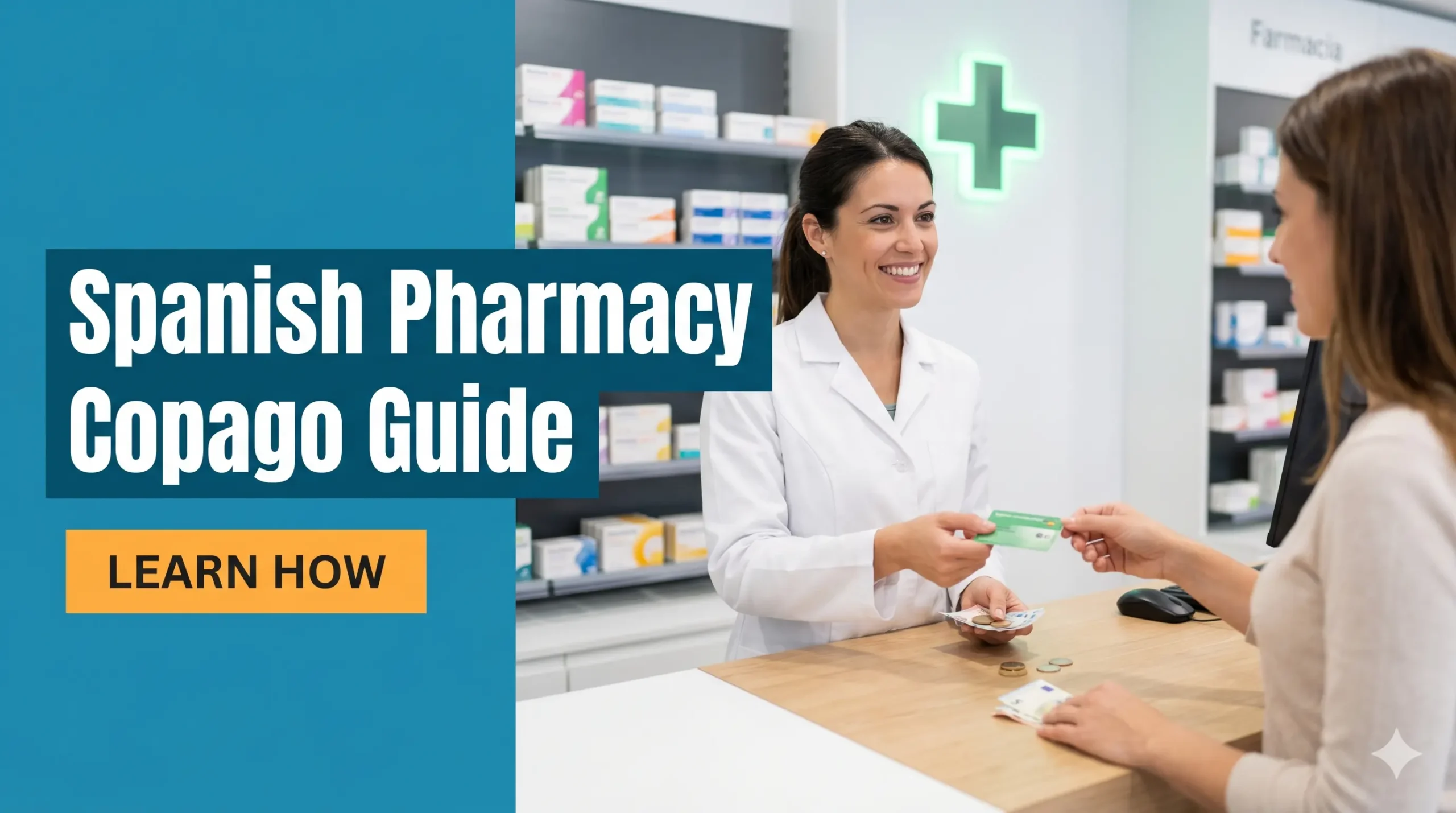
Pharmacies in Spain are ubiquitous; you can recognize them by the glowing green crosses on almost every major street. Whether you are buying a two-euro public prescription or spending fifty euros on over-the-counter painkillers (which are never subsidized), you need a reliable way to pay without incurring foreign transaction fees. If you try to use a US or UK credit card at a local pharmacy, you will lose a significant percentage to legacy banking markups.
To bypass this friction, opening your daily operational account with N26 is highly strategic. N26 issues a fully recognized local Spanish IBAN directly from your smartphone. You can use your N26 digital card to instantly tap and pay at any Spanish pharmacy, entirely avoiding the hidden foreign transaction fees of legacy home banks. Because N26 eliminates punitive quarterly maintenance fees, it perfectly serves as your local healthcare and utility hub. This seamless integration is exactly why digital alternatives dominate lists covering Opening a Bank Account in Spain: Step-by-Step for Foreigners. Furthermore, if your physical card is ever lost on the way to the clinic, the ability to freeze it via the app is a lifesaver, a process detailed in How to Report Lost or Stolen Bank Cards in Spain Quickly.
Managing Cross Border Health Funds
If you suffer a sudden health emergency and require thousands of euros in private, out-of-network prescription medication, you will likely need to move emergency funds from your home country to Spain.
Initiating a traditional international wire transfer through a legacy bank to cover these medical costs will crush your emergency budget with hidden SWIFT network fees and terrible exchange rates. To fiercely protect your medical capital, route your international transfers through Wise. Utilizing Wise allows you to completely bypass the expensive SWIFT network. Wise converts your home currency to euros using the real, transparent mid-market exchange rate. You can instantly transfer those cleanly converted euros directly into your localized Spanish account to settle the pharmacy bill. The deep mechanics of these cross-border savings are heavily mapped out in Sending Money to/from Spain: Comparing Banks vs Transfer Services.
Once your immediate healthcare needs are stabilized, it is crucial not to leave your remaining expat savings sitting idle in a vulnerable local checking account. To build robust, long-term wealth securely—which serves as your ultimate health and retirement safety net—many veteran expats transfer their surplus capital into a global brokerage account like Interactive Brokers.
Utilizing Interactive Brokers allows you to build a sophisticated, multi-currency portfolio that remains entirely portable, regardless of whether you eventually return to your home country’s healthcare system. It elegantly separates your long-term wealth building from your daily Spanish living expenses and pharmacy runs. Should the Spanish tax agency require proof of your worldwide financial standing to determine your copago brackets or general tax compliance, Interactive Brokers generates clean, standardized annual reports. Understanding the necessity of this global compliance is deeply explored in Foreign Income Reporting in Spain: What Residents Need to Know. Keeping your financial footprint agile ensures the money you save on healthcare continues to work for you.
References
Primary sources official
- Ministerio de Sanidad – Aportación de los usuarios en la prestación farmacéutica: https://www.sanidad.gob.es/gabinete/notasPrensa.do?id=4485
- Seguridad Social – Asistencia Sanitaria y Prestación Farmacéutica: https://www.seg-social.es/
Other helpful sources
- Portal de la Administración General del Estado – Sanidad: https://administracion.gob.es/
- Gobierno de Canarias – Documento de respuestas sobre el copago farmacéutico (PDF): https://www3.gobiernodecanarias.org/noticias/hemeroteca/preguntas-surgidas-aplicacion-copago-sanidad-elabora-documento-respuestas-habilita-procedimiento-informacion-traves-012/?format=pdf
Disclaimer
The information provided in this guide is exclusively for educational and informational purposes and does not constitute official legal, medical, or tax advice. Spanish public healthcare regulations, the specific income brackets governing the copago farmacéutico, and monthly maximum caps for pensioners are highly complex and subject to frequent updates by the Ministerio de Sanidad and the Agencia Tributaria. While we strive to ensure absolute accuracy, you should always verify your exact co-payment percentage, prescription exemptions, and healthcare rights directly with your local Centro de Salud or the Spanish Social Security office.