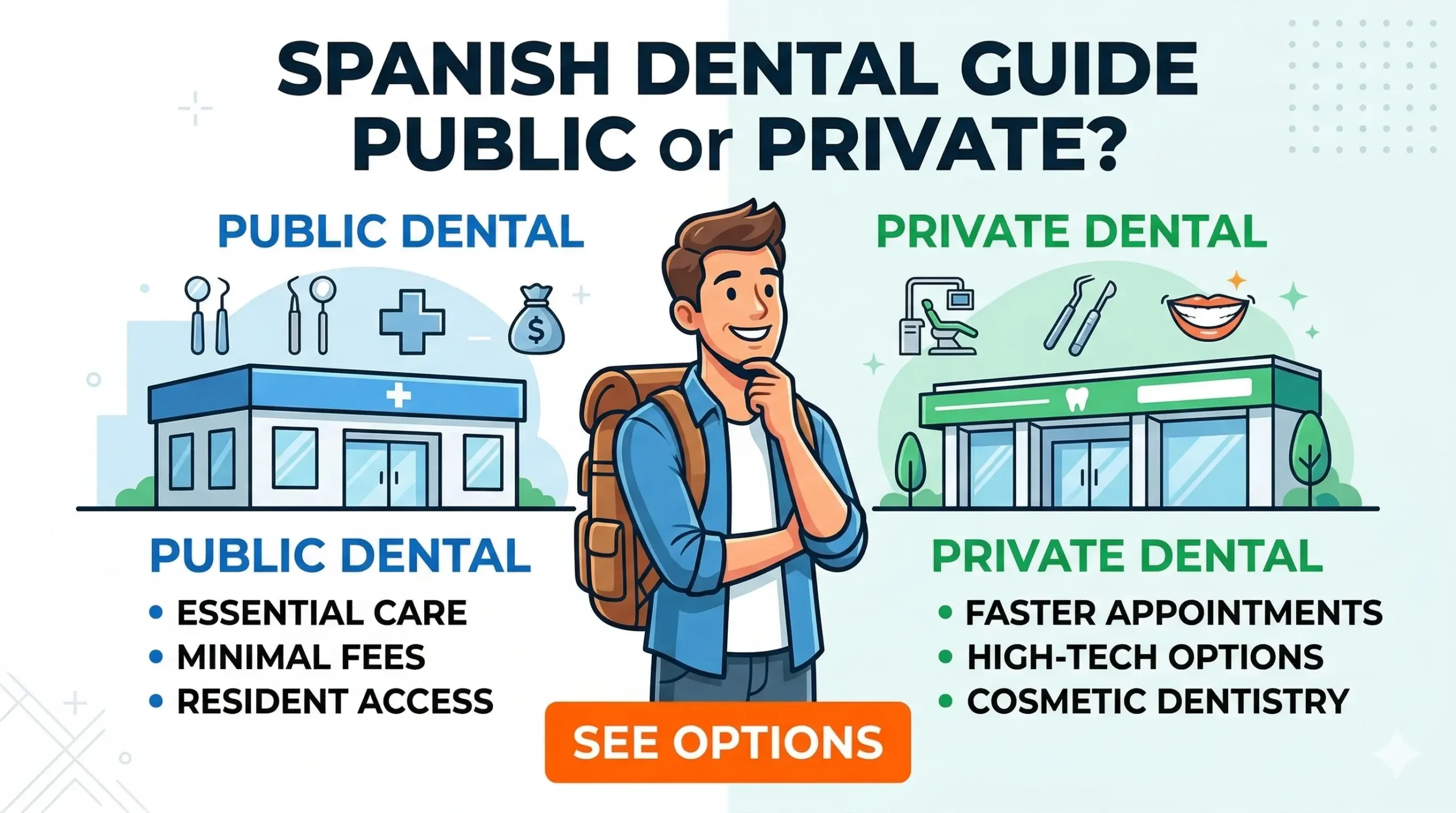
Public vs Private Dental Care in Spain: What Expats Usually Choose
Navigating dental care in a new country can be confusing. While Spain offers a world-class public healthcare system, adult dentistry is largely excluded. Discover the differences between public and private dental care, typical costs, and why expats overwhelmingly choose private treatment.
Disclosure: This post may contain affiliate links. We may earn a commission at no extra cost to you if you make a purchase through these links. Read full disclosure.
The Reality of Public Dental Care in Spain
Many expats relocate to the Iberian Peninsula with the assumption that the famous universal Spanish healthcare system will cover all their medical needs from head to toe. However, when it comes to oral health, the reality is quite different. The public system severely restricts dental services, forcing the vast majority of the population to look elsewhere for routine care.
What the Public System Covers for Adults
For adults over the age of fifteen, the public Sistema Nacional de Salud (SNS) provides strictly essential, emergency-based dental care. If you visit your local public clinic, the resident dentist will not perform preventive or restorative work. The public system explicitly does not cover routine cleanings, cavity fillings, root canals, crowns, bridges, dentures, or dental implants.
What the public system does cover is the management of acute infections and severe trauma. If you have a massive dental abscess that is causing facial swelling, a public doctor will prescribe antibiotics to clear the infection. If a tooth is completely decayed, causing agonizing pain, and cannot be saved, the public dentist will extract it for free. They will also handle severe maxillofacial emergencies, such as a fractured jaw from a traffic accident.
Because public care is limited exclusively to extractions and emergency stabilization, relying on it for your long-term oral health is a guaranteed path to tooth loss. If you are unsure how to access the public system for a general medical issue, you can learn the exact administrative steps in our guide on What Is a ‘Centro de Salud’ in Spain and How Do You Register?. If you find yourself in sudden, agonizing pain, reviewing our specific protocol on Emergency Dental Care in Spain: Where to Go will point you in the right direction.
Pediatric Dental Coverage
Fortunately, the Spanish government takes a much more proactive approach to children’s oral health. Pediatric dental care is managed regionally through a program generally known as PADI (Programa de Asistencia Dental Infantil). While the exact age brackets vary slightly depending on your autonomous community, PADI typically covers children between the ages of six and fifteen.
It is important to note that orthodontics (braces) are almost universally excluded from public pediatric coverage unless the child suffers from a severe congenital malformation, such as a cleft palate. Therefore, expat parents will still need to seek private care for their children’s cosmetic or standard structural teeth straightening. For a broader look at managing your child’s overall health in the Spanish system, consult our guide on Pediatric Care in Spain: Choosing a Pediatrician.
The Private Dental Care Landscape in Spain
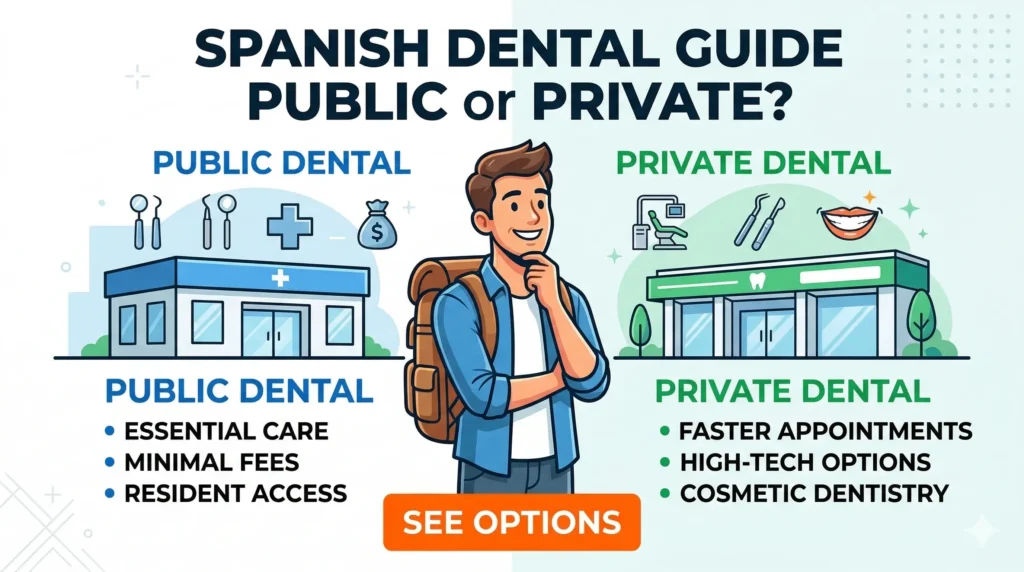
Because the state heavily restricts adult dental services, Spain features a massive, highly competitive, and technologically advanced private dental sector. More than ninety percent of all dental procedures in the country are performed in private clinics.
Why Most Expats Go Private
Expats overwhelmingly choose private dental care simply because it is the only viable option for preserving their teeth. However, the transition to the private sector in Spain is usually a pleasant surprise for newcomers. Because the market is so saturated with private dentists competing for patients, the quality of care is exceptionally high, and the prices remain incredibly affordable compared to the United States, the United Kingdom, or Australia.
Private Spanish clinics are generally outfitted with cutting-edge technology. It is standard for a local clinic to have on-site 3D CBCT scanners, intraoral digital scanners, and in-house milling machines that can create a ceramic crown in a single visit. The combination of world-class technology and low prices has actually turned Spain into a premier destination for European dental tourism. To understand how the private dental sector fits into the broader medical landscape, check out our deep dive into the Spain Healthcare System for Expats: Public vs Private.
Independent Clinics vs Corporate Franchises
When stepping into the private market, expats must choose between two distinct types of practices: independent clinics and corporate franchises.
Independent clinics, often referred to as dentistas de barrio (neighborhood dentists), are typically owned and operated by a single lead dentist or a small partnership. These clinics excel at continuity of care. You will see the exact same dentist at every visit, allowing you to build a strong doctor-patient relationship built on deep trust. They generally rely on word-of-mouth recommendations rather than aggressive marketing.
Dental Insurance vs Out of Pocket Payments
Once you choose to go private, the next hurdle is deciding how to finance your oral healthcare. Expats generally choose between paying cash as they go or utilizing a private dental insurance policy.
Managing Out of Pocket Costs
Because prices in Spain are highly competitive, many young, healthy expats simply choose to pay out of pocket for their routine care. An initial consultation and a panoramic X-ray are frequently offered for free as a marketing strategy to attract new patients. A routine professional dental cleaning typically costs between €40 and €60. If you need a standard composite filling, you can expect to pay around €50 to €80. A complex root canal generally ranges from €150 to €250, excluding the final restorative crown.
If you are navigating the broader costs of Spanish healthcare, you can compare these dental prices against general medical fees in our article on Health Costs in Spain: Typical Co‑Pays and Out‑of‑Pocket Fees.
When paying these bills at the clinic’s reception desk, expats should be highly cautious about how they process the transaction. Swiping a foreign bank card often subjects you to terrible dynamic currency conversion rates and hidden international transaction fees charged by your home bank. Financially savvy expats avoid this completely by using a multi-currency account like Wise. By tapping your Wise card, you guarantee that you are paying the exact Euro amount at the true mid-market exchange rate, keeping your money focused entirely on your health rather than enriching a legacy bank.
Furthermore, always ensure you ask for an itemized, officially stamped invoice (factura) after your treatment. If you have international travel insurance that covers emergency dental pain relief, you will need this specific document to successfully process a refund. We detail exactly what this paperwork must look like in How to Handle Medical Bills in Spain: Receipts, Claims, and Disputes.
How Private Dental Insurance Works
For families, older expats, or those requiring extensive restorative work, private dental insurance is an incredibly smart investment. However, Spanish dental insurance operates very differently from the American model. There are rarely any massive annual deductibles to meet, nor are there strict annual maximum payout caps. Instead, Spanish dental insurance functions more like a heavily discounted membership club.
You pay a very low monthly premium, often ranging from just €10 to €20 a month. In exchange, a vast array of preventative services—such as unlimited consultations, annual cleanings, emergency visits, and X-rays—are completely free. For complex treatments like fillings, extractions, crowns, and orthodontics, the insurance company provides a legally binding, pre-negotiated price list known as a baremo. This means that a root canal that normally costs a walk-in patient €250 will only cost an insured patient €140.
Navigating the various baremos across different insurers can be tedious. Utilizing a specialized, expat-focused broker like Innoinsure takes the stress out of the process. A broker from Innoinsure can seamlessly add a robust dental module to your existing private health policy or help you purchase a standalone dental plan. Because policies secured through Innoinsure generally feature no waiting periods, you can sign up on a Monday and book a discounted filling on a Tuesday.
To help clarify your options, here is a breakdown comparing the three main avenues of dental care in Spain:
| Feature | Public Dental Care (SNS) | Private (Out of Pocket) | Private (With Dental Insurance) |
| Routine Cleanings | Not covered | €40 – €60 per session | Free (Included in premium) |
| Cavity Fillings | Not covered | €50 – €80 per filling | Heavily discounted (e.g., €30) |
| Tooth Extractions | Free (Only if medically urgent) | €60 – €120 | Free or highly discounted |
| Wait Times | Long queues for triage | Immediate access | Immediate access |
| Choice of Dentist | Assigned by state | Unlimited freedom | Restricted to insurer’s network |
How to Choose the Right Dentist as an Expat
Finding a dentist you trust is a highly personal decision, and adding a foreign language into the mix requires a bit of strategic research.
Finding English Speaking Professionals
Discussing complex localized pain or the nuances of oral surgery in a second language can be terrifying. Fortunately, finding an English-speaking dentist in Spain is relatively easy, especially if you live in a popular expat hub like the Costa del Sol, Alicante, or major metropolitan cities like Madrid and Barcelona. Many independent clinics in these areas explicitly cater to the international community and advertise their bilingual services.
If you are struggling to find a reputable professional, the official Consejo General de Dentistas (General Council of Dentists) operates a public registry where you can verify a clinic’s credentials. Alternatively, if you suffer a severe toothache on a Sunday and cannot reach your regular English-speaking dentist, you will need to utilize emergency triage protocols. Our guide on What to Do If You Need Care on a Weekend in Spain explains how to find on-duty pharmacies and weekend emergency clinics to manage your pain until normal business hours resume.
Questions to Ask Before Treatment
Before committing to any major dental procedure in Spain, you should always request a presupuesto (a formal, written cost estimate). A reputable private clinic will provide a printed document breaking down the exact cost of every single material and labor charge involved in your treatment plan. Do not accept vague verbal estimates. It is also entirely acceptable in Spanish culture to take this presupuesto and seek a second opinion at a different clinic to compare prices and treatment philosophies.
Proactive expats order their daily oral care supplies through global platforms like iHerb. Utilizing iHerb allows you to affordably stock your Spanish bathroom with your favorite, trusted international dental brands. Furthermore, if you prefer natural, fluoride-free alternatives or specific xylitol mints to prevent decay, iHerb offers a massive catalog that local Spanish shops simply cannot match. By pairing excellent daily prevention with a smart Wise payment strategy and robust Innoinsure coverage, your dental journey in Spain will be completely painless.
References
Primary sources (official)
- Consejo General de Dentistas de España (General Council of Dentists): https://consejodentistas.es/
- Ministerio de Sanidad (Ministry of Health Spain) – Salud Bucodental: https://www.sanidad.gob.es/bucodental
Other helpful sources
- Expatica – Dentistry in Spain: https://www.expatica.com/es/healthcare/healthcare-services/dental-care-in-spain-582615/
- Caser Expat Insurance – Full Coverage Dental Plans: https://www.caserexpatinsurance.com/blog-typical-non-spanish/full-coverage-dental-plans-with-caser-expat-insurance
Disclaimer
The information provided in this article is for educational and informational purposes only and does not constitute formal medical, dental, or financial advice. Dental care regulations, public health coverage limits, and private insurance policies vary significantly by autonomous community and are subject to change. Always consult a licensed dental professional for medical diagnoses and refer to your specific insurance provider for exact coverage details and price lists.