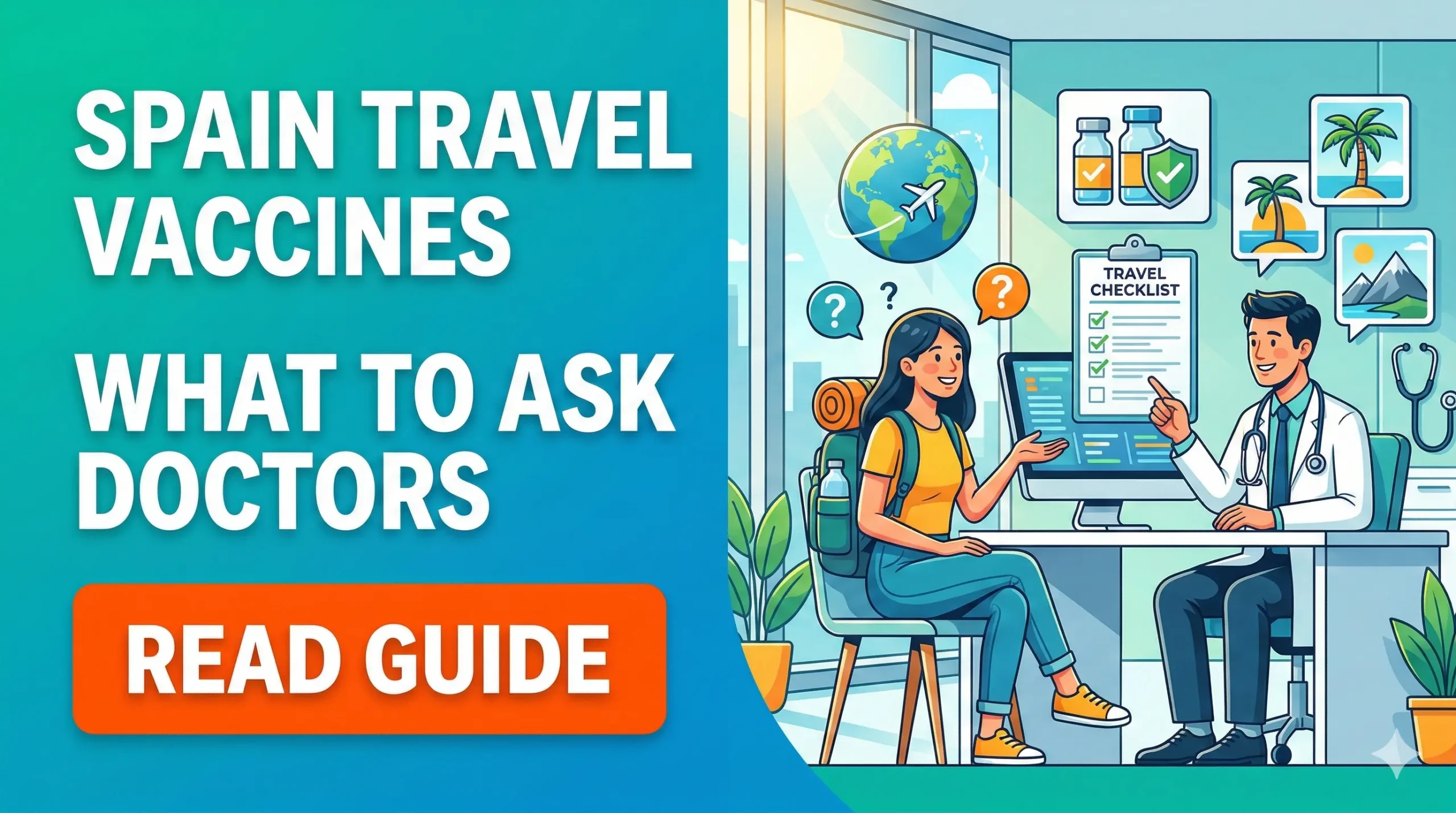
Vaccines for Travel From Spain: What to Ask Your Doctor
Preparing for an international trip from Spain requires more than just booking flights. This comprehensive guide details how expats can access Spanish international vaccination centers, secure necessary immunizations, and gather essential medical advice before exploring high-risk global destinations.
Disclosure: This post may contain affiliate links. We may earn a commission at no extra cost to you if you make a purchase through these links. Read full disclosure.
Understanding Travel Vaccinations in Spain
The Role of International Vaccination Centers
In Spain, standard primary care clinics do not handle specialized travel medicine. If you are traveling to a tropical, subtropical, or developing country, you cannot simply request exotic vaccines like Yellow Fever or Typhoid from your standard general practitioner. Instead, the Spanish Ministry of Health operates a highly dedicated network of facilities officially known as Centros de Vacunación Internacional (International Vaccination Centers). These specialized centers are overseen by Sanidad Exterior (External Health) and are staffed by dedicated doctors and nurses trained exclusively in tropical medicine and global epidemiological risks.
For expats, navigating this specialized branch of the Spanish healthcare system requires fully understanding the separation of administrative duties. While your local neighborhood clinic seamlessly manages your day-to-day health, the international centers are the only entities legally authorized to issue specific international health certificates. If you are unfamiliar with how the standard public health network operates compared to these specialized branches, reviewing our foundational guide on What Is a ‘Centro de Salud’ in Spain and How Do You Register? provides excellent context. To understand how public care interacts broadly with independent clinics in Spain, refer to the Spain Healthcare System for Expats: Public vs Private.
Mandatory versus Recommended Vaccines
When discussing travel immunizations with a Spanish doctor, it is crucial to understand the distinct legal and medical differences between mandatory vaccines and recommended vaccines. Mandatory vaccines are legally required by your destination country for border entry. The most prominent, globally recognized example is the Yellow Fever vaccine. Many countries in Sub-Saharan Africa and South America will outright deny you entry at the border, or force you into a state-run quarantine facility, if you cannot present an official, stamped certificate proving you have been inoculated prior to your arrival.
Recommended vaccines, on the other hand, are not legally required by customs officials for border entry, but they are highly advised by global health authorities to fiercely protect your personal wellbeing. Diseases like Hepatitis A, Typhoid, and Japanese Encephalitis fall firmly into this category. Choosing to skip recommended vaccines is a personal risk, but one that could result in severe, debilitating illness, massive foreign medical bills, and a completely ruined trip. The doctors at the Spanish international centers will heavily advocate for these recommendations based on current, real-time outbreak data monitored by the World Health Organization.
When to Start Planning Your Vaccinations
One of the most common and dangerous logistical mistakes expats and tourists make is leaving their travel vaccinations to the absolute last minute. The human immune system requires significant time to build adequate, protective antibodies after an inoculation. Some vaccines, such as the Hepatitis B or Rabies pre-exposure series, require multiple doses spread out over several weeks or even months to achieve their full, documented clinical efficacy. If you visit the clinic a mere week before your flight, you simply will not have enough time to safely complete these protective schedules.
If you are an expat managing an underlying, chronic health issue, such as diabetes, a heart condition, or an autoimmune disorder, you must also heavily factor in the time needed to consult your primary specialist in Spain. Certain live-attenuated travel vaccines may be strictly contraindicated for individuals with compromised immune systems. Coordinating care safely between your regular specialist and the travel doctor is a complex but necessary logistical step, which we detail extensively in Chronic Conditions in Spain: Managing Ongoing Care as an Expat.
Accessing the Centro de Vacunacion Internacional
Booking Your Cita Previa Online
Because these specialized centers operate under the direct jurisdiction of the Ministry of Health’s Sanidad Exterior department, walk-in appointments are strictly prohibited. You must secure a prior appointment, officially known as a cita previa, to be evaluated by a travel doctor. Fortunately, the Spanish government has thoroughly digitized this process, allowing registered residents and expats to book their slots through a centralized online portal seamlessly.
It is important to note that you do not necessarily have to visit the specific center located in your immediate municipality. If the primary center in central Madrid or Barcelona is fully booked for the next two months, you are legally permitted to book an appointment at a different facility in a neighboring province, such as Toledo or Girona, if you are willing to commute. For a broader, deep understanding of how to navigate digital medical bookings, secure electronic certificates, and utilize health portals across the country, read our comprehensive overview on Health Apps in Spain: Booking, Records, and Telemedicine Options.
What to Bring to Your Appointment
Arriving fully prepared for your appointment ensures the consulting Spanish doctor can provide the most accurate, safe, and efficient medical advice. Your most critical item is your complete, lifetime vaccination history. For expats, this often means tracking down childhood immunization records from your home country, having them translated if necessary, and presenting them alongside your current Spanish health card.
You must also bring your official, unexpired identification, such as your Passport, TIE, or green NIE certificate. The details printed on these documents must perfectly match the information printed on any official International Vaccination Certificates you receive to avoid issues at border control. Furthermore, bring a highly detailed, day-by-day itinerary of your trip. Knowing that you will be spending three days trekking in a specific rural province rather than strictly staying in a high-altitude capital city can dramatically alter the doctor’s malaria prophylaxis recommendations.
Finally, bring a comprehensive, written list of all medications you are currently taking daily, including over-the-counter wellness supplements. If you are planning to travel with a large, multi-month supply of your daily prescriptions, you must deeply understand the complex international customs rules for transporting drugs securely, a highly regulated topic we cover thoroughly in Traveling With Medication in Spain: Practical Carry-On Tips.
Expected Costs and Payment Methods
While routine primary care in Spain is generally entirely free for registered residents contributing to social security, specialized travel medicine operates under a very different, hybridized financial structure. Consultations at a public Centro de Vacunación Internacional are sometimes heavily subsidized or free depending on your region, but the exotic vaccines themselves almost always carry an out-of-pocket cost.
Managing these sudden, cumulative out-of-pocket medical expenses, especially if you are paying to vaccinate multiple family members simultaneously, can be a massive financial shock. Using a multi-currency financial tool like Wise is highly recommended for expats navigating these costs. By utilizing a Wise debit card, you can easily pay for expensive pharmacy runs and government administrative fees using the true mid-market exchange rate, avoiding the hidden foreign transaction fees that traditional international banks aggressively charge. For more crucial context on navigating Spanish medical billing and deciphering pharmacy receipts, see Health Costs in Spain: Typical Co-Pays and Out-of-Pocket Fees.
Essential Vaccines for Global Destinations
Immunizations for Tropical Regions
Traveling from Spain to tropical regions in Southeast Asia, Sub-Saharan Africa, or South America introduces a host of viral and bacterial risks not commonly found in the highly sanitized environments of Western Europe. The most frequently prescribed vaccines for these regions target devastating food and water-borne illnesses. Hepatitis A and Typhoid are the standard, non-negotiable baseline recommendations for almost any traveler heading to a developing nation, as both diseases are easily contracted through contaminated street food, unwashed fruit, or local tap water.
For travelers planning extended stays, working in remote healthcare clinics, or engaging in high-risk adventure tourism, the Hepatitis B and Rabies vaccines are strongly, urgently advised. Rabies is a particularly terrifying, 100% fatal risk in regions with large, uncontrolled populations of stray dogs and wild monkeys. The pre-exposure Rabies vaccine series does not completely eliminate the absolute need for medical treatment if bitten, but it radically buys you crucial time to reach a hospital and significantly simplifies the intense post-exposure treatment protocol, which is critical if you are deep in a remote jungle.
| Vaccine Type | Primary Transmission Route | Typical Destination Risk Profile | Requirement Status |
| Yellow Fever | Mosquito bites | Sub-Saharan Africa, South America | Mandatory for many borders |
| Hepatitis A | Contaminated food and water | Developing nations globally | Highly Recommended |
| Typhoid Fever | Contaminated food and water | Rural areas, Southeast Asia, Africa | Highly Recommended |
| Rabies | Animal bites (dogs, monkeys) | Remote areas far from medical care | Recommended for adventurers |
| Japanese Encephalitis | Mosquito bites | Rural Asia, agricultural regions | Recommended for long stays |
Yellow Fever and the International Certificate
Yellow Fever stands entirely apart from all other travel diseases because of its strict, uncompromising international legal framework. It is a severe, highly lethal viral hemorrhagic disease transmitted by infected mosquitoes, endemic to specific, heavily forested tropical regions of Africa and South America. Because the disease is highly fatal and easily spread by vectors, countries without Yellow Fever fiercely protect their borders to prevent the virus from being imported and establishing a local foothold.
When you legally receive the Yellow Fever vaccine at a recognized Spanish Centro de Vacunación Internacional, you will be issued a yellow booklet officially named the International Certificate of Vaccination or Prophylaxis (ICVP). This physical document is legally binding and must bear the official, authorized stamp of the center and the signature of the administering clinician. You must present this booklet alongside your passport at immigration checkpoints. Without it, border officials have the absolute, undisputed legal authority to deny you entry, deport you, or place you in isolation.
Routine Boosters for Expat Travelers
Amid the heavy, anxious focus on exotic tropical diseases like Dengue or Zika, many expats completely overlook the absolute necessity of updating their routine domestic boosters. Travel inherently involves moving through crowded international airports, utilizing tightly packed, poorly ventilated public transportation, and interacting with diverse global populations, which vastly increases your exposure to highly contagious, common respiratory and viral infections.
Before embarking on any major international trip, your Spanish travel doctor will likely recommend aggressively checking your status for standard childhood immunizations. Ensuring your Tetanus, Diphtheria, and Pertussis (Tdap) vaccine is completely up to date is absolutely vital, especially since a minor, accidental scrape on a rusty piece of metal during a jungle hike can expose you to lethal tetanus spores. Furthermore, confirming your immunity to Measles, Mumps, and Rubella (MMR) is critical, as severe measles outbreaks frequently occur globally in areas with low domestic vaccination rates.
If you are an expat traveling with children, managing their routine pediatric schedule alongside specialized, exotic travel vaccines requires expert, careful coordination. The developing pediatric immune system processes multiple live vaccines differently than a mature adult’s system. For expat parents needing to balance school-mandated Spanish vaccines with complex tropical travel requirements, consulting a dedicated pediatric specialist is non-negotiable. You can learn more about finding the right, English-speaking doctor for your children in our comprehensive guide on Pediatric Care in Spain: Choosing a Pediatrician.
Managing Mosquito Borne Risks and Prophylaxis
Understanding Antimalarial Medications
Vaccines cannot prevent every tropical disease; unfortunately, there is currently no commercially available, widely distributed vaccine for Malaria that is suitable for standard short-term travelers. Malaria is a life-threatening, aggressive blood parasite transmitted exclusively by the female Anopheles mosquito. To fiercely protect yourself, the Spanish travel clinic will formally prescribe a tailored course of antimalarial prophylactic pills, which you must purchase at a local pharmacy before your departure.
The complex choice of antimalarial medication involves a deep comparative analysis of your destination’s specific drug-resistance patterns, your personal medical history, and your overall travel budget. Common prophylactic options available in Spain include Atovaquone-Proguanil (commercially known as Malarone), Doxycycline, and Mefloquine. Malarone is highly effective and has minimal side effects, but it is incredibly expensive and must be taken daily. Doxycycline is much cheaper but can cause severe sun sensitivity—a major drawback for a beach holiday or desert trek. Mefloquine requires only a convenient weekly dose but is infamous in the medical community for causing vivid nightmares and severe psychological distress in some sensitive patients.
Dengue Fever and Preventive Measures
Dengue Fever, often morbidly called “breakbone fever” due to the severe, debilitating joint pain it causes, is another massive mosquito-borne threat highly prevalent in tropical and subtropical climates globally. Unlike Malaria, Dengue is transmitted by the aggressive Aedes mosquito, which is highly active during broad daylight hours and thrives in urban, concrete environments and stagnant city water just as much as in rural, dense jungles.
Expats must be incredibly proactive in their daily bite-avoidance strategies. This includes wearing long, light-colored clothing and meticulously applying high-concentration DEET or Picaridin insect repellents constantly. Finding premium, skin-safe insect repellents and permethrin clothing sprays in standard Spanish pharmacies can be difficult and surprisingly expensive due to high retail markups. The expat community frequently relies on global platforms like iHerb to bulk-order top-tier tropical insect repellents, soothing after-bite creams, and holistic immune-support vitamins. Sourcing these vital preventative tools securely through iHerb ensures you are fully equipped to combat daylight mosquito vectors long before you board your outbound flight.
Practical Tips for a Healthy Departure from Spain
Preparing a Comprehensive Medical Travel Kit
Relying entirely on pre-trip vaccines and daily pills is not a complete, robust travel health strategy. Every expat leaving Spain for a developing nation should meticulously pack a highly comprehensive medical travel kit. Finding basic first-aid supplies or trusted, safe digestive aids in a foreign, rural pharmacy can be a confusing and highly dangerous ordeal, especially when navigating heavy local language barriers and the very real threat of counterfeit medications in developing markets.
Your kit should minimally include standard sterile bandages, antiseptic wipes, oral rehydration salts, and over-the-counter pain relievers like paracetamol and ibuprofen. More importantly, you should proactively ask your Spanish travel doctor for “standby” emergency prescriptions. It is highly common for travel clinics to prescribe a broad-spectrum antibiotic (like Azithromycin) explicitly to be used for severe traveler’s diarrhea. Having this antibiotic physically in your backpack allows you to treat a severe gastrointestinal infection immediately, rather than suffering in agony for days while desperately searching for an English-speaking local doctor.
Additionally, managing the sudden, harsh dietary shifts associated with international travel requires robust, daily digestive support. Packing high-quality probiotics and activated charcoal can save you from days of intense stomach discomfort. Expats consistently order these specialized travel supplements via iHerb prior to departure. By intelligently stocking your medical kit with trusted, verified brands from iHerb, you completely bypass the anxiety of sourcing unfamiliar, potentially unsafe remedies abroad and guarantee that your digestive system is resilient against new, exotic cuisines.
Leveraging Private Expat Health Insurance
Even with flawless, up-to-date vaccination records and a perfect medical kit, terrible accidents and unexpected severe illnesses happen globally. Relying solely on your Spanish public health coverage outside of the European Union is a massive, potentially bankrupting financial risk. The Spanish public system will absolutely not reimburse you for a $50,000 emergency helicopter evacuation from a remote mountain in Peru, nor will it cover massive private hospital ICU fees if you are in a traffic accident in Thailand.
Securing comprehensive, international travel and medical insurance is absolutely non-negotiable for smart travelers. For expats, the smartest strategy is to utilize a dedicated, reputable insurance broker like Innoinsure to find a policy strictly tailored to the unique needs of international nomads and frequent flyers. A premium policy seamlessly sourced through Innoinsure guarantees that you have 24/7 access to English-speaking emergency assistance, direct billing at top-tier international private hospitals, and full financial coverage for emergency medical repatriation flights back to Spain if your condition requires complex, long-term care.
Managing Outpatient Costs While Abroad
If you suffer a minor illness abroad—such as a severe ear infection after diving or a sprained ankle on a hike—that does not require a massive emergency evacuation, you will likely need to visit a local foreign clinic. In these routine scenarios, you are almost always required to pay the local doctor upfront and entirely out of pocket, retaining the itemized receipts to file a formal reimbursement claim with your insurance company later upon your return.
Swiping your traditional Spanish bank card at a foreign clinic or a rural, cash-only pharmacy will subject you to aggressive dynamic currency conversion rates and brutal international transaction fees that inflate your medical bill. To fiercely protect your travel funds, you should always travel with a borderless, highly secure multi-currency account like Wise. By tapping your Wise debit card, you can pay local medical bills seamlessly at the true, transparent mid-market exchange rate, keeping your money focused entirely on your health recovery rather than padding excessive banking fees.
Ultimately, healthy, stress-free travel requires highly proactive preparation. By booking your appointment at a Spanish Centro de Vacunación Internacional early, thoroughly understanding the complex landscape of malaria prophylaxis, and leveraging modern financial and insurance tools, you can explore the globe with absolute, unshakeable confidence. And if you happen to fall ill the moment you return to Spanish soil on a Sunday evening, knowing exactly how to navigate the local urgent care system is crucial; keep our guide on What to Do If You Need Care on a Weekend in Spain bookmarked for your safe, healthy return.
References
Primary sources (official)
- Ministerio de Sanidad (Spain) – Centros de Vacunación Internacional: https://www.sanidad.gob.es/areas/sanidadExterior/laSaludTambienViaja/centrosVacunacionInternacional/centrosvacu.htm
- World Health Organization (WHO) – Travel Advice and Vaccines: https://www.who.int/travel-advice/vaccines
Other helpful sources
- Centers for Disease Control and Prevention (CDC) – Travelers’ Health Yellow Book: https://wwwnc.cdc.gov/travel/page/yellowbook-home
- National Health Service (NHS UK) – Travel Vaccination Advice: https://www.nhs.uk/vaccinations/travel-vaccinations/travel-vaccination-advice/
Disclaimer
The information provided in this article is for educational and informational purposes only and does not constitute medical, legal, or financial advice. International vaccination requirements, disease outbreaks, and clinical guidelines are subject to rapid change. Always consult directly with a qualified healthcare professional or an official International Vaccination Center in Spain to receive personalized medical advice tailored to your specific health history and travel itinerary.