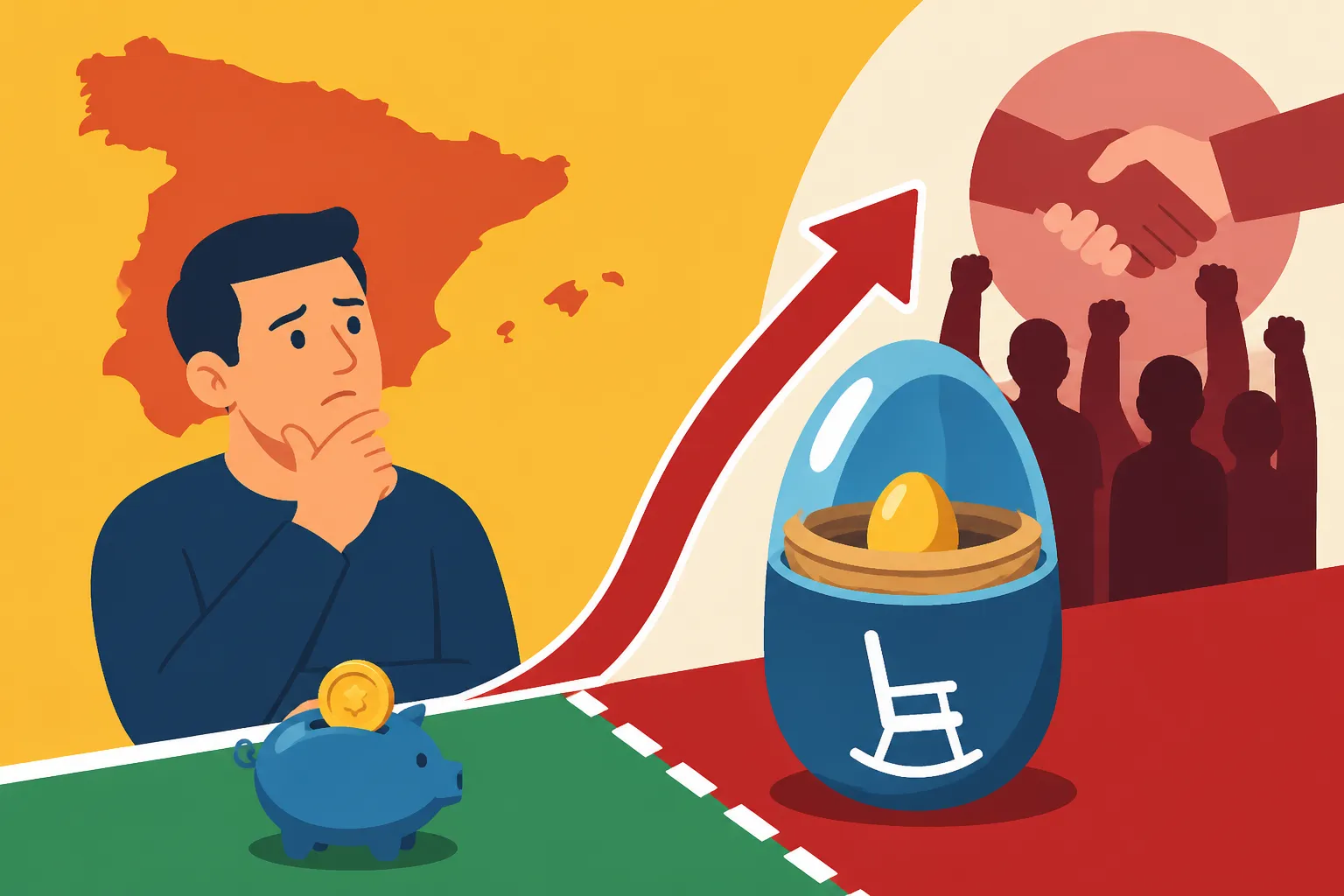
Solidarity Tax Thresholds: When a US Retirement Account Pushes You Over
Picture a retired American couple in Málaga with a paid-off flat, a brokerage account and two decades of 401(k) savings. On paper they feel comfortable, not rich. Then a Spanish adviser mentions the Solidarity Tax on large fortunes, and the retirement money suddenly counts. This guide explains the thresholds, the rates, and exactly when a US retirement account pushes you over.
Disclosure: This post may contain affiliate links. We may earn a commission at no extra cost to you if you make a purchase through these links. Read full disclosure.
How the Solidarity Tax Threshold Works for US Retirement Savers
I remember my first Spanish wealth tax conversation. I sat in a gestoría near Plaza de la Merced while the adviser added up everything I owned, including accounts I had stopped thinking of as “mine” because I could not touch them until retirement. That is where most Americans in Spain meet this tax. It is not an income tax and it does not care whether you withdrew anything. It is a snapshot of what you own.
The Impuesto Temporal de Solidaridad de las Grandes Fortunas is a national tax that sits alongside the regional wealth tax (Impuesto sobre el Patrimonio). Spanish tax residents are taxed on their worldwide net wealth. For an American, that means your Fidelity, Vanguard or Schwab accounts, your US house, your 401(k) and your IRA all go into the calculation, along with your Spanish assets. If you need the wider picture first, see Wealth Tax and Solidarity Tax in Spain: Overview for Foreigners.
The Threshold and the Rate Bands
The Solidarity Tax only bites on a taxable base above €3,000,000. Below that line the rate is zero. Above it, a progressive scale applies to the slice in each band. The band edges come from the state wealth tax scale, which is why they are not round numbers.
| Taxable base after allowances | Rate on the slice in this band | What it means in practice |
|---|---|---|
| Up to €3,000,000 | 0% | No Solidarity Tax at all |
| €3,000,000 to €5,347,998.03 | 1.7% | The first euro over €3,000,000 is taxed here |
| €5,347,998.03 to €10,695,996.06 | 2.1% | Only the portion inside this band |
| Above €10,695,996.06 | 3.5% | Only the portion above this figure |
The scale is marginal. If your taxable base is €3,500,000, you do not pay 1.7% on everything. You pay 1.7% on the €500,000 above the threshold, which comes to €8,500 before any deductions for regional wealth tax already paid.
Allowances That Sit Before the Threshold
The €3,000,000 line applies to your taxable base, not your gross wealth. Two allowances come off first:
- A general exempt minimum of €700,000 per person.
- An exemption of up to €300,000 on the value of your habitual home in Spain.
In practical terms, a single resident who owns a Spanish main home can hold up to roughly €4,000,000 of net wealth before the Solidarity Tax starts. Someone renting gets only the €700,000 allowance, so the effective line is around €3,700,000. Debts tied to your assets, such as a mortgage, reduce net wealth, though debts linked to exempt assets are restricted.
These allowances apply per taxpayer. A married couple each has their own threshold, which becomes very important later when we look at how US couples hold their accounts.
How Regional Wealth Tax Interacts
The Solidarity Tax was designed to catch wealth in regions that reduce or eliminate regional wealth tax. Any regional wealth tax you actually pay is deducted from your Solidarity Tax bill. So in a region that charges full wealth tax, the Solidarity Tax may come out at zero even if you are well above the threshold. In a region that grants a full relief on wealth tax, such as Madrid or Andalusia, the Solidarity Tax becomes the main bill.
This flips a lot of relocation advice on its head. The region that looked like a wealth tax haven may land you with the national tax instead. For a regional comparison, see Regional Tax Differences in Spain: How Your Comunidad Affects You, and for the US filer angle, Choosing a Comunidad for Tax Reasons: What Actually Changes for a US Filer.
There is also a combined ceiling that links income tax, wealth tax and Solidarity Tax to your taxable income, with a floor so that the reduction cannot wipe the bill out entirely. Retirees with large assets and modest withdrawals sometimes benefit from it, but it needs a proper calculation rather than a guess.
Why a 401(k) or IRA Can Tip the Scale
Here is the part that keeps American retirees up at night. Spain’s wealth tax law exempts consolidated rights in Spanish pension plans and similar Spanish systems. That exemption was written for planes de pensiones, not for American accounts.
Spain’s Exemption Is Built for Spanish Plans
Whether a US 401(k), traditional IRA or Roth IRA qualifies for the pension exemption is a contested point. An IRA in particular often looks, to Spanish eyes, like a brokerage account holding funds and shares that you can access, with a tax penalty, at any time. Many Spanish advisers therefore include IRAs at the value of the underlying investments. Employer 401(k) plans with stricter withdrawal limits have a somewhat stronger argument for exemption, but there is no blanket rule that protects them.
That uncertainty is the danger. If your non-retirement wealth sits at €2,500,000 and your retirement accounts hold another €1,500,000, the classification of those accounts decides whether you owe nothing or owe a meaningful annual bill. You want an adviser who has taken a clear position, documented why, and filed consistently year after year. For the valuation side in depth, see Wealth Tax on US Assets: How Spain Values Your American Portfolio.
Valuation on 31 December and Currency
The tax looks at what you own on 31 December. Your accounts are valued at that date and converted into euros. Two things follow from this.
First, a strong year in the US market can push you over the threshold even if you did nothing. Second, a strong dollar against the euro on that single day raises the euro value of everything you hold in the US. I have watched friends cross the line purely because of currency movement in December.
There is no smoothing. A €3,000,000 taxable base on 30 December and €3,100,000 on 31 December are two very different outcomes. Keep a running estimate through the autumn so the final number is not a surprise.
Worked Example: Linda in Madrid
Linda is a retired American teacher who moved to Madrid. She is single and tax resident in Spain. Her assets at 31 December, converted to euros:
| Asset | Gross value | Counted value |
|---|---|---|
| Madrid flat, main home, no mortgage | €900,000 | €600,000 after the €300,000 home exemption |
| US brokerage account | €1,600,000 | €1,600,000 |
| 401(k) and traditional IRA combined | €2,000,000 | €2,000,000 if not treated as exempt |
| Total net wealth | €4,500,000 | €4,200,000 |
| Less general exempt minimum | €700,000 | |
| Taxable base | €3,500,000 |
Her base is €500,000 above the threshold. At 1.7% that is €8,500 of Solidarity Tax. Madrid grants full relief on regional wealth tax, so there is no regional payment to deduct, and the €8,500 stands unless the income-linked ceiling reduces it.
Now remove the retirement accounts from the calculation. Counted wealth falls to €2,200,000, the taxable base to €1,500,000, and the Solidarity Tax to zero. Her 401(k) and IRA alone are what push her over.
Withdrawing the money does not solve this. Cash in her Spanish bank counts exactly like an IRA. A withdrawal only reduces wealth by the income tax paid on it, and it creates Spanish income tax exposure in the process. See Withdrawing From a US Retirement Account as a Spanish Resident before you move any money.
Planning Moves Before and After You Cross the Threshold
Once you know where you stand, there are legitimate ways to manage the exposure. None of them are tricks, and all of them depend on the exact facts of your household.
How Spouses Hold the Assets
Because each spouse has their own allowance and their own threshold, ownership matters enormously. Retirement accounts are individual by nature. If one spouse holds a large 401(k) and the other holds very little, the first spouse can cross the line while the household as a whole would not.
Take a couple with the same €4,500,000 gross wealth as Linda, home owned jointly. If everything is split evenly, each spouse has €2,100,000 of counted wealth after their share of the home exemption, a taxable base of €1,400,000, and no Solidarity Tax at all. If most assets sit with one spouse, that spouse may cross the threshold while the other wastes allowance.
Your US marital property regime matters here. Couples from community property states are treated differently from couples in separate property states, and Spain will look at who legally owns what. Rebalancing taxable accounts between spouses can sometimes help, but gifts between spouses carry their own Spanish and US consequences.
Residency Status, Timing and Debt
Several other levers are worth discussing with an adviser:
- Taxpayers under the special impatriate regime are generally taxed only on Spanish-located assets for wealth purposes, which can take US accounts out of the picture during the regime. See Beckham Law vs Standard Taxation for Americans: Which Leaves You Better Off.
- Roth conversions reduce wealth by the US tax paid, but they create Spanish income tax questions that must be modelled first.
- Genuine debts reduce net wealth, but borrowing simply to reduce the base rarely works because the borrowed cash is itself an asset.
- Moving between regions changes the interaction between regional wealth tax and the Solidarity Tax, so compare total liability, not just the headline relief.
For a broader planning framework, see How to Plan for Wealth Tax If You Own Assets Abroad.
Filing Obligations That Travel Together
The Solidarity Tax has its own return, Modelo 718, filed in July, right after the window for the regional wealth tax return, Modelo 714. You generally need to file the wealth tax return first, because the regional amount paid feeds into the Solidarity calculation.
The same US accounts also appear on your Modelo 720 informational return in Spain and on your FBAR and Form 8938 in the US. These filings must agree on what you own. Inconsistent values across returns are the kind of thing that invites questions. See Modelo 720 and FBAR Together: The Same Assets Reported to Two Countries, and for how the treaty affects the income side, The US-Spain Tax Treaty: How Americans Avoid Being Taxed Twice.
Why Taxes for Expats Belongs on Your Team
I have done the “local gestor plus a US preparer who never speaks to each other” arrangement, and I would not recommend it to anyone with retirement accounts large enough to approach these thresholds. The Spanish side needs to know what your 401(k) and IRA are worth, how they are structured, and what the US side is reporting. The US side needs to know what Spanish taxes you are paying and how they affect your foreign tax credit.
This is where Taxes for Expats earns its place. Taxes for Expats is a firm built around Americans living abroad, and its preparers deal every day with FBAR, Form 8938, foreign tax credits and the retirement account questions that come with life in Spain. When your US return is prepared by people who already understand Spanish residency, the numbers you give your Spanish adviser for Modelo 714, Modelo 718 and Modelo 720 start from the same foundation.
What to Prepare Before You Book a Consultation
Arrive with the documents that let Taxes for Expats and your Spanish adviser give you a real answer rather than a rough guess:
- Year-end statements for every US account, including each 401(k), traditional IRA and Roth IRA, showing the balance on 31 December.
- Plan documents or summary descriptions for employer plans, which help support any argument about restricted access.
- Your Spanish property valuation documents, including cadastral value and purchase deeds.
- Details of any mortgages or other debts, with balances on 31 December.
- Your marriage details and, if relevant, which US state’s property rules applied to your marriage.
- Copies of last year’s Spanish returns, including Modelo 720, and your last US return with its FBAR confirmation.
Steps to Work Out Whether You Cross the Line
- Add up your worldwide net wealth in euros at 31 December, per spouse, not per household.
- Subtract the €700,000 general allowance and up to €300,000 for your Spanish main home.
- Decide, with professional support, whether your US retirement accounts count or qualify for exemption.
- Compare the resulting taxable base to the €3,000,000 threshold, then apply the rate bands in the table above.
- Deduct regional wealth tax actually paid in your region.
- Check the income-linked ceiling, which may reduce the combined bill.
- Ask Taxes for Expats to confirm how these Spanish payments flow into your US return and foreign tax credit position.
If your rough calculation lands anywhere within a few hundred thousand euros of the threshold, treat it as a yes and get a professional review. Market moves and currency swings over a single autumn can carry you across. A conversation with Taxes for Expats early in the year, well before the 31 December snapshot, gives you time to rebalance ownership between spouses, plan any Roth conversions, or reconsider the timing of a regional move.
Retirement in Spain should feel like sunshine and long lunches, not dread every time the S&P rallies. Know your number, know which side of €3,000,000 your taxable base sits on, and let Taxes for Expats keep your American filings aligned with your Spanish ones. For the bigger retirement picture, read Retiring to Spain as an American: Pensions, Social Security, and Filing, then book your review with Taxes for Expats before the year-end snapshot locks your numbers in.
Disclaimer
This article is for general informational purposes only and does not constitute professional advice. Laws, prices and regulations vary by location and change over time. Consult a qualified professional for guidance on your specific situation.