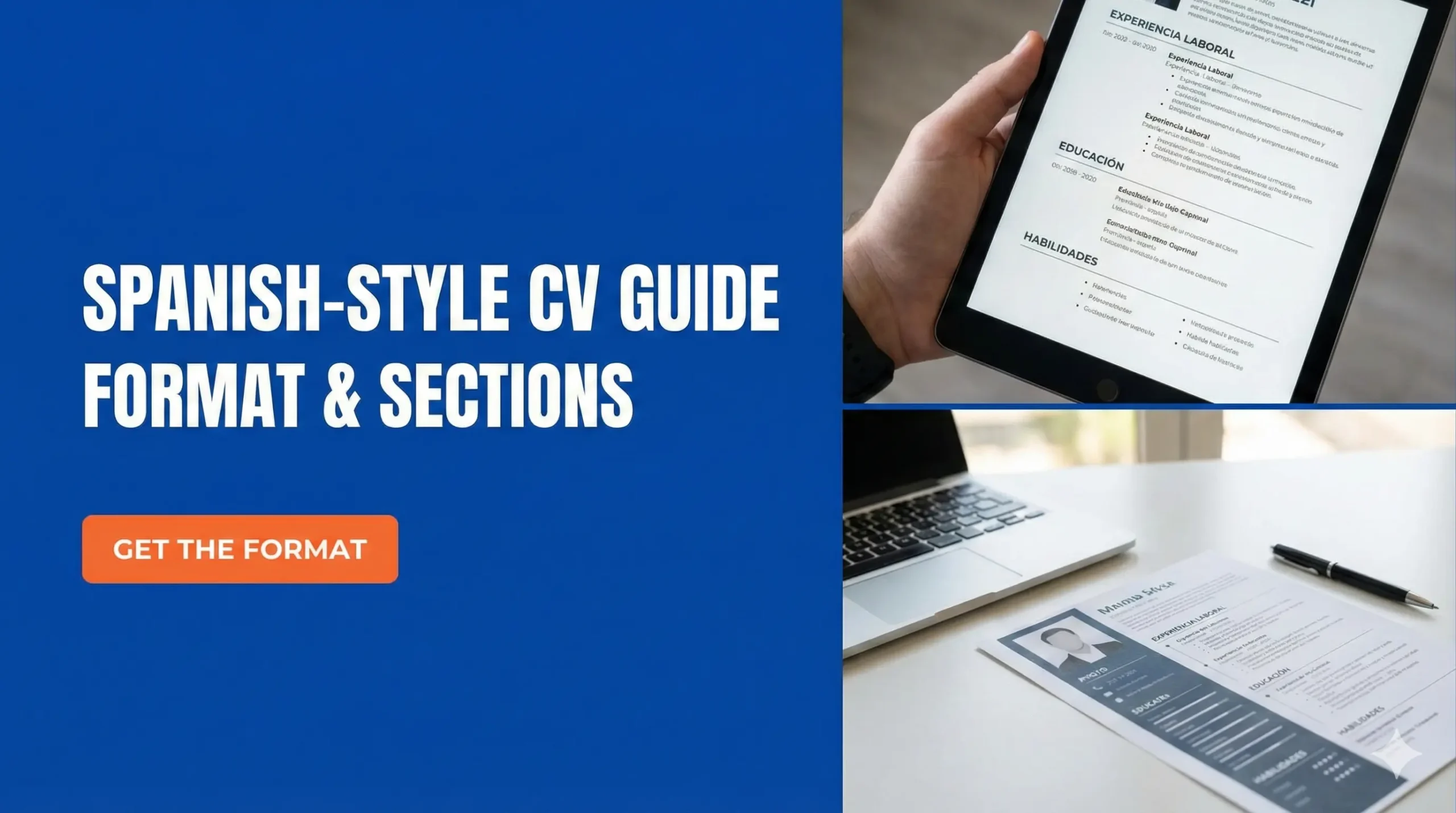
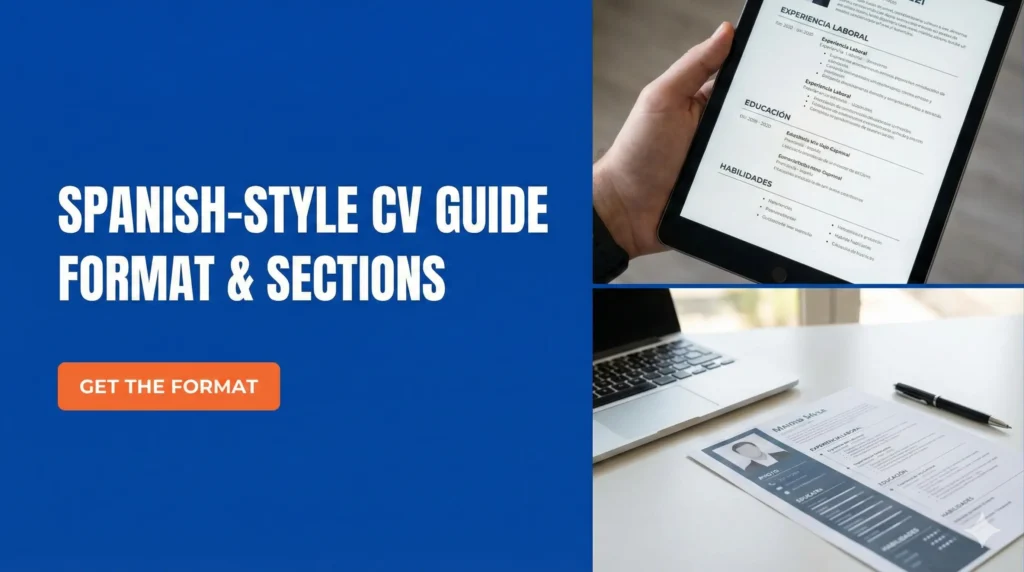
Writing a Spanish-Style CV: Format, Sections, and Examples
Disclosure: This article contains affiliate links. If you buy through them, we may earn a commission at no extra cost to you. Read our full disclosure.
Crafting a Spanish-style CV requires more than simply translating your current resume. This comprehensive guide covers essential formatting rules, mandatory personal details, proper section structures, and cultural expectations to help you successfully navigate the competitive job market in Spain.
Introduction
Spain is an incredibly attractive destination for international professionals. With its world-renowned quality of life, excellent climate, and growing technological hubs in cities like Madrid, Barcelona, and Valencia, the Iberian Peninsula offers diverse career opportunities. However, breaking into this labor market requires understanding the local hiring culture. For many expatriates, the first major hurdle is adapting their application materials to meet the specific expectations of Spanish recruiters and human resources departments.
You cannot simply run your standard United States or United Kingdom resume through a digital translator and expect it to yield results. A Spanish Curriculum Vitae is a distinct document with its own structural conventions, formatting rules, and cultural nuances. Certain personal details that are strictly omitted in North America to prevent discrimination are completely normalized and expected in Spain. Furthermore, the tone, length, and categorization of your skills must align with local corporate standards.
Whether you are applying for a senior management position in a multinational corporation or seeking an entry-level role in a local tourism enterprise, presenting a localized, polished CV is your first opportunity to demonstrate cultural integration. This extensive guide will walk you through every aspect of writing a Spanish-style CV, from choosing the right layout to mastering the specific vocabulary for each section.
Understanding the Spanish Job Market and Hiring Culture
Before diving into the technical formatting of your CV, it is vital to understand the environment in which it will be read. The Spanish job market blends traditional corporate formality with modern European hiring practices. While creative sectors and international startups might be more flexible, traditional industries such as finance, law, engineering, and domestic commerce expect a high degree of professionalism and adherence to established norms.
In recent years, the use of Applicant Tracking Systems (ATS) has become standard practice among medium and large enterprises in Spain. These software programs scan incoming applications for specific keywords before a human recruiter ever sees them. Therefore, your Spanish CV must not only appeal to local cultural sensibilities but also utilize standard, easily scannable section headers.
Additionally, Spanish employers place a heavy emphasis on formal education and specialized training. While practical experience is highly valued, academic credentials hold significant weight and should be presented clearly. If you are preparing to move and evaluating the financial viability of your job hunt, reviewing the local economic landscape is essential; consider exploring our Cost of Living in Spain: Monthly Budget Guide to align your salary expectations with regional realities.
Key Differences Between Anglo-Saxon Resumes and Spanish CVs
The transition from an Anglo-Saxon resume to a Spanish CV involves several major structural and content shifts. Understanding these differences is crucial to avoiding immediate rejection.
The Photo Requirement
In the United States, the United Kingdom, and Canada, including a photograph on a resume is strongly discouraged and often leads to automatic disqualification due to strict anti-discrimination laws. In Spain, the exact opposite is true. Including a professional headshot in the top corner of your CV is common practice and widely expected. While technically not a legal mandate, a CV without a photo may be perceived as incomplete or impersonal. The photograph should be a professional, passport-style headshot featuring conservative attire and a neutral background.
Extensive Personal Details
Anglo-Saxon resumes typically include only a name, phone number, email, and perhaps a LinkedIn profile. Spanish CVs require a much deeper level of personal disclosure. Employers expect to see your date of birth, nationality, and sometimes your marital status. For international applicants, clearly indicating your immigration status and identity numbers is critical to assure employers of your legal right to work.
Length and Detail
While a standard US resume is strictly kept to one page, a Spanish CV is typically two pages long. Spanish recruiters appreciate concise bullet points, but they also want enough detail to fully understand the scope of your previous responsibilities and the specific outcomes of your projects.
Choosing the Best Layout and Format
The visual presentation of your Spanish CV speaks volumes about your organizational skills. The most universally accepted and effective layout is the reverse-chronological format, where your most recent work experience and education are listed first.
Formatting Guidelines
Always use clean, professional fonts such as Arial, Calibri, or Helvetica. Maintain a font size between 10 and 12 points for the body text, and 14 to 16 points for section headings. Use standard margins of roughly one inch on all sides to ensure the document breathes and is easy to read.
The Europass Debate
The Europass CV is a standardized template created by the European Union to facilitate cross-border job applications. While it is widely recognized and acceptable for academic or government-funded positions, many private sector recruiters in Spain find the Europass format overly rigid and visually unappealing. For the private sector, it is highly recommended to use a clean, modern template that follows the standard Spanish sections but allows your personal brand to shine through.
Section by Section Guide to a Spanish CV
A successful Spanish CV follows a strict, predictable order. Below is a detailed breakdown of exactly what to include in each section, complete with the correct Spanish terminology.
Header and Personal Details (Datos Personales)
This section sits at the very top of your CV, usually alongside your professional photograph. It must contain comprehensive contact and identity information so the recruiter can easily reach you and verify your status.
Include the following information:
- Full Name: In bold, slightly larger font.
- Address (Dirección): Your current street address, city, and postal code. If you are applying from abroad, state your willingness to relocate.
- Telephone Number (Teléfono): Always include the international dialing code (e.g., +34 for Spain).
- Email Address (Correo Electrónico): A professional email address, ideally a combination of your first and last name.
- Date of Birth (Fecha de Nacimiento): Formatted as Day, Month, Year.
- Nationality (Nacionalidad): Crucial for international candidates.
- Identification Number: If you have already navigated the local bureaucracy, you must include your Foreigner Identity Number (NIE). If you need assistance obtaining this, refer to our comprehensive guide on Spain Work Visa Options.
- LinkedIn Profile: A hyperlink to your updated, professional profile.
Professional Summary (Perfil Profesional)
The professional profile acts as your elevator pitch. It is a brief paragraph of three to four lines situated immediately below your personal details.
Unlike the outdated “Career Objective” used in older resumes, the Spanish Perfil Profesional should summarize your core competencies, years of experience, and the specific value you bring to the company. Spanish corporate culture appreciates humility and factual statements; avoid overly promotional adjectives or buzzwords. Instead, focus on tangible skills and your industry specialization.
Example: “Especialista en marketing digital con más de cinco años de experiencia en la gestión de campañas internacionales. Experto en SEO y análisis de datos, con un historial comprobado de aumentar el tráfico web en un 40%. Busco aplicar mis conocimientos en el sector tecnológico.”
Work Experience (Experiencia Laboral)
This is the core of your CV. List your professional history in reverse chronological order. For each entry, you must provide clear, structured information.
- Job Title (Puesto): The official title of your role, translated accurately into Spanish.
- Company Name (Empresa): The name of the organization. If the company is not internationally known, add a brief, one-sentence description of its industry and size.
- Location (Ubicación): City and country.
- Dates of Employment (Fechas): Month and year of your start and end dates. Use “Actualidad” to indicate a current position.
Underneath these details, use bullet points to describe your responsibilities and achievements. In Spain, recruiters look for action-oriented descriptions. Use the first person past tense for previous roles, but omit the pronoun “Yo” (I). For example, use action verbs like desarrollé (developed), gestioné (managed), coordiné (coordinated), or logré (achieved).
Whenever possible, quantify your achievements with data. Stating that you “increased sales by 20%” is far more impactful than stating you “were responsible for improving sales.”
Education (Formación Académica)
Education is highly prized in the Spanish labor market. List your academic qualifications in reverse chronological order, starting with your highest degree.
Include the degree title, the name of the university or institution, the location, and the graduation year. One of the biggest challenges for expatriates is translating educational qualifications, as the grading systems and degree structures vary globally. If your degree has a direct equivalent under the European Bologna process, use it. For example, a Bachelor’s Degree is a Grado, and a Master’s Degree is a Máster.
If you graduated with high honors, you can include this, but do not list your specific Grade Point Average unless it translates easily to the Spanish 10-point scale.
Skills (Habilidades o Competencias)
Create a dedicated section for your skills to ensure your CV passes through the automated Applicant Tracking Systems. Divide this section logically between hard technical skills and soft interpersonal skills.
Focus heavily on hard skills that directly match the keywords in the job description. If you are applying for an IT role, list the specific programming languages and software you have mastered. When describing your soft skills, ensure they align with the highly collaborative nature of local offices. To understand exactly how teamwork and hierarchy function in this environment, it is helpful to familiarize yourself with Spanish Business Culture and Office Etiquette.
Languages (Idiomas)
For international applicants, your language section is one of your greatest assets. Do not bury this information; give it a prominent place on your CV.
When listing your languages, you must be specific about your proficiency level. The standard and expected method in Spain is to use the Common European Framework of Reference for Languages (CEFR). The scale ranges from A1 (Beginner) to C2 (Native or Bilingual Proficiency).
List the language and your corresponding level. For example:
- Inglés: Nativo (Native)
- Español: Nivel C1 (Advanced)
- Francés: Nivel B1 (Intermediate)
Never exaggerate your Spanish proficiency on your CV. If you claim to have a C1 level, the recruiter will seamlessly switch to rapid, professional Spanish during the interview. Honesty is critical to maintaining your professional credibility.
Additional Information (Otros Datos de Interés)
This brief section at the bottom of your CV is reserved for practical details that may influence the hiring process.
Common items included here are:
- Driving License (Carné de conducir): Specify the type, such as Type B for standard cars. This is particularly important for sales or field roles.
- Geographic Mobility (Disponibilidad geográfica): State if you are willing to travel or relocate.
- Immediate Availability (Disponibilidad inmediata): State if you can start work immediately without a notice period.
Comparison Table Anglo-Saxon Resume vs. Spanish CV
To clearly visualize the differences discussed, review this comparative breakdown:
| Feature | US / UK Resume | Spanish Curriculum Vitae |
| Document Length | Strictly 1 page | Up to 2 pages (widely accepted) |
| Professional Photo | Highly discouraged | Standard and expected practice |
| Personal Details | Name, phone, email, LinkedIn | Includes Date of Birth, Nationality, ID Number |
| Formatting Tone | Highly achievement-focused, dense | Factual, structured, academic emphasis |
| Language Levels | “Fluent, Conversational, Basic” | Strictly uses the CEFR scale (A1 to C2) |
| References | Often listed or “Available upon request” | Rarely included directly on the document |
The Importance of the Cover Letter (Carta de Presentación)
In Spain, submitting a CV without an accompanying cover letter is considered unprofessional. The Carta de Presentación is your opportunity to introduce yourself formally, explain your motivation for applying to that specific company, and expand upon the achievements listed in your CV.
Your cover letter should never exceed one page. It must utilize a highly formal tone, always addressing the reader using the formal “Usted” rather than the casual “Tú”. Begin with a formal salutation such as Estimado/a Sr./Sra. followed by the hiring manager’s surname. Ensure you close the letter with a respectful sign-off like Atentamente or Un cordial saludo.
Drafting this document requires distinct cultural nuance. For a step-by-step breakdown on structuring your formal introduction, read our detailed guide on How to Write a Cover Letter for Spanish Employers.
Common Mistakes to Avoid When Writing a Spanish CV
International applicants frequently fall into avoidable traps that hinder their job search in Spain.
The Direct Translation Trap
Never use automated software to directly translate your English resume into Spanish. Literal translations often produce clunky, unnatural phrasing and incorrect industry jargon. For instance, the English term “Management” does not always translate perfectly; depending on the context, it could be Gestión, Dirección, or Administración. If you are not completely fluent in Spanish business terminology, it is highly advisable to have a native speaker review your final document.
Ignoring Local Formatting Expectations
A document that looks too dense, lacks white space, or uses eccentric, overly creative layouts (unless applying for a graphic design role) will generally be rejected by conservative Spanish HR departments. Stick to clear hierarchies, bolded headers, and easily scannable bullet points.
Sending the Wrong File Format
Unless the job application specifically requests a Word document, always save and submit your CV as a PDF file. This ensures your formatting, fonts, and photo placement remain exactly as you designed them, regardless of what software the recruiter uses to open the file. Ensure the file name is professional, such as “CV_Firstname_Lastname.pdf”.
Failing to Network
While a perfect CV is essential, the Spanish job market relies heavily on personal connections and recommendations. Relying solely on cold digital applications will yield limited results. You must actively engage with local industry groups and professional platforms. Discover the best avenues for building your connections by exploring the Networking Events in Spain.
Conclusion
Drafting a Spanish-style CV is a meticulous exercise in cultural adaptation. By understanding the specific expectations of the local market—from the inclusion of a professional photograph and detailed personal information to the precise use of CEFR language gradings and formal action verbs—you demonstrate a high level of respect for Spanish corporate norms.
Remember that your CV is a living document. It should be continuously tailored to match the specific keywords and requirements of each role you apply for. Take the time to polish your formatting, ensure your translations are entirely accurate, and pair your application with a compelling formal cover letter. Once your materials are perfected, you will be in a prime position to secure an interview and take the next crucial step. Prepare yourself for the face-to-face evaluations by reading our insights on Spanish Job Interview Process. Your successful career in Spain begins with a flawlessly localized presentation.
References
Primary sources (official)
- Ministerio de Trabajo y Economía Social: https://www.mites.gob.es/
- SEPE (State Public Employment Service): https://www.sepe.es/
- Europass (European Union CV Standards): https://europa.eu/europass/en
Other helpful sources
- InfoJobs (Career Advice and Resume Tips): https://orientacion-laboral.infojobs.net/
- LinkedIn Spain (Market Insights): https://es.linkedin.com/
Disclaimer
This article is intended for general informational purposes only and does not constitute formal career counseling or legal advice regarding immigration and employment. Hiring practices, CV format preferences, and anti-discrimination policies can vary significantly depending on the specific industry, the size of the company, and the region within Spain. We highly recommend researching the specific corporate culture of the organization you are applying to and having your translated application materials reviewed by a native Spanish professional before submission.