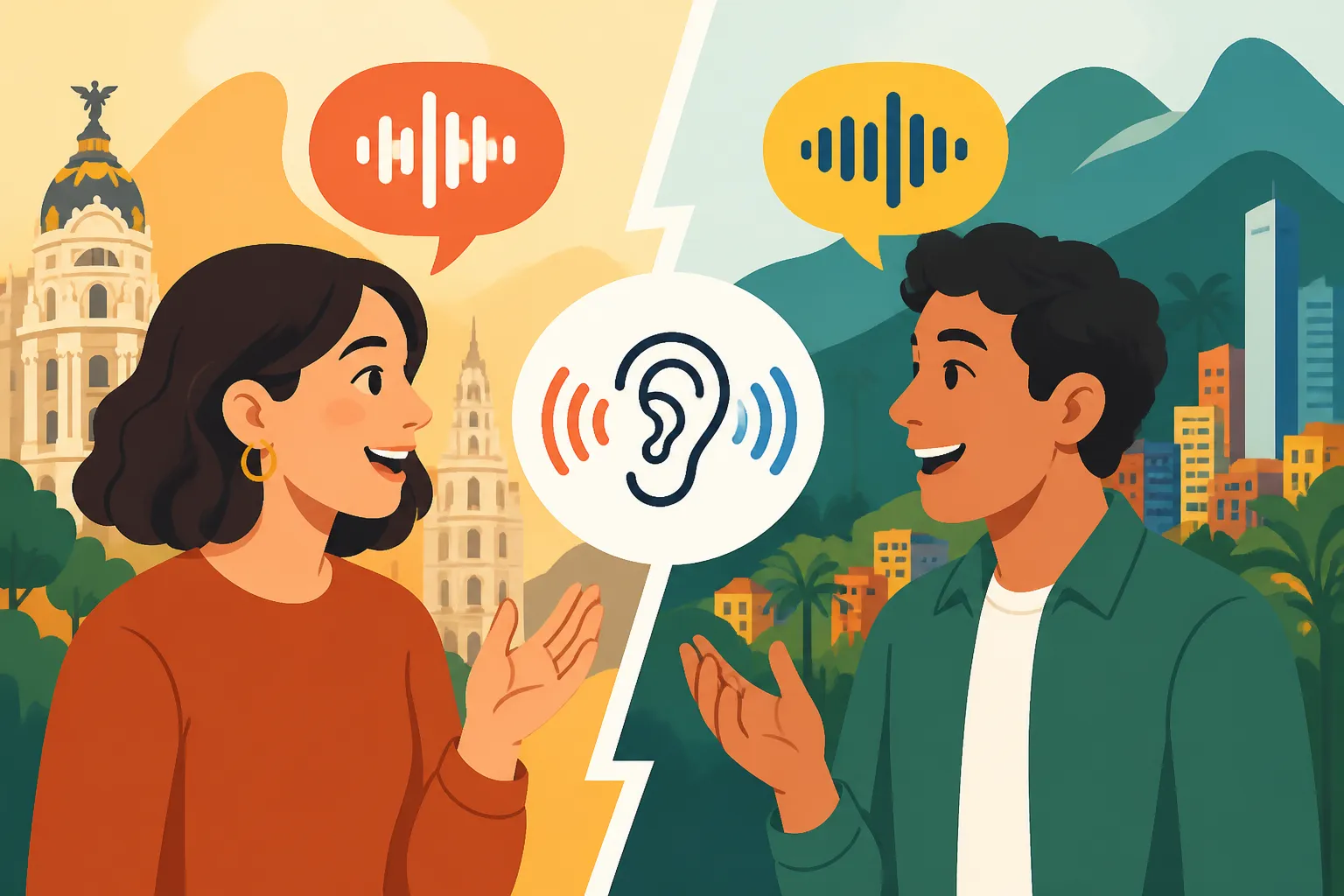
Why a Madrid Tutor Sounds Different From a Bogota One: Accent and Vocabulary
It's a common moment of confusion for many expats learning Spanish, isn't it? You’ve been diligently practicing your verb conjugations and expanding your vocabulary, only to arrive in Spain and realize that the Spanish spoken here sounds distinctly different from what you picked up in a language exchange with a friend from Latin America. Or perhaps you've been working with a tutor from Colombia and then heard someone from Madrid speak, leaving you wondering if they're even speaking the same language! This guide is here to unravel the fascinating differences in accent and vocabulary between Spanish from Madrid and Spanish from Bogota, helping you navigate these nuances with confidence.
Disclosure: This post may contain affiliate links. We may earn a commission at no extra cost to you if you make a purchase through these links. Read full disclosure.
The Distinctive Melody: Accent and Pronunciation
One of the first things you'll notice when comparing the Spanish spoken in Madrid with that from Bogota, or indeed most of Latin America, is the accent. It's not just a subtle shift; these are often core phonetic differences that shape the entire sound of the language. Understanding these will not only boost your comprehension but also prevent some common communication stumbles.
The "Lisp" That Isn't: Ceceo, Distinción, and Seseo
Let's tackle the elephant in the room first: the famed "Spanish lisp." In Peninsular Spanish, particularly in central and northern Spain (including Madrid), the letters 'c' (when followed by 'e' or 'i') and 'z' are pronounced with a 'th' sound, similar to the 'th' in the English word "think." This phenomenon is known as distinción or ceceo (though ceceo technically refers to when all 's', 'c', 'z' sounds are 'th'). So, a word like gracias (thanks) becomes "gra-thyas," and zapato (shoe) becomes "tha-pat-o."
Now, cross the Atlantic to Bogota, and you'll find what's known as seseo. Here, 'c' (before 'e' or 'i'), 'z', and 's' are all pronounced with an 's' sound, like the 's' in "say" or "snake." So, gracias sounds like "gra-syas," and zapato is "sa-pat-o." Neither is inherently "correct" or "incorrect"; they are simply regional phonetic variations. For an expat, this means that if you're used to seseo, listening to a Madrileño might initially sound like they have a speech impediment, but it's just their standard way of speaking! Similarly, if you learn distinción first and then speak to a Colombian, you might sound a bit formal or distinct to their ear. The good news is that both are fully comprehensible, and most native speakers are used to hearing both.
The Vigorous "Jota" and Subtle "S" Sounds
Another key phonetic difference lies in how the 'j' and 'g' (when followed by 'e' or 'i') are pronounced. In Madrid, the 'jota' sound is quite strong, guttural, and breathy, similar to the 'ch' in the Scottish "loch" or a very forceful English 'h'. Think of words like caja (box) or gente (people) in a Castilian accent, and you'll hear that robust sound.
In Bogota, and much of Latin America, while the 'j' sound is still present, it tends to be softer, less guttural, and sometimes almost indistinguishable from a standard English 'h'. It's often produced further forward in the mouth, giving it a lighter quality. This difference can make listening comprehension tricky at first, as words might blend together differently based on the strength of this consonant.
Then there's the 's' sound itself. While generally pronounced clearly in both regions, some accents in Spain (particularly Andalusia) and many parts of Latin America might aspirate or even drop the 's' sound at the end of syllables or words, turning dos (two) into something like "doh" or "dohh." Bogota's accent, often referred to as "rolos" or "cachacos" Spanish, is generally known for its clear, neutral, and well-enunciated pronunciation, which can sometimes be a relief for new learners. However, these subtle differences add to the unique flavor of each regional Spanish. To truly fine-tune your ear to these subtleties, having direct interaction with native speakers from various regions is invaluable. Platforms like iTalki allow you to connect with tutors specifically from Madrid or Bogota, giving you tailored exposure.
Divergent Dictionaries: Vocabulary and Grammatical Nuances
Beyond just how words sound, the words themselves can be completely different. It's like comparing American English with British English – you both understand the core, but certain terms and even grammatical structures diverge enough to cause momentary head-scratching or even comedic misunderstandings.
Everyday Nouns and Verbs: Bridging the Lexical Divide
You'd be surprised how many common items have entirely different names. Imagine trying to explain you need to catch a ride to work, only to find the word for "car" changes! In Spain, you'd typically say coche for a car, while in Bogota and most of Colombia, you'd use carro. Need some "juice"? In Spain, you'll ask for zumo, but in Colombia, it's jugo. And that computer you're working on? It's an ordenador in Spain, but a computador in Colombia.
These differences extend to verbs and other everyday items. To "drive" a car in Spain is conducir, whereas in Colombia, it's more common to hear manejar. If you need a pen, you might ask for an bolígrafo or boli in Spain, but a esfero or lapicero in Colombia. Getting used to these can feel like learning two languages at once, but with exposure, you'll start to recognize them. Don't be afraid to ask for clarification, or even better, work with a tutor who can point out these regional variations. Finding a Spanish tutor on iTalki and specifying their origin can be a game-changer for mastering these lexical nuances.
Here's a quick table of common vocabulary differences:
| English | Castilian Spanish (Spain) | Colombian Spanish (Bogota/General) |
|---|---|---|
| Car | Coche | Carro |
| Computer | Ordenador | Computador |
| Juice | Zumo | Jugo |
| Pen | Bolígrafo (or boli) | Esfero, Lapicero |
| To drive | Conducir | Manejar |
| To take/grab | Coger | Tomar, Agarrar (beware of coger) |
| Mobile phone | Móvil | Celular |
| Straw | Pajita | Pitillo, Popote, Sorbete |
| Apartment | Piso | Apartamento |
| Potato | Patata | Papa |
This table is just a small sample, but it illustrates how essential it is to be aware of these differences. Miscommunications can range from minor confusion to unintentionally hilarious or even offensive, as we'll touch on later.
The Ubiquitous "Vosotros" and Other Grammatical Nuances
One of the most significant grammatical distinctions lies in the second-person plural pronoun. In Spain, particularly in informal contexts, you will hear and use vosotros (you all, informal) with its corresponding verb conjugations. For example, "You all are going" would be Vosotros vais. This form is used when addressing a group of friends, family, or colleagues in a casual setting.
However, in virtually all of Latin America, including Bogota, the vosotros form is not used. Instead, ustedes is used for both formal and informal plural "you." So, whether you're addressing a group of children or a group of strangers, you'd use Ustedes van. For new learners, this often simplifies things initially, but it's crucial to understand that if you're in Spain, not using vosotros can make you sound overly formal or simply not quite natural in casual conversations. Many learners find it challenging to integrate vosotros into their speech, but with dedicated practice, it becomes second nature.
Another, albeit subtler, grammatical difference relates to past tenses. In Spain, for actions that have happened recently or within a period that is still ongoing (e.g., "this week," "today"), the pretérito perfecto compuesto (present perfect) is often preferred. For example, "Today I have eaten paella" (Hoy he comido paella). In Bogota and much of Latin America, the pretérito perfecto simple (preterite) is more commonly used for such recent past actions: "Today I ate paella" (Hoy comí paella). While both are grammatically correct, using the "wrong" one can sometimes subtly shift the nuance of your statement or simply mark you as a non-native speaker. Regular practice and focused attention during your Learning Spanish for Work and Study: Fast‑Track Strategy will help you internalize these patterns. This is where a personalized learning approach, like that offered by iTalki, can make a massive difference. You can find tutors who are experts in these regional grammatical distinctions and guide you through them.
Practical Strategies for Navigating Spanish Accents
So, you know there are differences. Now what? The key isn't to be intimidated, but to develop strategies to understand and adapt. It's a journey, not a sprint, and every conversation is an opportunity to learn.
Active Listening and Diverse Exposure
The best way to get comfortable with different accents is to immerse yourself in them. Don't limit your Spanish exposure to just one source.
- Media Consumption: Watch TV shows and movies from both Spain and Colombia. Listen to music from various Spanish-speaking artists. Podcasts are also fantastic resources; seek out podcasts from Madrid and from Bogota. You'll start to pick up on the intonation patterns, speed, and common phrases without even realizing it.
- Targeted Content: If you're focusing on business Spanish, try to find business-related content from both regions. This specific exposure will not only familiarize you with the accents but also the professional vocabulary used. This helps significantly if you’re looking into Spanish Workplace Communication: Meetings, Feedback, and Tone or trying to understand How to Understand a Spanish Employment Contract Before Signing.
- Be Patient: At first, it might feel overwhelming, especially with faster speech. But your ear will gradually adjust. Focus on keywords and context clues rather than trying to understand every single word.
Targeted Practice with Native Speakers
While passive listening is helpful, active practice is crucial. This is where personalized tutoring truly shines.
- Choose Your Accent: When you're learning, it's often beneficial to choose one accent to focus on initially, especially if you have a specific goal (e.g., moving to Madrid). However, once you have a good foundation, deliberately seeking out exposure and practice with other accents is invaluable.
- Platform Power: This is precisely where iTalki excels. You can browse through a vast selection of tutors and, crucially, filter them by their native country and even city. Want to practice with someone from Madrid? No problem. Looking for a tutor with a clear Bogota accent? You'll find them too. This personalized approach means you can specifically work on distinguishing the ceceo from seseo, understanding regional slang, and practicing specific vocabulary sets. It's an incredibly effective way to bridge the gap and ensure you're conversant in the Spanish you need, wherever you are. Imagine being able to ask a native speaker, "How would you say 'computer' in your country?" directly!
- Conversation Practice: Use platforms like iTalki not just for formal lessons but also for informal conversation practice. The more you speak with people from different regions, the more natural it becomes to switch between or at least understand the different ways Spanish is spoken. Don't be shy; native speakers are generally very understanding and appreciate the effort you're making to learn their language. For those who are still building confidence, learning How to Ask for an English‑Speaking Doctor Appointment in Spanish (Phrase Guide) or Spanish Medical Terminology: Common Words Expats Should Know can be a great starting point for practical conversations.
Common Misunderstandings and Cultural Context
Beyond sounds and specific words, there are cultural implications to these linguistic differences, including words that can be innocent in one place and wildly inappropriate in another. It's all part of the fun (and occasional embarrassment) of learning a new language.
False Friends and Embarrassing Moments
This is perhaps the most famous (and feared) aspect of regional variations: words that mean one thing in Spain and something entirely different, often rude, in Latin America. The classic example is the verb coger. In Spain, coger is a very common verb meaning "to take," "to grab," or "to catch" (e.g., coger el autobús – to catch the bus). However, in many parts of Latin America, particularly Colombia, coger is a vulgar slang term for sexual intercourse. Imagine the confusion, or worse, the offense, if you try to say "I'm going to catch the bus" using coger in Bogota!
Another example is concha. In Spain, a concha is a seashell or a bread roll. In some Latin American countries, it can refer to female genitalia. Fresa, meaning "strawberry" in Spain, can also be slang for a "snob" or "preppy person" in Mexico and other parts of Latin America. Plata is used for "money" in many Latin American countries, whereas in Spain, while understood, dinero is far more common.
The best defense against these linguistic landmines is awareness and a sense of humor. When in doubt, always use a more neutral alternative. For coger, for instance, tomar is a perfectly safe and widely understood alternative meaning "to take." Again, this is where iTalki tutors come into their own. They can act as cultural guides, explaining these subtle but significant differences in a safe and supportive environment, allowing you to learn from your mistakes without public embarrassment.
Beyond the Books: Colloquialisms and Slang
Every region, city, and even neighborhood has its own slang and colloquialisms that simply aren't taught in textbooks. These are the colorful expressions that make native speakers sound truly fluent and natural. In Madrid, you'll hear words like guay (cool), molar (to be cool/like), ir a tope (to go all out), or phrases like qué pasada! (how amazing!).
In Bogota, you'll encounter chévere (cool, great), bacano (also cool/great), parce/parcero (friend, buddy), and expressions like qué pena (how embarrassing, what a shame, or even "excuse me" to get attention). These words might initially sound like gibberish, but they are crucial for truly understanding and connecting with locals.
Learning slang comes with immersion, listening, and asking questions. Don't expect to master it overnight, but pay attention to what locals say and how they say it. A native-speaking tutor on iTalki can help you navigate the world of slang by introducing you to common expressions and explaining their context and usage, ensuring you're not just speaking grammatically correct Spanish, but culturally appropriate Spanish too. If you're trying to figure out Working in Spain Without Fluent Spanish: Realistic Options, understanding these informal elements will be a big plus for fitting into the workplace or social circles.
Spanish is a rich, diverse, and beautiful language, and its regional variations are a testament to that. Whether you're drawn to the distinct sounds of Madrid or the clear articulation of Bogota, embracing these differences will deepen your appreciation and enhance your ability to communicate effectively. Don't let the variations intimidate you; let them excite you! Every new word or accent you understand is another step toward becoming a truly global citizen.
Ready to dive deeper and truly master the nuances of Spanish, no matter which accent you prefer? Head over to iTalki today and find your perfect tutor from Madrid, Bogota, or anywhere else! Their flexible scheduling and diverse pool of experienced teachers make it easy to tailor your learning journey to your specific needs and regional interests.
Disclaimer
This article is for general informational purposes only and does not constitute professional advice. Laws, prices and regulations vary by location and change over time. Consult a qualified professional for guidance on your specific situation.