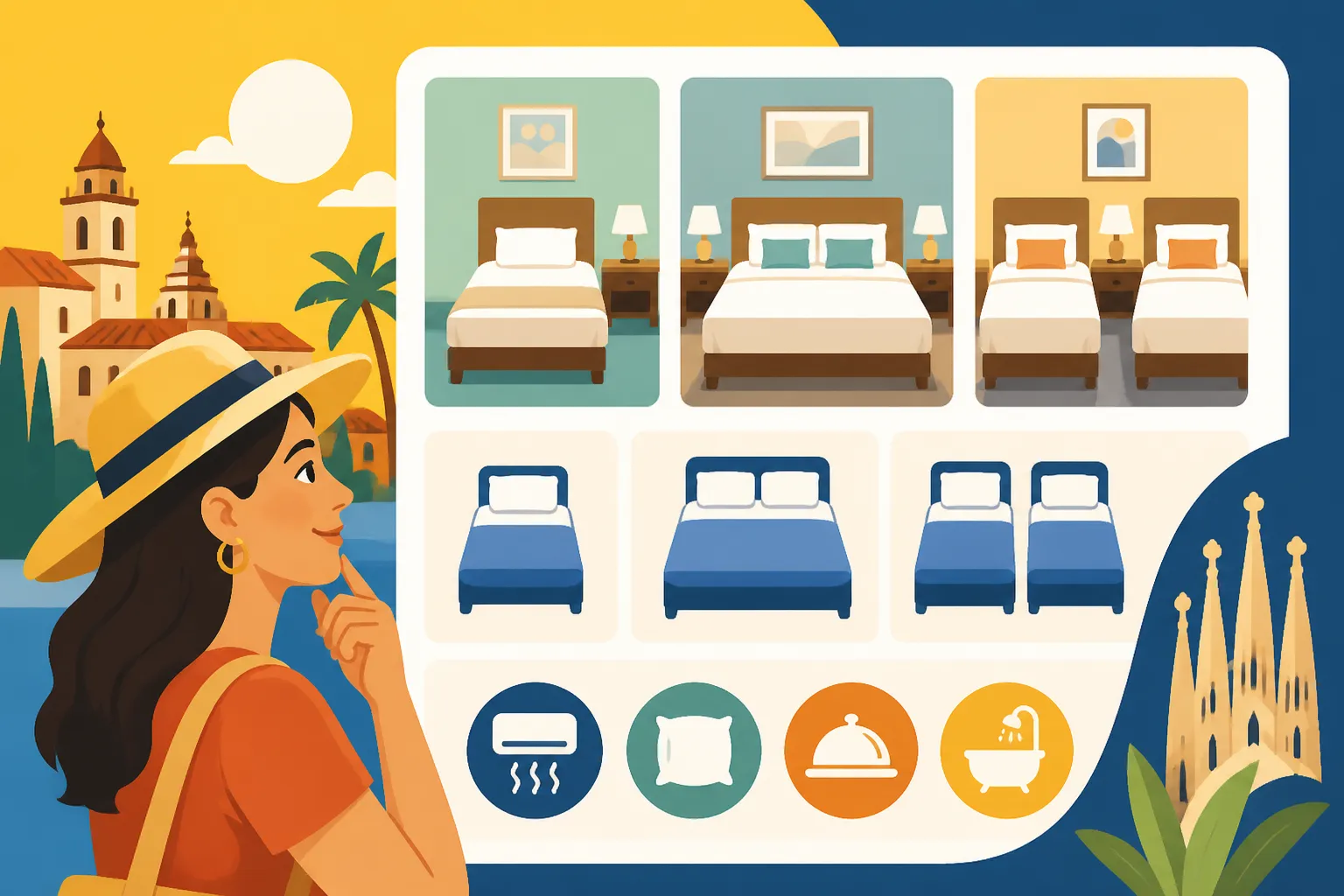
Reading Spanish Hotel Listings: Room Types, Bed Sizes, and Terms Decoded
Oh, the joy (and sometimes utter confusion) of trying to book a hotel in Spain when you’re not quite fluent in the local lingo! You stare at those listings, wondering if "doble" means two twin beds or one big one, or if "cama de matrimonio" is going to be a cozy queen or something surprisingly tiny. It's a common expat headache, trust me. This guide is here to untangle the mystery of Spanish hotel jargon, helping you understand room types, bed sizes, and other essential terms so you can book your perfect stay with confidence, whether for a quick getaway or visiting family.
Disclosure: This post may contain affiliate links. We may earn a commission at no extra cost to you if you make a purchase through these links. Read full disclosure.
Decoding Spanish Hotel Room Types
When you're sifting through accommodation options, especially on platforms like Booking.com, you'll encounter a specific set of terms for room types that might not directly translate to what you're used to back home. It's not just about the number of people, but often the bed configuration and even the perceived luxury or size of the room. Getting these wrong can lead to awkward check-ins or a less comfortable stay than you'd hoped for.
Individual (Single) Room
This one seems straightforward, right? "Individual" generally means a room for one person. However, don't assume it will always be spacious. Often, these rooms are quite compact, designed purely for a solo traveler who needs a place to sleep and not much else. The bed itself will almost always be a single (cama individual), which can sometimes feel quite small if you're used to sprawling out. If you’re a taller person or simply prefer more space, even when traveling alone, sometimes booking a "doble de uso individual" (double for single use) might be worth the slight price bump if your budget allows. Many travelers rely on Booking.com for its extensive database and user reviews, which often give clues about the actual size and comfort level of these rooms.
Doble (Double) Room
Here's where the confusion often begins! In many English-speaking countries, a "double room" implies one double bed. In Spain, "doble" can mean a room with one double bed, but it very often means a room with two single beds pushed together or side-by-side. It’s crucial to check the specifics in the description or look for clarifying terms. If you're a couple, you'll want to specifically look for "cama de matrimonio" (matrimonial bed). If you're traveling with a friend, two single beds might be exactly what you're after. The filters on Booking.com are your best friend here, allowing you to specify your preferred bed type to avoid any surprises.
Matrimonial (Double/Queen/King) Room
Ah, the "cama de matrimonio"! This is the magic phrase for couples. It explicitly refers to a single large bed designed for two people. While it literally translates to "matrimonial bed," it doesn't mean you need a marriage certificate to book it! The actual size of this "matrimonial" bed can vary, usually from a standard double (around 135-140 cm wide) to a queen (150 cm wide), and sometimes, in more upscale hotels, even a king-size (180-200 cm wide). It's always a good idea to check the dimensions if they're provided, especially if you're particular about your sleeping space. Remember, if a listing simply says "doble," it might not be a matrimonial bed, so keep an eye out for this specific term.
Familiar (Family) Room
When you're traveling with kids or a larger group, "familiar" rooms are designed to accommodate more than two people. These can come in many configurations: a matrimonial bed plus a sofa bed, a matrimonial bed plus two single beds, or even bunk beds. Sometimes, it might be two connecting rooms with an internal door. These rooms prioritize capacity, so while they fit everyone, they might not always offer vast amounts of extra space for luggage or lounging once all the beds are deployed. If you're planning a trip with the whole clan, look for detailed descriptions on Booking.com that specify the exact bedding setup to ensure everyone has a comfortable spot. Family Travel in Spain: Kid-Friendly Cities and Activities might give you some ideas on where to go with your family.
Triple and Cuádruple Rooms
These rooms are quite literal: "Triple" for three people and "cuádruple" for four. Like family rooms, their bed configurations can vary wildly. A triple room might have a matrimonial bed and one single, or three single beds. A quadruple could have two matrimonial beds, or one matrimonial and two singles, or even four singles. Again, detailed descriptions are key, as is using the filters on your preferred booking platform to narrow down choices by the number of guests.
Understanding Spanish Bed Sizes and Configurations
Beyond just the room type, understanding the actual dimensions of the beds themselves is crucial. Spanish bed sizes can be a bit different from what you might be accustomed to, leading to either pleasant surprises or cramped quarters.
Cama Individual (Single Bed)
A standard "cama individual" in Spain is typically 90 cm wide by 190 cm long. This is your basic single bed. If you're taller than average, you might find your feet dangling off the end. Many hostels and budget hotels will feature these, and as mentioned earlier, "habitaciones dobles" often contain two of these. It's a comfortable size for one person of average height and build, but certainly not one for stretching out king-style.
Cama Doble Estándar (Standard Double Bed)
This is generally the smallest "matrimonial" option you'll find, typically 135 cm wide by 190 cm long (sometimes 140 cm wide). If you're accustomed to a queen or king, this might feel a bit snug for two adults, especially if you like your personal space when sleeping. It's equivalent to what some countries might call a "full" size bed. Always check if a room listed as "doble" implies this single larger bed or two singles.
Cama Queen Size and King Size
While not universally common, especially outside of major cities or higher-end hotels, you will sometimes see "cama Queen size" (approx. 150 cm wide by 190-200 cm long) or "cama King size" (approx. 180-200 cm wide by 190-200 cm long) mentioned. These larger options are usually a selling point, so if a hotel has them, they’ll typically highlight it. If you explicitly want a larger bed, look for these terms or for specific dimensions in the room description. If they aren't mentioned, assume a standard double (135-140 cm) or two singles. Booking.com makes it easy to compare the bed types offered in different room categories, helping you make an informed decision.
Supletoria (Extra Bed) and Sofá Cama (Sofa Bed)
For groups needing additional sleeping arrangements beyond the main beds, hotels often offer "camas supletorias" or "sofá camas."
- Cama Supletoria: This is an extra rollaway bed. It’s usually a single bed, often a bit smaller or less comfortable than a standard bed, designed to be set up in a room to accommodate an additional person. There's often an extra charge for a supletoria, so always clarify this when booking.
- Sofá Cama: A sofa bed is a sofa that converts into a bed. These vary hugely in comfort. Some are perfectly fine for a few nights, while others can be quite unforgiving. They are a common feature in family rooms or apartments. If you're relying on a sofa bed for an adult, it's worth checking reviews or even looking for photos to gauge its quality.
Here's a quick reference table for common room and bed terms:
| Spanish Term | English Equivalent (Typical) | Bed Configuration (Most Common) | Notes |
|---|---|---|---|
| Individual | Single Room | 1 x Single Bed (90x190cm) | Small, for one person. |
| Doble | Double Room | 2 x Single Beds (90x190cm each) | Often two singles. Crucial to verify! |
| Doble Matrimonial | Double Room (Matrimonial Bed) | 1 x Standard Double (135-140x190cm) | One bed for two. |
| Queen Size | Queen Size Double Room | 1 x Queen Bed (150×190-200cm) | Larger double bed. |
| King Size | King Size Double Room | 1 x King Bed (180-200×190-200cm) | Largest double bed. |
| Triple | Triple Room | 3 x Singles OR 1 Matrimonial + 1 Single | For three people. |
| Cuádruple | Quadruple Room | Varied (e.g., 2 Matrimonial, 4 Singles) | For four people. |
| Familiar | Family Room | Varied (often Matrimonial + Sofa/Bunk) | For families, configurations differ. |
| Supletoria | Extra Bed / Rollaway Bed | 1 x Small Single Bed | Added for a fee, check comfort. |
| Sofá Cama | Sofa Bed | Converts from sofa to bed | Comfort varies widely. |
Navigating Hotel Amenities and Services in Listings
Once you've wrapped your head around room and bed types, the next layer of detail is understanding the amenities. Spanish hotel listings, particularly on global booking sites, will often have icons for standard amenities, but sometimes the Spanish term is still there, or crucial details are hidden in the text. Knowing these can make a huge difference to your comfort and experience.
Basic In-Room Amenities
- Baño Privado / Baño Completo: This means a private bathroom, usually with a shower, toilet, and sink. "Baño completo" often implies a full bathroom with a bath, though not always. If it just says "ducha" (shower) or "aseo" (toilet only), be aware.
- Aire Acondicionado (A/C): Essential during those scorching Spanish summers, especially in southern regions like Andalucía or cities like Madrid. Don't assume A/C if it's not explicitly stated, even in higher-end hotels. Many older buildings, even charming ones, might rely on fans.
- Calefacción (Heating): Conversely, if you're visiting in winter, especially in central or northern Spain, heating is important! While most hotels have it, budget options might be less efficient.
- Wi-Fi Gratuito: Free Wi-Fi. Almost universal now, but sometimes it’s only available in common areas or might be slow in rooms. Mobile Data and eSIMs for Travel in Spain can be a good backup if you need reliable internet.
- TV: Television. Usually a flat-screen, but don't expect a huge array of international channels unless specified.
- Minibar / Nevera: A minibar (stocked fridge) or simply a fridge (nevera) that you can use. Handy for keeping water or snacks cool.
- Caja Fuerte: A safe for valuables. Always a good idea to use it.
Property-Wide Services and Facilities
- Recepción 24 Horas: 24-hour reception. Crucial if you anticipate a late arrival or need assistance outside typical business hours. If a smaller hotel or guesthouse doesn't have this, you'll need to coordinate your check-in time carefully.
- Desayuno Incluido / Desayuno Buffet: Breakfast included, or buffet breakfast. Always check if breakfast is part of the room rate. Sometimes it's an optional extra, and prices can vary. Spanish hotel breakfasts often lean savory (toast, cheese, ham, tomato) with coffee and juice, though buffet options will be more diverse.
- Piscina (Cubierta/Exterior): Swimming pool (indoor/outdoor). A lifesaver in summer, but check for seasonal opening dates if it’s an outdoor pool.
- Parking (Gratuito/De Pago): Parking (free/paid). Parking can be a nightmare in Spanish cities, so knowing if the hotel has its own parking (and if it costs extra) is vital if you're driving. Renting a Car in Spain: Requirements, Insurance, and Driving Tips offers more on this.
- Ascensor: Elevator. If you're on a higher floor and have heavy luggage, an elevator is a blessing, especially in charming but ancient buildings.
- Terraza / Balcón: Terrace / Balcony. Offers private outdoor space, which can be lovely for enjoying the Spanish air. If you love a good view or a spot to enjoy a morning coffee, look for this feature.
- Gimnasio: Gym. For those who like to stay active even on holiday.
- Restaurante / Bar: On-site restaurant or bar. Convenient for dining or a quick drink.
A great resource like Booking.com allows you to filter by almost all these amenities, making it easier to find a place that matches your needs perfectly. Just tick the boxes for "air conditioning," "parking," or "swimming pool," and let the platform do the heavy lifting!
Key Booking Terms and Policies to Watch For
Beyond the physical attributes of the room and hotel, understanding the booking terms and policies is paramount to avoid unexpected charges or disappointments. These details can often be overlooked but are critical for a smooth travel experience in Spain.
Tarifas y Condiciones (Rates and Conditions)
This section is your best friend on any booking platform. Always double-check the 'Conditions' section for each specific room type you're considering. The price for a seemingly identical "doble matrimonial" might vary wildly based on the flexibility of the cancellation policy or whether breakfast is included.
Política de Cancelación (Cancellation Policy)
This is probably the most important policy to understand.
- Cancelación Gratuita: Free cancellation. This is usually the most flexible option, allowing you to cancel without penalty up to a certain date (e.g., 24-48 hours before check-in). This flexibility often comes with a slightly higher room rate. If your travel plans are still uncertain or you’re comparing multiple options, choosing a "cancelación gratuita" rate is a smart move.
- No Reembolsable / No Reembolsable: Non-refundable. These rates are typically cheaper, but once booked, you cannot cancel or modify them without losing your money. Only choose this if your plans are absolutely set in stone.
- Cancelación Parcial: Partial cancellation. Sometimes, you might be charged for the first night, or a percentage of the total, even with a "flexible" rate if you cancel too late.
Booking.com is excellent at clearly displaying these policies, often with color-coded warnings or detailed explanations right next to the rate. Don't skim over them!
Pago por Adelantado / Pago en el Hotel (Prepayment / Payment at the Hotel)
- Pago por Adelantado: Prepayment. Some hotels require you to pay a deposit or the full amount at the time of booking. This is common with non-refundable rates.
- Pago en el Hotel: Payment at the hotel. This means you'll pay upon arrival or departure. Even with this option, the hotel might take a pre-authorization on your credit card to ensure funds are available. It's always a good idea to confirm your payment method and currency conversion practices if you're using a foreign card. Money for Travel in Spain: Cards, Cash, and ATMs can provide more information on handling finances.
Impuestos y Tasas (Taxes and Fees)
What you see isn't always what you get, unfortunately.
- IVA Incluido: VAT (Value Added Tax) included. In Spain, this is generally 10% for hotel stays. Most listed prices will include IVA, but it’s always good to confirm.
- Tasa Turística / Impuesto Turístico: Tourist tax. Some regions in Spain, notably Catalonia (Barcelona, Girona, etc.) and the Balearic Islands (Mallorca, Ibiza, etc.), have a separate tourist tax that is not usually included in the online booking price. This tax is charged per person, per night, and you pay it directly to the hotel upon check-in or check-out. The amount varies by region and hotel category, typically ranging from a few cents to a few euros per person per night. It’s always clearly stated on Booking.com for affected properties, but it's a detail many foreigners miss.
Horario de Entrada / Salida (Check-in / Check-out Times)
- Horario de Entrada: Check-in time. Typically, this is from 2:00 PM or 3:00 PM onwards.
- Horario de Salida: Check-out time. Usually by 11:00 AM or 12:00 PM.
If you need an early check-in or late check-out, always request it in advance. Hotels are often flexible if they have availability, but they might charge an extra fee. If you’re arriving very late, especially at a smaller establishment without 24-hour reception, you must inform them of your estimated arrival time to ensure someone is there to let you in.
By taking a moment to understand these common terms and policies, you’ll not only avoid unnecessary stress and charges but also ensure your Spanish hotel experience is exactly what you hoped for. Booking.com makes it easy to compare and filter by these critical factors, giving you peace of mind before you even pack your suitcase. Accommodation in Spain: Hotels, Hostels, and Rentals can help you decide what type of accommodation is best for your trip, while How to Choose Between a Hotel and an Apartment in Spain provides further insights into different lodging options.
Disclaimer
This article is for general informational purposes only and does not constitute professional advice. Laws, prices and regulations vary by location and change over time. Consult a qualified professional for guidance on your specific situation.