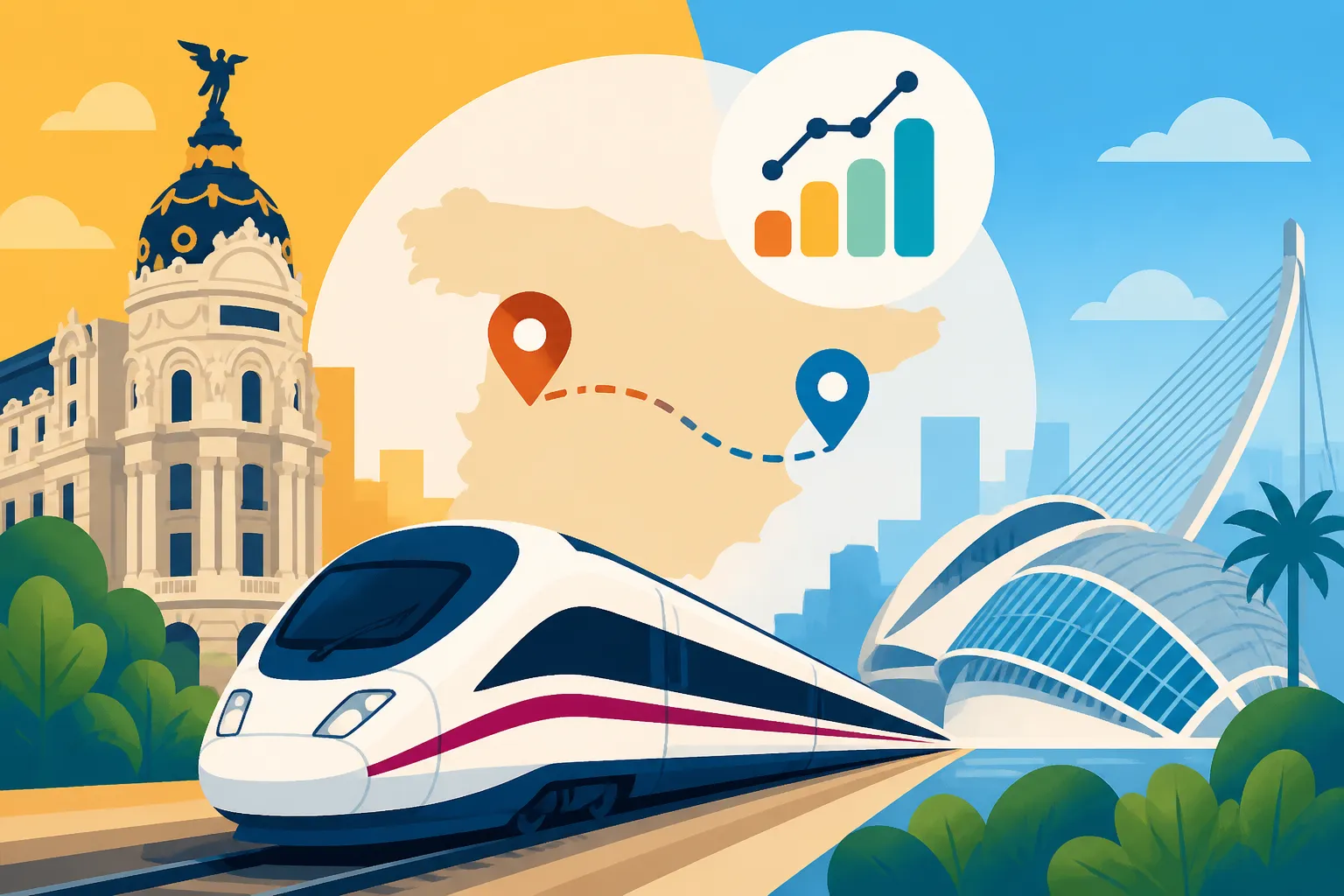
Madrid to Valencia: Train Options and Price Patterns
Oh, the Madrid to Valencia train journey! It sounds simple enough on paper, a quick hop from one vibrant city to another, but navigating the various train operators, understanding their different services, and trying to snag the best price can quickly turn into a headache. Many expats find Spanish travel logistics frustrating, so we know the struggle is real. This guide is here to simplify all that for you, especially by introducing you to Omio, a fantastic tool that makes comparing and booking your train tickets a breeze.
Disclosure: This post may contain affiliate links. We may earn a commission at no extra cost to you if you make a purchase through these links. Read full disclosure.
Why Choose the Train for Your Madrid to Valencia Journey?
Look, when you’re heading from the bustling capital of Madrid to the sun-drenched, paella-filled shores of Valencia, you’ve got options. You could drive, take a bus, or even fly for longer distances. But for this particular route, the train truly shines as the undisputed champion. It’s not just about getting there; it’s about how you get there.
Speed and Efficiency That Can't Be Beat
Let's be honest, time is precious, especially when you're exploring a new country. Spain's high-speed rail network is a marvel, and the journey from Madrid to Valencia is a prime example of its efficiency. What used to be a lengthy trek now takes less than two hours on the fastest services. Imagine leaving Madrid's Puerta de Atocha station – a stunning architectural feat in itself – and pulling into Valencia Joaquín Sorolla before you've even had time to finish a good book or catch up on emails.
This incredible speed means you gain precious hours back in your day, hours you can spend exploring Valencia's stunning City of Arts and Sciences, wandering through the historic Carmen neighborhood, or indulging in a leisurely almuerzo (mid-morning snack) with some authentic horchata. Unlike flying, where you have to factor in airport transfers, security checks, and gate waiting times, the train drops you right in the heart of the city. You simply arrive at the station, usually 20-30 minutes before departure, glide through a quick baggage scan, and board your train. It’s a seamless experience that vastly reduces travel stress, giving you more energy to enjoy your destination.
Comfort, Convenience, and a Glimpse of the Spanish Landscape
Beyond speed, the comfort level on Spanish high-speed trains is a game-changer. Forget cramped economy seats on a plane or the sometimes-tedious stops of a bus journey. On a train from Madrid to Valencia, you'll find spacious seating with ample legroom, often power outlets at your seat, and usually reliable Wi-Fi, allowing you to work, stream, or just relax. Many services offer a cafeteria car or even at-seat catering options, so you can grab a coffee or a snack while watching the world go by.
The journey itself, though swift, offers a pleasant visual transition. You'll depart from the arid, sun-baked landscapes surrounding Madrid, passing through olive groves and rolling hills, gradually noticing the change in flora as you approach the greener, more fertile Valencian plains. It's a subtle but beautiful shift that you'd completely miss if you were cruising at 30,000 feet. Plus, the ability to simply get up, stretch your legs, or visit the restroom without feeling like you're disturbing anyone is a luxury often overlooked. It genuinely transforms travel from a chore into part of the adventure.
An Eco-Conscious Choice for the Modern Traveler
In an age where we're all trying to be a bit more mindful of our environmental footprint, choosing the train over flying for domestic routes like Madrid to Valencia makes a tangible difference. High-speed rail is significantly more energy-efficient and produces fewer greenhouse gas emissions per passenger-kilometer compared to air travel. For those of us living in Spain or visiting frequently, making these small but impactful choices can add up.
Spain's commitment to modern rail infrastructure isn't just about speed; it's also about building a more sustainable future for travel. So, as you whiz across the Spanish countryside, knowing you're contributing to a greener planet can add an extra layer of satisfaction to your journey. It's a win-win: faster, more comfortable, and better for the environment. When planning your trips around the country, consider the environmental impact, and you'll find that options like the high-speed rail are often the best choice. For broader travel insights, check out our guide on Traveling Around Spain: Trains, Buses, Flights, and Car Hire.
Understanding Spain's High-Speed Rail Operators
Once upon a time, Renfe was pretty much the only game in town for high-speed trains in Spain. But like many things here, the landscape has changed, bringing more competition and, happily for us, more choice and often better prices! Now, you'll find a mix of operators, each with its own flavor and price point. It can feel a bit like trying to choose the right tapa from a bustling bar, but understanding the basics will help.
Renfe's Flagship: AVE and the Budget-Friendly Avlo
Renfe is the national railway company of Spain, and their AVE (Alta Velocidad Española) service is the original high-speed king. These are typically the most established and often the most comfortable trains, known for their punctuality and reliable service. When you ride AVE, you're usually looking at a premium experience, offering different classes like Estándar (Standard), Confort (Comfort, with larger seats), and sometimes Elige Estándar or Elige Confort. They often come with more generous baggage allowances and sometimes even a complimentary meal or drink, especially in higher classes. AVE trains are ideal if you value comfort and a slightly more refined travel experience.
Then there's Avlo, Renfe's answer to the new budget operators. Avlo trains are still high-speed, still get you there quickly, but they strip away some of the frills to offer a more affordable ticket. Think bright purple livery, slightly less spacious seating, and often additional charges for things like choosing your seat or carrying extra luggage. It's a no-frills, get-there-fast option that's perfect if you're traveling on a tighter budget but still want the speed advantage. It's essentially Renfe's way of saying, "We can do cheap and fast too!"
The New Kids on the Block: Ouigo and Iryo
The past few years have seen the arrival of new private operators, shaking up the market and introducing more competitive pricing. These newcomers are definitely worth considering for your Madrid to Valencia trip, as they can often be significantly cheaper, especially if you book in advance.
First up is Ouigo, the French-owned, bright pink and blue double-decker trains that have made a big splash. Ouigo is unashamedly a low-cost carrier, similar to a budget airline, but on rails. Their standard fare includes a carry-on and a small piece of hand luggage, with options to add larger bags, choose specific seats, or even upgrade to a more spacious "Ouigo Plus" option for an extra fee. The double-decker setup is a unique experience, offering great views from the upper deck. If you're traveling light and prioritizing price, Ouigo is often your best bet. Just remember to read the fine print on their baggage policies to avoid surprises!
Then we have Iryo, the Italian-Spanish consortium that launched with sleek, red trains and a focus on what they call "flexible premium." Iryo aims to sit somewhere between the full-service AVE and the ultra-budget Ouigo/Avlo. They offer different comfort levels, from Inicial (Economy) to Singular (Business) and Infinita (First Class), all of which typically include more generous baggage allowances than the true budget options and often on-board Wi-Fi and entertainment. Their trains are stylish and modern, and their pricing can be very competitive, especially when booked ahead. They're a great choice if you want a bit more comfort than the bare-bones budget options without necessarily paying top-tier AVE prices.
With all these options, it's easy to get overwhelmed. This is precisely where a platform like Omio becomes invaluable. Instead of hopping between four different websites, you can see all the available trains from Renfe (AVE and Avlo), Ouigo, and Iryo on a single search page, allowing you to directly compare prices, times, and amenities. It genuinely simplifies the decision-making process, ensuring you find the best ticket for your specific needs and budget.
Deciphering Price Patterns and Smart Booking Strategies
Booking train tickets in Spain, especially for popular routes like Madrid to Valencia, can feel a bit like a treasure hunt. Prices fluctuate wildly, and what seems like a great deal one day can be double the next. Understanding these patterns and adopting smart booking strategies is key to saving money and avoiding unnecessary stress.
The Dynamic Pricing Game: It's Like Airfare, But on Rails
The biggest thing to grasp is that train tickets in Spain, particularly for high-speed services, operate on a dynamic pricing model, very similar to airline tickets. This means there's no fixed price. The cost of your ticket will depend on several factors:
- How far in advance you book: This is by far the most significant factor. Operators release tickets weeks or even months in advance, and the cheapest fares are almost always available when tickets first go on sale.
- Time of day and day of the week: Peak travel times (early mornings, late afternoons, Friday evenings, Sunday evenings) and peak travel days (Fridays, Sundays, public holidays, and the days surrounding major Spanish festivals) will naturally be more expensive. Mid-day on a Tuesday or Wednesday will almost always yield better prices.
- Demand: If a particular train is filling up fast, the remaining tickets will become more expensive.
- Fare type: All operators offer different fare classes. You'll often see "Promo" or "Basic" fares which are the cheapest but come with strict restrictions (e.g., no changes, no refunds). More expensive "Flexible" or "Premium" fares offer more leeway but at a higher cost.
So, if you're looking at a last-minute ticket for a Friday afternoon, don't be shocked if it's three or four times the price of a mid-week, advance-booked ticket. This dynamic pricing is why checking and booking early is the golden rule for saving money on your Madrid to Valencia train journey.
Best Time to Book and Other Savvy Tips
To truly master the art of booking affordably, here are some tried-and-true tips:
- Book as far in advance as possible: Seriously, I can't stress this enough. For popular routes and dates, aim to book at least 2-3 months out if you can. Operators like Renfe, Ouigo, and Iryo will release their cheapest "promo" fares first, and these disappear quickly. Booking through a platform like Omio allows you to easily see how far in advance tickets are available across all operators, giving you the best chance to grab those early bird specials.
- Be flexible with your travel dates and times: If your schedule allows, consider traveling on a Tuesday, Wednesday, or Thursday. Avoid the busy Friday and Sunday commuter rushes. Even shifting your departure time by an hour or two can sometimes unlock significantly cheaper tickets. Early morning or late evening trains are often less in demand than mid-day services.
- Consider different operators: Don't just default to the first name you know. As we discussed, Renfe (AVE/Avlo), Ouigo, and Iryo all run services on the Madrid-Valencia route. Their pricing strategies differ, and one might have a flash sale or cheaper baseline fares for your specific date. This is where a comparison tool like Omio is indispensable. You type in your route and dates, and Omio instantly shows you all the available trains from all operators, side-by-side, making it incredibly easy to spot the cheapest option without juggling multiple browser tabs.
- Understand fare conditions: The cheapest tickets are usually non-refundable and non-changeable. If your plans are set in stone, go for it! But if there's any chance your schedule might shift, it might be worth paying a little extra for a more flexible fare, particularly if you're booking many months in advance. Always weigh the risk against the potential cost savings.
- Set up price alerts: Some booking platforms, and even Omio, allow you to set price alerts for specific routes and dates. This way, you'll get a notification if prices drop, which can be useful if you're keeping an eye on a particular journey but aren't ready to commit yet.
By keeping these strategies in mind, you'll be well on your way to securing the best possible price for your high-speed train journey from Madrid to Valencia. Don't let the dynamic pricing intimidate you; just be prepared, be flexible, and leverage the tools available to you. For more insights on financial planning for your adventures, explore our guide on Money for Travel in Spain: Cards, Cash, and ATMs.
Booking Your Train Ticket: The Omio Advantage
Alright, let's talk about the real game-changer when it comes to booking train tickets in Spain: Omio. I’ve tried all the official operator websites, and while they work, they often don’t give you the full picture or the easiest way to compare. This is where Omio steps in, making your life infinitely easier. It’s the platform I consistently recommend to friends and family visiting or moving to Spain, and for good reason.
A Seamless Search and Comparison Experience
One of the biggest frustrations with booking European train travel used to be the sheer number of different operators. You’d go to Renfe’s site, then Ouigo’s, then Iryo’s, trying to manually compare departure times, journey durations, and, most importantly, prices. It was a tedious, time-consuming process that often left you wondering if you’d truly found the best deal.
Enter Omio. This platform (available as both a website and a really slick mobile app) aggregates all the major train operators, including Renfe (AVE and Avlo), Ouigo, and Iryo, for your Madrid to Valencia journey. This means with a single search, you instantly see all the available trains from all these companies. You just input your departure and arrival cities, your travel dates, and hit search. Within seconds, a comprehensive list appears, showing you:
- Departure and arrival times
- Journey duration
- The operating company
- The most current, real-time price
It’s an absolute lifesaver. You can then sort and filter these results by price (lowest to highest), departure time, arrival time, or even by operator if you have a preference. This transparency and ease of comparison are precisely why Omio has become my go-to. It cuts through the noise and presents you with clear, actionable options, allowing you to quickly identify the cheapest or most convenient train that fits your schedule.
Navigating Options and Choosing the Best Fare
Beyond simply listing trains, Omio also excels at helping you understand the nuances of each option. When you click on a specific train, you can often see details about the fare classes available (e.g., Ouigo's Standard vs. Ouigo Plus, or Renfe's various Elige options). While the booking process continues, Omio will guide you through adding extras like specific seat selections, additional luggage, or even bike transport, clearly showing how these add to the base fare. This level of detail empowers you to make an informed decision based on both cost and comfort.
For example, you might see an Iryo train that's slightly more expensive than an Avlo, but Omio might highlight that the Iryo fare includes more baggage allowance or a more comfortable seat. Or perhaps an early morning Ouigo train is unbelievably cheap, and if you’re traveling light, Omio makes it easy to snap up that deal. The platform simplifies the otherwise complex task of comparing true value across different providers. It’s not just about the cheapest ticket; it's about the best ticket for your specific needs, and Omio helps you discern that without any guesswork.
Simple, Secure Booking and Digital Tickets
Once you've found your ideal train, the booking process through Omio is incredibly straightforward and secure. You select your desired journey, proceed to checkout, enter your passenger details (which, if you create an account, can be saved for future bookings – another time-saver!), and complete your payment. Omio accepts various payment methods, making it convenient for international travelers.
After your booking is confirmed, you’ll receive your e-ticket directly to your email. Even better, if you use the Omio app, your tickets are stored there, accessible offline, which is fantastic when you're navigating busy train stations in Spain. No need to print anything or fuss with QR codes in different apps; it’s all right there in one place. This seamless digital experience, from searching to booking to ticket storage, eliminates a lot of potential stress points for travelers. For a deep dive into Spain's high-speed network and how these tickets work, consider reading about High-Speed Trains in Spain AVE: Routes, Booking, and Savings. Using Omio makes getting your ticket to Valencia utterly effortless.
Your Journey from Madrid to Valencia: What to Expect
Now that you've got your ticket squared away, thanks to Omio, let's talk about the journey itself. Knowing what to expect at the stations and onboard can smooth out any last-minute jitters and help you settle in for a relaxing ride.
Departing from Madrid Puerta de Atocha Station
Your journey will almost certainly begin at Madrid's magnificent Puerta de Atocha station. This isn't just a train station; it's an experience in itself. The original 19th-century terminal building now houses a stunning tropical garden complete with turtles, a true oasis in the heart of the city. High-speed trains depart from the newer terminal section, but you'll pass through the historical part to get there.
- Arrival Time: While you don't need to arrive hours in advance like at an airport, it is wise to get to Atocha at least 20-30 minutes before your scheduled departure. This gives you ample time to find your platform (your vía), pass through the mandatory security check (where your luggage will be scanned, similar to airport security but much faster), and locate your carriage.
- Security: This security check is usually quick and efficient, but it's not something to skip or take lightly. Just put your bags on the conveyor belt and walk through the scanner.
- Connecting to the City: Atocha is incredibly well-connected to Madrid’s public transport network. You can easily reach it via Metro (Line 1 to Atocha Renfe), Cercanías (commuter trains), or numerous bus lines. If you're staying in the city center, it's often just a short Metro ride away. For first-time visitors to the capital, our Madrid for First-Time Visitors: Neighborhoods and Highlights guide can help you navigate getting around.
Once you're through security, you'll find plenty of shops, cafes, and waiting areas. Check the departure boards for your specific train number and platform (it's usually a digital display, so look for "Valencia Joaquín Sorolla" as your destination). Boarding typically begins around 15-20 minutes before departure.
Arriving at Valencia Joaquín Sorolla Station
In Valencia, your high-speed train will pull into Valencia Joaquín Sorolla station. This is Valencia’s dedicated high-speed train terminal, conveniently located just south of the city center.
- Getting to the City Center: Joaquín Sorolla is within walking distance (around 15-20 minutes) of the historic Old Town and about a 10-minute walk from Estació del Nord, Valencia's main regional train station and a beautiful modernist building in its own right. If you have luggage or prefer not to walk, there's a Metro stop (Joaquín Sorolla) directly connected to the station, offering easy access to various parts of the city. Numerous local bus lines also serve the station, and taxis are readily available. Our Valencia City Guide: Old Town, Beaches, and Science Park has more on how to navigate the city.
- Amenities: The station itself is modern and well-equipped with amenities like cafes, shops, and car rental agencies. You'll find plenty of options to grab a quick coffee or snack upon arrival.
Once you step off the train, you'll simply follow the signs towards the exit, and you're officially in Valencia, ready to explore!
The Onboard Experience and Luggage Rules
The onboard experience largely depends on the operator and the class of ticket you've chosen. However, some general expectations apply:
- Seating: All high-speed trains offer comfortable, usually reclining seats. Most will have power outlets, and Wi-Fi is generally available (sometimes for a fee on budget operators, or included in higher classes).
- Catering: AVE and Iryo trains often have a cafeteria car where you can purchase drinks, snacks, and light meals. In premium classes, at-seat service might be offered. Ouigo and Avlo typically have vending machines or a small bar car with limited options, so you might consider bringing your own snacks and drinks on these services.
- Luggage: This is crucial! All operators have baggage policies. Generally, you're allowed two pieces of luggage (suitcases) that fit in the overhead racks or dedicated luggage areas at the end of the carriages, plus a small carry-on. The exact dimensions and weight limits vary slightly by operator, especially with the budget carriers like Ouigo and Avlo, where exceeding the free allowance can incur additional charges. Always check the specific operator's rules if you're traveling with oversized bags or more than the standard allowance. This information is usually clearly outlined when you book through Omio, helping you avoid surprises.
Enjoy the journey! It's one of the most relaxing and efficient ways to travel between these two incredible Spanish cities.
Train Options: A Quick Comparison Table
To help you visualize the choices for your Madrid to Valencia journey, here's a quick overview of the main high-speed train operators you'll encounter. Remember, prices are dynamic, so this table reflects general characteristics and typical starting points.
| Operator | Service Type | Comfort Level | Price Range (Typically) | Key Features | Baggage Allowance (Standard) | Onboard Wi-Fi | Cafeteria/Bar |
|---|---|---|---|---|---|---|---|
| Renfe AVE | High-speed | Premium/Standard | €30 – €90+ | Punctual, reliable, spacious | 2 large + 1 hand | Yes (free) | Yes |
| Renfe Avlo | High-speed | Budget | €7 – €50+ | Low-cost, no-frills, fast | 1 carry-on + 1 small | Yes (basic) | Vending machines |
| Ouigo | High-speed | Budget | €9 – €60+ | Double-decker, vibrant | 1 carry-on + 1 small | Yes (basic) | Bar car (limited) |
| Iryo | High-speed | Premium Economy | €15 – €80+ | Modern, stylish, flexible | 2 large + 1 hand | Yes (free) | Bar/Bistro |
Note: Prices are illustrative and can vary significantly based on booking time, demand, and promotions. Always check current prices on Omio for the most accurate information.
Disclaimer
Please note that travel information, including train schedules, prices, and regulations, is subject to change. While we strive to provide the most up-to-date and accurate information, it is always recommended to check official sources, such as Omio or the individual train operators' websites, for the latest details before making any travel plans. This guide offers general advice and personal insights based on typical expat experiences in Spain.