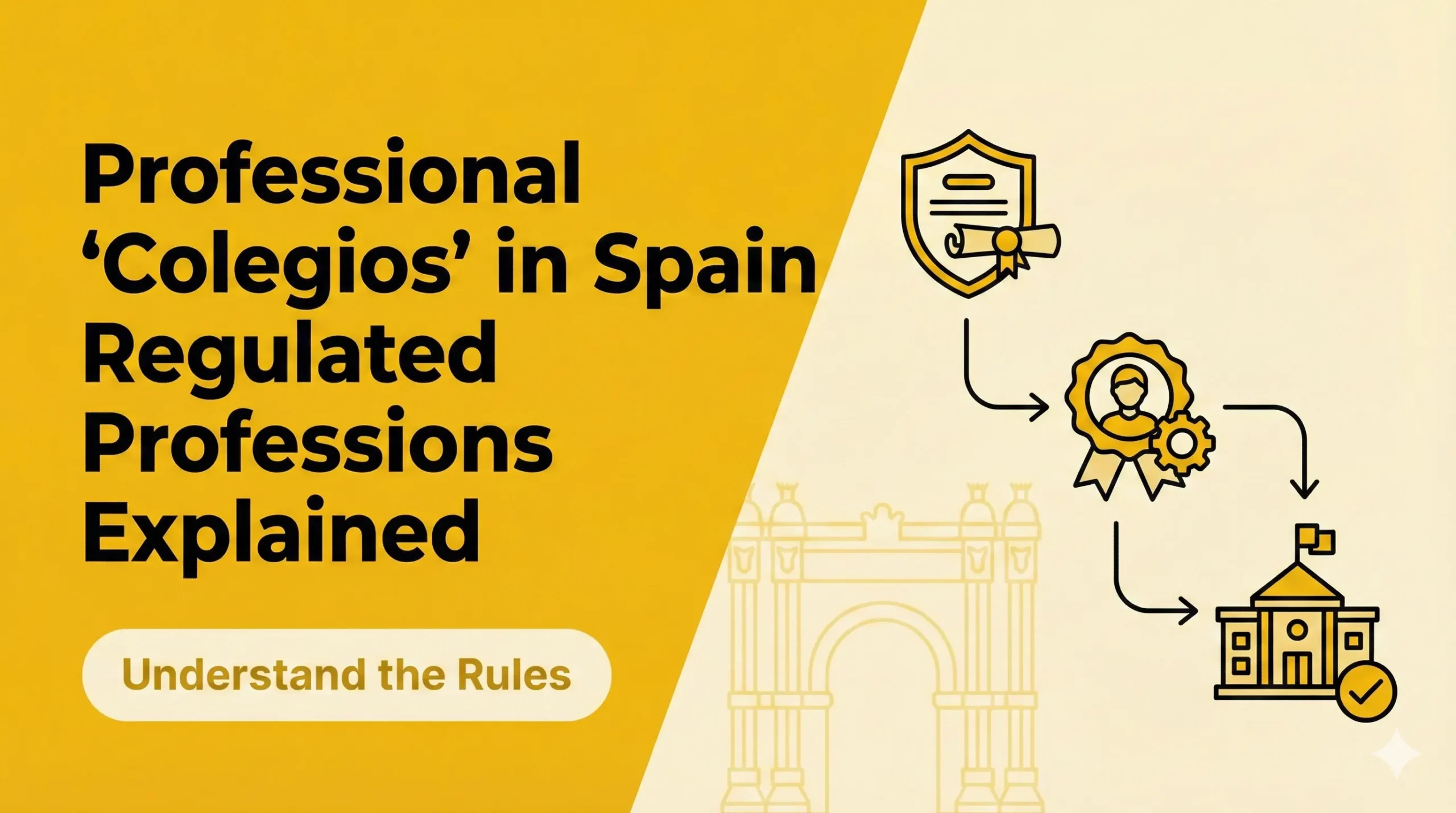
Professional ‘Colegios’ in Spain: Regulated Professions Explained
Navigating the Spanish job market as a highly qualified expert requires understanding the strict system of regulated professions. This guide explains how professional colleges function, the vital process of degree homologation, and the exact steps expatriates must take to practice legally.
Disclosure: This post may contain affiliate links. We may earn a commission at no extra cost to you if you make a purchase through these links. Read full disclosure.
What Are Professional Colleges in Spain
To an expatriate from the United States, the United Kingdom, or Australia, the term “Colegio” might be confusing. It does not refer to a high school or a university. A Colegio Profesional is a regulatory body, roughly equivalent to a professional association, board, or chamber in other countries, but with significantly more legal authority.
Historically rooted in the medieval guild systems, modern Colegios Profesionales in Spain are classified as “Corporations of Public Law” protected by the Spanish Constitution. This unique legal status means they are hybrid entities. While they are independently funded and governed by their own members, they act as delegates of the Spanish state. The government entrusts them with the power to regulate the profession, issue licenses, and discipline members who violate ethical codes.
It is crucial to distinguish a Colegio from a trade union. A trade union exists primarily to defend the labor rights, salaries, and working conditions of employees against employers. A Colegio Profesional, on the other hand, exists to defend the integrity of the profession itself and to protect the public from malpractice. While they do offer support and services to their members, their ultimate loyalty is to the societal standards of the profession.
Understanding Regulated vs Unregulated Professions
The Spanish labor market is sharply divided into two categories: regulated and unregulated professions. Knowing which category your career falls into will determine your entire administrative journey in Spain.
The Unregulated Market
An unregulated profession is one where the law does not strictly dictate the academic qualifications required to perform the job. The market and the employer determine who is fit for the role. Examples include graphic designers, marketing executives, journalists, software developers, and business consultants.
If your profession is unregulated, you can begin applying for jobs immediately. You do not need to register with a professional board, and your foreign university degree is generally evaluated by the hiring company based on its own merits rather than strict government standards. If you are entering this sector, you can focus entirely on optimizing your resume and interviewing skills, a process you can learn more about by reviewing our Finding a Job as an Expat in Spain.
The Regulated Market
A regulated profession is one where the Spanish national legislation stipulates that specific academic requirements and legal registrations must be met to practice the profession and use the associated job title. The primary justification for this regulation is the protection of fundamental public interests, such as life, health, safety, and the environment.
In these fields, it is legally forbidden to practice unless all requirements are met. The most heavily regulated sectors include healthcare, law, education, architecture, and engineering. If you belong to this category, your path to employment will be significantly longer and more bureaucratic.
The Crucial First Step Homologation and Equivalencia
Before you can even approach a Colegio Profesional to request membership, you must prove that your foreign academic qualifications are equivalent to the Spanish standards required for the profession. This is achieved through a process managed by the Spanish Ministry of Universities.
There are two distinct pathways for recognizing foreign degrees: Equivalencia and Homologación. Understanding the difference is vital.
Equivalencia
Equivalencia (Equivalence) is the official recognition that your foreign degree is equivalent to a general academic level in Spain, such as a Bachelor’s or Master’s degree, within a specific field of knowledge (like Humanities or Social Sciences). It does not grant you the right to practice a regulated profession. It is typically used by expats who need to prove their academic level to access public civil service jobs or simply want official recognition of their educational background for unregulated corporate roles.
Homologacion
Homologación is the rigorous process required for regulated professions. It is the official recognition that your foreign degree is exactly equivalent to a specific, qualifying Spanish university degree that allows the holder to practice a regulated profession (for example, recognizing a foreign medical degree as equivalent to the Spanish “Licenciado en Medicina”).
For expats from outside the European Union, the Homologación process is notoriously slow and demanding. It can take anywhere from one to two years to receive a resolution. The Ministry evaluates your university transcripts, the duration of your studies, and the specific syllabus of every course you took.
In many cases, the Ministry will issue a “conditional homologation.” This means they recognize your degree, but they have identified gaps between your education and the Spanish curriculum. To receive full homologation, you must pass specific supplementary exams known as compensatory measures. These exams are usually taken at a Spanish university.
Because this process is entirely in Spanish and requires dealing directly with the Ministry in Madrid, many professionals choose to hire a specialized administrative agent. You can read more about the benefits of this in our article on Spanish Bureaucracy For Daily Life.
Key Regulated Professions and Their Colegios
Spain has dozens of regulated professions. Below is a comprehensive table detailing some of the most common regulated professions, their Spanish titles, and the typical regulatory bodies associated with them.
| English Profession Name | Spanish Professional Title | Typical Corresponding Regulatory Body |
| Medical Doctor | Médico | Organización Médica Colegial (OMC) / Colegio Oficial de Médicos |
| Registered Nurse | Enfermero/a | Consejo General de Enfermería / Colegio Oficial de Enfermería |
| Dentist | Odontólogo | Consejo General de Dentistas / Colegio Oficial de Odontólogos |
| Pharmacist | Farmacéutico | Consejo General de Colegios Oficiales de Farmacéuticos |
| Lawyer | Abogado | Consejo General de la Abogacía Española / Ilustre Colegio de Abogados |
| Architect | Arquitecto | Consejo Superior de los Colegios de Arquitectos de España |
| Civil Engineer | Ingeniero de Caminos, Canales y Puertos | Colegio de Ingenieros de Caminos, Canales y Puertos |
| Industrial Engineer | Ingeniero Industrial | Colegio Oficial de Ingenieros Industriales |
| Psychologist (Clinical) | Psicólogo General Sanitario | Colegio Oficial de la Psicología |
| Veterinarian | Veterinario | Organización Colegial Veterinaria Española |
Deep Dive The Medical and Healthcare Sector
The healthcare sector in Spain is arguably the most strictly regulated environment in the country. Patient safety is paramount, and the integration of foreign professionals requires multiple layers of verification.
If you are a general practitioner or a specialist doctor from outside the European Union, your first step is the homologation of your basic medical degree. However, this only grants you the title of a general doctor. To work as a specialist in the Spanish public healthcare system or to open a private specialized clinic, you must also homologate your specialty title, which is a separate and equally complex process overseen by the Ministry of Health.
Furthermore, Spain utilizes a national residency system known as MIR (Médico Interno Residente). Many foreign doctors who wish to specialize in Spain must pass the highly competitive MIR exam to secure a residency spot in a Spanish hospital, even if they have some experience abroad.
Once your qualifications are recognized, you must register with the Colegio Oficial de Médicos in the specific province where you intend to practice. For instance, if you live in Madrid, you will join the ICOMEM. The Colegio will verify your homologation, ensure you have no history of medical malpractice, and require you to secure civil liability insurance before issuing your collegiate number. This number is your professional lifeline; it must appear on every prescription you write and every official medical report you sign.
If you are a healthcare professional moving to Spain, you will also need to understand how the system works from a patient’s perspective. You can learn more by reading our overview on Spanish Healthcare System.
Deep Dive Law and the Legal Professions
The legal sector in Spain is unique and can be quite jarring for lawyers trained in common law jurisdictions like the US or the UK. Practicing law in Spain is strictly regulated by the Ilustre Colegio de Abogados of the respective province.
It is important to note the distinction between an “Abogado” (Lawyer) and a “Procurador” (Court Attorney). An Abogado provides legal counsel and leads the defense strategy, while a Procurador is a specialized professional who exclusively represents the client before the court, handling all procedural notifications and filings. Both are regulated professions requiring membership in their respective Colegios.
If you are a foreign lawyer, simply translating your law degree is not enough. To practice Spanish law, you must usually complete the Homologation process for your Bachelor of Laws (Grado en Derecho). Following this, Spanish law requires all prospective lawyers to complete a Master’s Degree in Legal Practice (Máster de Acceso a la Abogacía) and pass a rigorous state evaluation exam. Only after passing this state exam can you apply for membership in the Colegio de Abogados and officially refer to yourself as an Abogado.
Foreign lawyers who only wish to advise clients on the laws of their home country or international public law may register under a special status as a foreign legal consultant, but they are strictly prohibited from appearing in Spanish courts or advising on Spanish domestic law.
Deep Dive Engineering and Architecture
Spain has a deep tradition of engineering and architecture, and the regulatory framework reflects this prestige. One of the most unique aspects of practicing these professions in Spain is the concept of the “Visado Colegial” (Collegiate Visa).
When an architect or a civil engineer completes a set of blueprints or a structural calculation for a project, they cannot simply hand it to the client or the city council. The project must first be submitted to their Colegio Profesional for a Visado. The Colegio reviews the documents to verify that the professional is properly registered, possesses the necessary liability insurance, and that the project complies with fundamental formal and regulatory requirements. Without this stamp of approval from the Colegio, city councils will not issue building permits.
The engineering profession is also divided by academic levels. Spain distinguishes between a Technical Engineer (Ingeniero Técnico), who typically holds a three or four-year Bachelor’s degree, and a Higher Engineer (Ingeniero), who holds a Master’s degree. Each level has its own specific Colegio and its own legally defined scope of practice. Homologating an engineering degree requires matching your foreign syllabus precisely to the corresponding Spanish technical or higher engineering tier.
How to Register with a Colegio Profesional
Once you have successfully navigated the homologation of your academic degree, the process of registering with a Colegio Profesional is relatively straightforward, though highly formal. While specific requirements vary by region and profession, the general steps are as follows.
Step 1: Secure Your Legal Identification
You cannot register with a Colegio without your Foreigner Identity Number. This number is essential for all tax and administrative purposes in Spain. If you have not yet completed this step, please refer to our Complete Guide to Obtaining Your NIE in Spain.
Step 2: Gather Your Documentation
You will need to present a comprehensive dossier to the admissions department of the Colegio. This typically includes:
- Your original passport or national identity card.
- Your official NIE document.
- The original and a certified copy of your university degree.
- The original credential of Homologation issued by the Spanish Ministry of Universities.
- A recent criminal record certificate from your home country and from Spain, verifying that you have not been disqualified from practicing your profession due to criminal activity.
Any documents issued outside of Spain must bear the Apostille of the Hague and be translated by a professional authorized by the Spanish government. You can find more information on this process in our article about translating your official documents using a sworn translator.
Step 3: Pay the Registration Fees
Joining a professional college is not free. You will generally be required to pay two types of fees. The first is the “Cuota de Incorporación” (Registration Fee), a one-time payment made when you submit your application. This can range from fifty euros to several hundred euros depending on the prestige of the institution. The second is the “Cuota Colegial” (Collegiate Fee), a recurring membership due paid monthly, quarterly, or annually to maintain your active status.
Benefits and Obligations of Joining a Professional College
While registration is an unavoidable legal obligation, the Colegios provide significant benefits and protections to their members that justify the ongoing membership fees.
Civil Liability Insurance
The most critical benefit provided by or facilitated through the Colegio is the Seguro de Responsabilidad Civil (Civil Liability Insurance). Practicing a regulated profession exposes you to massive financial risk if a client or patient sues you for malpractice or negligence. Many Colegios negotiate collective insurance policies on behalf of their members, offering comprehensive coverage at vastly reduced premium rates compared to the open market.
Continuous Education and Training
Professions are constantly evolving, and Spanish law often requires regulated professionals to engage in continuous learning. Colegios host seminars, specialized courses, and certification programs to ensure their members remain at the cutting edge of their fields. For an expatriate, attending these courses is also an excellent way to familiarize yourself with the specific technical vocabulary used in Spain.
Legal and Tax Advice
Navigating the complexities of Spanish taxation and labor law can be overwhelming. Many professional colleges maintain in-house legal and tax advisory departments. As a member, you can consult with these experts for free or at a subsidized rate, which is particularly beneficial if you are setting up your own private practice and need guidance, a topic covered extensively in our guide to setting up as an autonomo or freelancer in Spain.
Deontological Protection and Networking
The Colegio defends the ethical standards of the profession. If you face an ethical dilemma or a dispute with an employer demanding you compromise your professional integrity, the Colegio will offer guidance and institutional backing. Furthermore, the college acts as a central hub for professional networking, often maintaining exclusive job boards where major firms post high-level vacancies.
Consequences of Practicing Without Registration
The Spanish authorities take the regulation of professions extremely seriously. Attempting to bypass the homologation and registration processes is not merely an administrative oversight; it is a criminal offense.
Under Article 403 of the Spanish Penal Code, practicing a regulated profession without possessing the corresponding official academic title and, where applicable, the mandatory collegiate registration, constitutes the crime of “Intrusismo Profesional” (Professional Intrusion).
If you are caught offering services as a doctor, lawyer, or architect without being a registered member of the respective Colegio, you can face severe financial penalties and prison sentences ranging from six months to two years. Furthermore, if you cause harm to a client or patient while practicing illegally, the criminal penalties escalate significantly, and no insurance policy will cover your civil liability. The damage to your professional reputation and your immigration status in Spain will be permanent.
The European Professional Card and EU Citizens
If you are a citizen of the European Union, the European Economic Area, or Switzerland, the process of recognizing your qualifications is significantly smoother, thanks to European directives on the free movement of professionals.
EU citizens benefit from the mutual recognition of professional qualifications. In many cases, you do not need to go through the lengthy homologation process. Instead, you apply for professional recognition directly through the competent Spanish ministry for your specific sector.
For certain professions, including nurses, pharmacists, physiotherapists, and real estate agents, the EU has introduced the European Professional Card (EPC). The EPC is an electronic procedure that vastly accelerates the recognition of your qualifications.
Furthermore, if you are an EU professional who is legally established in your home country and you only wish to provide temporary or occasional services in Spain, you may not need to join a Spanish Colegio permanently. You simply submit a prior written declaration to the competent Spanish authority before providing your services, allowing you to operate under your home country’s professional title.
Tips for Expat Professionals Navigating the System
Embarking on the journey to practice a regulated profession in Spain requires stamina and strategic planning. Here are the most important tips for a smooth transition:
- Start Early: Do not wait until you arrive in Spain to begin the homologation process. You can initiate the application through the Spanish embassy or consulate in your home country. Because the process can take years, starting early is your best defense against prolonged unemployment.
- Master the Language: To pass compensatory exams, communicate with the Colegio, and eventually serve Spanish clients, a high level of professional Spanish is mandatory. Invest heavily in language courses tailored to your specific industry.
- Seek Local Mentorship: Reach out to expats who have successfully navigated your specific profession in Spain. The nuances of joining the Colegio de Ingenieros in Madrid might differ slightly from joining the same body in Andalusia. First-hand advice is invaluable.
- Utilize Expert Help: The bureaucratic labyrinth of apostilles, sworn translations, and ministry filings is daunting. Engaging a legal expert or a specialized Gestor who focuses on professional homologation can save you countless hours of frustration and prevent costly application errors.
Conclusion
The system of Colegios Profesionales and regulated professions in Spain is built on a foundation of public protection and professional excellence. While the bureaucratic hurdles of homologation and registration can feel like insurmountable barriers to an expatriate eager to start working, they are necessary steps to integrate into a highly respected professional community.
By understanding the distinction between regulated and unregulated roles, meticulously preparing your academic documents, and respecting the authority of the professional colleges, you can successfully transition your career to Spain. The journey requires patience, but the reward—practicing your lifelong profession in one of Europe’s most dynamic and culturally rich nations—is well worth the effort.
References
Primary sources (official)
- Spanish Ministry of Universities (Homologation and Equivalence): https://www.universidades.gob.es/
- National Assistance Centre for the Recognition of Professional Qualifications: https://administracion.gob.es/pag_Home/en/Tu-espacio-europeo/derechos-obligaciones/ciudadanos/trabajo-jubilacion/reconocimiento-cualificaciones/asistencia.html
- Union of Professional Colleges (Unión Profesional): https://www.unionprofesional.com/
Other helpful sources
- ENIC-NARIC (Regulated Professions Database): https://www.enic-naric.net/page-regulated-professions
- Academia Guiu (Homologation of Studies Guide): https://www.academiaguiu.com/blog/en/homologation-studies-spain-requirements/
Disclaimer
The information provided in this article is for educational and informational purposes only and does not constitute formal legal or administrative advice. The requirements for degree homologation and the rules governing Colegios Profesionales are subject to change by the Spanish government and regional authorities. We strongly recommend consulting with the relevant Spanish Ministry and a qualified legal professional regarding your specific academic and professional circumstances.