How to Improve Your Spanish for Workplace Meetings
Walking into a Spanish meeting room only to realize the "business Spanish" you learned in a textbook bears zero resemblance to the rapid-fire slang and technical jargon flying across the table is a rite of passage. I remember sitting through my first board meeting in Madrid, nodding like a bobblehead while having absolutely no clue what the team meant by "puesta en marcha" in that specific context. This guide solves the language barrier by providing actionable strategies to master the art of the Spanish workplace meeting.
Disclosure: This post may contain affiliate links. We may earn a commission at no extra cost to you if you make a purchase through these links. Read full disclosure.
Mastering the Rhythm of Spanish Professional Communication
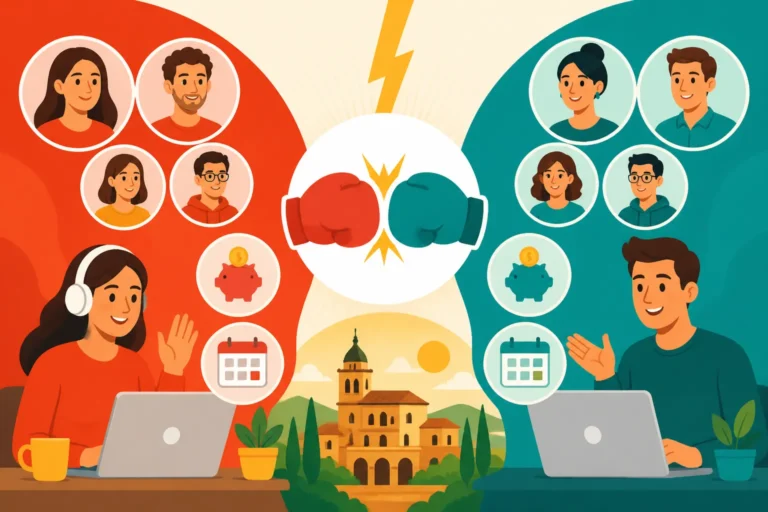
The biggest hurdle for most expats isn't just the vocabulary; it’s the cultural rhythm of how Spaniards communicate in a professional setting. Unlike the rigid "one person speaks at a time" rule common in North American or Northern European boardrooms, Spanish meetings are often collaborative, loud, and characterized by frequent overlapping speech. If you wait for a perfect silence to contribute, you might never speak at all.
The Art of the Polite Interruption
In Spain, interrupting isn't necessarily seen as rude; it’s often interpreted as a sign of engagement and passion for the topic. To improve your presence in these meetings, you need to learn the "interrupción educada." This involves using specific phrases to slide into the conversation without sounding aggressive. Phrases like "Perdona que te corte, pero…" (Sorry to cut you off, but…) or "Si me permites un segundo…" (If you'll allow me a second…) are your best friends here.
Practicing these transitions is vital because they buy you a few seconds of the room's attention. Once you have the floor, keep your points concise. The goal is to match the energy of the room. If you find the speed overwhelming, don’t be afraid to use a clarifying phrase like "A ver si te he entendido bien…" (Let’s see if I’ve understood you correctly…). This forces the speaker to slow down and summarize, which helps your comprehension and shows you are following the logic of the discussion. For those looking to refine these specific conversational nuances, platforms like iTalki can be a lifesaver, allowing you to simulate these high-pressure scenarios with a native speaker who understands the Spanish corporate environment.
Deciphering High-Speed Business Slang
Standard Spanish classes rarely prepare you for the "Spanglish" and local idioms that dominate the tech and corporate sectors in cities like Madrid, Barcelona, and Valencia. You will hear terms like "hacer un follow-up," "target," and "deadline" mixed in with very specific Spanish colloquialisms. Understanding the difference between formal "Usted" (rarely used in modern startups but common in traditional legal or banking sectors) and the informal "Tú" is also crucial.
Beyond the technical terms, you’ll encounter idiomatic expressions used to describe project statuses. If someone says a project is "en pañales" (in diapers), they mean it’s in the very early stages. If they say they are "a tope" (at the limit/full), they are incredibly busy. Learning these nuances is just as important as knowing how to write a Spanish-style CV (Currículum) That Gets Read. The more you can weave these natural expressions into your own speech, the more you will be seen as part of the team rather than an outsider.
Preparation Strategies Before You Step Into the Room
Preparation is ninety percent of the battle when you are working in a second language. You cannot rely on "winging it" the way you might in your native tongue. To feel confident, you need to create a pre-meeting ritual that focuses on both the technical content and the linguistic requirements of the upcoming discussion.
Building Your Personal Meeting Glossary
Before every meeting, review the agenda and identify the three most important points you want to make. Don't just think about them in English; write them down in Spanish. Search for the specific verbs and nouns associated with those points. If the meeting is about quarterly results, make sure you are comfortable with terms like "crecimiento" (growth), "pérdidas" (losses), and "presupuesto" (budget).
I highly recommend keeping a "meeting notebook" where you jot down recurring words you hear but don't understand. After the meeting, look them up and try to use them in the next one. This active recruitment of vocabulary is much more effective than passive listening. It also helps to understand the broader context of your employment. For instance, knowing how to read your What is ‘Nómina’? Understanding Spanish Payroll Documents can provide a lot of the financial vocabulary you’ll hear when management discusses company costs or employee benefits.
Leveraging Specialized Tutoring and Peer Support
If you are struggling with the specific vocabulary of your industry—be it law, medicine, or engineering—generic language apps won't be enough. You need targeted practice. Using a service like iTalki to find a tutor who has a background in your specific field can accelerate your progress significantly. You can spend thirty minutes a week just role-playing a difficult negotiation or a project update.
Additionally, find a "work buddy"—a sympathetic Spanish colleague with whom you can grab a coffee. Ask them about the "hidden" meaning of things said in the meeting. Sometimes, a "we’ll look into it" (lo miraremos) actually means "this is never going to happen," and a local colleague can help you decode these cultural subtleties. This kind of social intelligence is what truly helps you improve your Spanish for workplace meetings.
Active Participation and Essential Vocabulary
Once you are in the meeting, your goal is to transition from a passive listener to an active participant. This doesn't mean you have to give a twenty-minute presentation; it means providing value through short, impactful interventions.
Crucial Phrases for Every Meeting Stage
Having a "cheat sheet" of phrases for different parts of the meeting can reduce anxiety. Here is a breakdown of what you might need:
| Meeting Phase | Spanish Phrase | English Equivalent |
|---|---|---|
| Opening | "¿Podemos empezar con el primer punto?" | Can we start with the first point? |
| Seeking Clarification | "¿Podrías darme más detalles sobre esto?" | Could you give me more details on this? |
| Giving Opinion | "Desde mi punto de vista…" | From my point of view… |
| Agreeing | "Estoy totalmente de acuerdo con lo que has dicho." | I totally agree with what you've said. |
| Disagreeing | "Entiendo lo que dices, pero no lo veo igual." | I see what you're saying, but I don't see it the same way. |
| Closing | "¿Cuáles son los próximos pasos?" | What are the next steps? |
Using these phrases allows you to structure your thoughts without getting lost in complex grammar. Remember, your colleagues care more about your ideas than your perfect use of the subjunctive. If you make a mistake with a gender or a verb ending, just keep going. The momentum of the conversation is more important than grammatical perfection.
Understanding Workplace Bureaucracy and Financials
Many meetings in Spain inevitably touch upon administration, taxes, or legal requirements, especially if you are working for a smaller company or as a freelancer (autónomo). If the conversation turns to invoices, VAT (IVA), or social security, you might find the terminology particularly daunting. If you are a freelancer attending a meeting with a client, you need to be clear on your Autónomo Monthly Fees: What New Freelancers Should Budget to discuss rates and contracts effectively.
For those managing their own business or working as an independent contractor in Spain, tools like Xolo can be incredibly helpful. They simplify the administrative side of things, and their platform can help you understand the terminology of the invoices and tax filings you might need to discuss in a professional setting. Similarly, if you are an expat dealing with complex international tax situations, consulting with Taxes for Expats can ensure you have a handle on your financial standing, which gives you more confidence when discussing budgets or salaries during meetings. Being linguistically prepared for the "boring" admin talk is a sign of a truly integrated professional.
Post-Meeting Follow-up and Long-Term Integration
The meeting doesn't actually end when everyone stands up from the table. In Spain, some of the most important "meeting" work happens in the five minutes after the formal session ends or in the follow-up email sent an hour later.
The Importance of the Acta or Summary
In many Spanish companies, a formal "acta de reunión" (minutes of the meeting) is taken. Even if it isn't, it is wise to send a brief summary of what you understood to be your action items. This serves two purposes: it confirms you understood the Spanish correctly, and it creates a written record in case of future confusion.
Writing these emails is also a great way to practice your formal business Spanish. You can use tools to check your grammar, but try to use the phrases you heard during the meeting. For example, if your boss used the phrase "ponerse las pilas" (to get a move on/start working hard), you might mention in your follow-up that you are already "poniéndote las pilas" on your assigned tasks. For more tips on the transition from study to work, check out our guide on How to Switch From a Student Visa to a Work Permit in Spain.
Social Integration and the Cafecito Culture
Never underestimate the power of the "cafecito." Many decisions in Spain are socialized before or after the actual meeting. If you are invited for a coffee at 11:00 AM, go. This is a lower-pressure environment where people speak more slowly, use more slang, and are more willing to explain things. It’s the perfect place to ask, "Hey, what did Juan mean when he said the budget was 'ajustado'?"
Over time, these informal interactions will build your confidence more than any textbook ever could. You’ll learn how to handle workplace feedback in Spain without misunderstanding tone, and you’ll start to feel like a member of the team. The more you immerse yourself in the social fabric of the office, the more natural the formal meetings will become.
Spanish Healthcare and Administrative Support for Workers
As you settle into your professional life in Spain, you’ll also need to navigate the health requirements often discussed in HR meetings, such as the How to Get a Sick Note in Spain (Baja Médica) — Overview. Understanding the local system is part of being a prepared employee. If you ever find yourself needing a doctor's appointment to discuss a "baja" or a routine check-up, knowing How to Book GP Appointments in Spain: Apps, Phones, and Walk-ins is essential.
Furthermore, if your work involves any physical risk or specialized requirements, you might need to understand Occupational Health Visits in Spain: What to Expect. Being well-versed in these topics ensures that when HR brings them up in a meeting, you aren't left scrambling for a dictionary. For more comprehensive advice on the broader system, see our guide on Spain Healthcare System for Expats: Public vs Private.
Disclaimer
This guide is for informational purposes only. Language learning progress and workplace cultural norms can vary significantly depending on the specific region of Spain, the industry, and individual company policies. Always consult with a qualified language professional or a local gestor for specific legal, tax, or administrative advice related to your employment in Spain.