What Income Do You Need for the Spain Digital Nomad Visa?
Disclosure: This article contains affiliate links. If you buy through them, we may earn a commission at no extra cost to you. Read our full disclosure.
Picture yourself with a remote contract you love, a flat in Valencia bookmarked, and a visa form asking you to prove “sufficient income.” Then you need to work out which figure actually applies to you. This guide sets out the actual monthly income threshold for the Spain Digital Nomad Visa, how it grows with family members, and how to prove it.
How the Spain Digital Nomad Visa Income Requirement Is Calculated
When I first started helping friends with their remote work residency files, the money question made people more anxious than anything else. It isn’t a hard rule once you see how it’s built. It is a formula with one moving part, Spain’s national minimum wage.
The Minimum Wage Is the Yardstick
Spain ties the digital nomad income requirement to the Salario Mínimo Interprofesional, usually shortened to SMI. This is the national minimum wage that the government updates by royal decree. The SMI for 2026 was set by Real Decreto 126/2026 at EUR 1,221 a month, or EUR 40.70 a day, and it took effect on 1 January 2026.
The Unidad de Grandes Empresas, the unit that handles many of these applications, explains the rule in its FAQ. The main applicant needs income of at least 200% of the SMI per month. With the 2026 SMI, that works out to EUR 2,442 a month. Spanish consulates, including the ones in Washington and Houston, publish this same EUR 2,442 figure for the main applicant.
Because the formula is pegged to the SMI, the threshold moves whenever the minimum wage changes. It is not a fixed number written into the visa law. Before you submit, check the SMI that applies on your application date. Then check the figure published by the consulate or office that will handle your file. If you apply from inside Spain, look at the UGE guidance. If you apply from abroad, look at your consulate’s own page.
Adding Family Members to Your Application
The digital nomad route lets you bring your family, and the formula covers them too. Each person adds a set percentage of the SMI:
- The first family member, usually a spouse or partner, adds at least 75% of the SMI, which is about EUR 916 a month.
- Each further family member, such as a child, adds 25% of the SMI. That is EUR 305.25 a month before rounding.
The consulates round that last figure differently. Houston lists EUR 305 per additional member and Washington lists EUR 306. The difference is tiny, but your bank statements are compared against your own consulate’s published number. So it’s worth knowing which rounding your office uses.
I remember a couple in Málaga who had their numbers ready for themselves but had not budgeted for their two children. Seeing the per-person additions laid out made their planning much calmer. They could show they cleared the full household figure with room to spare.
Spain Digital Nomad Visa Income Requirements by Household Size
The table below shows the minimum monthly income for common household sizes. It uses the 2026 SMI of EUR 1,221 and the rounding published by the Houston and Washington consulates.
| Household | Share of SMI | Exact Monthly Amount | Houston Rounding | Washington Rounding |
|---|---|---|---|---|
| Main applicant only | 200% | EUR 2,442.00 | EUR 2,442 | EUR 2,442 |
| Applicant plus 1 family member | 275% | EUR 3,357.75 | EUR 3,358 | EUR 3,358 |
| Applicant plus 2 family members | 300% | EUR 3,663.00 | EUR 3,663 | EUR 3,664 |
| Applicant plus 3 family members | 325% | EUR 3,968.25 | EUR 3,968 | EUR 3,970 |
Each additional person beyond the first family member adds another 25% of the SMI, so you can extend the table for larger families.
Worked Examples From Real-Life Situations
The solo developer. Imagine Priya, a software developer employed by a company in Toronto. She plans to move to Madrid on her own. Her threshold is EUR 2,442 a month. If her salary arrives in Canadian dollars, she needs to show that the converted amount reliably clears that line every month. It is wise not to hover just above the minimum. A month with a weak exchange rate can push you under on paper.
The couple. Tom works as a freelance UX designer for clients in the UK and Germany, and he is moving to Seville with his partner. Their combined requirement is EUR 2,442 plus EUR 916, which totals EUR 3,358 a month. One important detail: the rule describes the income the applicant needs, and that income must come from work. Tom should plan to show the household figure from his own professional activity. He shouldn’t count on his partner’s savings to fill the gap.
The family of four. Elena works remotely for a US firm and is moving to Valencia with her husband and two children. Using the exact percentages, she needs 325% of the SMI, which is EUR 3,968.25. If she applies through Houston, the published amounts give EUR 3,968. Through Washington, they give EUR 3,970. She should prepare her statements against the figure her own consulate publishes.
What Counts as Qualifying Income for Remote Workers
Clearing the number is only half the job. The income also has to come from the right kind of source, and your work relationship has to meet some conditions of its own.
Your Income Must Come From Work
The UGE guidance is clear: the qualifying income must come from work. This visa is built for people who work remotely, whether as employees of a foreign company or as self-employed professionals with foreign clients.
A savings balance, rental income or investment dividends can help you live comfortably, and some officials may see them as reassuring. They do not replace income from remote work in the core requirement. If you plan to show money held across accounts in two countries, read Funding a Digital Nomad Visa Application: Showing Funds Across Two Countries before you put your file together. For the formats that officials accept, see Proof of Funds for Spain Visas: Accepted Bank Statements and Formats.
Work Relationship and Company History Rules
Several conditions about your work sit alongside the income threshold:
- You must have worked with the non-Spanish company for at least the last 3 months before you apply.
- The working relationship must be set to continue for at least 1 year.
- The company itself must show at least 1 year of real, continuous activity.
The 3-month condition catches out recent job-switchers. A friend of mine accepted a better remote offer just weeks before her planned move to Barcelona. The new salary was higher, but she had to wait until she had three months with the new employer before applying. The higher pay did not make up for the short history.
The company-activity condition matters if your client is a young startup. You may need incorporation documents, tax filings or other evidence that the company has been operating for at least a year. Spain Digital Nomad Visa: How to Prove Remote Work Relationship covers how to document these points with contracts and letters.
The Freelancer Rule on Spanish Clients
If you are self-employed, you may take on some Spanish clients, with a limit. Work for Spanish companies can make up no more than 20% of your total professional activity. The other 80% or more must come from companies outside Spain.
In practice, keep a clear record of where your invoices go. Suppose a freelance copywriter in Alicante picks up a local hotel group as a client after arriving. That work has to stay a minor part of the business. A simple spreadsheet listing each client, its country and its share of your revenue makes this easy to show when someone asks.
Proving Your Income Step by Step
Officials judge what you put on paper, not what you say. A tidy, well-labelled file that answers the obvious questions before they come up will serve you best. For the full list of supporting documents and processing stages, see Spain Digital Nomad Visa: Requirements, Documents, and Timeline.
Building Your Income Evidence File
This is the order I suggest to anyone preparing an application:
- Confirm the current SMI and the monthly figure published by your consulate or the UGE, then calculate your household threshold.
- Gather your employment contract or freelance service agreements. They should show your role, your pay and that the relationship continues for at least 1 year.
- Get a letter from your employer or main clients confirming that you work remotely and stating when the relationship started, which must be at least 3 months ago.
- Collect payslips or invoices and the matching bank statements, so each payment can be traced from source to account.
- Prepare evidence that the company has had at least 1 year of real, continuous activity.
- If you are self-employed, add a client breakdown showing that Spanish clients make up no more than 20% of your activity.
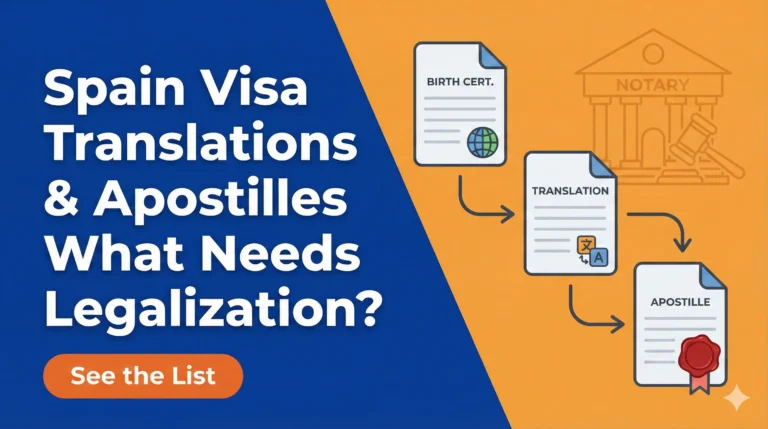
- Have foreign-language documents translated by a sworn translator, and get an apostille where required.
- Arrange health insurance that meets the visa conditions and add the certificate to your file.
On step seven, sworn translation is required for many documents, and a slow or rejected translation can hold up the whole application. Online services like Translayte offer sworn translations into Spanish, which helps if you’re applying from abroad and don’t know a local translator. To find out which documents need legalisation, see Apostilles and Sworn Translations for Spanish Visas.
On step eight, Innoinsure is one of the providers people use for health cover that fits Spanish visa requirements. Check the insurer’s own policy pages for current pricing and coverage terms, and make sure the policy matches what your consulate asks for. You can also compare options in Insurance Quotes for the Spain Digital Nomad Visa: Provider Shortlist and Annual Cost.
Social Security: The Detail That Changes Your Paperwork
This part affects your file and your monthly budget, so it’s worth getting right from the start.
If you are an employee of a foreign company, there are two possible routes. Your employer can register you with Spanish social security. The only alternative is a certificate from your home country issued under a social security agreement between that country and Spain. That certificate shows you stay covered in your home system while you work from Spain. If your home country has no such agreement with Spain, this alternative is not available to you.
If you are self-employed, you must register in RETA, the Spanish special scheme for self-employed workers. This route has no home-country certificate option. RETA contributions become a regular monthly cost, so include them when you check how comfortably you clear the income threshold. To understand the registration itself, see Registering as Autónomo for Freelancers in Spain: Work Setup. For more on coordinating contributions between countries, see How to Avoid Double Social Security Payments When Moving to Spain.
Some freelancers do their sums based only on gross income and then feel squeezed once their regular contributions start. Budget for the contributions from the beginning and the first few months in Spain will feel much easier.
Currency, Taxes, and the Rest of Your Budget
Most digital nomad applicants are paid in a currency other than the euro. Officials will look at what your income is worth in euros against the threshold. If you earn in dollars or pounds and sit close to the line, a currency swing can matter. It helps to keep a buffer and to think about how you’ll handle exchange rate changes over the life of your residency. How to Plan for Currency Fluctuations When Living in Spain covers this.
Tax is the other big question. Many remote workers ask whether the special expat tax regime applies to them. The answer depends on your situation, and the interaction between the visa and the regime is technical. Read The Digital Nomad Visa and the Beckham Law: How They Interact before you assume either way.
Finally, there is the move itself. Once your visa is approved, shipping belongings to Spain can be a significant cost, especially for families. Sirelo is a comparison platform that lets you request quotes from several international movers, so you don’t have to rely on a single price. Request quotes early, because removal companies get booked up in the busy summer months.
A Final Word From Someone Who Has Been There
The income requirement looks intimidating at first, but it comes down to a few clear points:
- Take 200% of the SMI for yourself.
- Add 75% for the first family member.
- Add 25% for each further person.
- Show that the income comes from remote work with the right history behind it.
Get those right, document them cleanly, and you remove the biggest source of worry from your application. If your situation is unusual, for example several part-time employers, a mix of employment and freelancing, or a company with a complicated structure, get professional advice before you submit. For a wider look at earning from abroad while based in Spain, see Remote Work for a Foreign Company While Living in Spain: Basics.
Disclaimer
This article is for general informational purposes only and does not constitute professional advice. Laws, prices and regulations vary by location and change over time. Consult a qualified professional for guidance on your specific situation.