How to Find a Legal Part-Time Job as a Student in Spain
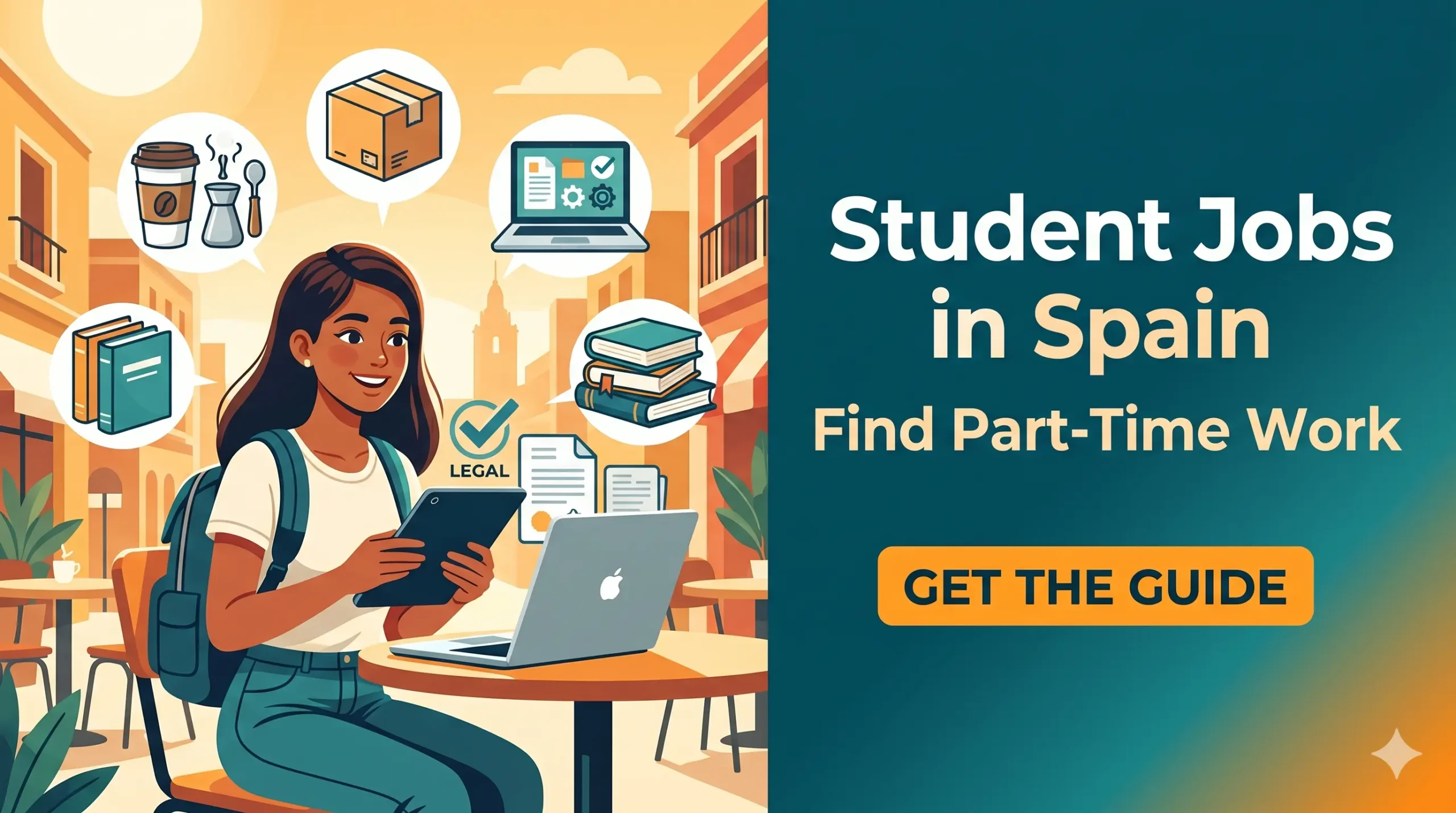
Staring at a dwindling bank account while trying to decode complicated Spanish labor laws is a stressful expat initiation. I spent my first semester surviving on cheap tapas because I falsely believed student visas banned all employment. This guide breaks down exactly how to legally secure a part-time job in Spain so you can fund your studies without risking deportation.
Disclosure: This post may contain affiliate links. We may earn a commission at no extra cost to you if you make a purchase through these links. Read full disclosure.
Navigating the 30-Hour Work Allowance
Spanish immigration law regarding students has undergone massive, incredibly positive changes in recent years. However, walking into a local café and asking for a job without understanding your specific legal standing will result in instant rejection from employers who fear government fines.
The Automatic Right to Work
Prior to the recent immigration reforms, international students had to jump through agonizing bureaucratic hoops, begging their potential employer to sponsor a separate work authorization. Today, the process is streamlined. If you are enrolled in higher education (such as a bachelor’s, master’s, or PhD) or a regulated vocational training program (Formación Profesional), your Tarjeta de Identidad de Extranjero (TIE) automatically grants you the right to work up to 30 hours per week.
This automatic authorization applies across the entire national territory, removing previous geographical restrictions. However, this rule does not apply to everyone. If you are enrolled in a short-term language academy or hold a visa valid for less than six months, you are generally legally barred from formal employment. If you are a language student trying to reach the proficiency required to enroll in a degree program that allows working, using SpanishPod101 is an incredible way to accelerate your learning and pass the mandatory official exams required by the immigration office.
The Strict Separation of Work and Studies
The Spanish government explicitly views you as a student first and a worker second. Therefore, your employment schedule legally cannot overlap with your academic timetable. If your university lectures run from 9:00 AM to 2:00 PM, your employment contract cannot list you as working during those specific hours.
If the Oficina de Extranjería (Immigration Office) discovers an overlap, or if your academic grades plummet because you are working too much, they will deny your visa renewal. Furthermore, the money you earn from this part-time job cannot be legally counted as your primary financial means of survival. When you apply for your next visa, an administrative hurdle explained in How to Extend a Spanish Student Visa: Renewal Checklist, you still have to prove you possess the minimum IPREM threshold in your bank account, completely independent of your Spanish salary. To easily show this proof without paying exorbitant translation fees for foreign bank statements, many students hold their required savings in Wise to generate clean, Euro-denominated financial records that Spanish officials instantly accept.
The Bureaucracy of Getting Hired Legally
Finding a willing employer is only half the battle. To actually sign the contract and receive your first paycheck, you must integrate yourself into the Spanish governmental labor system.
Securing Your Social Security Number
Even with the automatic right to work printed on your physical residency card, you cannot legally start a shift until you have a Spanish Social Security Number (Número de Afiliación a la Seguridad Social or NUSS).
You must apply for this number before you sign your contract. You can request it online via the Tesorería General de la Seguridad Social portal if you have a digital certificate, or you can book an in-person appointment. You will need to fill out the TA.1 form and present your passport, your TIE, and your municipal registration certificate. Once you have this number, your employer uses it to register your contract with the government, ensuring you are legally paying taxes and building a limited social safety net. If you are struggling to understand the complex terms on the TA.1 form, taking the time to study administrative vocabulary with SpanishPod101 will help you navigate this dense government portal without accidentally selecting the wrong registration category.
Understanding Internships vs Standard Contracts
Spanish universities heavily rely on internships (prácticas). When navigating the job market, you must understand the difference between an internship and standard employment. Internships are divided into two categories: Prácticas Curriculares (mandatory for your degree) and Prácticas Extracurriculares (optional).
Curricular internships are not considered standard employment; they are academically supervised and, unfortunately, often unpaid. Extracurricular internships must be paid and require a specific legal agreement (Convenio de Prácticas) signed by the university, the hiring company, and you.
If you manage to secure a standard part-time contract outside of the university system, such as working in retail, you will receive a standard payroll (nómina) and will need a local IBAN to receive your wages. Establishing this local financial infrastructure is a crucial step we detail in Opening a Bank Account in Spain: Step-by-Step for Foreigners. If your employer insists on depositing your paycheck into a traditional local bank, you can still use Wise to instantly transfer a portion of your Spanish wages back to your home country to pay off student loans or international credit cards without losing money to terrible bank exchange rates.
The Dangers of Freelancing Autonomo
Many international students, especially digital nomads, graphic designers, or freelance writers, assume they can just pick up independent clients on the side. In Spain, freelancing requires officially registering as an autónomo (self-employed).
While the student visa technically allows you to register as an autónomo, it is an administrative and financial minefield. You must register with the tax authority (Hacienda) and pay a flat monthly Social Security quota regardless of how much you earn. If you make zero euros one month, you still owe the government their quota. Furthermore, you must file quarterly VAT (IVA) tax returns. If you have international freelance clients, asking them to pay your invoices directly into your Wise account helps you seamlessly convert USD or GBP into Euros so you have the correct currency on hand to pay your mandatory Spanish tax obligations. Failing to manage this heavy administrative burden will absolutely ruin your legal residency status.
| Employment Type | Contract Type | Maximum Hours | Social Security | Best Suited For |
| Standard Part-Time | Contrato de trabajo | 30 hours / week | Paid by Employer | Retail, Hospitality, Tutoring |
| Curricular Intern | Convenio educativo | Varies by program | Exempt or minimal | Mandatory degree requirements |
| Extracurricular Intern | Convenio de prácticas | Usually 20-30 hours | Minimal, paid by company | Career building in your field |
| Freelancer | Alta de Autónomo | 30 hours / week | Paid by YOU (Monthly Quota) | Tech, Design, Online Consulting |
Where to Find Jobs and Survive the Market
Spain’s youth unemployment rate is notoriously high, meaning you are competing against locals for part-time entry-level roles. To succeed, you must leverage your unique skills as a foreigner.
The Best Industries for Expat Students
Unless you arrive fully fluent in Spanish, your initial job hunt will be restricted. The most reliable sector for English-speaking students is language teaching. Private language academies (academias de idiomas) constantly hire native speakers for afternoon and evening classes, which perfectly complements a morning university schedule.
Another massive sector is hospitality (hostelería). Spain’s massive tourism industry relies on bilingual students to staff Irish pubs, boutique hotel reception desks, and specialized tour guide agencies in major hubs like Madrid, Barcelona, and Seville. However, if you want to escape the lowest-paying tourist trap jobs, improving your local language skills is mandatory. Dedicating time to practicing conversational industry phrases with SpanishPod101 will drastically improve your interview confidence and allow you to apply for specialized administrative or retail roles that demand local fluency.
Avoiding the Trabajar en B Trap
You will inevitably meet a bar owner or a private tutor agency that offers to pay you “under the table” in cash to avoid taxes. This is known in Spain as trabajar en B (working in B).
Do not do it under any circumstances. First, it is entirely illegal and constitutes massive tax fraud. Second, if a workplace inspector (Inspección de Trabajo) raids the restaurant while you are waiting tables, you will face instant deportation and the cancellation of your student visa. You have zero legal protections if you get injured on the job, and the boss can fire you or refuse to pay you without consequence. If you are struggling to make ends meet and are tempted by cash-in-hand jobs to cover your rent, you should instead aggressively review your domestic overhead using the survival strategies outlined in Understanding Utility Bills in Spain and Cost of Living in Spain. Securing your foundational expenses, like setting up a proper residential contract—a process mapped out in Renting an Apartment in Spain: A Guide for Expats—ensures you do not fall victim to predatory employers.
The Post-Graduation Transition
Landing a legal part-time job as a student is not just about paying for weekend trips; it is a strategic bridge to your permanent future in the country. Spain has a dedicated visa pathway called the Residencia para la Búsqueda de Empleo (Job Search Visa).
After completing your degree, you can apply for this one-year residency to stay in Spain and look for a highly qualified full-time job. If you spent your student years building a professional network through legitimate, legal part-time employment and registered internships, converting those local connections into a full-time work permit sponsor is infinitely easier. Just remember, as soon as you transition from a student visa to a full work permit, your legal right to travel the continent changes, an administrative nuance we explore deeply in Can You Travel in Schengen While on a Spain Student Visa?.
When you finally land that salaried graduate role, continuing to use Wise ensures you can safely and cheaply send your newfound professional savings back home to family or pay off foreign university debts. Furthermore, keeping your language skills sharp with SpanishPod101 ensures you integrate seamlessly into Spanish corporate culture, proving to your new employer that hiring an international graduate was the smartest investment they could make. First, however, ensure all your official identification is tied to your permanent post-grad address by following the steps in How to Change Address on Your TIE Card After Moving in Spain.
References
Primary sources (official)
- Ministerio de Inclusión, Seguridad Social y Migraciones – Estudiantes: https://extranjeros.inclusion.gob.es/es/InformacionInteres/InformacionProcedimientos/Ciudadanosnocomunitarios/estudiantes.html
- Tesorería General de la Seguridad Social – Afiliación y Número de Seguridad Social: https://www.seg-social.es/wps/portal/wss/internet/Trabajadores/Afiliacion
- Ministerio de Asuntos Exteriores – Visado de Estudios: https://www.exteriores.gob.es/Consulados/losangeles/en/ServiciosConsulares/Paginas/Consular/Visado-de-estudios.aspx
Other helpful sources
- SEPE (Servicio Público de Empleo Estatal) – Contratos formativos y de prácticas: https://www.sepe.es/HomeSepe/empresas/Contratos-de-trabajo/modelos-contrato.html
- Spain Student Visa Regulations Update Portal: https://www.inclusion.gob.es/
Disclaimer
The information provided in this guide is exclusively for educational and informational purposes and does not constitute official legal, immigration, or tax advising. Spanish labor laws, the exact requirements for securing a Número de Seguridad Social, and the specific restrictions on student visa working hours (maximum 30 hours per week) are subject to frequent updates by the Ministerio de Inclusión, Seguridad Social y Migraciones. You should always consult directly with a registered Spanish immigration lawyer (abogado de extranjería) or the Oficina de Extranjería before signing an employment contract or registering as an autónomo to ensure your specific visa status permits formal employment.