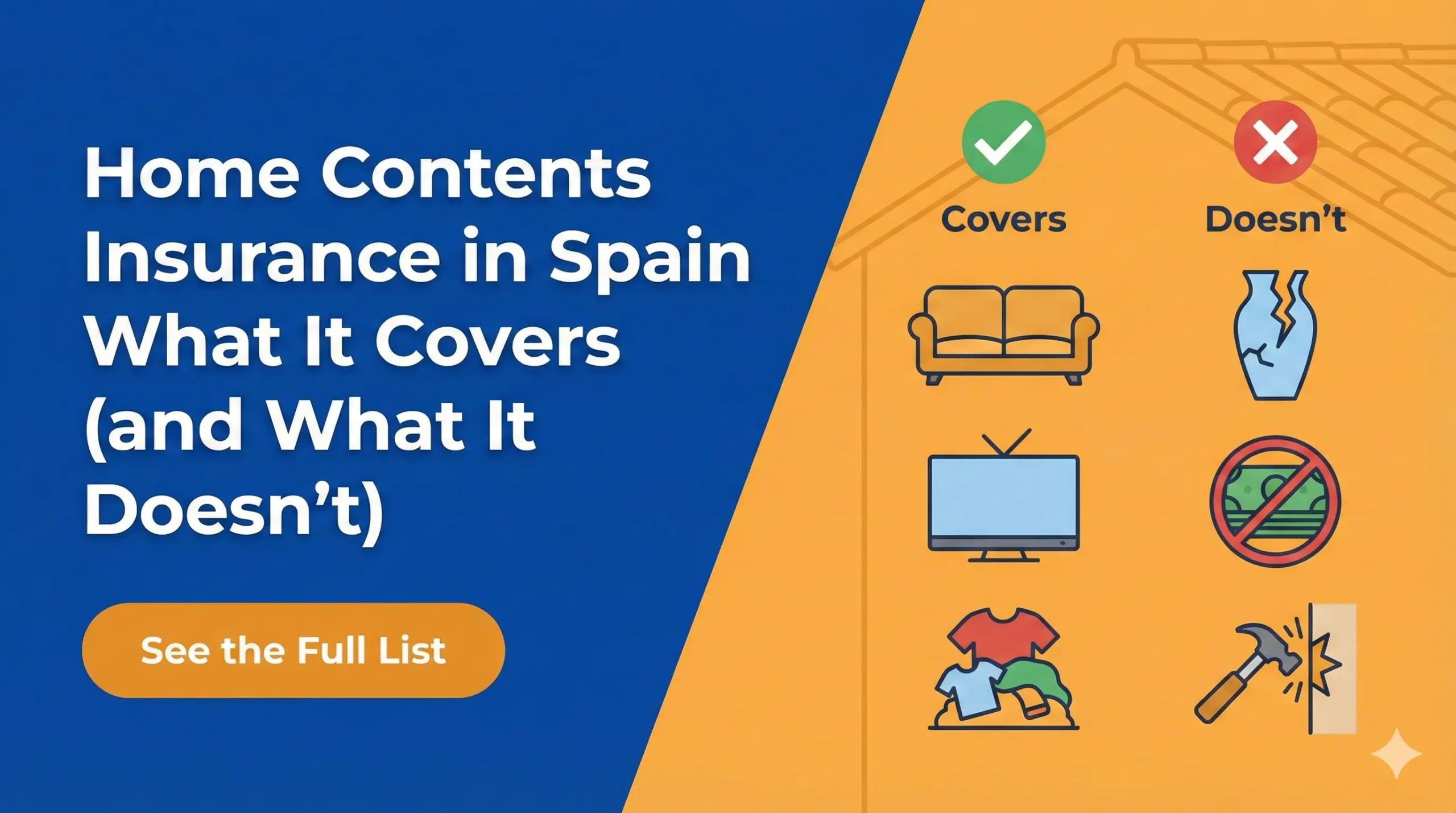
Home Contents Insurance in Spain: What It Covers (and What It Doesn’t)
Spanish contents insurance (Seguro de Contenido) protects your belongings from theft, water damage, and electrical surges, but distinct legal definitions between “robbery” and “larceny” can catch expats off guard. This guide clarifies coverage limits, high-value item declarations, and the critical “Rule of Proportionality.”
Disclosure: This post may contain affiliate links. We may earn a commission at no extra cost to you if you make a purchase through these links. Read full disclosure.
What Exactly is “Contenido”?
In Spanish insurance law, Contenido refers to everything inside the home that is not permanently attached to the structure.
The “Shake Test”: Imagine you could pick up your apartment building and shake it upside down. Everything that falls out is Contenido. Everything that stays stuck to the walls is Continente.
- Standard Contenido: Furniture, clothes, electronics, books, kitchenware, linens, and food in the fridge.
- The Grey Areas:
- Fitted Kitchens: Usually Continente (landlord’s responsibility), but appliances (fridge, washing machine) are Contenido (yours or landlord’s, depending on who bought them).
- Renovations: If you, as a tenant, paid to install a new parquet floor, that floor is technically Continente, but some policies allow you to insure it as “Tenant Improvements” (Obras de Reforma).
Standard Coverage: What Is Included?
A good contents policy protects you against more than just burglary. Here are the standard pillars of coverage you should expect in 2026.
1. Water Damage (Daños por Agua)
This is the most frequent claim in Spain.
- What it covers: Water leaking from pipes, taps, or radiators that damages your furniture or electronics.
- Example: The upstairs neighbor’s washing machine floods. Water drips through your ceiling onto your leather sofa. Your policy pays for the sofa; the neighbor’s policy pays for the ceiling paint.
2. Electrical Damage (Daños Eléctricos)
Spain’s power grid can be prone to surges (subidas de tensión), especially during storms in rural areas.
- What it covers: Short circuits or surges that fry your TV, computer, or fridge.
- Condition: Many insurers require the item to be less than 10 years old or worth more than a certain amount (e.g., €150) to process a claim.
3. Spoilage of Food (Alimentos Refrigerados)
If the power goes out for more than a specific time (usually 6+ hours) or your fridge breaks down mechanically, the insurer will reimburse you for the lost food.
- Limit: Usually capped between €300 and €600.
4. Street Robbery (Atraco en Vía Pública)
High-quality policies extend coverage beyond your front door.
- What it covers: If you are mugged on the street (threatened with violence/intimidation), the insurer will reimburse the stolen items (phone, watch) and sometimes the cash carried (up to a small limit, e.g., €150).
- Requirement: You must file a police report (denuncia) immediately. Simple pickpocketing (where you didn’t notice it happening) is often excluded.
5. Locksmith Services (Cerrajería)
If you lose your keys or they are stolen, the policy covers the cost of changing the lock to secure your home.
The Big Distinction: Robo vs. Hurto
This is the single most important legal distinction in Spanish insurance. Understanding it will prevent a rejected claim.
Robo (Robbery)
- Definition: Theft involving force against things (breaking a door/window) or violence/intimidation against people.
- Coverage: Covered by almost all policies, usually up to 100% of the insured sum.
Hurto (Larceny/Theft)
- Definition: Theft without force or violence. It implies stealth or negligence.
- Examples:
- Leaving your front door unlocked and someone walks in.
- Leaving a window open on the ground floor.
- A cleaner or guest stealing jewelry from a drawer.
- Coverage: Many basic policies exclude Hurto entirely, or cap coverage at a very low limit (e.g., €200). You must specifically check your policy for “Hurto” coverage.
High-Value Items (Joyas y Objetos de Valor)
If you own a Rolex, a diamond ring, or high-end art, your standard policy likely does not cover it fully. Spanish insurers classify items into three tiers:
- General Contents: Clothes, furniture, standard electronics.
- Special Objects (Objetos de Valor Especial): Items exceeding a certain unit value (often €2,000 – €3,000 per item). This includes high-end cameras, ebikes, or musical instruments.
- Jewelry (Joyas): Items made of gold, silver, platinum, or containing precious stones.
The “Safe” Rule
If you have jewelry worth more than a certain percentage of your total contents (e.g., 10%), the insurer will require you to declare it separately.
- Requirement: For jewelry collections over a certain value (e.g., €6,000), insurers often demand you keep them in a wall-mounted safe (caja fuerte). If you are robbed and the jewelry was not in the safe, they may refuse to pay or pay only a fraction.
Liability Coverage (Responsabilidad Civil)
While this article focuses on contents, Civil Liability is often bundled with contents insurance and is vital for renters.
- Tenant Liability (RC Locativa): If you accidentally burn the landlord’s kitchen or flood their parquet floor, this covers the damages you owe the landlord.
- Family Liability (RC Familiar): If your child throws a ball off the balcony and dents a car, or if you accidentally injure someone with your umbrella on the street, this pays the damages.
- Pet Liability: As of September 2023, under the new Animal Welfare Law, dog owners in Spain are legally required to have third-party liability insurance for their dogs. Most home contents policies allow you to add your dog to the Responsabilidad Civil section for a small fee, fulfilling this legal requirement.
The “Rule of Proportionality” (Regla Proporcional)
This is the mathematical trap that catches thousands of expats every year. It happens when you are Under-Insured (Infra-seguro).
If you declare that your contents are worth €15,000 to get a cheaper premium, but the real value of your stuff is €30,000, the insurer considers you are only insured for 50% of your risk.
The Consequence: In the event of a claim, they will only pay 50% of the damage, even if the claim is small.
Example:
- Real Value of Contents: €30,000
- Insured Value: €15,000 (50% under-insured)
- The Accident: A fire destroys your sofa (Value: €1,000).
- The Payout: The insurer pays €500 (50%), not €1,000. You are penalized proportionally for under-insuring.
Tip: Always overestimate your contents slightly. It is better to pay €10 more a year in premiums than to lose 50% of a major payout.
Valuing Your Goods: New vs. Real Value
Check the valuation clause in your contract (Valoración de los bienes).
- Value as New (Valor a Nuevo): The insurer pays what it costs to buy the item new today. This is the best coverage.
- Real Value (Valor Real): The insurer applies depreciation. If your 5-year-old TV is stolen, they pay you what a 5-year-old TV is worth (very little), not the price of a new one.
Strategy: Always insist on Valor a Nuevo for at least the first 5-10 years of an item’s life.
Exclusions: What Is NOT Covered?
Even the best “All Risks” (Todo Riesgo) policy has exclusions.
- Unexplained Disappearance: If you simply can’t find your ring, but there is no sign of robbery or theft, insurance won’t pay.
- Negligence: Damages caused by leaving windows open during a storm, or leaving keys in the door.
- Business Equipment: If you are a digital nomad with €10,000 of camera gear used for work, standard home insurance may exclude it as “professional tools.” You need specific professional insurance.
- Cash (Dinero en Efectivo): Cash stolen from the home is usually capped at €150 – €300 unless it was locked in a safe.
- Garden Furniture: Items left outdoors (terraces/patios) are often excluded from theft coverage unless secured with chains.
How to Make a Claim (Dar un Parte)
If you need to claim, speed and documentation are key.
- Police Report (Denuncia): Mandatory for any theft or vandalism claim. You must list every single item stolen. If you forget to list the iPad on the police report, the insurer won’t pay for it.
- Proof of Ownership: You need receipts, invoices, or at least photos of the items.
- Tip: Walk around your house today and take a video of your belongings, opening drawers and cupboards. Upload it to the cloud. This is your proof of pre-existence.
- The 7-Day Rule: You must notify the insurer within 7 days of discovering the incident.
Comparison Table: Standard vs. Premium Coverage
| Feature | Standard Policy (Básico) | Premium Policy (Todo Riesgo) |
| Fire & Water | ✅ Included | ✅ Included |
| Robbery (Force) | ✅ Included | ✅ Included |
| Larceny (No Force) | ❌ Excluded | ✅ Included (with limits) |
| Street Mugging | ❌ Excluded | ✅ Included |
| Food Spoilage | ❌ Excluded | ✅ Included (~€300) |
| Broken Glass | ✅ Windows only | ✅ Mirrors, Ceramic hobs, Glass tables |
| Locksmith | ✅ Emergency only | ✅ Lost keys included |
| Pet Liability | ❌ Add-on | ✅ Often included |
| Aesthetic Restoration | ❌ Excluded | ✅ Included (Matches paint/tiles) |
Conclusion
Home contents insurance in Spain is a critical safety net, especially for renters who carry significant liability risks. The difference between a payout and a rejection often lies in the fine print—knowing the difference between Robo and Hurto, and ensuring you haven’t fallen foul of the Regla Proporcional.
Take an hour this weekend to inventory your belongings. If the total value exceeds your current coverage, call your broker. And if you have a dog, ensure your liability clause is updated to meet the new 2023 legal standards.
For more on protecting your financial life in Spain, ensure your base administration is in order by reviewing Opening a Bank Account in Spain: Step-by-Step for Foreigners, or learn how to protect your rental deposit in Getting Your Deposit Back in Spain: Disputes and Documentation.
References
Primary sources (official)
- Boletín Oficial del Estado (Law 50/1980 – Insurance Contracts): https://www.boe.es/buscar/act.php?id=BOE-A-1980-22501
- BOE (Law 7/2023 – Animal Welfare & Liability): https://www.boe.es/eli/es/l/2023/03/28/7
- Consorcio de Compensación de Seguros (Extraordinary Risks): https://www.consorseguros.es/
Other helpful sources
- OCU (Organization of Consumers and Users – Home Insurance Guide): https://www.ocu.org/vivienda-y-energia/seguro-de-hogar
- Mapfre (Glossary of Insurance Terms – Robo vs Hurto): https://www.mapfre.es/seguros/guia/glosario-seguros.jsp
- Linea Directa (Under-insurance explanation): https://www.lineadirecta.com/seguros-hogar/infraseguro.html
Disclaimer
The information provided in this article is for educational and informational purposes only and does not constitute financial or legal advice. Insurance policies vary by provider. We strictly recommend reading the “Condiciones Generales” of your specific policy to understand exclusions and limits.