Tenant Insurance in Spain: Do You Need It for a Lease?
Disclosure: This article contains affiliate links. If you buy through them, we may earn a commission at no extra cost to you. Read our full disclosure.
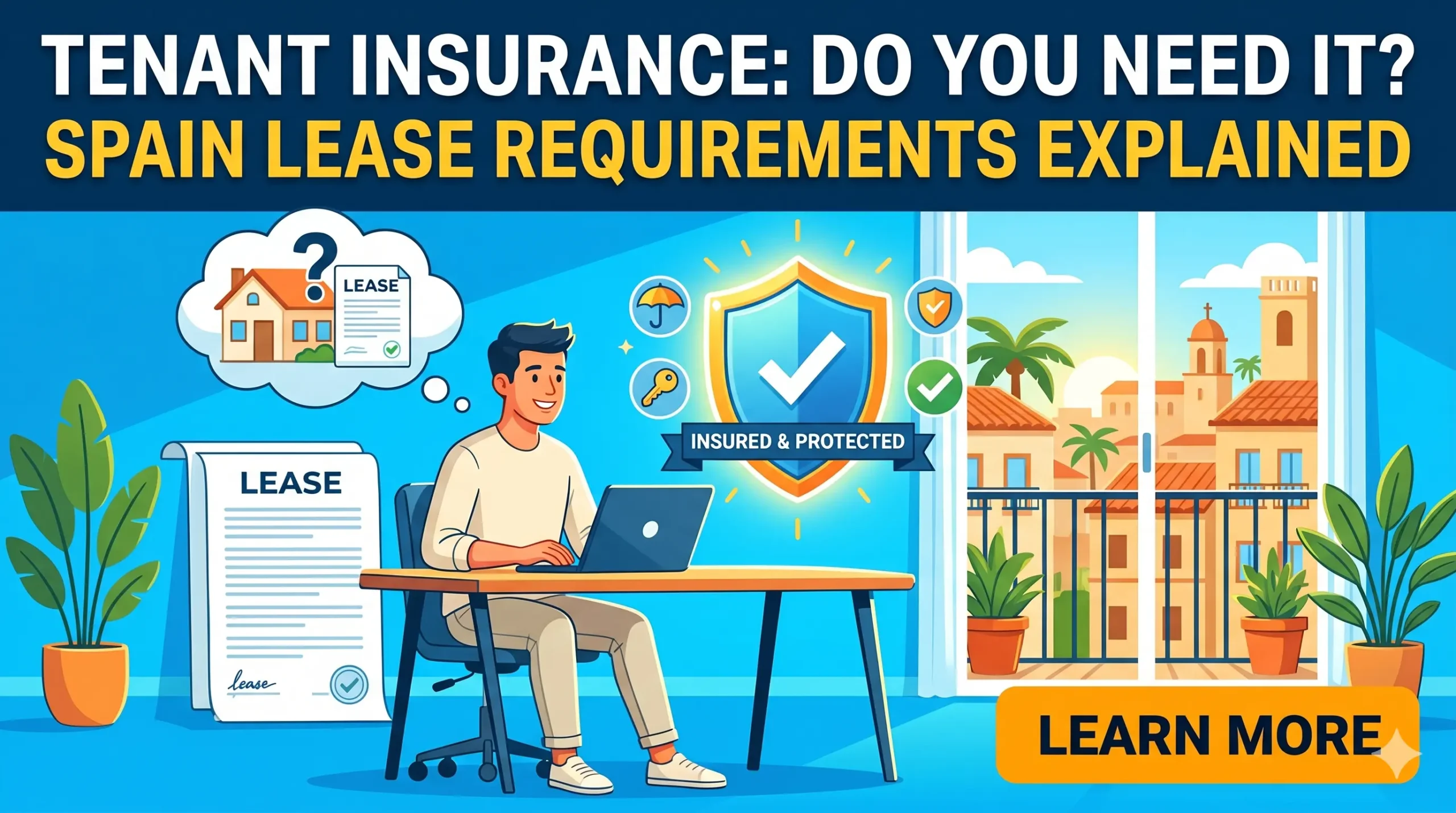
Staring at a dense Spanish rental contract demanding you purchase tenant insurance while wondering if it is a legal requirement is a massive expat headache. An accidental flood in a rented Madrid apartment can quickly turn into panic over who pays for the neighbor’s ruined ceiling. This guide deciphers Spanish tenant insurance rules, liability, and what you actually need before signing a lease.
The Legal Reality of Tenant Insurance in Spain
When you finally find a flat in a competitive Spanish city, the landlord will hand you a contract filled with complex legal jargon. One of the most fiercely debated clauses is the requirement for the tenant to purchase a Seguro de Hogar (Home Insurance).
Is It Legally Required to Rent?
The short, absolute legal answer is no. Under the Ley de Arrendamientos Urbanos (LAU)—the federal law that governs residential rentals in Spain—there is absolutely no legal mandate forcing a tenant to purchase renter’s insurance. Furthermore, the LAU does not force the landlord to buy it either, unless the apartment has an active mortgage that requires it.
Because the federal law is silent on the matter, many expats assume that a landlord demanding insurance is trying to pull a scam. You might feel tempted to cross the clause out or argue with the real estate agent. However, pushing back too aggressively on this point often results in losing the apartment entirely. To understand the broader, highly skewed power dynamics of the Spanish rental market, you must thoroughly review Student Housing in Spain: Options and Typical Contracts.
The Landlord Clause Trap
While the Spanish government does not mandate tenant insurance, Spanish contract law allows landlords to make it a mandatory condition of your specific lease.
If the landlord inserts a clause stating, “The tenant is obligated to contract a civil liability and contents insurance policy,” and you sign the contract, it instantly becomes a legally binding requirement. If you fail to buy the policy and provide proof to the landlord within a specified timeframe, you are in direct material breach of your lease, and the landlord has grounds for eviction.
Modern Spanish landlords are incredibly risk-averse. They use these insurance clauses as an extra layer of financial security. If you are preparing to move, you must proactively factor the annual cost of this policy into your initial capital calculations. Understanding exactly how much cash you need on day one is a survival skill deeply detailed in Renting in Spain: How to Budget for Deposits, Fees, and Utilities.
Continente vs. Contenido: What Are You Actually Insuring?
If you agree to buy the insurance, you cannot simply click the first policy you find online. Spanish home insurance is divided into highly specific categories, and paying for the wrong coverage means you are wasting your money.
Understanding Continente (The Building Structure)
The Continente refers to the physical, structural container of the apartment. This includes the brick walls, the ceiling, the fixed electrical wiring, the structural plumbing inside the walls, and the original hardwood floors.
As a renter, you do not own the continente. Therefore, you should absolutely never pay to insure it. The landlord is strictly responsible for maintaining and insuring the physical structure of the property against fires, burst structural pipes, and severe weather damage. If a massive storm damages the communal roof, that is an issue for the landlord and the building’s Community of Owners, a bureaucratic structure explained in Understanding Spain Comunidad Fees: What They Cover. If an insurance broker attempts to sell you a policy that includes heavy continente coverage, decline it immediately.
Protecting Your Contenido (Your Belongings)
The Contenido refers to the contents of the apartment—everything that would fall out if you could pick the building up and shake it. This includes your clothes, laptops, televisions, bicycles, and any furniture you purchased yourself.
The landlord’s insurance policy does not cover your personal contenido. If the apartment burns down due to a faulty electrical wire (the landlord’s fault), the landlord’s insurance will rebuild the physical walls, but they will not write you a check to replace your ruined MacBook or your expensive wardrobe. If you want your belongings protected, you must insure them yourself. When setting up your policy, you must calculate the total value of your possessions. If your belongings are destroyed and you need to replace essential home electronics immediately, ordering replacements via Amazon Spain ensures you have the necessary tech to continue remote working within 24 hours while you wait for the insurance payout.
Civil Liability (Responsabilidad Civil)
This is the single most important element of any Spanish tenant insurance policy. Responsabilidad Civil covers the financial damages you accidentally cause to a third party.
If you leave the bathtub running, fall asleep, and the overflowing water destroys your downstairs neighbor’s antique ceiling, you are personally liable for the repairs. The landlord’s insurance will not cover damages caused by your negligence. Without Responsabilidad Civil coverage, the neighbor can successfully sue you, and the Spanish government can embargo your bank accounts to pay the massive repair bill. Ensuring you have an agile local banking setup to pay for this crucial coverage without triggering international fraud alerts is vital; review Opening a Bank Account in Spain as a Non-Resident to set up your financial base.
| Coverage Type | Spanish Term | Who Is Responsible | What It Actually Covers |
| Building Structure | Continente | Landlord | Walls, structural pipes, electrical wiring, fixed windows. |
| Personal Belongings | Contenido | Tenant | Electronics, clothes, bicycles, and tenant-owned furniture. |
| Civil Liability | Responsabilidad Civil | Both (Depending on fault) | Financial damage caused to neighbors or third parties. |
| Legal Defense | Defensa Jurídica | Both | Legal fees in the event of disputes or civil claims. |
Why Expats Actually Need Tenant Insurance
Even if your landlord forgets to mandate an insurance policy in your lease, veteran expats strongly advise purchasing a basic tenant policy voluntarily. The cost is shockingly low—usually between 60 and 100 euros for the entire year—and it prevents catastrophic financial ruin.
The Downstairs Neighbor Disaster
The architectural reality of classic Spanish city centers is that the plumbing is often decades old. Water damage (daños por agua) is consistently the most frequent and most expensive insurance claim filed in Spain.
If a pipe suddenly bursts under your kitchen sink, the damage will quickly seep through the thin tile floors and ruin the ceiling of the apartment below you. The immediate dispute will be over who is at fault. If the pipe broke inside the wall due to old age, the landlord’s continente insurance pays. But if the flexible hose connected to your washing machine snapped because you installed it incorrectly, the fault lies entirely with you. Having a tenant policy with Defensa Jurídica (Legal Defense) means your insurance company will assign their own lawyers to fight the landlord’s insurance company to determine fault, completely removing you from the agonizing, high-stress negotiation. If you need to stop the water immediately before the insurance assessor arrives, you must know how to navigate local tradesmen, a skill covered in How to Find an English-Speaking Plumber/Electrician in Spain.
Burglary and Theft Protection
Spain is generally a very safe country regarding violent crime, but residential burglaries (robos) and opportunistic thefts are common, particularly in major cities like Barcelona and Madrid. If you rent a ground-floor apartment (Bajo) or a top-floor penthouse with an accessible terrace (Ático), you are at a statistically higher risk of a break-in.
Tenant insurance policies frequently cover the theft of your contenido if the burglar used force to enter the flat (such as breaking a window or drilling the lock). To actively deter these break-ins, modern expats frequently order smart security cameras and heavy-duty dual-clutch lock cylinders directly from Amazon Spain. However, a smart camera is useless if it disconnects the moment you leave the building. You must have a robust, uninterrupted home internet connection to monitor the live feed. Securing your home fiber through an expat-centric provider like Tiekom guarantees your security equipment stays online constantly, providing you with absolute peace of mind while you travel. To navigate the unspoken rules of installing security equipment on exterior walls without infuriating your community president, carefully review How to Deal With Spanish Building Rules (Pets, Noise, Renovations).
How to Set Up Your Policy and Handle Claims
Securing a policy is relatively simple, but you must avoid the aggressive upselling tactics common in the Spanish financial sector.
Evaluating Providers and Policy Basics
If you open a Spanish bank account, the bank teller will almost certainly pressure you to buy their in-house home insurance policy, often promising to lower your account maintenance fees in exchange. You must resist this pressure. Bank-issued insurance policies are notorious for being wildly overpriced and offering terrible customer service when an actual emergency occurs.
Instead, you should independently seek out dedicated Spanish insurance companies (like Mapfre, Allianz, or Caser) or use an online comparative broker. When calculating your premium, you will be asked to estimate the total value of your contenido. Be realistic; if you only own a laptop and a suitcase of clothes, do not insure your contents for 30,000 euros, as this will needlessly skyrocket your premium. Simply factoring a realistic 80-euro annual insurance premium into your broader financial plan ensures you are never caught off guard. You can deeply refine these baseline calculations by reviewing Cost of Living in Spain: Budgeting for Expats.
Dealing with Emergency Breakdowns
When a disaster occurs—such as a power surge destroying your television or a burst pipe flooding your living room—you must act quickly and document everything.
Spanish insurance companies require heavy proof before they issue a payout. You must immediately take high-definition photographs and videos of the damage before you clean anything up. Uploading massive, 4K video files of water damage to an insurance portal requires significant upload speeds. Attempting to submit this critical multimedia evidence on a weak, lagging Wi-Fi connection is incredibly frustrating. Utilizing an expat-friendly fiber provider like Tiekom ensures you have the robust bandwidth required to submit your digital claims flawlessly without the session timing out.
Once your claim is submitted, the insurance company will typically dispatch a perito (an official assessor) to physically inspect your apartment and confirm the damage. Only after the perito signs off will the company transfer the reimbursement funds or dispatch their own certified repairmen. If you want to proactively prevent the most common water damage disasters from ever occurring in the first place, placing small, battery-operated smart water leak detectors ordered from Amazon Spain under your kitchen sink and washing machine will instantly alert your phone the second moisture is detected. Keeping your household infrastructure secure and properly connected is the absolute bedrock of a successful expat transition, a holistic process deeply explored in Utility Costs in Spain: Electricity, Gas, Water, and Internet.
References
Primary sources (official)
- Boletín Oficial del Estado (BOE) – Ley 29/1994, de 24 de noviembre, de Arrendamientos Urbanos (LAU): https://www.boe.es/buscar/act.php?id=BOE-A-1994-26003
- Ministerio de Derechos Sociales, Consumo y Agenda 2030 – Seguros de hogar: https://www.consumo.gob.es/
Other helpful sources
- BBVA – ¿Quién paga el seguro de hogar de un piso alquilado?: https://www.bbva.es/finanzas-vistazo/ef/seguros/quien-paga-el-seguro-de-hogar-de-un-piso-alquilado.html
- Caser Seguros – ¿Es obligatorio el seguro de Responsabilidad Civil para inquilinos?: https://www.caser.es/seguro-para-inquilinos/preguntas-frecuentes/es-obligatorio-el-seguro-de-responsabilidad-civil
Disclaimer
The information provided in this article is for educational and informational purposes only and does not constitute formal legal, financial, or insurance advice. Under the Ley de Arrendamientos Urbanos (LAU), tenant insurance (seguro de inquilino) is not legally mandated by the Spanish government; however, property owners hold the absolute legal right to enforce the purchase of a policy covering Responsabilidad Civil (Civil Liability) and Contenido (Contents) as a mandatory, binding clause within a signed Contrato de Arrendamiento (rental lease). Always verify the specific liability limits and coverage exclusions of your policy, and consult with a certified Spanish insurance broker (corredor de seguros) or legal counsel to ensure comprehensive protection.