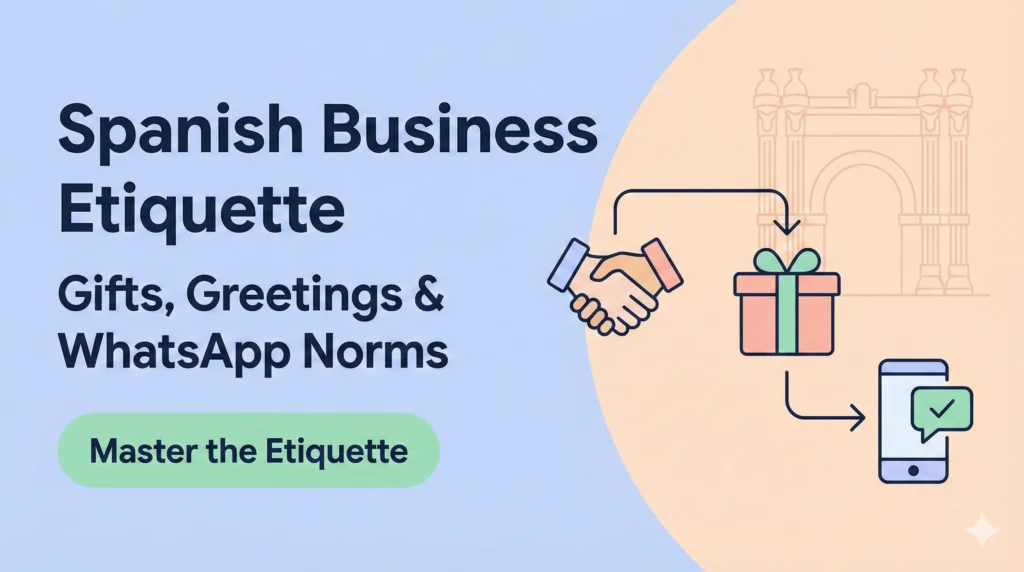
Spanish Business Etiquette: Gifts, Greetings, and WhatsApp Norms
Disclosure: This article contains affiliate links. If you buy through them, we may earn a commission at no extra cost to you. Read our full disclosure.
Mastering Spanish business etiquette requires understanding that relationships often outweigh rigid protocols. This guide explores the nuances of the “dos besos” greeting, the professional use of WhatsApp, appropriate gift-giving strategies, and how to navigate the long business lunch to build lasting professional trust.
The Art of the Greeting
The first few seconds of any business interaction in Spain are critical. The physical greeting sets the tone for the relationship, and getting it wrong can create an awkwardness that is hard to shake.
Handshakes vs Kisses
The most common source of anxiety for foreigners is the dos besos (two kisses). Here is the definitive rulebook for the professional environment:
- Men greeting Men: Always a firm handshake. Direct eye contact is essential. If you know each other very well or are family friends, this might evolve into a hug (abrazo) with a back slap, but in a business context, the handshake is the standard.
- Women greeting Women: In a purely corporate setting (e.g., a boardroom meeting with strangers), a handshake is perfectly acceptable and professional. However, in slightly more relaxed business settings or after you have met once, two kisses (one on each cheek, starting with the right) is the norm.
- Men greeting Women: This is the trickiest interaction. In a formal first meeting, a handshake is standard. However, the threshold for switching to dos besos is very low. If the atmosphere is friendly, or if you are being introduced by a mutual friend, the two kisses are common.
- The Strategy: Let the woman lead. If she offers her hand, shake it. If she leans in, offer your cheek. Do not physically kiss the cheek; touch cheeks and make a kissing sound.
Tú vs Usted
The Spanish language has two forms of “you”: the informal tú and the formal usted.
- Usted: Use this initially with anyone senior to you, older than you, or in government/legal settings. It signals respect.
- Tú: Spain has become much more informal in the last decade. In creative industries, startups, or among peers of the same age, tú is often used from the start.
The Transition: usually, the senior person will say, “Por favor, tutéame” (Please, treat me as ‘tú’). Once this permission is granted, you must switch immediately. Continuing to use usted after being invited to use tú can create distance and imply you don’t want to build a relationship.
Mastering these linguistic nuances is often just as important as your CV. If you are preparing for an interview and want to know how these formalities apply in a hiring context, review our guide on Finding a Job in Spain: CV, Interviews, and Networking.
WhatsApp as a Business Tool
In many countries, texting a client on their personal number is considered a breach of professional boundaries. In Spain, it is standard operating procedure.
The Blurring of Lines
WhatsApp is the lifeblood of Spanish communication. It is used for everything from scheduling dentist appointments to closing real estate deals. You should expect clients, bosses, and colleagues to contact you via WhatsApp.
- Availability: The “Blue Tick” anxiety is real. While you are not legally obligated to reply to work messages after hours, the cultural expectation is often that you will acknowledge the message, even if just to say “I’ll look at this tomorrow.”
- Profile Pictures: Because you use the same app for work and friends, your profile picture is visible to your boss. Ensure it is somewhat presentable. A photo of you at a beach party might be fine, but keep it within reason.
Voice Notes (Audios)
Spaniards love voice notes. It allows for tone and nuance that text lacks.
- The Norm: It is acceptable to send a 30-60 second voice note to a colleague to explain a complex idea.
- The Etiquette: Do not send a 5-minute podcast. If it takes that long, call them. Always ask “¿Te puedo llamar?” (Can I call you?) via text before making a voice call, as unplanned calls are sometimes seen as interruptions.
Emojis in Business
In the UK or Germany, using a “winking face” emoji in a business email might get you fired. In Spain, using emojis in WhatsApp business chats is common to soften the tone. A “thumbs up” or “handshake” emoji is perfectly professional on this platform.
Meeting Dynamics and Time Management
The stereotype of the “lazy Spaniard” who is always late is outdated and offensive. However, the Spanish conception of time is different from the Anglo-Saxon one. It is polychronic, meaning they view time as fluid and relationships as more important than the clock.
Punctuality
- Arrival: You should be on time. Arriving 5 minutes early is good. Arriving 10 minutes late is usually forgiven with a quick apology, but consistently being late is disrespectful.
- The Start: Meetings often start with 5-10 minutes of “small talk” (charla). Do not try to rush this. Asking about the weekend, football, or the family is not “wasting time”; it is “investing in the relationship.”
- The End: This is where the fluidity comes in. Meetings often run over. If you have a hard stop at 11:00 AM for another call, state this at the beginning. Otherwise, the conversation will flow naturally until it is finished, not when the calendar invite says it should end.
Interruptions
In some cultures, interrupting is rude. In Spain, it often signals engagement. If you are presenting and someone interrupts you to ask a question or add a point, it means they are listening and interested. A silent room is often a worse sign than a noisy one.
The Hierarchy
Despite the informality of tú and WhatsApp, Spanish companies can be quite hierarchical. Decisions often flow from the top down. You might spend weeks negotiating with a middle manager who agrees with everything you say, only to find out they cannot sign the check without the Jefe (Boss). Identifying the decision-maker early is crucial.
If you are navigating these dynamics as a freelancer or a contractor, understanding how to formalize your relationship is key. Check our guide on Getting a Spanish Social Security Number for Work: Steps to ensure your administrative footing is solid before you start negotiating contracts.
The Business Lunch (La Comida)
The business lunch is arguably the most important meeting of the day. It is rarely a quick sandwich at the desk.
Timing and Duration
- Start: Lunch typically starts between 14:00 and 14:30.
- Duration: Expect it to last 2 hours minimum.
- Content: The first hour (starters and main course) is usually for building rapport. You talk about travel, food, culture, or current events. Business is usually discussed during the coffee or dessert phase. Bringing out a laptop or spreadsheets during the soup is a faux pas.
Alcohol
Having a glass of wine or a beer with lunch is socially acceptable and common, though less mandatory than in the past. If your host orders wine, feel free to join them. If they stick to water, you should probably do the same. Getting drunk, however, is strictly unprofessional.
The Bill
The unwritten rule is simple: Whoever invites, pays.
If you invited the client to lunch, you must pay the bill.
- Fighting for the Bill: It is polite to make a small gesture to pay, but if the host insists, let them pay. Do not split the bill (pagar a medias) in a business context unless it is a casual lunch with coworkers.
Sobremesa
This is the period after the meal when the plates are cleared, coffee is served, and conversation continues. This is often where the real agreements are made. Do not rush off immediately after eating.
Gift Giving Protocol
Gift giving in the Spanish business world is practiced but requires subtlety. It is less formal than in Japan or China but more common than in the US.
When to Give
- Conclusion of a Deal: A small gift to celebrate a signed contract is appropriate.
- Christmas: This is the big one. Companies often send Cestas de Navidad (Christmas Hampers) to clients and partners.
- Hospitality: If you are invited to a business partner’s home for dinner (a rare honor), bring a high-quality bottle of wine, chocolates, or flowers (avoid chrysanthemums, which are for funerals).
What to Give
- Quality over Cost: The gift should not be extravagantly expensive, as this can look like a bribe. It should be high quality.
- Company Swag: High-quality pens, notebooks, or tech accessories with your logo are safe.
- Regional Specialties: If you are visiting from your home country, bringing a specialty from your region (e.g., Scottish whiskey, Belgian chocolate) is highly appreciated.
- Avoid: Cheap items or overly personal items (perfume/clothing) for the opposite sex.
Dealing with “The Bribe” Question
Spain has strict anti-corruption laws. Corporate compliance departments often have limits on the value of gifts employees can accept (e.g., nothing over €50). If a contact refuses your gift citing compliance rules, do not insist.
Dress Code and Appearance
Spain is a fashion-conscious country. Appearances (la imagen) matter.
- Men: In banking, law, and consulting, a dark suit and tie are still standard, though the tie is disappearing in summer. In other sectors, “smart casual” means high-quality trousers, a button-down shirt, and a blazer. Jeans are risky unless you are in tech.
- Women: Professional business attire. High-quality fabrics and well-fitted clothes are valued.
- Shoes: Keep them polished. People notice shoes in Spain.
- Summer: It gets incredibly hot. Short sleeves are acceptable in casual offices, but in formal meetings, men usually wear long sleeves and tolerate the heat (or rely on A/C). Shorts are never acceptable in a business context, even in August.
Regional Differences
Spain is not a monolith. Business culture varies by region.
- Madrid: More formal, more hierarchical, and more political. Business lunches are long.
- Barcelona (Catalonia): Generally more “European.” Punctuality is stricter, meetings are more direct, and lunches might be shorter. There is a strong emphasis on “seny” (common sense/pragmatism).
- Basque Country: serious, direct, and very word-is-bond. Trust takes longer to build, but once established, it is ironclad.
- Andalusia: More relationship-driven. Initial meetings may be very chatty. Do not mistake the warmth for a lack of professionalism.
Business Hours and The Schedule
Understanding the Spanish clock is vital to avoid calling someone while they are napping (which they aren’t) or eating (which they definitely are).
The Standard Day
- Morning: 9:00 AM – 14:00 PM.
- Lunch: 14:00 PM – 16:00 PM. (Many offices maintain a shorter break now, but 14:00 is the sacred start time).
- Afternoon: 16:00 PM – 19:00/20:00 PM.
Summer Hours (Jornada Intensiva)
In July and August, many companies switch to “Intensive Hours.”
- Schedule: 8:00 AM – 15:00 PM.
- Afternoon: Everyone goes home. Do not try to schedule a meeting at 4:00 PM in August.
Understanding these seasonal shifts is crucial for planning projects. If you are moving to Spain and planning your arrival, knowing these timelines helps you avoid the dreaded “August shutdown.” For more on how to plan your move timeline, see Spain Relocation Checklist: First 30 Days for New Residents.
Negotiation Style
Spanish negotiators are generally tough but look for a win-win. They are rarely aggressive or confrontational in the way a New York negotiator might be.
- Emotion: Expect some emotion. If they are passionate, it means they care.
- Patience: Decisions take time. Pushing for a “quick close” often backfires and breeds suspicion.
- The Contract: The contract is important, but the relationship is more important. Spaniards may try to renegotiate terms later if circumstances change, expecting you to be flexible because “we are partners.”
Comparison Table: Spain vs. Anglosphere Business Norms
| Feature | Spain | USA / UK |
| Greeting | Handshake or Two Kisses (gender dependent) | Handshake |
| Punctuality | Flexible (5-10 mins late is OK) | Strict |
| Lunch | 2 Hours, Full Meal, Relationship focus | 30-60 Mins, often functional |
| Personal Space | Close proximity, frequent touching (arm/back) | Larger distance, no touching |
| Communication | WhatsApp (Voice notes, emojis allowed) | Email / Slack / Teams |
| August | Business shuts down (Jornada Intensiva) | Business as usual |
| Decision Making | Hierarchical / Top-Down | Varies, often delegated |
Digital Etiquette and Privacy
While WhatsApp is used, privacy laws (GDPR) are strict in Europe.
- Data Protection: Be careful about adding people to WhatsApp groups without their permission.
- Email Tone: Emails often start formally (Estimado/a) and end formally (Saludos cordiales), but quickly drop to Hola and Un abrazo as trust builds.
- Response Time: There is an expectation of quick responses on WhatsApp, but email can be slower.
If you are setting up your own business infrastructure to handle these communications, ensuring you have the right internet and mobile setup is the first step. Review Setting Up Your Life in Spain: Utilities, Internet, and Essentials to compare the best providers for business-grade connectivity.
Conclusion
Succeeding in the Spanish business world requires you to calibrate your internal clock and your social radar. It requires accepting that a two-hour lunch is not time wasted, but trust earned. It means embracing the fact that your lawyer might send you a WhatsApp voice note, and that you might have to kiss a potential business partner on the cheek.
The key takeaway is that in Spain, business is human. If you hide behind your laptop and rely solely on emails and spreadsheets, you will struggle. If you step out, share a meal, learn the language of confianza, and respect the local customs, you will find that Spanish business partners are among the most loyal and dedicated in the world.
References
Primary sources (official)
- ICEX España Exportación e Inversiones (Business Guide): https://www.icex.es/
- Ministry of Industry, Trade and Tourism: https://www.mincotur.gob.es/
- Chamber of Commerce of Spain (Cámara de España): https://www.camara.es/
- Official State Gazette (Labor Regulations): https://www.boe.es/
Other helpful sources
- Santander Trade (Business Practices in Spain): https://santandertrade.com/en/portal/establish-overseas/spain/business-practices
- Strong Abogados (Business Culture Guide): https://www.strongabogados.com/business-culture.php
Disclaimer
The information provided in this article is for educational and informational purposes only and does not constitute legal or professional business advice. Cultural norms can vary by region and industry. We recommend observing the specific dynamics of your workplace and consulting with local mentors or professionals for specific business situations.