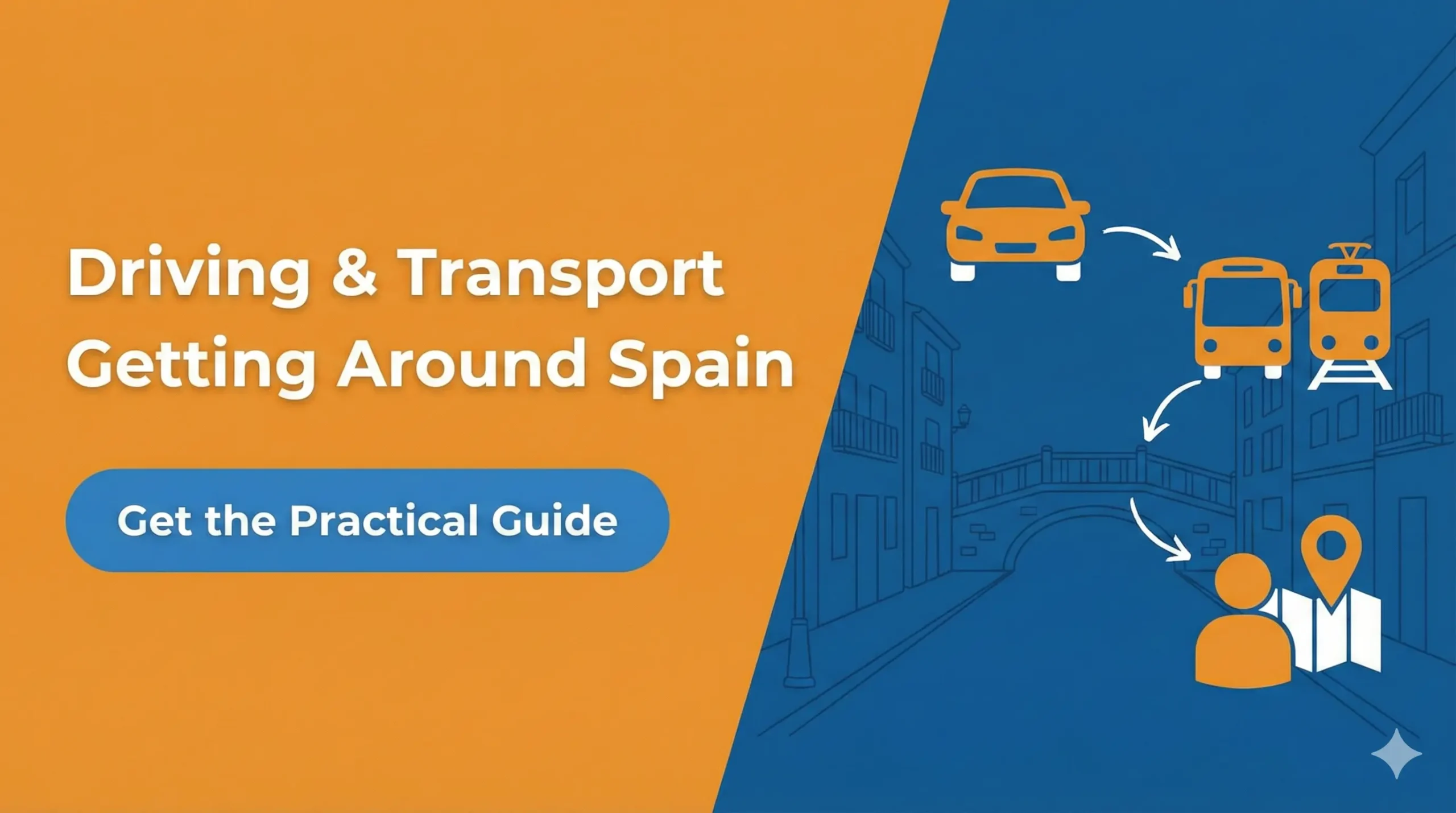
Driving, Transport, and Getting Around Spain: Practical Guide
Disclosure: This article contains affiliate links. If you buy through them, we may earn a commission at no extra cost to you. Read our full disclosure.
Navigating Spain is efficient thanks to world-class infrastructure, but it requires local knowledge. This guide covers everything from the high-speed AVE train network and regional bus systems to the complexities of driving rules, exchanging your license, and handling urban parking zones.
The Spanish Rail Network
Spain’s railway system is the jewel in its transport crown. Managed largely by Renfe (the state-owned operator) and Adif (the infrastructure manager), it is divided into three distinct tiers: high-speed, medium-distance, and commuter lines. Understanding the difference between these services is essential for budgeting and time management.
High Speed and Long Distance
The AVE network revolutionized travel in Spain. It allows you to travel from Madrid to Barcelona in 2.5 hours or Madrid to Valencia in under 2 hours. Historically, Renfe held a monopoly, but recent liberalization of the rail market has introduced competition, driving prices down significantly. You now have three major operators on the high-speed lines:
- Renfe (AVE & Avlo): The traditional operator. AVE is the premium service, while Avlo is the low-cost carrier with stricter luggage limits.
- Ouigo: A French operator offering low-cost, double-decker trains.
- Iryo: A consortium involving Italian Trenitalia, offering a more premium experience often at competitive prices.
When booking these tickets, dynamic pricing applies. A ticket bought three months in advance might cost €18, while a last-minute fare could exceed €100. If you are planning a cross-country trip, comparing these three providers is the best way to save money. For a deeper dive into the specific routes and booking strategies, we have a detailed breakdown in our article on Train Travel in Spain: High-Speed vs Regional Routes Explained.
Commuter Trains or Cercanias
In major metropolitan areas like Madrid, Barcelona (where they are called Rodalies), Valencia, and Bilbao, the commuter rail network is extensive. These trains connect the city center with suburbs and satellite towns. They are generally reliable, though strikes and delays can occur.
A crucial tip for long-distance travelers: If you buy an AVE or long-distance ticket with Renfe, it usually includes a “Combinado Cercanías” code. This code gives you a free commuter train ticket at both your origin and destination, allowing you to get from the main station to your final stop without paying extra.
Bus Travel
While trains get the glory, buses are the workhorses of Spanish transport. In many regions, especially in the north (Galicia, Asturias) and parts of Andalusia where rail coverage is sparser, buses are the only public transport option.
The dominant national operator is Alsa, which runs comfortable coaches with Wi-Fi and entertainment screens. Another major player is Avanza. For trips between smaller provincial capitals (e.g., Salamanca to Zamora), the bus is often faster and cheaper than the train, which might require a transfer in Madrid.
In cities, municipal buses are clean and efficient. You can pay with contactless cards on board in most major cities, or use a rechargeable transport card. If you are commuting daily, understanding the specific travel cards is vital to saving money; we cover the nuances of monthly passes and multi-trip discounts in our guide on Public Transport in Spain: Cards, Discounts, and Etiquette.
Driving in Spain
For those living in rural areas or wishing to explore the countryside, a car is indispensable. Spain has an excellent network of highways (autovías and autopistas). Autovías (labeled A-XX) are generally free expressways, while autopistas (labeled AP-XX) are often toll roads, though many tolls have been removed in recent years (such as on the AP-7).
The Driver License Situation
This is the most critical bureaucratic hurdle for new residents from outside the EU.
- EU/EEA Citizens: Your license is valid in Spain. However, if you become a permanent resident, you may eventually need to renew it under Spanish periods of validity (usually every 10 years up to age 65, then every 5).
- Non-EU Citizens (UK, USA, Canada, etc.): Your foreign license is typically valid for only six months from the date you acquire residency. After this grace period, it becomes invalid for driving in Spain.
Spain has exchange agreements with countries like the UK, South Korea, and most South American nations, allowing a direct swap. However, for US and Canadian citizens, no such agreement exists. This means you must go through the entire process of obtaining a Spanish license, including driving school, a theory exam, and a practical road test. For those staying long-term, it is essential to look into the specifics of Exchanging a Foreign Driver’s License in Spain: Eligibility and Steps well before your six-month grace period expires.
Roundabouts and Road Etiquette
Spanish driving culture is generally safe but has specific quirks. The most famous is the roundabout (rotonda). The rule is strict: you must exit from the right-hand (outer) lane. However, locals often use the outer lane to circle the entire roundabout, cutting off anyone trying to exit from the inner lane. As a defensive driver, assume the car in the outer lane is going to continue circling.
Tailgating is also common on highways. If you are in the left lane overtaking and see a car approaching rapidly from behind with their left indicator on, move over as soon as it is safe. It is an aggressive but standard signal that they want to pass. To avoid hefty penalties and understand the specific local behaviors, familiarize yourself with Driving in Spain: Road Rules, Fines, and What Surprises Expats.
Traffic Fines and Points System
Spain uses a points-based license system (carnet por puntos). You start with 12 points (8 for new drivers). Serious offenses deduct points; if you hit zero, you lose your license.
Common Fines (Multas)
- Speeding: Radar cameras are everywhere—fixed, mobile, and section control (calculating average speed over a distance).
- Mobile Phones: Holding a phone while driving (even if just looking at maps) carries a €200 fine and a loss of 6 points.
- Alcohol: The limit is 0.5 g/l (0.25 mg/l in air), which is lower than in the UK or US. Ideally, stick to zero.
If you receive a fine, you can check it on the DGT (Directorate-General for Traffic) website or app (miDGT). Paying within 20 days usually grants you a 50% discount on the monetary amount, though you waive the right to appeal.
Owning a Vehicle
Bringing a car from your home country is often more trouble than it is worth due to re-registration taxes and bureaucracy. Most expats choose to buy locally.
Buying a Car
The second-hand market in Spain holds value well, meaning used cars are often more expensive than you might expect. When buying, the key document is the transfer of ownership (transferencia), which involves paying a transfer tax (ITP). If you buy from a dealer, they handle this. If you buy from a private individual, you (or your gestor) must handle the paperwork at the traffic office. If you decide to purchase your own vehicle, the bureaucratic process of Buying a Car in Spain: Paperwork, Taxes, and Registration can be daunting, so having a professional assist you is often recommended.
Mandatory Inspections (ITV)
All cars over four years old must undergo a periodic technical inspection called the ITV (Inspección Técnica de Vehículos).
- Cars 4-10 years old: Every 2 years.
- Cars over 10 years old: Every year.
Driving with an expired ITV is a serious offense that can lead to fines and invalidate your insurance.
Car Insurance
In Spain, the car is insured, not the driver. This means other people can typically drive your car if they meet age/experience requirements set by the policy. Third-party liability (responsabilidad civil) is mandatory. Comprehensive coverage (todo riesgo) is common for newer cars. Before purchasing, you must understand the mandatory liabilities, which we detail in Car Insurance in Spain: Minimum Coverage and What to Compare.
Parking in Cities
Urban parking is a major challenge. Street parking is regulated by color-coded zones, usually managed by meters (parquímetros).
- Blue Zone (Zona Azul): Paid parking for everyone. Usually limited to 2-4 hours.
- Green Zone (Zona Verde): Prioritized for residents. Non-residents can park here but it is more expensive and time-limited (often 1-2 hours). Residents pay a small annual fee to park unlimitedly in their neighborhood.
If you park illegally, your car may be towed (grúa). You will find a triangular sticker on the curb with a phone number to call. Navigating the highways is one thing, but city centers have their own ecosystem of Parking in Spain: Resident Permits, Zones, and Fine Appeals that you must master to avoid constant tickets.
Ride-Sharing and Taxis
Taxis in Spain are heavily regulated and generally safe and reliable. They are easily identified (white with a red stripe in Madrid, black and yellow in Barcelona). You can hail them on the street if the green light is on.
Ride-sharing apps like Uber, Cabify, and Bolt operate in major cities. However, due to strikes and regulations designed to protect the taxi sector, their availability can fluctuate. In some cities, Cabify is more prevalent than Uber. There is also FreeNow, an app that allows you to book standard taxis digitally.
Low Emission Zones (ZBE)
A critical recent development is the introduction of Low Emission Zones (Zonas de Bajas Emisiones or ZBE). By law, all municipalities with over 50,000 inhabitants must establish restricted zones to improve air quality.
To enter these zones (like Madrid Central or ZBE Rondes de Barcelona), your car must display an environmental sticker (distintivo ambiental) issued by the DGT.
- Label 0 (Blue): Electric and plug-in hybrids. Unrestricted access.
- Label ECO (Green/Blue): Hybrids and gas.
- Label C (Green): Modern petrol/diesel.
- Label B (Yellow): Older petrol/diesel.
Cars without a label (generally pre-2000 petrol and pre-2006 diesel) are banned from entering these zones during working hours or entirely. If you have a foreign plate, you must register your car with the local authority to prove it meets emissions standards, as you cannot get a Spanish sticker.
Cycling and Micro-Mobility
Spain has embraced the electric scooter (patinete eléctrico) and cycling revolution. Cities like Valencia, Seville, and Barcelona have extensive bike lane networks.
- Helmets: Mandatory on interurban roads. In cities, it depends on local ordinances, but is mandatory for under-16s.
- Scooters: Must be ridden in bike lanes or on the road (never on sidewalks). Speed limited to 25 km/h. Insurance for scooters is becoming mandatory in an increasing number of cities.
Transport Comparison Table
| Feature | Train (High Speed) | Bus (Coach) | Car (Personal) | Car (Rental) |
| Cost | Medium/High (Variable) | Low | Medium (Fuel/Tolls) | High (Seasonal) |
| Speed | Very Fast | Slow | Fast | Fast |
| Flexibility | Fixed Schedule | Fixed Schedule | High | High |
| Luggage | Generous | Generous | Unlimited | Unlimited |
| City Access | Center to Center | Center to Center | Difficult (Parking/ZBE) | Difficult |
| Best For | City hopping (Madrid-BCN) | Rural towns / Budget | Exploring countryside | Day trips |
Conclusion
Getting around Spain is generally a pleasure. The investments made in infrastructure over the last few decades have created a system that is robust, modern, and accessible. For the expat, the challenge lies not in the lack of options, but in the administrative hurdles of legal driving and the nuances of urban restrictions.
By planning ahead—booking your AVE tickets early, understanding the parking zones, and ensuring your license is valid—you can navigate Spain with the confidence of a local. Whether you choose the relaxed pace of a regional bus or the freedom of the open road, the journey is often as rewarding as the destination.
References
Primary sources (official)
- Dirección General de Tráfico (DGT): https://www.dgt.es/
- Renfe (National Rail): https://www.renfe.com/
- Adif (Rail Infrastructure): https://www.adif.es/
- Aena (Airports): https://www.aena.es/
Other helpful sources
- Alsa (Bus Network): https://www.alsa.com/
- RACE (Royal Automobile Club of Spain): https://www.race.es/
- Ouigo Spain: https://www.ouigo.com/es/
Disclaimer
The information provided in this article is for educational and informational purposes only and does not constitute legal or professional advice. Traffic laws, low emission zone regulations, and driver’s license exchange agreements in Spain are subject to change. We recommend consulting with the ‘Dirección General de Tráfico’ (DGT) or a qualified ‘gestor’ for the most up-to-date regulations regarding your specific situation.