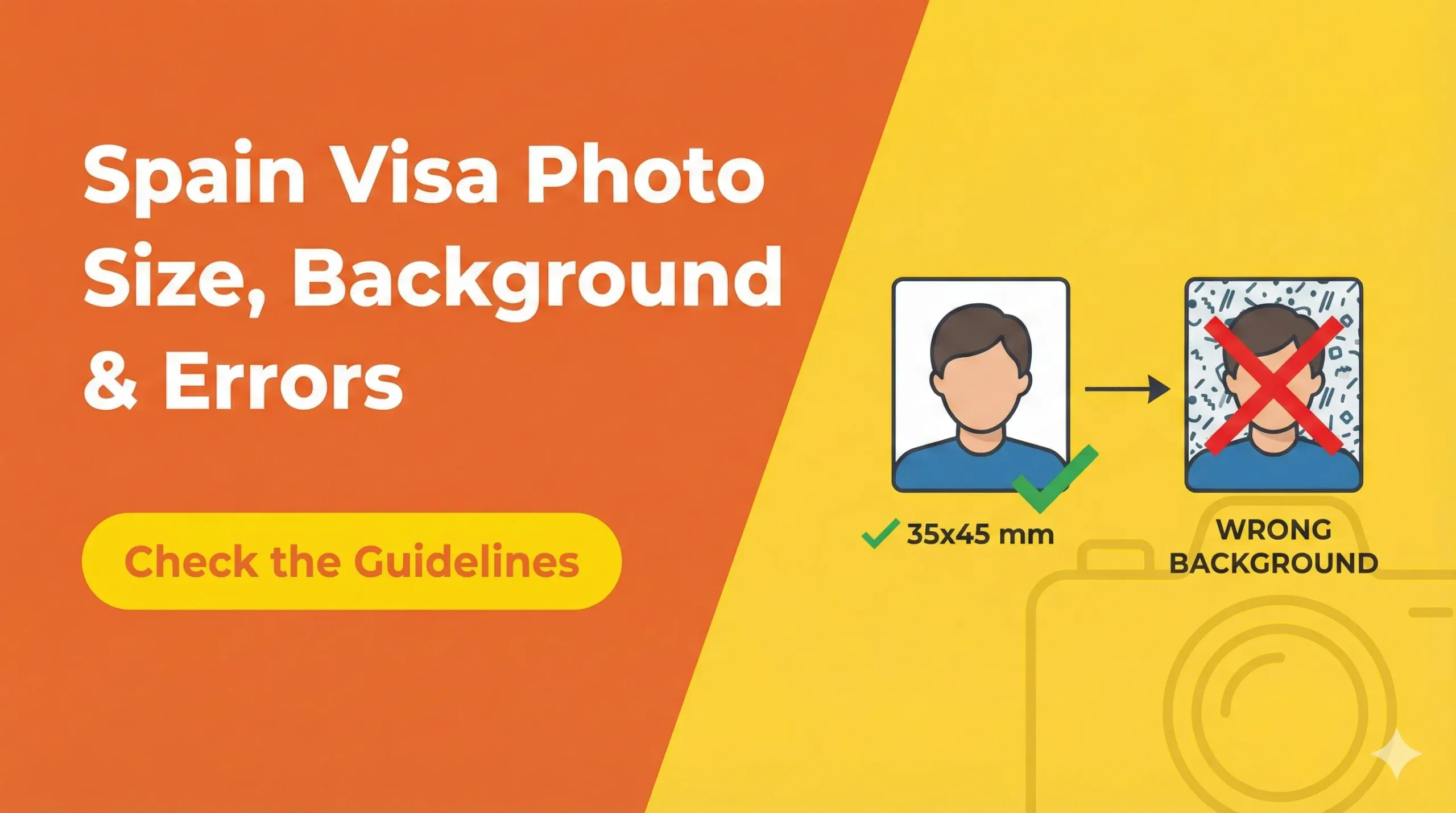
Spain Visa Photo Requirements: Size, Background, and Common Errors
A rejected photo is one of the most avoidable reasons for visa delays. This guide details the exact Spain visa photo specifications, including the mandatory ICAO dimensions, background rules, and the critical size difference between visa application photos and TIE card photos.
Disclosure: This post may contain affiliate links. We may earn a commission at no extra cost to you if you make a purchase through these links. Read full disclosure.
The Golden Standard: Dimensions and Format
The most fundamental requirement for your Spain visa photo is the size. Spain follows the standard Schengen dimension, which is distinct from the square 2×2 inch format used by the United States.
The 35mm x 45mm Rule
For your initial visa application (submitted to the Consulate or BLS/VFS center in your home country), your photo must measure exactly 35 millimeters in width by 45 millimeters in height.
- Width: 35mm
- Height: 45mm
- Format: Portrait (vertical)
Do not attempt to crop a larger photo down to this size with scissors at home. The proportions of the head relative to the frame are just as important as the outer dimensions. If you submit a US-style 2×2 inch photo, it will likely be rejected because it does not fit the scanning zones on the Schengen visa sticker.
Head Size and Positioning
The composition of the photo is mathematically defined. Your face must be the dominant element of the image.
- Face Coverage: The head (measured from the chin to the top of the head, including hair) must occupy 70% to 80% of the total photograph.
- Measurement: In practical terms, your head should be between 32mm and 36mm high within the 45mm frame.
- Centering: Your head must be perfectly centered. You cannot be looking over your shoulder or tilting your head to the side (portrait style). You must face the camera directly, with your face and shoulders visible and balanced.
If your face is too far away (taking up only 50% of the photo), the biometric facial recognition software used by border control cannot map your features accurately. Conversely, if you are too close (zoomed in so your hair is cut off significantly), it will also be invalid.
Recentness
The photo must be recent, which is legally defined as being taken within the last 6 months.
- The “Look” Test: If you have undergone a significant change in appearance—such as dyeing your hair a drastically different color, growing a full beard, or losing/gaining a significant amount of weight—you should take a new photo, even if your old one is technically less than six months old.
- Reusing Photos: Do not use the same photo that is in your passport if your passport was issued three years ago. The consular officer will look at your passport bio page, look at your visa photo, and immediately know the photo is outdated.
Background and Lighting: The Canvas Matters
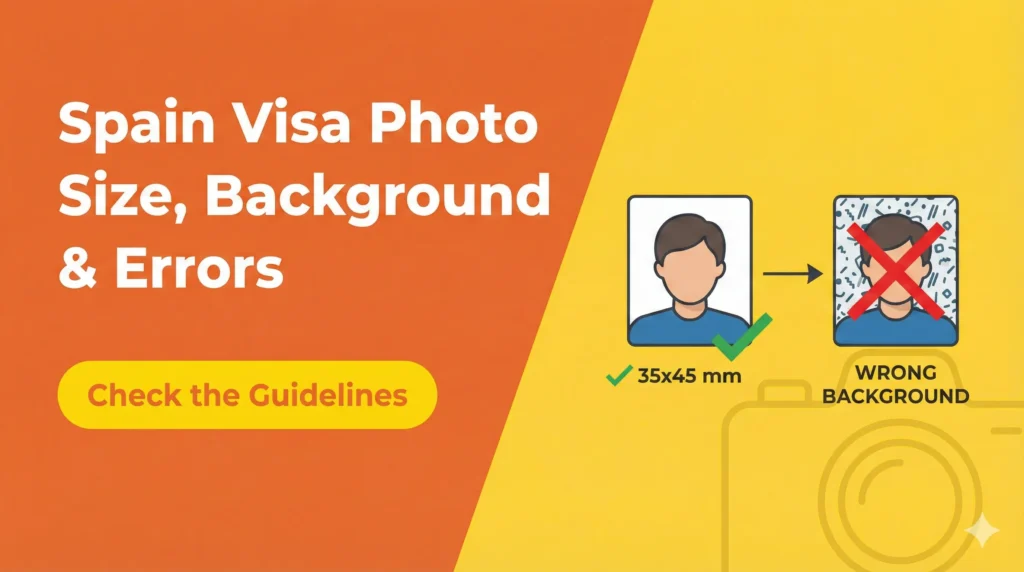
The background is one of the most common reasons for rejection. While some countries allow “light blue” or “light gray,” Spain is quite specific.
The “Plain White” Requirement
The background must be plain white or extremely light-colored.
- No Patterns: There should be no wallpaper patterns, door frames, or vegetation visible behind you.
- No Shadows: This is critical. You cannot have a shadow cast on the wall behind you (which often happens if you stand too close to the wall) or shadows on your face (which happens with overhead lighting). The background must be uniformly illuminated.
Lighting Quality
- Even Exposure: Your face must be evenly lit. “Rembrandt lighting” or artistic shadows that obscure one side of the nose or eye are strictly forbidden.
- Red Eye: There can be no red-eye effect. If you use a flash and get red eyes, retake the photo; do not attempt to fix it with digital editing tools, as this alters the biometric data.
- Skin Tone: The lighting must show your natural skin tone. Photos that are overexposed (making you look ghostly white) or underexposed (making you look dark and grainy) will be rejected.
Facial Expression: The “Neutral” Look
This is not a social media profile picture. You are not trying to look attractive; you are trying to be identifiable by a machine.
The Neutral Expression
You must maintain a neutral facial expression.
- No Smiling: You cannot smile, frown, or show your teeth. Your mouth must be completely closed.
- Eyes Open: Your eyes must be open, level, and looking directly into the camera lens. Squinting or looking away is not permitted.
Hair and Visibility
- Bangs/Fringe: If you have long bangs, you must sweep them aside so they do not cover your eyebrows or eyes. The “oval of the face” must be clearly visible.
- Ears: While not strictly mandatory in every single ICAO interpretation, it is highly recommended to tuck your hair behind your ears. Spain’s requirements often mention the face should be visible from “ear to ear” or that the “oval of the face” must be clear.
Attire and Accessories: What to Wear
Glasses
This is a contentious topic. While ICAO rules technically allow prescription glasses if the eyes are visible, the practical reality at Spanish consulates is stricter.
- Recommendation: Remove your glasses. It is the safest option.
- The Rules: If you must wear them for medical reasons, the frames cannot be thick, they cannot cover any part of your eyes, and there can be zero glare or reflection on the lenses. Tinted glasses or sunglasses are absolutely forbidden.
- Risk: If there is even a tiny reflection of the camera flash on your pupil, the photo is invalid. Why risk your visa for a pair of frames?
Head Coverings
- Religious/Medical Exceptions: Head coverings are permitted only for religious or medical reasons.
- Visibility Rules: Even with a religious head covering (like a hijab), the face must be visible from the tip of the chin to the top of the forehead, and both edges of the face (left and right) must be clearly shown. The covering cannot cast a shadow on the face.
- Hats/Caps: Baseball caps, beanies, or fashion headwear are strictly prohibited.
Uniforms and Clothing
- No Uniforms: You should wear normal street clothes. Do not wear military or professional uniforms unless it is for a specific diplomatic visa class where required.
- Contrast: Avoid wearing a white shirt against the white background, as your shoulders might disappear, making you look like a floating head. Wear a dark or colored top to create contrast.
The TIE Card “Gotcha”: Size Confusion
This is arguably the most important section for those moving to Spain long-term. There is often a difference between the photo you submit for your visa (at the consulate) and the photo you submit for your TIE (foreign identity card) once you arrive in Spain.
Visa vs. TIE Dimensions
- Visa Application: As stated, this is strictly 35mm x 45mm. You submit this to the consulate to get the sticker in your passport.
- TIE Card (Tarjeta de Identidad de Extranjero): When you arrive in Spain and go to the National Police station for fingerprinting, you need to bring a new photo. While many police stations will accept the standard 35x45mm photo and crop it, the official size for the carnet (card) itself is often cited as 26mm x 32mm (the standard Spanish “carnet” size).
Why this matters: If you go to a Spanish photo booth (fotomatón) in a metro station or shopping mall, you will often see an option for “Carnet.” This produces the smaller 26x32mm photos.
- For the Police Station (TIE): The “Carnet” size (26x32mm) is specifically designed for the ID card. However, most extranjería offices are equipped to handle the 35x45mm and crop it.
- Safe Bet: When you go to your TIE appointment, bring a standard 32x26mm photo if you can, but having a 35x45mm backup is wise. Most importantly, ensure it has a white background. Some older Spanish ID photos used to allow grey, but for foreigners (TIE), white is the standard.
Once you successfully navigate the visa process, you will eventually need to understand the next steps for your physical card. For a detailed breakdown of that process, see our guide on How to Get the TIE Card in Spain: Fingerprints, Fees, and Pickup.
Requirements for Babies and Children
Photographing infants is notoriously difficult, but the Spanish authorities grant very little leniency regarding the technical quality, even if they are more forgiving about the “neutral expression.”
Key Rules for Minors
- Eyes Open: The baby’s eyes must be open.
- No Support Visible: If you are holding the baby, your hands, arms, or body cannot be visible in the photo. A common trick is to drape a white sheet over a car seat or lie the baby down on a white sheet (ensuring no shadows).
- No Toys/Pacifiers: The child cannot have a pacifier in their mouth or be holding a toy near their face.
- One Person: Only the child can be in the photo. No siblings or parents.
If you are moving as a family, you will likely be handling multiple applications at once. To ensure you don’t miss any other critical documents for your children, it is worth reviewing the Spain Visa Checklist: What to Do Before You Fly.
Digital vs. Printed Photos
Depending on how you apply, you may need physical copies or digital files.
Physical Photos (Paper Application)
- Paper Quality: Photos must be printed on high-quality photo paper. You can choose matte or glossy, though matte is often preferred as it reduces glare and fingerprints.
- Condition: The photos cannot be creased, stapled across the face, or have ink marks. Glue them gently to the application form only if instructed; otherwise, use a paperclip or let the consular staff handle it.
Digital Photos (Online Applications)
Some consulates now allow partial online submissions.
- Resolution: The image must be at least 600 dpi (dots per inch) when scanned.
- File Size: Typically, the file should be under 120 KB for uploads, though this varies by the specific portal.
- Format: JPG or JPEG is the standard.
Where to Get Your Photos Taken
Don’t try to take a selfie. Selfies distort facial features due to the wide-angle lenses on smartphones and are almost always rejected.
- Professional Studios: This is the safest option. Tell the photographer you need a “Schengen Visa” or “Spain Visa” photo (35x45mm). They usually know the drill.
- Photo Booths (Spain): If you are already in Spain (perhaps applying for a renewal or a student extension), you can use the fotomatón machines found in bus and metro stations. Look for the button that says “Carnet” or “DNI/Pasaporte.”
- Pharmacies/Post Offices (UK/US): In the UK, Snappy Snaps or Timpson are reliable. In the US, CVS or Walgreens can do it, but warning: You must explicitly tell them “35mm by 45mm.” If they print the standard US 2×2 inch square, you will have to cut it, and the head proportions might be wrong.
Common Errors Summary Table
To help you troubleshoot before you submit, here is a breakdown of the most frequent reasons for photo rejection.
| Error | Why it fails | The Fix |
| The “Instagram” Smile | Smiling distorts facial muscles and eyes, confusing biometric scanners. | Keep a neutral, “bored” expression. Mouth closed. |
| The Grey Wall | Background is not pure white, reducing contrast. | Use a dedicated white backdrop or a professional studio. |
| The “Floating Head” | Wearing a white shirt against a white background makes edges hard to define. | Wear a dark blue, black, or red shirt. |
| Old Photos | You look different than you did 7 months ago. | Take a new photo every time you apply for a new visa. |
| Glass Glare | Flash reflects off glasses, obscuring the pupil. | Remove glasses entirely. It is safer. |
| Bad Crop | Face is too zoomed in or too far away. | Ensure head takes up 70-80% of the vertical height. |
| Hair Over Eyes | Bangs cover eyebrows or eyes. | Pin bangs back. Biometrics need to see the eyebrows. |
Why Accuracy Costs You Money
It might seem trivial to worry about millimeters, but a rejected photo usually means a rejected application appointment. In many consulates, if your documents are incomplete (including the photo), you are sent away to book a new appointment. Considering the difficulty of getting appointments—a topic we cover in our guide on How to Book a Cita Previa for Extranjería in Spain (Step-by-Step)—this can delay your travel plans by weeks.
Furthermore, visa fees are generally non-refundable. If your application is processed and then denied because the photo didn’t meet ICAO standards, you have lost your application fee. For a family of four, that is a significant sunk cost. You can check the current costs in our breakdown of Spain Visa Fees and Government Charges: What to Budget.
Digital Nomad Specifics
If you are applying for the Digital Nomad Visa, the process is slightly more digitized, especially if applying from within Spain via the UGE (Unit of Large Companies and Strategic Collectives).
- Digital Upload: You will likely need a high-resolution digital scan of your photo to upload to the Ministry’s platform.
- Same Rules Apply: Just because it is digital does not mean you can use a casual webcam shot. It must still be a scanned version of a compliant 35x45mm passport photo.
If you are in the middle of this specific application process, ensure you have all your other documents aligned by reading our post on the Spain Digital Nomad Visa: Requirements, Documents, and Timeline.
Final Checklist Before You Print
Before you head to your appointment, hold your photo up against this checklist:
- Measure it: Is it exactly 35mm wide and 45mm high?
- Check the age: Is it less than 6 months old?
- Check the background: Is it stark white?
- Check the expression: Is your mouth closed and are your eyes looking at the camera?
- Check for shadows: Is there a dark shadow behind your head?
If you check all these boxes, you are one step closer to your Spanish residency.
References
Primary sources (official)
- BLS International (Official Service Provider for Spain): https://india.blsspainvisa.com/assets/pdf/english/general-instructions.pdf
- Ministry of Foreign Affairs, European Union and Cooperation (Schengen Visa): https://www.exteriores.gob.es/Consulados/mumbai/en/ServiciosConsulares/Paginas/Consular/Visados-Schengen.aspx
- VFS Global (ICAO Standards): https://visa.vfsglobal.com/one-pager/belgium/uae/pdf/photo-specification.pdf
- Spanish Consulate London (Digital Nomad Visa): https://www.exteriores.gob.es/Consulados/londres/en/ServiciosConsulares/Paginas/Consular/Digital-Nomad-Visa.aspx
Other helpful sources
- Atlys (Photo Tool & Guide): https://www.atlys.com/tools/spain-visa-photo-maker
- Photopassport.app (TIE vs Visa Sizes): https://photopassport.app/en/requirements/Spain
Disclaimer
The information provided in this article is for educational and informational purposes only and does not constitute legal or government advice. Visa requirements, including photo specifications and dimensions, are subject to change by the Spanish Ministry of Foreign Affairs and individual consulates. While we strive to keep this information up to date for 2026, you should always verify the specific requirements with the official BLS/VFS website or the Spanish Consulate in your jurisdiction before submitting your application.