How to Pay Bills in Spain: Direct Debit, Cash, and Online Portals
Disclosure: This article contains affiliate links. If you buy through them, we may earn a commission at no extra cost to you. Read our full disclosure.
Arriving home to shut-off electricity because a foreign bank transfer bounced is a uniquely terrifying expat initiation. Some utility companies quietly reject non-Spanish IBANs without notifying the customer, which can leave a household without power over a freezing weekend. This guide demystifies the exact methods for paying rent, utilities, and taxes in Spain so you never miss a deadline.
The Dominance of Domiciliacion Bancaria
In many Anglo-Saxon countries, paying bills is a highly manual, somewhat flexible process. You log into a web portal on the first of the month, type in your credit card number, or perhaps mail a physical check to your landlord. When you move to Spain, you must completely unlearn this behavior. The entire Spanish financial ecosystem runs on extreme automation.
Why Direct Debit is Non Negotiable
In Spain, the concept of manually paying your monthly recurring bills is practically non-existent. Landlords, utility companies, internet providers, and gyms universally operate on a system called domiciliación bancaria (direct debit). When you sign a contract for a new apartment or a mobile phone plan, you do not agree to send them money; you legally grant them the right to reach directly into your checking account and pull the money out on a specific day.
This system removes the administrative burden of chasing down late payments. For the expat, it provides a massive convenience factor, ensuring you never accidentally forget to pay your water bill while traveling. The automated system will attempt to pull the funds on the exact contracted date, utterly indifferent to your current balance. To understand exactly how these monthly expenses stack up, you should review our comprehensive breakdown in Utility Costs in Spain: Electricity, Gas, Water, and Internet.
Setting Up Your SEPA Mandate Correctly
To grant a company the legal right to pull funds from your account, you must authorize a SEPA Direct Debit Mandate (Mandato SEPA). SEPA stands for the Single Euro Payments Area, which standardizes electronic payments across Europe.
When you sign up for electricity or gym membership, you will be handed a physical or digital SEPA mandate form. You must provide your full name, your Spanish identification number (NIE or TIE), and your bank account’s International Bank Account Number (IBAN). Once you sign this document, the company sends it to their bank, which communicates with your bank to establish the automated bridge.
The Hidden Danger of Bounced Payments
While the SEPA system offers convenience, it is utterly unforgiving if your account lacks sufficient liquid funds on the exact day a bill is presented. If an electricity company attempts to pull €80 and you only have €70 in your account, the transaction will not partially clear. It will bounce entirely.
Bounced payments (recibos devueltos) trigger a cascade of highly stressful, expensive consequences. First, your bank will often charge you a penalty fee for the failed transaction. Second, the utility provider will immediately apply a late payment surcharge to your account. Unlike in the US or UK, where you might receive several friendly warning letters, Spanish utility companies move with terrifying speed. If a bill is not manually settled within a strict grace period (often just a few days), they will dispatch a technician to physically cut off your power or water.
Navigating IBAN Discrimination as an Expat
The reliance on direct debit introduces the single most infuriating administrative roadblock for new arrivals in Spain: the widespread, illegal practice of IBAN discrimination.
The Illegal Practice of Rejecting Foreign Accounts
Under European Union law, specifically the SEPA regulation, any company operating within the Eurozone is strictly, legally required to accept any valid SEPA-compliant bank account for a direct debit. It should not legally matter if your IBAN starts with FR (France), DE (Germany), IE (Ireland), or ES (Spain).
In reality, the archaic legacy software utilized by Spanish municipal water monopolies, regional gas providers, and independent landlords frequently flat-out rejects foreign IBANs. If your account number does not begin with “ES”, their computer systems simply throw a validation error. You will sit in a utility office, citing EU law to a customer service representative, and they will simply shrug and tell you the computer won’t let them proceed.
Securing a Compliant Spanish IBAN
To completely and permanently bypass this horrific administrative friction, you must capitulate to the reality on the ground and secure a localized account. However, walking into a traditional Spanish high-street bank to open an account is an archaic nightmare of required physical appointments, massive language barriers, and predatory quarterly maintenance fees.
For expats who want to avoid the legacy banking headache entirely, utilizing a modern digital platform like N26 is a massive administrative lifesaver. By opening a dedicated account with N26, you instantly receive a recognized, official Spanish IBAN directly from your smartphone.
Because N26 operates as a fully licensed European bank but utilizes modern digital infrastructure, you get the coveted “ES” IBAN without having to buy the overpriced life insurance policies that legacy Spanish bank managers often try to force on foreigners. Linking your N26 account to your lease and your utility providers ensures your direct debits process flawlessly, preventing utility shut-offs and late rent penalties without you ever having to argue with a customer service representative again. If you are struggling with the basic documentation required to navigate local banking, read Opening a Bank Account in Spain as a Non-Resident for context.
Strategies to Fund Your Local Account
Once you have your localized Spanish IBAN set up to handle the automated barrage of monthly direct debits, you must ensure it remains properly funded. If your primary source of income is a remote salary paid in US Dollars, British Pounds, or Australian Dollars, you must move that money into Spain efficiently.
If you attempt to wire your living expenses from a foreign bank account to your Spanish account via a traditional SWIFT transfer, you will be financially crushed over time. Traditional legacy banks hide aggressive profit margins in terrible currency exchange rates and charge exorbitant international wiring fees. You lose capital before it even arrives in Spain.
To fiercely protect your utility budget and rent money, you must use a dedicated currency specialist like Wise. By executing your monthly living expense transfers through a Wise account, you bypass the legacy banking system entirely, securing the true, transparent mid-market exchange rate. You can use Wise to transfer a large chunk of capital into your Spanish N26 account once a quarter when exchange rates are highly favorable, eliminating daily anxiety about fluctuating currency markets. To understand how optimizing these transfers interacts with your annual budgeting, review Cost of Living in Spain: Budgeting for Expats.
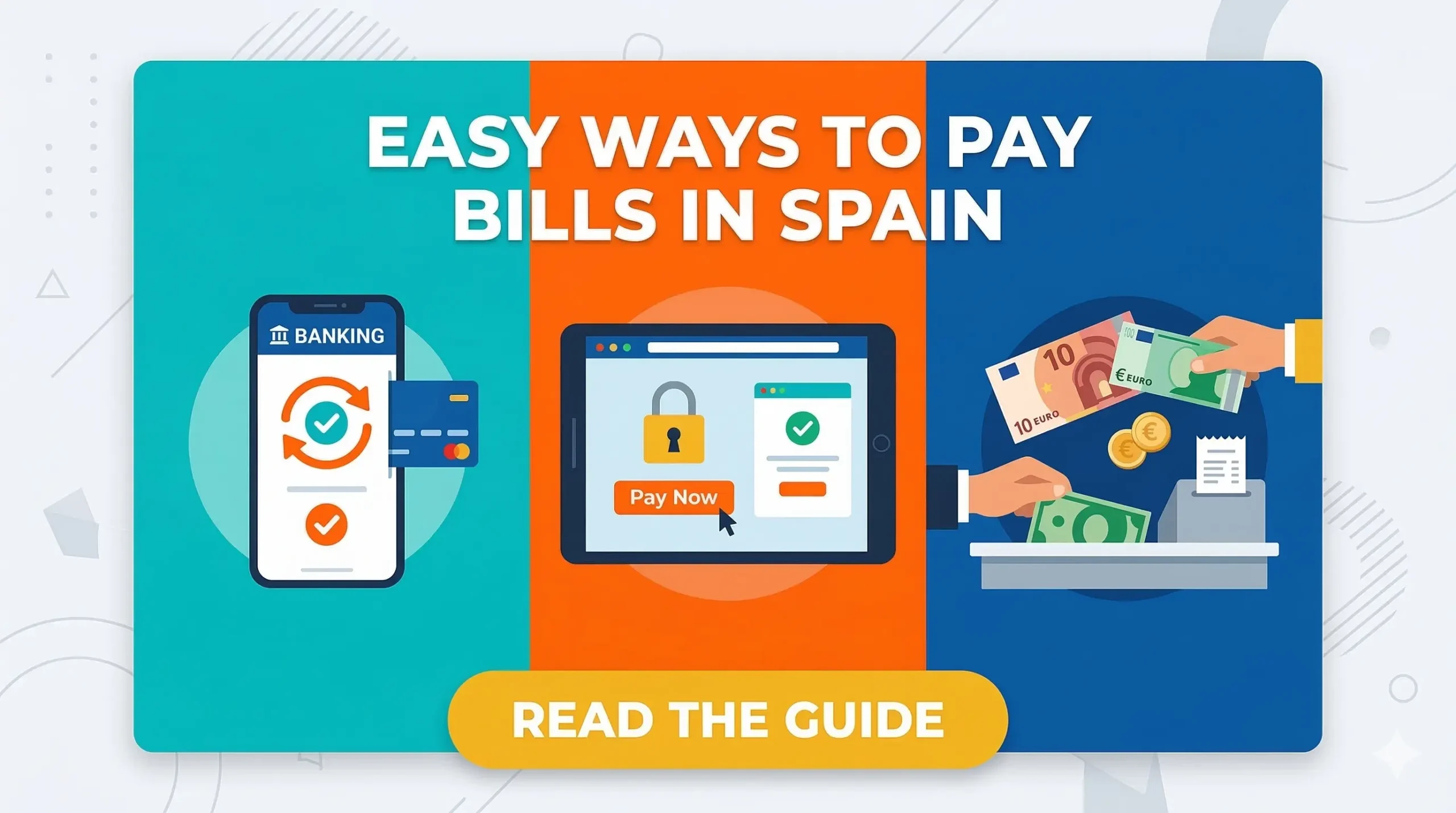
| Payment Method | Primary Use Case | Convenience Level | Expat Friction |
| Direct Debit (Domiciliación) | Rent, Electricity, Internet, Gyms | Extremely High | High (Requires Spanish “ES” IBAN to avoid rejection) |
| ATM Barcode Scanner | Traffic fines, missed utility bills | Medium | Medium (Requires finding a specific collaborating bank) |
| Online Payment Gateway | National taxes, municipal fees | High | High (Requires Digital Certificate or Cl@ve setup) |
| Physical Cash (Correos) | Small local taxes, non-urgent bills | Low | Low (Accessible to anyone, but strict legal limits apply) |
Manual Bill Payments Cash ATMs and Correos
While direct debit dominates recurring contracts, there are countless scenarios where you will be handed a physical paper bill that requires a manual, one-off payment. This frequently happens with municipal property taxes, unexpected traffic fines, or a utility bill that bounced and requires immediate manual settlement.
Using Bank ATMs to Scan Barcodes
If you receive an official government fine or a final notice utility bill in the mail, you will notice a large, highly standardized barcode printed at the bottom, alongside a CPR code (usually Cuaderno 60). This barcode is the key to settling the debt.
Spain has an incredibly efficient system where you can pay these bills directly at the ATM of collaborating banks, even if you do not hold an account with that specific bank. For example, if your municipal water bill explicitly lists CaixaBank or BBVA as a collaborating entity (entidad colaboradora), you can walk up to any of their street-facing ATMs.
You simply select the “Pay Bills and Taxes” (Pago de recibos e impuestos) option on the ATM screen, hold the physical barcode under the machine’s red laser scanner, and insert your debit card. The machine reads the exact amount owed, pulls the funds from your card, and prints an official receipt proving the debt is settled. This is the fastest way to manually pay a bill without dealing with human tellers or restricted banking hours.
Paying at the Post Office Correos
If you are uncomfortable navigating Spanish ATM menus or if you prefer to handle transactions with physical cash, the Spanish postal service (Correos) serves as a massive, national payment hub.
Almost all official municipal taxes, such as the Impuesto sobre Bienes Inmuebles (IBI property tax) or the Tasa de Basuras (trash collection fee), can be paid over the counter at any local Correos branch. You simply walk in, take a ticket, hand the teller the physical bill, and hand them your debit card or cash.
Correos charges a nominal processing fee (usually around two euros) for this service, but it provides immense peace of mind. You walk out with a physically stamped document proving that the government has received your payment, which is invaluable if a bureaucratic error later attempts to claim you defaulted. If you are navigating the complex web of buying or renting property that generates these municipal taxes, review Renting in Spain: How to Budget for Deposits, Fees, and Utilities.
Cash Payment Caps and Anti Fraud Laws
While paying bills with cash at the post office or a bank teller is culturally acceptable for small amounts, expats must be hyper-aware of Spain’s incredibly strict anti-fraud legislation regarding physical currency.
To combat money laundering and tax evasion in the black market, the Spanish government legally prohibits cash transactions exceeding €1,000 where at least one party acts in a professional or business capacity. If your monthly rent is €1,200, it is highly illegal to hand your landlord an envelope of cash. If you attempt to pay a massive €1,500 property tax bill in cash at the bank, the teller will flatly refuse the transaction.
Online Payment Portals and Tax Agency Systems
As an expat living in Spain, your most stressful financial interactions will inevitably be with the government. Paying national income taxes, registering a freelance business, or settling a speeding ticket requires navigating a labyrinth of highly secure, deeply frustrating online portals.
Navigating Clave and Digital Certificates
You cannot simply navigate to the Spanish tax agency website, add a tax payment to a digital shopping cart, and check out as a guest using your credit card. The Spanish government requires absolute, undeniable cryptographic proof of your identity before they allow you to process financial transactions on their portals.
To pay taxes online, you must secure a Certificado Digital (Digital Certificate) or register for the Cl@ve system. A Digital Certificate is a secure file issued by the Spanish Royal Mint that installs directly into your computer’s web browser, acting as your unforgeable digital signature. Securing this file requires a Kafkaesque process of requesting a code online, physically visiting a registry office with your passport to prove your identity, and returning to the exact same computer to download the file.
Without this digital identity, you are completely locked out of the modern Spanish administrative state. You will not be able to pay your freelance quarterly taxes online, nor will you be able to access the municipal portals to pay your car registration. To ensure you don’t miss a critical tax deadline simply because you cannot log in, carefully follow the step-by-step setup instructions in Cl@ve and Digital Certificate: Accessing AEAT (Tax Agency) Online.
Paying Taxes via the AEAT Portal
Once you successfully authenticate your identity on the Agencia Tributaria (AEAT) portal, the actual mechanics of paying a tax bill are complex and highly specific. The system rarely allows you to simply type in a debit card number.
When your accountant files your quarterly tax return (such as the Modelo 130 for income tax prepayments or the Modelo 303 for VAT), the portal generates a payment demand. To settle this, you generally have two options. The easiest is domiciliación, where you authorize the tax agency to automatically debit your Spanish bank account on the final day of the tax season. However, this option requires you to file the tax forms several days before the absolute deadline.
If you miss the direct debit window, you must generate an NRC (Número de Referencia Completo). This is an archaic system where you must log into your Spanish bank’s specific portal, tell your bank exactly which tax model you are paying and the exact euro amount, and the bank instantly pulls the funds and issues you a secure 22-character cryptographic code (the NRC). To understand the rhythm of these filings, read Spanish Income Tax (IRPF) 101: Who Pays and When.
Using Payment Gateways for Municipal Fines
Unlike national income taxes, municipal fines and fees are generally handled by much friendlier, localized payment gateways. If you are caught by a speed camera, the Dirección General de Tráfico (DGT) will send a physical ticket to your registered address.
These tickets almost universally include a QR code and a link to a dedicated payment portal. Because the government aggressively incentivizes early payment to reduce administrative backlog, they usually offer a massive 50% discount if you pay the fine within the first twenty days of receiving the letter.
You can log onto the DGT portal, input the record number printed on the ticket, and pay the discounted amount instantly using a standard credit or debit card, completely bypassing the need for a Digital Certificate or an NRC code. Local town halls (Ayuntamientos) operate similar, user-friendly portals for paying local property taxes and trash collection fees, allowing expats to settle local debts with minimal friction.
Budgeting and Moving Money Across Borders
Successfully paying your bills in Spain requires more than just understanding the portals; it requires a sophisticated strategy for moving your wealth across international borders without slowly bleeding capital to the banking sector.
Escaping High Street Banking Fees
Expats routinely underestimate how aggressively legacy banking infrastructure penalizes international lives. If you maintain your primary savings in a United States brokerage account or a UK high-street bank, and you attempt to wire money to Spain every single month to cover your rent and direct debits, your budget will slowly disintegrate.
Traditional banks apply hidden markups to the exchange rate. If the true market rate dictates that one US Dollar buys 0.90 Euros, your legacy bank will quietly process the transaction at 0.86 Euros, pocketing the massive difference. Furthermore, both the sending bank and the receiving Spanish bank will apply flat international wire fees, easily totaling forty or fifty dollars per transaction.
Managing Currency Conversion for Bill Payments
To fiercely protect your carefully calculated living budget, you must utilize modern financial technology. Setting up a dedicated currency routing system is the most important financial decision an expat can make.
Veteran expats universally utilize Wise to manage their cross-border cash flow. By opening a Wise account, you gain access to local account details in dozens of countries. You can move your USD or GBP into Wise using a cheap local transfer, and then convert those funds into Euros at the true, transparent mid-market exchange rate—the exact same rate you see on Google.
You can then execute a free SEPA transfer from Wise directly into your local Spanish N26 account to ensure your direct debits clear flawlessly. This strategic separation ensures your money moves cheaply, while your local Spanish IBAN handles the rigid domestic billing requirements. To understand how optimizing these transfers interacts with your broader corporate reporting, review Starting a Business in Spain: Taxes and Accounting Basics.
Protecting Your Surplus Capital
If you successfully manage your budget, your income or foreign pensions will exceed your monthly Spanish bills. Leaving this massive, hard-earned surplus sitting idle in a Spanish checking account exposed to high European inflation is a devastating financial mistake.
To actually protect and aggressively grow the wealth you are not spending on Spanish utility bills, veteran expats utilize global brokerage platforms like Interactive Brokers. By transferring your surplus capital into an institutional-grade account with Interactive Brokers, you gain direct, unfiltered access to low-cost, globally diversified ETFs, index funds, and sovereign bonds. This allows you to build a highly portable, tax-efficient global portfolio. If your expat journey eventually takes you away from Spain, your investments remain seamlessly intact without having to liquidate restrictive local Spanish banking products. If you are preparing to submit your final tax forms and need to integrate this global wealth data, verify the required steps in How to File a Tax in Spain: A Guide for Expats (IRPF).
References
Primary sources (official)
- Banco de España (Bank of Spain) – SEPA Direct Debits Guide: https://www.bde.es/bde/en/secciones/servicios/Particulares_y_e/Adeudos_SEPA/
- Agencia Tributaria (AEAT) – Payment of Taxes and NRC generation: https://sede.agenciatributaria.gob.es/Sede/en_gb/pagar-aplazar-consultar.html
- Boletín Oficial del Estado (BOE) – Ley 11/2021 regarding the €1,000 cash payment limit: https://www.boe.es/diario_boe/txt.php?id=BOE-A-2021-11473
Other helpful sources
- Expatica – Setting up and paying utilities in Spain: https://www.expatica.com/es/housing/housing-basics/utilities-in-spain-106746/
- N26 – What is IBAN discrimination and how to fight it: https://n26.com/en-eu/blog/iban-discrimination
Disclaimer
The information provided in this article is for educational and informational purposes only and does not constitute formal financial, banking, or legal tax advice. Spanish banking regulations regarding SEPA direct debits, the operational mechanics of generating an NRC code for the Agencia Tributaria, and the strict €1,000 limitation on professional cash transactions are highly complex and subject to frequent legislative updates. Always consult directly with your local utility provider, a certified Spanish tax advisor (asesor fiscal), or your banking institution regarding specific payment deadlines, account blocking policies, and international transfer compliance before establishing financial operations in Spain.