Building Credit in Spain: What ‘ASNEF’ Means and How to Avoid Issues
Moving to Spain often means realizing your financial reputation resets to zero the moment you land, but nothing prepares you for the sheer panic of discovering you have been blacklisted over a clerical error. I was once denied a basic internet contract because a previous phone provider flagged me in a national database over a disputed €60 bill. This guide explains how the Spanish credit system actually works, what the dreaded ASNEF list is, and how to build a bulletproof financial profile abroad.
Disclosure: This post may contain affiliate links. We may earn a commission at no extra cost to you if you make a purchase through these links. Read full disclosure.
The Myth of the Spanish Credit Score
When expats relocate from countries like the United States, the United Kingdom, or Canada, they usually arrive deeply conditioned to obsess over their three-digit credit score. You might assume that opening a Spanish credit card and paying it off every month is the secret to buying a house here. In Spain, this logic is fundamentally flawed.
Why Your Foreign Credit Score Means Nothing
The first hard truth of Spanish finance is that your foreign credit history does not cross the border with you. You could have a flawless 800 FICO score in the US or a pristine Experian file in the UK, but a Spanish bank cannot see it, and even if they could, their underwriting software has no mechanism to calculate its local value.
When you walk into a traditional Spanish high-street bank to ask for a loan, you are effectively a financial ghost. This complete erasure of your financial past is incredibly frustrating for established professionals who are used to premium banking treatment back home. You must accept that your past good behavior will not fast-track a Spanish mortgage. Instead of proving you know how to juggle rotating debt, you must prove your current, localized income stability. If you are struggling to get your initial administrative footing to even open a standard checking account, reviewing our breakdown on Opening a Bank Account in Spain as a Non-Resident is a critical first step.
The Positive Credit Concept vs The Blacklist System
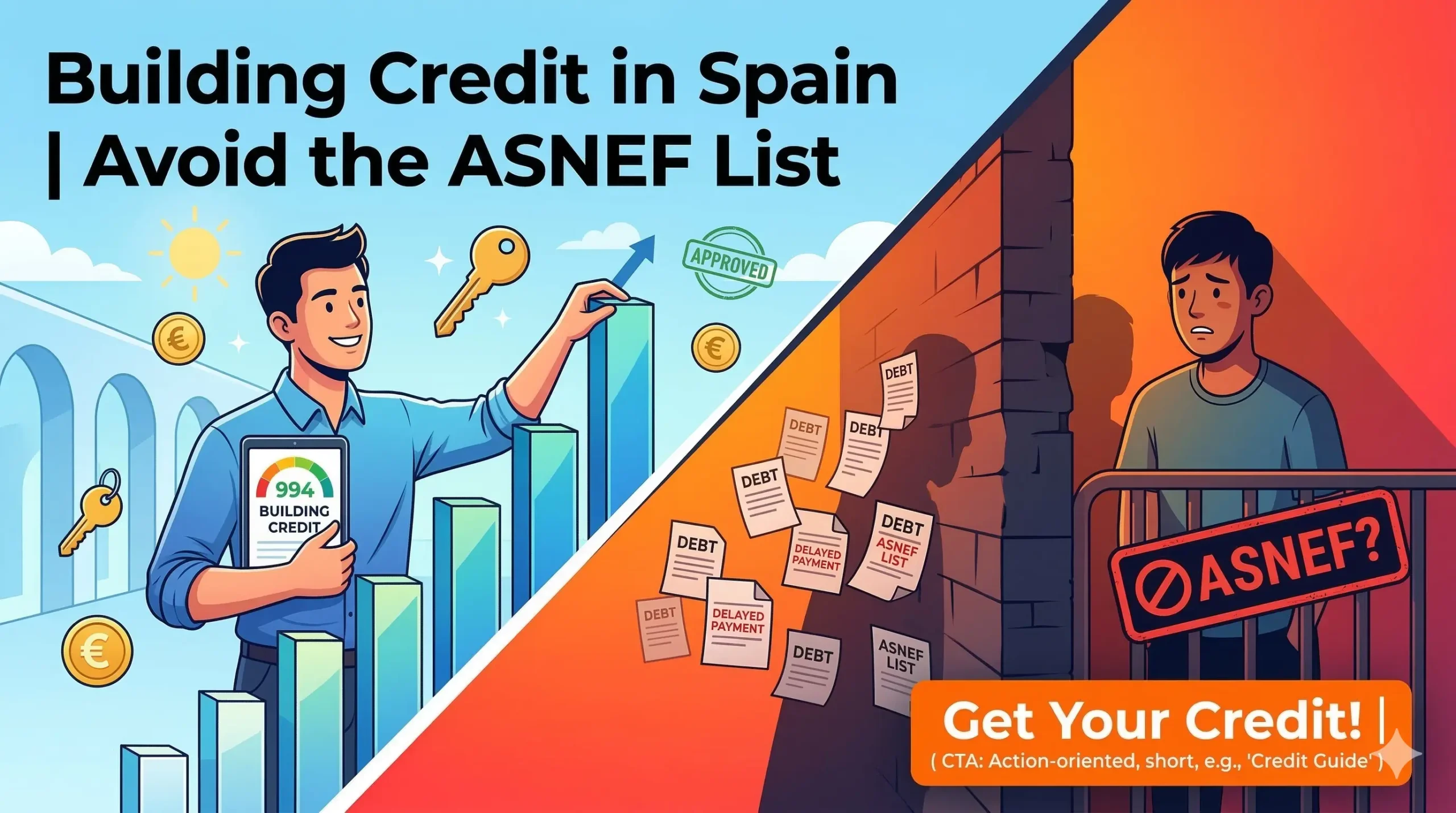
In Anglo-Saxon countries, the credit system is “positive.” You start with a neutral score and actively build it up by borrowing money and repaying it. You are rewarded for having multiple lines of credit. Spain operates on a “negative registry” system. There is no central bureau assigning you points for good behavior.
In the Spanish system, you are assumed to be a trustworthy borrower by default, provided you meet strict income requirements. The only time a central database gets involved is when you mess up. If you fail to pay a bill, your name is added to a negative registry—the most famous being ASNEF. Therefore, “building credit” in Spain does not mean collecting credit cards; it simply means keeping your name off the blacklist and demonstrating a high, stable income.
However, there is one official database you should be aware of: the CIRBE (Central de Información de Riesgos del Banco de España). Managed by the Bank of Spain, the CIRBE is not a blacklist. It is a risk registry that records any loan, mortgage, or guarantee you hold that exceeds €1,000. When you apply for a new loan, banks check the CIRBE simply to ensure you are not secretly holding massive debt with a competitor.
Establishing Financial Trust Without a Score
Because Spanish banks do not rely on an algorithm to summarize your character, they rely heavily on localized, physical documentation to assess your risk. If you want to borrow money, lease a car, or secure a premium apartment, the institution is going to demand proof of ongoing solvency.
The absolute golden ticket to financial trust in Spain is the contrato indefinido (permanent employment contract). If you have a permanent contract with a Spanish company that has passed the initial probationary period, banks view you as a highly secure investment. They will ask to see your nómina (paycheck) from the last three months, your latest Declaración de la Renta (annual income tax return), and your Vida Laboral (a government document tracking your entire Spanish work history).
If you are self-employed (autónomo), proving this trust is significantly harder. You will be asked to provide quarterly tax filings and bank statements proving a steady influx of client invoices. If you are navigating this specific hurdle, you must understand the local employment landscape, which we detail in Understanding the Spanish Employment Contract (Contrato Indefinido).
Understanding ASNEF: The Spanish Blacklist
ASNEF is the boogeyman of Spanish personal finance. The acronym is whispered with a mix of fear and frustration by locals and expats alike. Understanding how this database functions is your only defense against sudden financial exile.
What is the ASNEF Registry
ASNEF stands for the Asociación Nacional de Establecimientos Financieros de Crédito. Despite the official-sounding name, ASNEF itself is simply an association. The actual database of defaulters—the physical list—is operated and managed by Equifax Iberia.
This registry is a massive, shared database utilized by almost every major financial institution, telecommunications company, and utility provider in Spain. When you apply for a new service—whether it is a €300,000 mortgage or a €15 mobile phone data plan—the company’s automated underwriting software instantly pings the ASNEF database. If your NIE (Foreigner Identity Number) matches a record in the system, a red flag is raised, and your application is usually automatically denied by the computer, with zero room for human negotiation. To understand how tied your financial identity is to your official number, read Guide to NIE Numbers and TIE Cards in Spain.
How You End Up on the List (It’s Easier Than You Think)
The most terrifying aspect of the ASNEF registry is that you do not need to default on a massive mortgage to end up on it. The vast majority of people on the ASNEF list are there because of petty, highly disputed administrative errors with utility companies.
A classic expat scenario goes like this: You move out of an apartment and call the internet provider to cancel your service. The provider verbally agrees but fails to process the cancellation in their system. The following month, they charge your bank account €60. You notice the charge, call your bank, and ask them to return the receipt (devolver el recibo). You think the issue is solved. Meanwhile, the internet provider registers that €60 as an unpaid debt. After a few automated warning letters sent to your old address, the internet company legally reports you to ASNEF.
You can be blacklisted for a debt as small as €50. Telecommunications companies (internet and mobile), electricity providers, and budget gym chains are notorious for leveraging the threat of ASNEF to force customers to pay disputed exit fees.
The Immediate Consequences of Being Listed
The consequences of appearing on the ASNEF registry are immediate and deeply restrictive. You become a financial pariah in the Spanish corporate system.
If you are on the list, traditional high-street banks will instantly refuse to give you a credit card, a personal loan, or a mortgage. Even if you earn €100,000 a year, a €50 disputed phone bill on ASNEF will trigger an automatic mortgage denial. Furthermore, the restriction bleeds into everyday life. You will be unable to finance a car, you will be denied post-paid mobile phone contracts, and you will not be able to switch your electricity provider to a cheaper rate.
Most critically for new arrivals, many professional landlords and real estate agencies now run ASNEF checks on prospective tenants. If you are flagged, they will refuse to rent to you, fearing you will stop paying rent. If you are currently hunting for housing, you must ensure your profile is pristine; review Renting an Apartment in Spain: Guide for Expats to understand exactly what landlords will demand.
How to Check and Clear Your ASNEF Status
If you suddenly find yourself rejected for a basic financial service, you must assume you have been listed and take immediate, aggressive action to clear your name.
Exercising Your Right to Access (Derecho de Acceso)
Under the European GDPR and the Spanish Data Protection Law (LOPDGDD), you have the absolute legal right to know if your data is being held in a negative registry, who put it there, and exactly how much they claim you owe. This is known as the Derecho de Acceso (Right of Access).
Do not fall for scam websites that promise to “check your ASNEF status immediately for €30.” The official check is completely free. You must go directly to the Equifax Iberia consumer portal. You will need to provide a copy of your TIE/NIE or passport, and an email address. Equifax is legally required to respond to your request within 30 days, providing a full PDF report detailing any active debts registered against your identity.
The Process of Paying and Disputing Debts
Once you receive your Equifax report, you have two paths depending on the validity of the debt. If you genuinely forgot to pay your final water bill, the fastest way to get your life back is simply to swallow your pride and pay it. You must pay the creditor directly (the water company, not Equifax). Once paid, you must send the payment receipt to Equifax, who is then legally obligated to remove you from the list.
However, if the debt is fraudulent or heavily disputed—for example, if a telecom company is charging you for a router you physically returned—you should not pay it. Instead, you must file a formal complaint with the Agencia Española de Protección de Datos (AEPD). Spanish law states that a debt cannot be registered in ASNEF if it is actively being disputed through official consumer protection channels. Filing a formal dispute forces the creditor to temporarily remove your name from the blacklist while the administration investigates.
The Timeline for Registry Removal
The Spanish government places strict timelines on how long you can be financially penalized. By law, the maximum amount of time a specific debt can remain on the ASNEF registry is five years from the date the debt was due. After five years, Equifax must permanently delete the record, regardless of whether you paid it or not.
If you do pay the debt, Equifax is legally required to remove your name from the registry immediately—usually within 10 days of receiving your proof of payment. Do not assume the telecom company will inform Equifax that you paid; you must be proactive and submit the receipt to the registry yourself to force the removal.
Proactive Steps to Build Financial Credibility in Spain
Since you cannot rely on an arbitrary score to prove your worth, you must intentionally build a localized, undeniable trail of financial solvency from the moment you unpack your bags.
Setting Up a Solid Banking Foundation
Your financial anchor in Spain is a local bank account with a Spanish IBAN (International Bank Account Number). While you can legally use any European IBAN in Spain, local utilities and landlords heavily prefer a Spanish prefix (ES).
For expats tired of the archaic, paperwork-heavy high-street banks, utilizing a digital-first platform like N26 is a massive tactical advantage. By opening a Spanish-branch account with N26, you get a fully recognized Spanish IBAN, English-language customer support, and an incredibly intuitive app that alerts you instantly to any pending charges. Having a responsive bank like N26 prevents the classic expat mistake of missing a random utility charge because you couldn’t decipher a letter mailed in Spanish.
To fund this new local account from your home country without bleeding money to hidden bank exchange rates, you should always use Wise. By setting up a recurring transfer through Wise, you ensure your Spanish account is always capitalized, preventing any accidental overdrafts that could lead to bounced bills. If you want to understand how far your transferred money will actually go in different regions, check out our breakdown on the Cost of Living in Spain: Budgeting for Expats.
Managing Utility Bills and Direct Debits (Domiciliación)
In Spain, almost no one pays their monthly electricity, water, or internet bills manually via a website portal. The entire economy runs on domiciliación bancaria (direct debit). You give the utility company your IBAN, and they automatically pull the funds from your account every month.
This system is highly efficient, but it requires extreme vigilance. If you close a bank account before formally terminating a utility contract, the utility company will try to pull the funds, fail, and instantly mark you as a defaulter. Never just empty a bank account and assume a service is canceled. If you notice a fraudulent charge from a gym you already quit, use your banking app to explicitly devolver el recibo (return the receipt) within the 8-week legal window, but always follow up with a formal written cancellation to the gym to ensure they do not escalate the issue to ASNEF.
Payroll, Taxes, and Demonstrating Solvency
Your most powerful financial weapon in Spain is your tax return. When you apply for a major loan, the bank’s risk department will scrutinize your Declaración de la Renta.
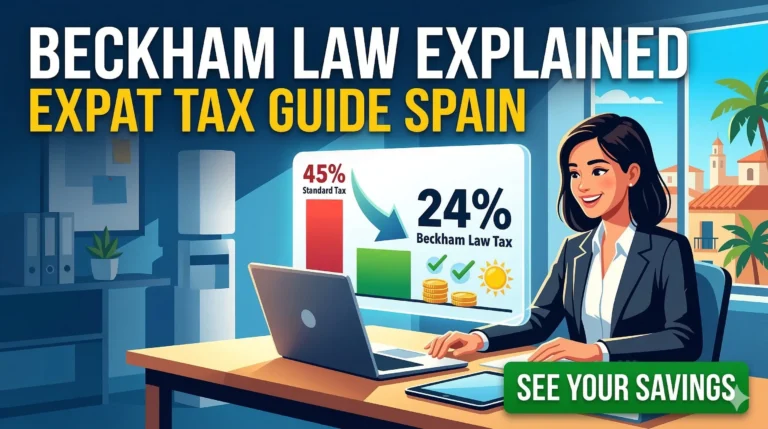
If you are a high-earning expat operating under the special expat tax regime (often called the Beckham Law), you must be prepared to explain this to local bank managers who might only be familiar with standard IRPF tax returns. The Beckham Law allows you to pay a flat 24% tax rate on Spanish-sourced income, but it requires specific documentation. Providing clean, timely tax filings proves to a bank that you are a highly solvent, legally compliant resident. To ensure your tax profile is pristine before applying for major credit, review The Beckham Law Explained: Tax Benefits for Expats.
Navigating Loans and Investments as an Expat
Once your baseline reputation is secure and you know how to avoid the blacklist, you can begin utilizing the Spanish financial system to actually grow your wealth and secure property.
Getting Approved for a Mortgage or Personal Loan
Applying for a Spanish mortgage as a foreigner requires significantly more upfront capital than in the US or UK. Because the bank cannot rely on a credit score, they mitigate their risk by demanding a larger down payment.
While Spanish residents can sometimes secure an 80% loan-to-value (LTV) mortgage, non-residents and newly arrived expats are routinely capped at 60% or 70% LTV. This means you must arrive with 30% to 40% of the property’s value in cash, plus an additional 10% to 12% to cover massive local purchasing taxes and notary fees.
When you are ready to transfer this massive down payment from your home country to your Spanish bank to finalize the deed, using traditional bank wire transfers will cost you thousands of euros in inflated exchange margins. Utilizing a dedicated currency specialist like Wise is absolutely essential for large capital transfers, ensuring you get the mid-market rate and protecting your purchasing power. To understand the exact legal steps required to secure the deed once the money arrives, read Buying Property in Spain as a Foreigner.
Credit Cards in Spain (Why They Operate Differently)
If you walk into a Spanish bank and ask for a credit card, you will likely be handed a debit card or a deferred charge card. True revolving credit cards (where you carry a balance month-to-month and pay interest) are not the default financial tool in Spain.
When Spanish banks do issue revolving credit cards (often called tarjetas revolving), they are notoriously predatory. The interest rates (TAE) on these cards can easily exceed 20%, and the minimum payment structures are designed to keep you in debt for years. Because having a credit card does absolutely nothing to improve your financial reputation in Spain, there is zero strategic advantage to holding one. Expats are vastly better off using a premium debit card tied directly to their liquid cash via an account like N26, ensuring they never accidentally miss a payment and trigger a negative registry event.
Growing Your Wealth Locally
Because the Spanish financial system does not require you to play games with credit utilization ratios to prove your worth, you can focus your energy entirely on genuine wealth accumulation.
Instead, veteran expats manage their portfolios through global brokerage platforms like Interactive Brokers. By utilizing Interactive Brokers, you gain access to low-cost, globally diversified ETFs and stocks, bypassing the predatory fees of the local Spanish banking sector. Furthermore, Interactive Brokers allows you to maintain your investment portfolio effortlessly even if your expat journey eventually takes you out of Spain, providing the ultimate financial flexibility. By avoiding the pitfalls of local credit traps and focusing on portable wealth generation, you secure true financial independence abroad.
| Financial Concept | US / UK System | Spanish System |
| Primary Metric | 3-Digit Credit Score (e.g., FICO) | Income Stability (Nómina & Taxes) |
| Credit Bureaus | Experian, Equifax, TransUnion (Positive & Negative) | ASNEF (Equifax) & CIRBE (Negative & Risk Only) |
| Building Trust | Opening credit cards, keeping balances low | Avoiding unpaid bills, maintaining a permanent work contract |
| Credit Card Use | Essential for building credit history | Optional, often discouraged due to high revolving interest |
| Major Loan Requirement | High Credit Score, Low DTI | High Downpayment (30%+), Clean CIRBE/ASNEF, Low DTI |
References
Primary sources (official)
- ASNEF (Asociación Nacional de Establecimientos Financieros de Crédito): https://www.asnef.com/
- Equifax Iberia (Official portal to check ASNEF status): https://soluciones.equifax.es/
- Banco de España – Central de Información de Riesgos (CIRBE): https://sedeelectronica.bde.es/sede/es/tramites/solicitud-informes-riesgos-cirbe-p58.html
- Agencia Española de Protección de Datos (AEPD) – Ficheros de Morosos: https://www.aepd.es/es
Other helpful sources
- Expatica – Banking and Finance in Spain: https://www.expatica.com/es/finance/
Disclaimer
The information provided in this article is for educational and informational purposes only and does not constitute formal financial, legal, or tax advice. The regulations governing the ASNEF registry, the Spanish Data Protection Law (LOPDGDD), and banking underwriting criteria are subject to frequent legislative updates. Always consult directly with a certified financial advisor, a registered Spanish lawyer (abogado), or the Agencia Española de Protección de Datos (AEPD) regarding specific debt disputes, registry removals, or complex financial investments.